
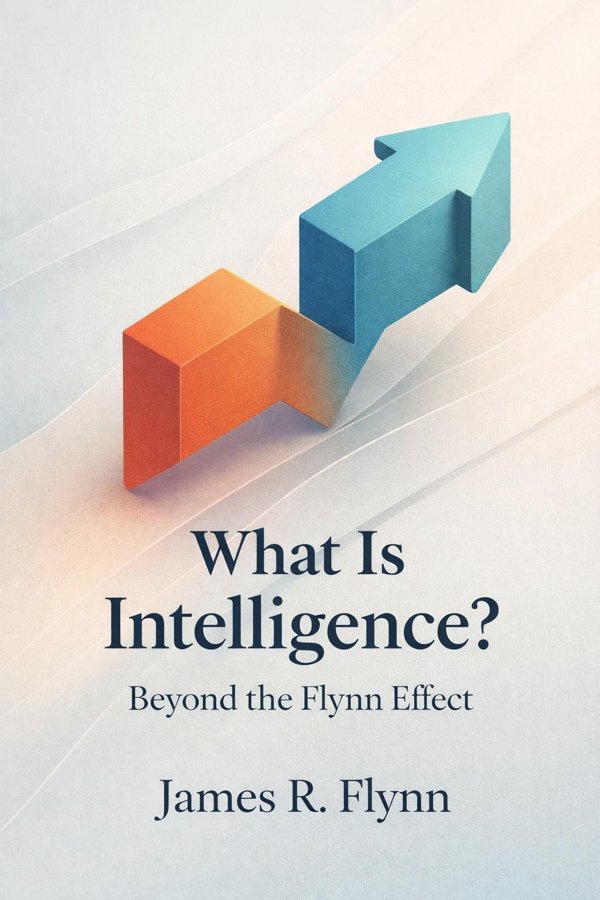
What Is Intelligence?: Beyond the Flynn Effect: Summary & Key Insights
 10 min5 chaptersAudio available
What Is What Is Intelligence?: Beyond the Flynn Effect About?
What Is Intelligence?: Beyond the Flynn Effect by James R. Flynn is a popular_sci book spanning 5 pages. In this influential work, James R. Flynn explores the phenomenon now known as the 'Flynn Effect'—the observed rise in IQ scores over the twentieth century. He examines what this trend reveals about human intelligence, the role of environment and culture, and the implications for education and social policy. The book challenges conventional assumptions about intelligence testing and cognitive development, offering a nuanced view of how intelligence evolves across generations.
This FizzRead summary covers all 5 key chapters of What Is Intelligence?: Beyond the Flynn Effect in approximately 10 minutes, distilling the most important ideas, arguments, and takeaways from James R. Flynn's work. Also available as an audio summary and Key Quotes Podcast.
What Is Intelligence?: Beyond the Flynn Effect
In this influential work, James R. Flynn explores the phenomenon now known as the 'Flynn Effect'—the observed rise in IQ scores over the twentieth century. He examines what this trend reveals about human intelligence, the role of environment and culture, and the implications for education and social policy. The book challenges conventional assumptions about intelligence testing and cognitive development, offering a nuanced view of how intelligence evolves across generations.
Who Should Read What Is Intelligence?: Beyond the Flynn Effect?
This book is perfect for anyone interested in popular_sci and looking to gain actionable insights in a short read. Whether you're a student, professional, or lifelong learner, the key ideas from What Is Intelligence?: Beyond the Flynn Effect by James R. Flynn will help you think differently.
- ✓Readers who enjoy popular_sci and want practical takeaways
- ✓Professionals looking to apply new ideas to their work and life
- ✓Anyone who wants the core insights of What Is Intelligence?: Beyond the Flynn Effect in just 10 minutes
Want the full summary?
Get instant access to this book summary and 100K+ more with Fizz Moment.
Get Free SummaryAvailable on App Store • Free to download
Key Chapters
When psychologists across nations began collecting long-term data on IQ test performance, they noticed a perplexing pattern. Whether in America, Europe, or parts of Asia, test scores rose generation after generation—by roughly three IQ points per decade. This was not a localized anomaly but a global phenomenon. I introduced the term 'Flynn Effect' to describe this rise and to invite serious reflection about its causes.
The implications were staggering. If IQ tests were truly measures of innate mental ability, such large gains in merely one century were impossible. Evolution does not proceed at that pace. Something else had to be reshaping how we think. The first task was verifying that these gains were real and meaningful, not artifacts of flawed testing. I painstakingly reviewed data from numerous studies, standardizing comparisons and checking that the trend was consistent across both verbal and performance subtests. The conclusion was robust: humanity’s performance on abstract cognitive tasks was indeed improving.
But what did that mean? Did the average person in 2000 really think better than the average person in 1900? That question became central. I came to believe the Flynn Effect was not about genetic improvement but about new ways of thinking fostered by modern life. Over the twentieth century, people became increasingly exposed to formal education, scientific reasoning, and technological symbol systems—all of which encourage abstract thought. Our ancestors were adept at practical, concrete forms of problem-solving—knowing how to mend a tool or tend a field. Today’s world demands the ability to think hypothetically, to analyze patterns divorced from immediate sensory experience. IQ tests, which reward abstraction, registered that cognitive shift.
Through this lens, rising test scores reveal how societies can cultivate new cognitive habits. Rather than seeing intelligence as something one is born with, I argue it’s something shaped by environment, by the mental demands we face daily. The Flynn Effect tells a story not of innate superiority, but of changed intellectual landscapes. It is a testament to humanity’s plasticity—the mind’s capacity to adapt to conceptual challenges posed by education, technology, and culture.
To explain how IQ gains happened, we must look at how modern life trains our thinking. In pre-industrial societies, intelligence was rooted in concrete experience. People reasoned within familiar contexts: what crop to plant, how to repair machinery, how to read the sky for weather patterns. Their wisdom was practical, deeply contextual. Modern life, however, demands thinking beyond immediate contexts. We live surrounded by abstract symbols—numbers that stand for unseen quantities, diagrams that model unseen systems, and processes that only make sense through hypothetic reasoning.
Schools are one of the major engines driving this transformation. Mass education doesn’t just teach facts; it teaches ways of manipulating symbols and imagining possibilities. Scientific and technical education introduced the idea of general laws that apply across situations—gravity, energy, probability—training minds to see beyond the concrete. The habit of thinking 'what if?' or 'in principle' has become a cultural norm.
Our communication technologies further amplify this change. Television, digital media, and the internet expose us to multiple perspectives and abstract representations. Consider how data visualization, infographics, or algorithmic thinking shape how we interpret the world. These forces encourage mental flexibility and symbolic reasoning, the very skills that IQ tests reward. But they also risk creating a cognitive mismatch between what tests measure and the kinds of practical wisdom most needed for moral or social understanding.
Educational and cultural complexity have accelerated our cognitive evolution. We no longer live primarily by the logic of daily tasks but by conceptual frameworks. The Flynn Effect reflects that cultural shift. IQ gains, therefore, measure something real—but not innate intellectual improvement. They signify changing modes of thought: from the concrete to the abstract, from localized understanding to systematic reasoning.
These changes should make us rethink intelligence as a spectrum of adaptive styles. My central claim is that human intelligence flourishes in environments that challenge us to think differently, to operate in spaces of abstraction and symbol. Modern culture has widened those spaces enormously.
+ 3 more chapters — available in the FizzRead app
All Chapters in What Is Intelligence?: Beyond the Flynn Effect
About the Author
James R. Flynn (1934–2020) was a New Zealand political scientist and intelligence researcher best known for discovering the 'Flynn Effect'. He was a professor at the University of Otago and authored numerous works on intelligence, ethics, and political philosophy.
Get This Summary in Your Preferred Format
Read or listen to the What Is Intelligence?: Beyond the Flynn Effect summary by James R. Flynn anytime, anywhere. FizzRead offers multiple formats so you can learn on your terms — all free.
Available formats: App · Audio · PDF · EPUB — All included free with FizzRead
Download What Is Intelligence?: Beyond the Flynn Effect PDF and EPUB Summary
Key Quotes from What Is Intelligence?: Beyond the Flynn Effect
“When psychologists across nations began collecting long-term data on IQ test performance, they noticed a perplexing pattern.”
“To explain how IQ gains happened, we must look at how modern life trains our thinking.”
Frequently Asked Questions about What Is Intelligence?: Beyond the Flynn Effect
What Is Intelligence?: Beyond the Flynn Effect by James R. Flynn is a popular_sci book that explores key ideas across 5 chapters. In this influential work, James R. Flynn explores the phenomenon now known as the 'Flynn Effect'—the observed rise in IQ scores over the twentieth century. He examines what this trend reveals about human intelligence, the role of environment and culture, and the implications for education and social policy. The book challenges conventional assumptions about intelligence testing and cognitive development, offering a nuanced view of how intelligence evolves across generations.
You Might Also Like

Structures: Or Why Things Don"t Fall Down
J.E. Gordon
10 min
The Road to Wigan Pier
George Orwell
10 min
Bonk: The Curious Coupling of Science and Sex
Mary Roach
10 min
First Bite: How We Learn to Eat
Bee Wilson
10 min
In Pursuit Of The Unknown: 17 Equations That Changed The World
Ian Stewart
10 min
Napoleon's Buttons: 17 Molecules That Changed History
Penny Le Couteur and Jay Burreson
10 minBrowse by Category
Ready to read What Is Intelligence?: Beyond the Flynn Effect?
Get the full summary and 100K+ more books with Fizz Moment.