
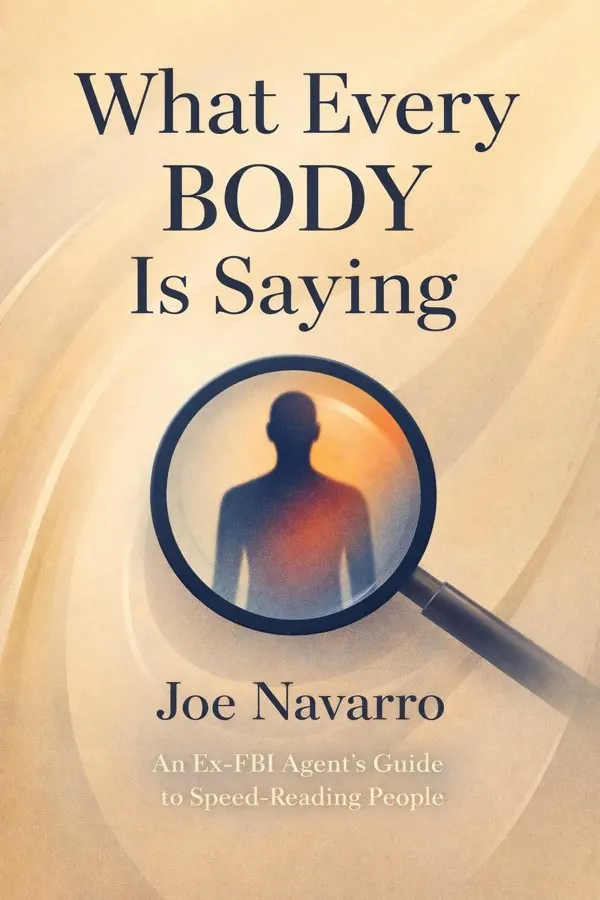
What Every BODY Is Saying: An Ex-FBI Agent's Guide to Speed-Reading People: Summary & Key Insights
by Joe Navarro
 10 min11 chaptersAudio available
What Is What Every BODY Is Saying: An Ex-FBI Agent's Guide to Speed-Reading People About?
What Every BODY Is Saying: An Ex-FBI Agent's Guide to Speed-Reading People by Joe Navarro is a communication book spanning 11 pages. A practical guide to understanding and interpreting nonverbal communication, written by former FBI counterintelligence officer Joe Navarro. The book teaches readers how to decode body language and recognize subtle physical cues that reveal true emotions and intentions, helping improve interpersonal awareness and communication.
This FizzRead summary covers all 11 key chapters of What Every BODY Is Saying: An Ex-FBI Agent's Guide to Speed-Reading People in approximately 10 minutes, distilling the most important ideas, arguments, and takeaways from Joe Navarro's work. Also available as an audio summary and Key Quotes Podcast.
What Every BODY Is Saying: An Ex-FBI Agent's Guide to Speed-Reading People
A practical guide to understanding and interpreting nonverbal communication, written by former FBI counterintelligence officer Joe Navarro. The book teaches readers how to decode body language and recognize subtle physical cues that reveal true emotions and intentions, helping improve interpersonal awareness and communication.
Who Should Read What Every BODY Is Saying: An Ex-FBI Agent's Guide to Speed-Reading People?
This book is perfect for anyone interested in communication and looking to gain actionable insights in a short read. Whether you're a student, professional, or lifelong learner, the key ideas from What Every BODY Is Saying: An Ex-FBI Agent's Guide to Speed-Reading People by Joe Navarro will help you think differently.
- ✓Readers who enjoy communication and want practical takeaways
- ✓Professionals looking to apply new ideas to their work and life
- ✓Anyone who wants the core insights of What Every BODY Is Saying: An Ex-FBI Agent's Guide to Speed-Reading People in just 10 minutes
Want the full summary?
Get instant access to this book summary and 100K+ more with Fizz Moment.
Get Free SummaryAvailable on App Store • Free to download
Key Chapters
Human beings are born fluent in nonverbal expression long before we speak our first word. As I explain in this section, body language is not a cultural invention—it is evolutionary. It comes from our survival instinct. The earliest humans depended on physical cues to judge threats and opportunities; smiling, for instance, evolved as a display of non-aggression, while frowning signaled tension or displeasure. Every gesture we make, every posture we assume, carries traces of those primal lessons. When you understand this, watching body language becomes not about decoding mystery but about observing ancient truths acted out in modern clothes.
Science backs this up. Research in ethology and psychology shows that limbic responses—the emotional signals processed by the part of the brain responsible for survival—manifest physically before reason intervenes. When we’re afraid, our chest tightens and we turn away even if we insist, 'I’m fine.' When we’re comfortable, we relax, exposing vulnerable areas like the neck or the torso. This makes nonverbal communication a direct reflection of the limbic system: honest, fast, and uncontrollable. It’s why body language often reveals more than speech.
When I worked in counterintelligence, I came to rely heavily on these reactions. Words can be rehearsed; posture cannot. This is why understanding nonverbal behaviors is both scientific and profoundly human—it’s about noticing physiological truth. Once you grasp that every movement stems from a need either to be comfortable or to escape discomfort, you start seeing clarity amidst chaos.
In the field, one of the first rules is simple: before you can detect deception or stress, you must understand normal behavior. What does this person look like when relaxed? How do they typically move, gesture, and hold themselves? That's their baseline. Without it, all interpretation is guesswork.
In my investigations, I always began observation during neutral conversation—when no pressure existed. I watched how the subject sat, smiled, or used their hands. Those patterns became my map. Then, when an emotional trigger appeared—a stressful question, an unexpected stimulus—I could detect deviations from that map. A sudden crossing of arms, tensing of the shoulders, or shifting of the legs would tell me: something changed.
In everyday life, you must do the same. Don’t look for universal 'tells'—they don’t exist. Instead, calibrate your understanding to individual norms. A baseline helps you differentiate between what is idiosyncratic and what is significant. It reminds you that body language is contextual and that every interpretation must start with empathy and observation, not assumption.
+ 9 more chapters — available in the FizzRead app
All Chapters in What Every BODY Is Saying: An Ex-FBI Agent's Guide to Speed-Reading People
About the Author
Joe Navarro is a former FBI special agent who served for twenty-five years in counterintelligence and counterterrorism. He is a globally recognized expert on nonverbal behavior and has authored several books on body language and human behavior.
Get This Summary in Your Preferred Format
Read or listen to the What Every BODY Is Saying: An Ex-FBI Agent's Guide to Speed-Reading People summary by Joe Navarro anytime, anywhere. FizzRead offers multiple formats so you can learn on your terms — all free.
Available formats: App · Audio · PDF · EPUB — All included free with FizzRead
Download What Every BODY Is Saying: An Ex-FBI Agent's Guide to Speed-Reading People PDF and EPUB Summary
Key Quotes from What Every BODY Is Saying: An Ex-FBI Agent's Guide to Speed-Reading People
“Human beings are born fluent in nonverbal expression long before we speak our first word.”
“In the field, one of the first rules is simple: before you can detect deception or stress, you must understand normal behavior.”
Frequently Asked Questions about What Every BODY Is Saying: An Ex-FBI Agent's Guide to Speed-Reading People
What Every BODY Is Saying: An Ex-FBI Agent's Guide to Speed-Reading People by Joe Navarro is a communication book that explores key ideas across 11 chapters. A practical guide to understanding and interpreting nonverbal communication, written by former FBI counterintelligence officer Joe Navarro. The book teaches readers how to decode body language and recognize subtle physical cues that reveal true emotions and intentions, helping improve interpersonal awareness and communication.
More by Joe Navarro

You Might Also Like

Magic Words: The Science and Secrets Behind Seven Words That Motivate, Engage, and Influence
Tim David
10 min
Talking Across The Divide: How to Communicate with People You Disagree with and Maybe Even Change the World
Justin Lee
10 min
The Exceptional Presenter: A Proven Formula to Open Up! and Own the Room
Timothy J. Koegel
10 min
4 Essential Keys to Effective Communication in Love, Life, Work--Anywhere!: Including the 12-Day Communication Challenge!
Bento C. Leal III
10 min
Active Listening Techniques: 30 Practical Tools to Hone Your Communication Skills
Nisha Gupta
10 min
Bargaining for Advantage: Negotiation Strategies for Reasonable People
G. Richard Shell
10 minBrowse by Category
Ready to read What Every BODY Is Saying: An Ex-FBI Agent's Guide to Speed-Reading People?
Get the full summary and 100K+ more books with Fizz Moment.