
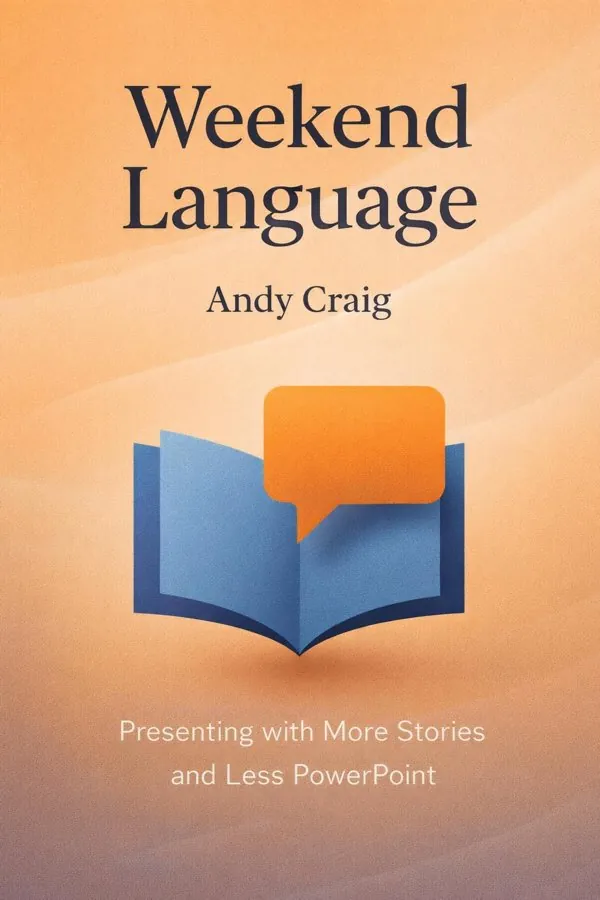
Weekend Language: Presenting with More Stories and Less PowerPoint: Summary & Key Insights
by Andy Craig
 10 min6 chaptersAudio available
What Is Weekend Language: Presenting with More Stories and Less PowerPoint About?
Weekend Language: Presenting with More Stories and Less PowerPoint by Andy Craig is a communication book spanning 6 pages. Weekend Language explains how to transform business presentations into engaging stories that connect with audiences. The book emphasizes storytelling techniques over traditional slide-heavy approaches, helping professionals communicate ideas clearly and memorably.
This FizzRead summary covers all 6 key chapters of Weekend Language: Presenting with More Stories and Less PowerPoint in approximately 10 minutes, distilling the most important ideas, arguments, and takeaways from Andy Craig's work. Also available as an audio summary and Key Quotes Podcast.
Weekend Language: Presenting with More Stories and Less PowerPoint
Weekend Language explains how to transform business presentations into engaging stories that connect with audiences. The book emphasizes storytelling techniques over traditional slide-heavy approaches, helping professionals communicate ideas clearly and memorably.
Who Should Read Weekend Language: Presenting with More Stories and Less PowerPoint?
This book is perfect for anyone interested in communication and looking to gain actionable insights in a short read. Whether you're a student, professional, or lifelong learner, the key ideas from Weekend Language: Presenting with More Stories and Less PowerPoint by Andy Craig will help you think differently.
- ✓Readers who enjoy communication and want practical takeaways
- ✓Professionals looking to apply new ideas to their work and life
- ✓Anyone who wants the core insights of Weekend Language: Presenting with More Stories and Less PowerPoint in just 10 minutes
Want the full summary?
Get instant access to this book summary and 100K+ more with Fizz Moment.
Get Free SummaryAvailable on App Store • Free to download
Key Chapters
Craig’s foundational idea is simple yet profound: people are natural storytellers when they’re relaxed, but when they enter the boardroom, they forget how to speak like human beings. The phrase *Weekend Language* comes from his observation of how friends and family interact during off-hours. On weekends, conversations flow easily—filled with anecdotes, humor, emotion, and real stakes. You might tell someone about a tough project at work, not in bullet points, but as a mini-story: how things went wrong, what you felt, and how you solved it. Craig contends that this natural narrative instinct is precisely what good presentations need.
He contrasts this with *weekday language*—the formal, jargon-heavy style of corporate communication. In weekday language, the speaker hides behind slides and data, fearing to sound informal or too emotional. Weekend language, by contrast, lets the speaker connect, empathize, and build a rhythm of engagement. Craig illustrates this shift vividly through examples of executives who transformed lifeless updates into compelling stories. One sales leader, for example, replaced a tedious quarterly report with a personal account of how a customer’s dilemma revealed the team’s true value. The result? The audience remembered not just the numbers but the feeling of accomplishment.
The concept is not about being casual—it’s about being real. Craig invites readers to dissect the language of high-stakes meetings and notice how unnatural it sounds compared to day-to-day human interactions. He stresses that storytelling isn’t a performance trick; it’s how people have always shared wisdom. Weekend Language restores that balance by reminding leaders to speak the way they think when they actually care. When you speak in weekend language, the focus shifts from slides to stories, from message points to meaning.
Craig dives into cognitive science to explain why storytelling works better than data dumps. The human brain is wired for narrative—it seeks patterns, emotion, and moral tension. Audiences remember stories because stories mirror experience. Data, on its own, fades quickly; emotion binds memory. Craig refers to this as the *emotional anchor* of storytelling. When listeners connect emotionally, facts have a structure to hold onto. He contrasts that with typical PowerPoint-heavy sessions, where information is presented without context, causing mental fatigue and disengagement.
Craig reminds us that every audience, from interns to executives, listens for relevance. People don’t want more information; they want transformation. He teaches presenters to ask themselves: what’s the human outcome behind the numbers? What tension drives this project? Whose lives changed? Once we answer these questions, stories naturally emerge, and audiences lean in because they hear themselves reflected within the narrative.
He shows how stories stimulate neural coupling—when speaker and listener’s brain activity synchronize, a phenomenon rooted in empathy. This synchronization doesn’t happen with charts or lists; it requires emotion and conflict. Craig uses this insight to argue that storytelling isn’t decoration—it’s the delivery system for meaning. It doesn’t compete with logic; it integrates logic and feeling, allowing comprehension and retention to flourish together.
He concludes this section with a bold challenge: stop treating your audience as data processors. Treat them as humans searching for meaning. The psychological power of storytelling lies not in entertainment, but in shared understanding—the moment when the listener thinks, “I’ve been there too.”
+ 4 more chapters — available in the FizzRead app
All Chapters in Weekend Language: Presenting with More Stories and Less PowerPoint
About the Author
Andy Craig is a communication coach and presentation expert who helps business leaders and professionals improve their storytelling and public speaking skills.
Get This Summary in Your Preferred Format
Read or listen to the Weekend Language: Presenting with More Stories and Less PowerPoint summary by Andy Craig anytime, anywhere. FizzRead offers multiple formats so you can learn on your terms — all free.
Available formats: App · Audio · PDF · EPUB — All included free with FizzRead
Download Weekend Language: Presenting with More Stories and Less PowerPoint PDF and EPUB Summary
Key Quotes from Weekend Language: Presenting with More Stories and Less PowerPoint
“Craig’s foundational idea is simple yet profound: people are natural storytellers when they’re relaxed, but when they enter the boardroom, they forget how to speak like human beings.”
“Craig dives into cognitive science to explain why storytelling works better than data dumps.”
Frequently Asked Questions about Weekend Language: Presenting with More Stories and Less PowerPoint
Weekend Language: Presenting with More Stories and Less PowerPoint by Andy Craig is a communication book that explores key ideas across 6 chapters. Weekend Language explains how to transform business presentations into engaging stories that connect with audiences. The book emphasizes storytelling techniques over traditional slide-heavy approaches, helping professionals communicate ideas clearly and memorably.
You Might Also Like
Magic Words: The Science and Secrets Behind Seven Words That Motivate, Engage, and Influence
Tim David
10 min
Talking Across The Divide: How to Communicate with People You Disagree with and Maybe Even Change the World
Justin Lee
10 min
The Exceptional Presenter: A Proven Formula to Open Up! and Own the Room
Timothy J. Koegel
10 min
4 Essential Keys to Effective Communication in Love, Life, Work--Anywhere!: Including the 12-Day Communication Challenge!
Bento C. Leal III
10 min
Active Listening Techniques: 30 Practical Tools to Hone Your Communication Skills
Nisha Gupta
10 min
Bargaining for Advantage: Negotiation Strategies for Reasonable People
G. Richard Shell
10 minBrowse by Category
Ready to read Weekend Language: Presenting with More Stories and Less PowerPoint?
Get the full summary and 100K+ more books with Fizz Moment.