
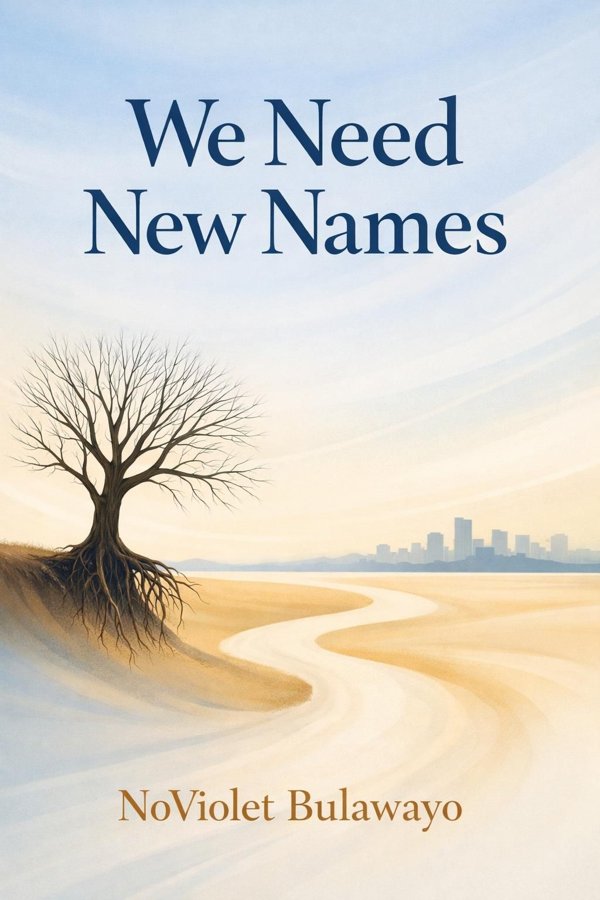
We Need New Names: Summary & Key Insights
 10 min9 chaptersAudio available
Key Takeaways from We Need New Names
One of the novel’s most unsettling insights is that children can normalize almost anything, even catastrophe.
Loss often becomes clearest not in the moment of disaster but in the encounter with what used to be ordinary.
Some truths become unspeakable not because they are unclear, but because speaking them would threaten survival.
Migration is often imagined as a clean break: leave one country, arrive in another, begin again.
Distance does not simply weaken memory; it often intensifies and distorts it.
What Is We Need New Names About?
We Need New Names by NoViolet Bulawayo is a bestsellers book spanning 5 pages. NoViolet Bulawayo’s We Need New Names is a piercing coming-of-age novel about what happens when home becomes unlivable and the promised elsewhere proves equally unsettling. Told through the voice of Darling, a sharp, observant girl growing up in a shantytown called Paradise in Zimbabwe, the novel begins amid hunger, political violence, collapsing institutions, and childhood improvisation. Darling and her friends steal guavas, invent games, witness brutality, and absorb the language of adults long before they fully understand it. Later, when Darling emigrates to the United States, the story shifts from physical survival to emotional dislocation: immigration, loneliness, racialization, accent, memory, and the painful realization that reinvention always extracts a cost. What makes this novel matter is its refusal to flatten migration into either tragedy or triumph. Bulawayo shows both the desperation that drives departure and the fractures that follow arrival. Drawing on her own Zimbabwean background and transnational experience, she writes with authority, wit, and emotional precision. The result is a vivid portrait of childhood, exile, and identity in a global age—one that asks what belonging means when every place changes you.
This FizzRead summary covers all 9 key chapters of We Need New Names in approximately 10 minutes, distilling the most important ideas, arguments, and takeaways from NoViolet Bulawayo's work. Also available as an audio summary and Key Quotes Podcast.
We Need New Names
NoViolet Bulawayo’s We Need New Names is a piercing coming-of-age novel about what happens when home becomes unlivable and the promised elsewhere proves equally unsettling. Told through the voice of Darling, a sharp, observant girl growing up in a shantytown called Paradise in Zimbabwe, the novel begins amid hunger, political violence, collapsing institutions, and childhood improvisation. Darling and her friends steal guavas, invent games, witness brutality, and absorb the language of adults long before they fully understand it. Later, when Darling emigrates to the United States, the story shifts from physical survival to emotional dislocation: immigration, loneliness, racialization, accent, memory, and the painful realization that reinvention always extracts a cost. What makes this novel matter is its refusal to flatten migration into either tragedy or triumph. Bulawayo shows both the desperation that drives departure and the fractures that follow arrival. Drawing on her own Zimbabwean background and transnational experience, she writes with authority, wit, and emotional precision. The result is a vivid portrait of childhood, exile, and identity in a global age—one that asks what belonging means when every place changes you.
Who Should Read We Need New Names?
This book is perfect for anyone interested in bestsellers and looking to gain actionable insights in a short read. Whether you're a student, professional, or lifelong learner, the key ideas from We Need New Names by NoViolet Bulawayo will help you think differently.
- ✓Readers who enjoy bestsellers and want practical takeaways
- ✓Professionals looking to apply new ideas to their work and life
- ✓Anyone who wants the core insights of We Need New Names in just 10 minutes
Want the full summary?
Get instant access to this book summary and 100K+ more with Fizz Moment.
Get Free SummaryAvailable on App Store • Free to download
Key Chapters
One of the novel’s most unsettling insights is that children can normalize almost anything, even catastrophe. In We Need New Names, Paradise is a place whose name mocks its reality: a settlement of scrap materials, hunger, uncertainty, and broken promises created after political upheaval and state violence. Yet for Darling and her friends, Paradise is also where games are invented, friendships formed, and imagination used as shelter. This tension gives the novel much of its emotional force. Bulawayo does not portray the children simply as victims. They are resourceful, funny, curious, and often startlingly perceptive. But their play happens against a background of deprivation that shapes them in ways they cannot fully name.
The irony of Paradise helps us understand how language can conceal suffering. A place may be called paradise, freedom, reform, or progress while its people live the opposite reality. Through the children’s eyes, readers see how political collapse enters ordinary life: empty stomachs, absent adults, damaged neighborhoods, and bodies marked by violence. Even so, childhood does not disappear. It adapts. The children chase guavas, gossip, tease one another, and dream about escape.
In real life, this idea applies beyond Zimbabwe. Communities everywhere develop habits of endurance under pressure, and children often become fluent in instability before adults admit how bad things are. The novel asks readers to notice both resilience and its cost.
Actionable takeaway: Pay attention to the environments children are learning to call normal. Resilience is admirable, but no child should have to build a world out of ruins.
Loss often becomes clearest not in the moment of disaster but in the encounter with what used to be ordinary. Darling’s visits to Budapest, the wealthier neighborhood she once belonged to, create exactly this effect. Budapest is not simply a richer place across town; it is a living archive of what has been taken away. In Paradise, deprivation is immediate and total. In Budapest, the contrast becomes visible. Lawns, houses, food, order, and privacy all suggest a previous life that now feels inaccessible, almost unreal.
Bulawayo uses this movement between places to show that class difference is not abstract. It is experienced through smell, texture, distance, appetite, and shame. For Darling, Budapest carries the ache of exclusion. It reminds her that poverty is not just the absence of things; it is the feeling of being locked out of a version of life that still exists for others. At the same time, Budapest complicates nostalgia. It is not a simple paradise lost, because even memory is unstable under crisis. What was once familiar becomes foreign when one no longer belongs there.
This dynamic appears in many lives. Economic decline, displacement, divorce, migration, and political instability can all create a “Budapest” effect: the painful recognition that your old world continues somewhere, but not for you. The novel gives this feeling a concrete geography. It shows how memory can sustain identity while also intensifying grief.
Actionable takeaway: When reflecting on loss, name the specific places and routines that shaped your sense of self. Precision can turn vague sorrow into clearer understanding—and help you grieve what changed without denying it.
Some truths become unspeakable not because they are unclear, but because speaking them would threaten survival. Throughout We Need New Names, Bulawayo pays close attention to bodies: hungry bodies, beaten bodies, sexualized bodies, sick bodies, and bodies crossing borders. The body in this novel is not only personal; it is political. It records violence long before institutions acknowledge it. Children notice wounds, swelling, pregnancy, disease, and physical fear even when they do not understand the full social meanings behind them.
Silence is central here. Adults often withhold explanations, children misread what they witness, and trauma circulates in fragments rather than complete narratives. This is especially important in scenes involving gendered vulnerability and humiliation. The body becomes the site where power is enacted and remembered. Hunger changes behavior. Fear alters posture. Shame reshapes speech. Even migration, which seems like movement toward opportunity, begins in bodily exposure: waiting, paperwork, inspection, cold, fatigue, estrangement.
In practical terms, the novel reminds us that social crisis is never purely ideological. It enters muscles, stomachs, skin, and breath. We can apply this insight by becoming more attentive to embodied experience in our own lives and communities. When people live under chronic stress, their bodies often reveal what their words cannot. A child acting out, an exhausted parent, or a withdrawn newcomer may be responding to conditions deeper than attitude or personality.
Actionable takeaway: Listen for what suffering says through the body. Ask not only “What happened?” but also “What has this experience done to someone’s sense of safety, dignity, and physical being?”
Migration is often imagined as a clean break: leave one country, arrive in another, begin again. Bulawayo dismantles that fantasy. When Darling moves to the United States, she does not become a new person so much as a divided one. The journey across oceans changes her circumstances, but it does not erase hunger, memory, grief, or the social codes learned in Zimbabwe. Instead, migration produces a layered identity in which the past remains active inside the present.
The novel shows how arrival is both relief and rupture. America offers abundance compared with Paradise, but abundance does not produce belonging on its own. Darling encounters cold weather, racial categorization, loneliness, undocumented precarity, and the awkwardness of becoming legible in a society that already has scripts for immigrants and Blackness. She must learn new speech patterns, new social expectations, and new forms of invisibility. The self she carries from Zimbabwe does not disappear; it becomes harder to explain.
This idea matters because migration narratives are too often reduced to success or failure. Bulawayo insists on ambivalence. You can be grateful and alienated, safer and lonelier, materially better off and emotionally fractured. Many readers will recognize this even if they have never crossed a national border. Any major life transition—college, career change, marriage, exile from a community—can create the feeling of carrying unfinished versions of yourself into a new world.
Actionable takeaway: If you are navigating a major transition, resist the pressure to perform total reinvention. Make room for continuity. The parts of you formed elsewhere are not obstacles to your future; they are part of what you must learn to carry with honesty.
Distance does not simply weaken memory; it often intensifies and distorts it. In the second half of We Need New Names, Darling’s relationship to Zimbabwe becomes mediated through phone calls, stories, digital images, and longing. Home turns into something both intimate and inaccessible. She is far away, but not free from it. The result is fragmentation: she belongs neither fully to the America she inhabits nor to the Zimbabwe she remembers.
Bulawayo captures a common immigrant paradox. Leaving home can preserve it in memory even as the actual place keeps changing without you. The remembered home becomes selective, emotional, and symbolic. At the same time, the new country demands adaptation. Darling’s speech, habits, and ambitions begin to shift, yet these shifts can feel like betrayal. She is pulled between the need to fit in and the fear of forgetting. Distance creates a double estrangement: from the old world because she has left it, and from the new world because she has not wholly entered it.
This fragmentation is increasingly common in a connected world. Many people live across time zones and emotional geographies, present in one place while mentally tethered to another. Family obligations, media flows, and transnational friendships make identity less stable than national myths suggest. The novel offers no easy resolution, but it clarifies the experience.
Actionable takeaway: When you feel divided between places, stop demanding a single, pure identity from yourself. Instead, build deliberate practices of connection—journaling, calling relatives, learning family history, or creating rituals—that let memory support you without imprisoning you.
Sometimes the most powerful way to expose a broken society is to let a child describe it plainly. Darling’s voice is one of Bulawayo’s greatest achievements. It is lively, mischievous, observant, and often darkly funny. Because Darling does not interpret events in polished adult language, the reader must often grasp the deeper horror indirectly. This creates a striking moral effect. The gap between what the child narrates and what the adult reader understands becomes part of the novel’s force.
A child narrator can reveal hypocrisy with unusual precision. Darling notices what adults say, how they contradict themselves, and how public language fails to match lived reality. Political slogans, religious assurances, and family explanations all become unstable when filtered through her perspective. Her innocence is not naivete in a simple sense. It is a form of seeing before ideology fully hardens. She notices status, desire, absurdity, and fear without always arranging them into acceptable adult narratives.
This has broader application in how we listen to marginalized voices. People with less formal power often describe social truth with greater directness because they have less investment in preserving official stories. Teachers, parents, policymakers, and community leaders can learn from the novel’s attentiveness to children as witnesses rather than merely dependents.
Actionable takeaway: Take seriously the observations of those whose perspectives are often dismissed as immature or unsophisticated. Ask what they see that more powerful speakers have learned to ignore, excuse, or disguise.
Belonging is often judged by sound before it is understood by substance. In America, Darling learns that language is not merely a tool for communication; it is a social border. Accent, slang, pronunciation, and code-switching shape how others place her and how she manages herself. Speech becomes a survival strategy. To be understood, accepted, or protected, she must adjust how she sounds. But every adjustment raises a troubling question: when does adaptation become erasure?
Bulawayo explores the politics of language with subtlety. Darling’s relationship to words changes as she moves between worlds. In Zimbabwe, language reflects local rhythms, communal intimacy, and political tension. In America, it becomes tied to schooling, legality, aspiration, and performance. She learns new idioms, but language never feels neutral. It carries class assumptions, racial scripts, and the pressure to be legible to others. Even the novel’s title points to naming as a matter of power: who gets to define reality, and whose words are considered proper or modern?
Readers can apply this idea in everyday interactions. Accent bias remains widespread. People are often judged as less intelligent, less trustworthy, or less competent because they speak differently from the dominant norm. At the same time, immigrants and outsiders may feel exhausted by the constant labor of translation and self-editing.
Actionable takeaway: Notice how you respond to unfamiliar speech. Challenge the habit of equating fluency in a dominant accent with intelligence or worth. If you are adapting your own language to fit in, do so strategically—but remember that your voice is not a defect to be corrected.
Modern migration does not sever connection; it reorganizes it into partial, often painful forms. In We Need New Names, phones, online communication, and mediated contact allow migrants to remain tied to home while also exposing the limits of distance. News travels fast, but comfort does not. You can hear a loved one’s voice without being able to help them. You can witness a homeland’s crisis through screens while living in physical safety elsewhere. This produces a uniquely contemporary emotional condition: distant intimacy.
Bulawayo understands that technology changes diaspora but does not solve it. Communication can sustain family bonds, preserve language, and reduce isolation. It can also intensify guilt, obligation, and helplessness. Darling and others in the diaspora are expected to remember, send money, care from afar, and remain emotionally available across enormous practical gaps. Home is never fully absent because it keeps calling, literally and symbolically.
This idea resonates with millions of people whose family lives are stretched across borders. Digital tools create the illusion of closeness, yet embodied presence still matters. A video call cannot attend a funeral, hold a grieving relative, or restore lost time. The novel captures this painful mismatch between technological connection and human need.
Actionable takeaway: Use technology to maintain meaningful ties, but do not confuse contact with closeness. Be explicit in long-distance relationships about expectations, needs, and limits. Honest communication about what you can and cannot do may deepen connection more than constant availability.
The novel’s deepest wisdom may be that belonging is not a destination many people arrive at once and for all. It is unstable, negotiated, and often incomplete. Darling’s story does not end with full integration into America or triumphant return to Zimbabwe. Instead, Bulawayo presents belonging as a condition shaped by memory, law, race, class, language, and time. You may love a place that cannot sustain you. You may reach a place that sustains you materially but leaves you spiritually unmoored.
This refusal of neat closure is one reason the novel feels so truthful. Popular narratives often demand resolution: home lost and regained, immigrant struggle rewarded, identity harmonized. We Need New Names resists those simplifications. Darling’s life remains marked by discontinuity. Yet this is not merely bleak. The novel suggests that honesty about fracture can itself be a form of dignity. To live across worlds is difficult, but difficulty does not nullify meaning.
For readers, this idea offers a more realistic framework for understanding selfhood in a global era. Many people inherit multiple affiliations, contested histories, and shifting loyalties. Rather than forcing a singular answer to “Where are you from?” or “Who are you now?”, the novel invites us to tolerate complexity.
Actionable takeaway: Stop measuring your life against stories that promise perfect belonging. Instead, ask where you are loved, where you are responsible, and where you can live truthfully. Sometimes a workable identity is not seamless; it is consciously assembled.
All Chapters in We Need New Names
About the Author
NoViolet Bulawayo is a Zimbabwean author known for her vivid prose, sharp social insight, and powerful exploration of migration, identity, and postcolonial life. She was born in Tsholotsho, Zimbabwe, and later moved to the United States, where she pursued further study and developed her literary career. Her debut novel, We Need New Names, brought her international recognition and was shortlisted for the Man Booker Prize in 2013, marking her as one of the most significant contemporary voices in African literature. Bulawayo’s fiction often examines the emotional realities of displacement, the fractures of belonging, and the ways political upheaval shapes ordinary lives. Her writing is admired for combining lyrical intensity, dark humor, and deep compassion, especially through unforgettable narrators who reveal the complexity of living between worlds.
Get This Summary in Your Preferred Format
Read or listen to the We Need New Names summary by NoViolet Bulawayo anytime, anywhere. FizzRead offers multiple formats so you can learn on your terms — all free.
Available formats: App · Audio · PDF · EPUB — All included free with FizzRead
Download We Need New Names PDF and EPUB Summary
Key Quotes from We Need New Names
“One of the novel’s most unsettling insights is that children can normalize almost anything, even catastrophe.”
“Loss often becomes clearest not in the moment of disaster but in the encounter with what used to be ordinary.”
“Some truths become unspeakable not because they are unclear, but because speaking them would threaten survival.”
“Migration is often imagined as a clean break: leave one country, arrive in another, begin again.”
“Distance does not simply weaken memory; it often intensifies and distorts it.”
Frequently Asked Questions about We Need New Names
We Need New Names by NoViolet Bulawayo is a bestsellers book that explores key ideas across 9 chapters. NoViolet Bulawayo’s We Need New Names is a piercing coming-of-age novel about what happens when home becomes unlivable and the promised elsewhere proves equally unsettling. Told through the voice of Darling, a sharp, observant girl growing up in a shantytown called Paradise in Zimbabwe, the novel begins amid hunger, political violence, collapsing institutions, and childhood improvisation. Darling and her friends steal guavas, invent games, witness brutality, and absorb the language of adults long before they fully understand it. Later, when Darling emigrates to the United States, the story shifts from physical survival to emotional dislocation: immigration, loneliness, racialization, accent, memory, and the painful realization that reinvention always extracts a cost. What makes this novel matter is its refusal to flatten migration into either tragedy or triumph. Bulawayo shows both the desperation that drives departure and the fractures that follow arrival. Drawing on her own Zimbabwean background and transnational experience, she writes with authority, wit, and emotional precision. The result is a vivid portrait of childhood, exile, and identity in a global age—one that asks what belonging means when every place changes you.
More by NoViolet Bulawayo
You Might Also Like

The Godfather
Mario Puzo
10 min
The Handmaid's Tale
Margaret Atwood
10 min
The Hunger Games
Suzanne Collins
10 min
The Nightingale
Kristin Hannah
10 min
The Seven Husbands of Evelyn Hugo
Taylor Jenkins Reid
10 min
Backwater Justice
Fern Michaels
10 minBrowse by Category
Ready to read We Need New Names?
Get the full summary and 100K+ more books with Fizz Moment.