
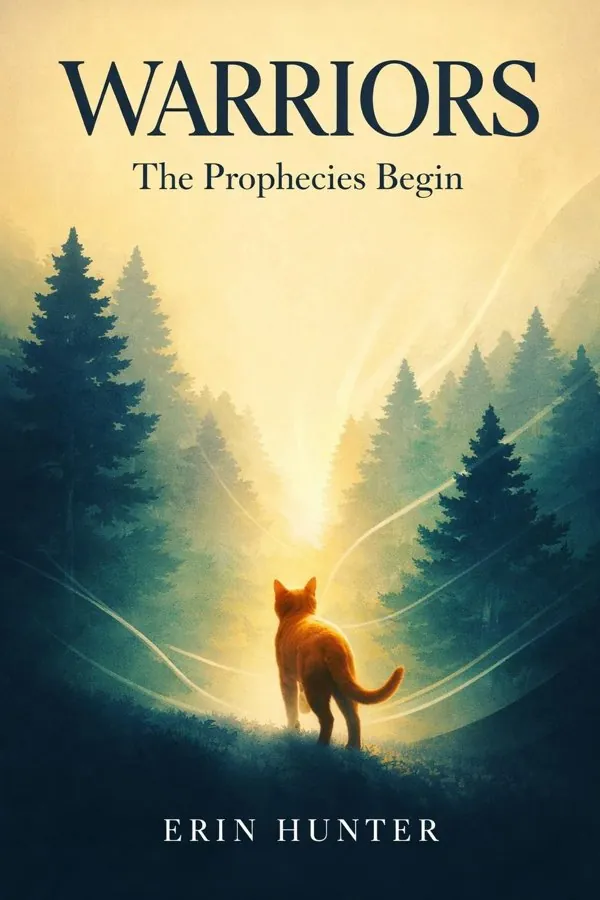
Warriors: The Prophecies Begin: Summary & Key Insights
by Erin Hunter
 10 min9 chaptersAudio available
Key Takeaways from Warriors: The Prophecies Begin
Every transformation begins with discomfort.
Power becomes dangerous when fear is mistaken for strength.
Communities are often weakened less by outside enemies than by secrets inside their own walls.
Leadership is not a reward for being admired; it is a burden carried through impossible tradeoffs.
Prophecy in Warriors does not erase choice; it intensifies it.
What Is Warriors: The Prophecies Begin About?
Warriors: The Prophecies Begin by Erin Hunter is a bestsellers book spanning 5 pages. Warriors: The Prophecies Begin is the original arc of Erin Hunter’s bestselling Warriors series, a sweeping animal fantasy that transforms a forest into a battlefield of loyalty, prophecy, ambition, and survival. Spanning six novels—Into the Wild, Fire and Ice, Forest of Secrets, Rising Storm, A Dangerous Path, and The Darkest Hour—the saga follows Rusty, a housecat who leaves the comfort of human life to join ThunderClan and becomes the warrior Fireheart, and later Firestar. What begins as a coming-of-age adventure quickly expands into a politically charged epic about belonging, moral courage, leadership, and the cost of protecting a community under constant threat. The series matters because it gives young and adult readers alike a vivid, emotionally resonant world where questions of identity, justice, and power are explored through unforgettable characters. Erin Hunter, the shared pen name behind the Warriors franchise, is celebrated for creating layered animal societies with strict codes, spiritual traditions, and high-stakes conflicts. The Prophecies Begin remains the foundation of that world: accessible, suspenseful, and surprisingly rich in insight about trust, duty, and the choices that define who we become.
This FizzRead summary covers all 9 key chapters of Warriors: The Prophecies Begin in approximately 10 minutes, distilling the most important ideas, arguments, and takeaways from Erin Hunter's work. Also available as an audio summary and Key Quotes Podcast.
Warriors: The Prophecies Begin
Warriors: The Prophecies Begin is the original arc of Erin Hunter’s bestselling Warriors series, a sweeping animal fantasy that transforms a forest into a battlefield of loyalty, prophecy, ambition, and survival. Spanning six novels—Into the Wild, Fire and Ice, Forest of Secrets, Rising Storm, A Dangerous Path, and The Darkest Hour—the saga follows Rusty, a housecat who leaves the comfort of human life to join ThunderClan and becomes the warrior Fireheart, and later Firestar. What begins as a coming-of-age adventure quickly expands into a politically charged epic about belonging, moral courage, leadership, and the cost of protecting a community under constant threat. The series matters because it gives young and adult readers alike a vivid, emotionally resonant world where questions of identity, justice, and power are explored through unforgettable characters. Erin Hunter, the shared pen name behind the Warriors franchise, is celebrated for creating layered animal societies with strict codes, spiritual traditions, and high-stakes conflicts. The Prophecies Begin remains the foundation of that world: accessible, suspenseful, and surprisingly rich in insight about trust, duty, and the choices that define who we become.
Who Should Read Warriors: The Prophecies Begin?
This book is perfect for anyone interested in bestsellers and looking to gain actionable insights in a short read. Whether you're a student, professional, or lifelong learner, the key ideas from Warriors: The Prophecies Begin by Erin Hunter will help you think differently.
- ✓Readers who enjoy bestsellers and want practical takeaways
- ✓Professionals looking to apply new ideas to their work and life
- ✓Anyone who wants the core insights of Warriors: The Prophecies Begin in just 10 minutes
Want the full summary?
Get instant access to this book summary and 100K+ more with Fizz Moment.
Get Free SummaryAvailable on App Store • Free to download
Key Chapters
Every transformation begins with discomfort. Rusty’s story matters because he is not born powerful, noble, or certain of his destiny; he is simply restless. Living as a well-fed housecat among Twolegs, he has safety, routine, and comfort, yet he feels drawn toward the forest and the untamed life beyond his fence. That inner pull becomes the emotional engine of the entire saga. When he meets Graypaw and Lionheart and is offered a place in ThunderClan, Rusty chooses risk over familiarity. In doing so, he proves one of the series’ earliest lessons: identity is not fixed by origin, but shaped by choice, discipline, and courage.
Rusty’s transition into Firepaw is not instant triumph. He must learn hunting, battle moves, clan customs, and the warrior code. More importantly, he must earn trust from cats who see him as an outsider. That tension mirrors a common real-world experience: entering a new school, team, workplace, or community where your past does not automatically grant belonging. You may have enthusiasm, but credibility still has to be built through action.
This idea resonates because many readers know what it feels like to leave comfort behind in pursuit of growth. Rusty’s leap into the wild shows that uncertainty is often the price of discovering one’s fuller self. His example suggests that courage is not fearlessness; it is the willingness to move forward despite fear.
A practical application is simple: when facing a major transition, focus less on whether you already “fit” and more on whether you are willing to learn, contribute, and endure early doubt. Like Rusty, you do not need a perfect beginning to earn a meaningful place. Actionable takeaway: choose one area of your life where comfort is limiting growth, and take a concrete first step into the unknown.
Power becomes dangerous when fear is mistaken for strength. One of the defining conflicts of The Prophecies Begin is the rise of ShadowClan under Brokenstar, whose brutal leadership throws the balance of the forest into chaos. Instead of protecting his clan, Brokenstar drives aggression, trains kits too young for battle, and turns survival into domination. Through Firepaw’s eyes, readers witness how political rhetoric can mask cruelty: claims of necessity, toughness, and clan pride are used to justify reckless violence.
This storyline gives the forest more than adventure; it gives it moral complexity. The clans are not simple heroes and villains divided by neat borders. They are societies under pressure, and pressure exposes character. Brokenstar represents leadership detached from responsibility. He values control over care, fear over loyalty, and conquest over stability. The result is not lasting power, but misery and fragmentation.
The idea applies far beyond fiction. In families, schools, offices, and governments, unhealthy leaders often frame harshness as realism and empathy as weakness. Warriors challenges that assumption. True strength in the series is shown by cats who protect the vulnerable, listen carefully, and act with restraint. Firepaw learns early that courage includes speaking against the crowd when the crowd has normalized injustice.
A useful way to apply this insight is to evaluate leaders by outcomes rather than image. Do people around them become safer, more capable, and more united, or more fearful and disposable? Brokenstar’s reign teaches readers to recognize the difference between authority and legitimacy.
Actionable takeaway: when you encounter a strong personality in your own life, ask not “Are they powerful?” but “What kind of world do they create for others?” Let that answer guide your trust.
Leadership is not a reward for being admired; it is a burden carried through impossible tradeoffs. As Fireheart matures, he is drawn into conflicts where personal loyalty, romantic feeling, clan duty, and survival collide. His bond with Graystripe is strained by Graystripe’s love for Silverstream of RiverClan, a relationship that is tender and genuine but also politically dangerous. At the same time, Fireheart must navigate betrayal, grief, and the growing realization that doing what is right rarely pleases everyone.
What makes this part of the series so compelling is its refusal to simplify emotional conflict. Graystripe is not disloyal because he feels love; he is torn because two forms of loyalty claim him at once. Fireheart is not cold because he worries about clan rules; he understands that private choices can trigger public consequences. This is the essence of mature leadership: holding compassion and responsibility together without pretending they are always easy to reconcile.
Readers can apply this idea to everyday life. Friendships, family expectations, career goals, and personal values often pull in different directions. The temptation is to avoid difficult decisions until they become crises. Fireheart’s journey shows the opposite path. He listens, hesitates, suffers, and still acts. Leadership means accepting that some decisions carry pain even when they are necessary.
The books also highlight the cost of being dependable. Fireheart increasingly becomes the one others lean on, and that reliability can be isolating. Yet his strength comes from refusing to let bitterness replace compassion. He remains capable of understanding others even when forced to set boundaries.
Actionable takeaway: when facing a conflict between emotion and responsibility, write down who may be affected by your choice, then choose the path that protects the most trust over the longest term.
Prophecy in Warriors does not erase choice; it intensifies it. The forest is shaped by omens from StarClan, mysterious warnings, and the recurring sense that Fireheart is destined for something greater. Yet The Prophecies Begin makes a crucial point: destiny alone does not make a leader. Fireheart becomes Firestar not because prophecy carries him effortlessly forward, but because he repeatedly chooses courage, fairness, restraint, and service when easier paths are available.
This makes the fulfillment of prophecy emotionally satisfying rather than mechanical. Readers watch Fireheart earn what was foretold through trial after trial. He loses mentors, faces false accusations, uncovers conspiracies, survives battles, and shoulders grief. Each challenge tests whether he will become consumed by fear or shaped by wisdom. By the time he rises to leadership, the transformation feels believable because it has been moral as much as external.
The idea has broad relevance. Many people carry a sense of calling, potential, or expectation. A teacher may say you are talented. A family may believe you are meant for something significant. You may even feel internally that your life should matter in a particular way. But potential is only a beginning. What matters is whether your habits align with the person you hope to become.
Warriors suggests that a meaningful destiny is built through repeated acts of integrity. Firestar’s greatness lies not in being chosen, but in becoming worthy of the role he is chosen for. This is a refreshing model in fantasy, where fate can sometimes excuse passivity. Here, fate demands discipline.
Actionable takeaway: if you believe you are meant to do something important, identify the daily virtues that future role requires, and begin practicing them now rather than waiting for the title or recognition.
Rules are only as valuable as the values they protect. The warrior code in The Prophecies Begin governs hunting rights, battle conduct, loyalty, mentorship, and the responsibilities of each clan member. At first glance, the code seems like a strict set of laws meant to preserve order. But as the story unfolds, it becomes clear that the code is both necessary and imperfect. It creates identity, continuity, and mutual expectations, yet it also produces dilemmas when rigid obedience clashes with compassion or changing circumstances.
This tension is one of the saga’s strongest themes. The clans need shared principles because life in the forest is dangerous. Without structure, conflict escalates, trust erodes, and vulnerable members suffer. The code gives cats a framework larger than themselves. It teaches sacrifice, discipline, and belonging. At the same time, characters repeatedly face situations where literal rule-following may not be the same as moral wisdom. Fireheart often succeeds because he respects the code’s purpose even when he questions how it is applied.
This idea has practical value in modern life. Every community has a version of the warrior code: workplace norms, family traditions, school policies, religious teachings, or social expectations. These rules can create stability, but they can also become hollow if no one remembers why they exist. Healthy communities revisit principles with honesty. They ask whether the rules still protect fairness, safety, and human dignity.
The series encourages thoughtful loyalty instead of blind obedience. Fireheart is committed to ThunderClan, yet he understands that true loyalty includes moral reflection. Belonging does not require turning off conscience.
Actionable takeaway: look at one important rule in your life—at work, home, or community—and ask what value it is supposed to serve. Follow it more wisely by honoring the value, not just the form.
No hero survives alone for long. Although Fireheart is central to The Prophecies Begin, his journey is sustained by bonds of friendship, mentorship, and earned trust. Graystripe, Cinderpelt, Bluestar, Yellowfang, Ravenpaw, and many others shape his path, each offering something different: humor, wisdom, warning, healing, loyalty, or perspective. In a world defined by territory and rivalry, these relationships become the emotional architecture that allows Fireheart to endure repeated crisis.
What the series understands well is that friendship is not merely comforting; it is functional. Good relationships expand what a character can see, bear, and accomplish. Ravenpaw’s fear reveals truths others miss. Yellowfang’s sharp honesty challenges assumptions. Cinderpelt’s resilience turns injury into a new form of purpose. Even flawed friendships, such as Fireheart’s tension with Graystripe, show that closeness requires forgiveness, boundaries, and re-commitment.
This idea applies directly to real life. Under pressure, many people default to self-reliance and secrecy, assuming independence is strength. Warriors offers a different model. Support systems are not signs of weakness; they are survival tools. Trustworthy relationships help us reality-check our fears, recover from setbacks, and stay morally grounded when circumstances become confusing.
The books also remind readers to invest in relationships before crisis hits. Fireheart can act decisively in danger because he has already built credibility and care with others. Communities are strongest when trust has been practiced in ordinary moments, not invented in emergencies.
Actionable takeaway: identify two or three relationships that strengthen your judgment and resilience, and nurture them intentionally—through honesty, gratitude, and presence—before life forces you to depend on them.
Growing up often means learning that courage cannot prevent loss. Across The Prophecies Begin, Fireheart and the other cats experience death, injury, exile, shattered trust, and the collapse of old certainties. Mentors fall. Friends suffer. Leaders falter. The forest remains beautiful, but it is never safe for long. This persistent exposure to grief is one reason the series feels more emotionally substantial than a simple adventure story. It teaches that pain is not an interruption of life’s journey; it is part of what shapes maturity.
What matters, however, is how characters respond to loss. Some become harsher, more suspicious, or more power-hungry. Others deepen in compassion. Fireheart’s growth lies in refusing to let grief turn into cruelty. He mourns deeply, but he continues to protect, to listen, and to act with integrity. That is moral resilience: not bouncing back unchanged, but moving forward without surrendering your values.
This lesson is highly practical. In real life, disappointment and grief can make people cynical. A betrayal may lead us to distrust everyone. A failure may tempt us to quit. Warriors acknowledges that suffering changes us, yet it argues that our response still matters. Hardship can sharpen wisdom rather than harden the heart.
The story also shows the importance of ritual, memory, and shared mourning. The clans grieve together, honor the dead, and draw strength from continuity. These practices help transform private pain into communal meaning.
Actionable takeaway: when facing a personal loss, ask not only “How do I survive this?” but also “What kind of person do I want to remain through this?” Let that answer guide your next small act of courage.
Home is not always where you begin; sometimes it is where you finally become responsible. Rusty enters the saga as an outsider to clan life, and even after becoming Firepaw and later Fireheart, questions of belonging never fully disappear. Some cats distrust him because of his kittypet origins. Others underestimate him, assuming background determines worth. The series repeatedly returns to this bias to challenge the belief that identity is inherited rather than built.
Fireheart’s place in ThunderClan becomes secure not because the prejudice vanishes overnight, but because he keeps choosing the clan through service, sacrifice, and principle. He hunts for it, fights for it, defends it, and speaks truth for its sake. In turn, ThunderClan slowly becomes his not by blood, but by commitment. This is one of the saga’s most powerful messages: belonging is both relational and ethical. A community becomes home when mutual loyalty is proven over time.
This theme speaks to anyone who has entered a space where they were seen as different—whether due to class, culture, accent, background, or inexperience. Warriors validates the pain of exclusion, but it also avoids reducing identity to grievance. Fireheart neither denies where he came from nor lets it imprison what he can become.
For readers, the practical insight is that healthy belonging involves two responsibilities. Individuals must contribute honestly, and communities must learn to judge by character rather than stereotype. The best groups are not those without boundaries, but those able to recognize merit, growth, and sincerity.
Actionable takeaway: if you feel like an outsider somewhere important, focus on consistent contribution and integrity; if you hold power in that community, examine whether your judgments are based on evidence or assumption.
All Chapters in Warriors: The Prophecies Begin
About the Author
Erin Hunter is the shared pen name behind the internationally successful Warriors series. Originally developed by editor Victoria Holmes and written in collaboration with authors including Kate Cary and Cherith Baldry, the name represents a team effort rather than a single individual. Under this collective identity, Erin Hunter has created one of the most expansive and beloved animal fantasy franchises in modern children’s literature. The Warriors books are known for their intricate clan politics, memorable characters, spiritual mythology, and emotionally resonant explorations of loyalty, power, grief, and belonging. The collaborative structure behind Erin Hunter has allowed the series to grow into multiple arcs, companion books, and special editions while maintaining a consistent voice and immersive world. For many readers, Erin Hunter is synonymous with vivid storytelling and epic adventure rooted in the natural world.
Get This Summary in Your Preferred Format
Read or listen to the Warriors: The Prophecies Begin summary by Erin Hunter anytime, anywhere. FizzRead offers multiple formats so you can learn on your terms — all free.
Available formats: App · Audio · PDF · EPUB — All included free with FizzRead
Download Warriors: The Prophecies Begin PDF and EPUB Summary
Key Quotes from Warriors: The Prophecies Begin
“Every transformation begins with discomfort.”
“Power becomes dangerous when fear is mistaken for strength.”
“Communities are often weakened less by outside enemies than by secrets inside their own walls.”
“Leadership is not a reward for being admired; it is a burden carried through impossible tradeoffs.”
“Prophecy in Warriors does not erase choice; it intensifies it.”
Frequently Asked Questions about Warriors: The Prophecies Begin
Warriors: The Prophecies Begin by Erin Hunter is a bestsellers book that explores key ideas across 9 chapters. Warriors: The Prophecies Begin is the original arc of Erin Hunter’s bestselling Warriors series, a sweeping animal fantasy that transforms a forest into a battlefield of loyalty, prophecy, ambition, and survival. Spanning six novels—Into the Wild, Fire and Ice, Forest of Secrets, Rising Storm, A Dangerous Path, and The Darkest Hour—the saga follows Rusty, a housecat who leaves the comfort of human life to join ThunderClan and becomes the warrior Fireheart, and later Firestar. What begins as a coming-of-age adventure quickly expands into a politically charged epic about belonging, moral courage, leadership, and the cost of protecting a community under constant threat. The series matters because it gives young and adult readers alike a vivid, emotionally resonant world where questions of identity, justice, and power are explored through unforgettable characters. Erin Hunter, the shared pen name behind the Warriors franchise, is celebrated for creating layered animal societies with strict codes, spiritual traditions, and high-stakes conflicts. The Prophecies Begin remains the foundation of that world: accessible, suspenseful, and surprisingly rich in insight about trust, duty, and the choices that define who we become.
More by Erin Hunter


You Might Also Like

The Godfather
Mario Puzo
10 min
The Handmaid's Tale
Margaret Atwood
10 min
The Hunger Games
Suzanne Collins
10 min
The Nightingale
Kristin Hannah
10 min
The Seven Husbands of Evelyn Hugo
Taylor Jenkins Reid
10 min
Backwater Justice
Fern Michaels
10 minBrowse by Category
Ready to read Warriors: The Prophecies Begin?
Get the full summary and 100K+ more books with Fizz Moment.