
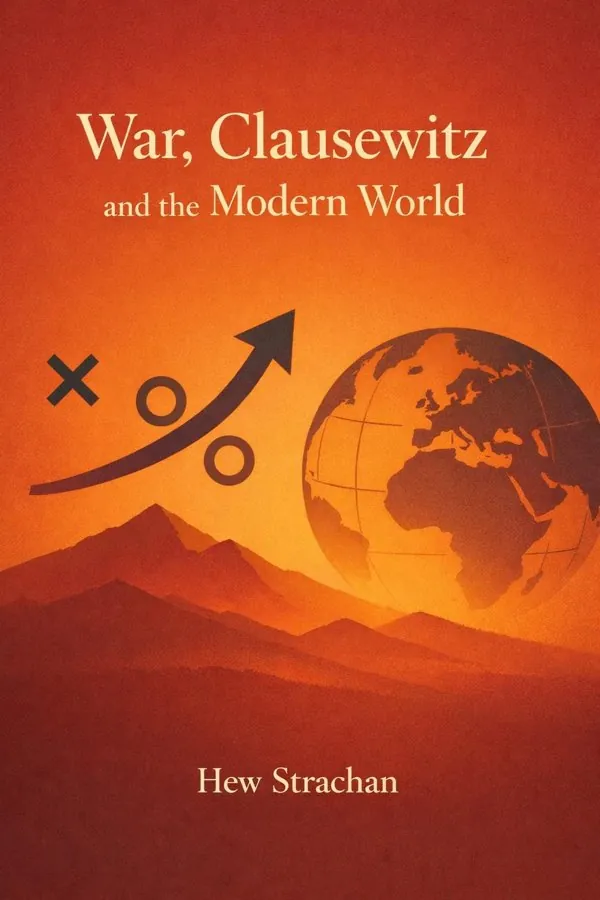
War, Clausewitz and the Modern World: Summary & Key Insights
by Hew Strachan
 10 min6 chaptersAudio available
What Is War, Clausewitz and the Modern World About?
War, Clausewitz and the Modern World by Hew Strachan is a war_military book spanning 6 pages. This collection of essays explores the continuing relevance of Carl von Clausewitz’s theories of war to the modern world. Leading scholars examine how Clausewitz’s ideas have influenced military strategy, political thought, and the understanding of conflict from the nineteenth century to the present day. The volume situates Clausewitz within his historical context while assessing his impact on contemporary military and strategic studies.
This FizzRead summary covers all 6 key chapters of War, Clausewitz and the Modern World in approximately 10 minutes, distilling the most important ideas, arguments, and takeaways from Hew Strachan's work. Also available as an audio summary and Key Quotes Podcast.
War, Clausewitz and the Modern World
This collection of essays explores the continuing relevance of Carl von Clausewitz’s theories of war to the modern world. Leading scholars examine how Clausewitz’s ideas have influenced military strategy, political thought, and the understanding of conflict from the nineteenth century to the present day. The volume situates Clausewitz within his historical context while assessing his impact on contemporary military and strategic studies.
Who Should Read War, Clausewitz and the Modern World?
This book is perfect for anyone interested in war_military and looking to gain actionable insights in a short read. Whether you're a student, professional, or lifelong learner, the key ideas from War, Clausewitz and the Modern World by Hew Strachan will help you think differently.
- ✓Readers who enjoy war_military and want practical takeaways
- ✓Professionals looking to apply new ideas to their work and life
- ✓Anyone who wants the core insights of War, Clausewitz and the Modern World in just 10 minutes
Want the full summary?
Get instant access to this book summary and 100K+ more with Fizz Moment.
Get Free SummaryAvailable on App Store • Free to download
Key Chapters
Clausewitz’s assertion that war is the continuation of politics by other means stands as one of the most quoted and least understood propositions in all of military thought. To read it in context makes it far more than a slogan—it becomes the foundation of an entire philosophy. What Clausewitz wanted us to grasp was that war is never autonomous. It may appear brutal and chaotic, but it remains bound to political purpose. The commander must always remember the statesman’s intent, and the statesman must never forget the soldier’s realities.
In this section, I explore how this concept reshaped nineteenth-century statecraft. Clausewitz’s ideas emerged in an age when war served the ambitions of sovereigns and the passions of nations. For him, the political character of war demanded constant adjustment; war could never be reduced to mere technique or aggression. This insight, though born out of European experience, still resonates in modern strategic discourse: whether in coalition operations, nuclear deterrence, or humanitarian interventions, clarity of political objective determines whether war succeeds or disintegrates into violence without end.
If war is a tool of policy, then it is also subject to the same constraints as politics—it is bounded by reason, informed by uncertainty, and steered by human judgment. Clausewitz rejects the fantasy of total control. A commander’s genius lies not in predicting every outcome, but in adapting the means of violence toward a rational goal. Modern leaders who fail to internalize this linkage often stumble into conflicts where the use of force exists for its own sake. The debates surrounding Vietnam, Iraq, and Afghanistan all show how a misalignment between political ends and military means creates prolonged struggle without resolution. That tension defines modern statecraft as much as it did in Clausewitz’s own Prussia.
The reception of Clausewitz’s ideas across Europe reveals both their potency and their vulnerability to misinterpretation. After his death, military thinkers from Germany to France, Britain, and Russia reinterpreted his work through their own national experiences. In the professionalization of European armies during the late nineteenth century, Clausewitz became a touchstone—but often a misunderstood one.
In Germany, his emphasis on the unity of politics and war was overshadowed by a technical fascination with decisive battle and operational art. The Prussian and later German staffs adopted parts of his theory—friction, chance, and moral forces—but neglected the political restraint at its core. This selective reading laid intellectual foundations that framed military thinking up to the First World War. In contrast, French officers treated Clausewitz with skepticism, associating his dialectical approach with German militarism, while British strategy absorbed him more through academic reflection than institutional doctrine.
The First World War tested Clausewitz’s relevance brutally. Industrialization and mass mobilization produced warfare on scales never imagined by Napoleonic strategists. His notion of war as a rational instrument of policy collided with political nationalism and technological lethality. Yet even amid the seeming breakdown of rational war, Clausewitz’s insights endured. His idea of friction—the unpredictable details that thwart plans—became the lived experience of every trench soldier. His emphasis on the moral dimension of war, the interplay of courage, fear, and endurance, found tragic embodiment in the armies of Europe. Thus, rather than disproving Clausewitz, the war confirmed his recognition that war’s nature—chaotic, human, and political—never changes, only its form does.
+ 4 more chapters — available in the FizzRead app
All Chapters in War, Clausewitz and the Modern World
About the Author
Hew Strachan is a British military historian and professor of international relations, known for his extensive work on the history of war and strategy. He has written and edited numerous books on military theory, including studies on Clausewitz and the First World War.
Get This Summary in Your Preferred Format
Read or listen to the War, Clausewitz and the Modern World summary by Hew Strachan anytime, anywhere. FizzRead offers multiple formats so you can learn on your terms — all free.
Available formats: App · Audio · PDF · EPUB — All included free with FizzRead
Download War, Clausewitz and the Modern World PDF and EPUB Summary
Key Quotes from War, Clausewitz and the Modern World
“Clausewitz’s assertion that war is the continuation of politics by other means stands as one of the most quoted and least understood propositions in all of military thought.”
“The reception of Clausewitz’s ideas across Europe reveals both their potency and their vulnerability to misinterpretation.”
Frequently Asked Questions about War, Clausewitz and the Modern World
War, Clausewitz and the Modern World by Hew Strachan is a war_military book that explores key ideas across 6 chapters. This collection of essays explores the continuing relevance of Carl von Clausewitz’s theories of war to the modern world. Leading scholars examine how Clausewitz’s ideas have influenced military strategy, political thought, and the understanding of conflict from the nineteenth century to the present day. The volume situates Clausewitz within his historical context while assessing his impact on contemporary military and strategic studies.
You Might Also Like
Patriot
Andrew Britton
10 min
War
John Hersey
10 min
An Army at Dawn: The War in North Africa, 1942–1943
Rick Atkinson
10 min
Brave New War: The Next Stage of Terrorism and the End of Globalization
John Robb
10 min
Catch-22
Joseph Heller
10 min
Command and Control: Nuclear Weapons, the Damascus Accident, and the Illusion of Safety
Eric Schlosser
10 minBrowse by Category
Ready to read War, Clausewitz and the Modern World?
Get the full summary and 100K+ more books with Fizz Moment.