
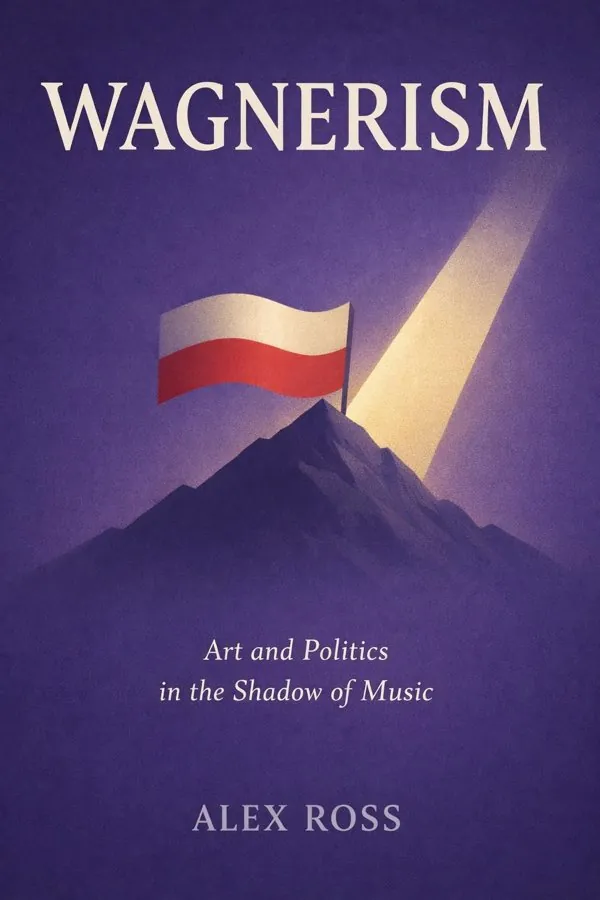
Wagnerism: Art and Politics in the Shadow of Music: Summary & Key Insights
by Alex Ross
 10 min9 chaptersAudio available
Key Takeaways from Wagnerism: Art and Politics in the Shadow of Music
One of the most revealing facts about Wagner is that he did not wait for history to mythologize him; he started the process himself.
Wagner’s revolution was not only musical; it was architectural, theatrical, literary, and psychological.
By the late nineteenth century, Wagner had become more than a composer; he was a cultural atmosphere.
Few intellectual relationships reveal Wagner’s complexity better than his bond with Friedrich Nietzsche.
A central achievement of Ross’s book is that it refuses any easy separation between Wagner the genius and Wagner the bigot.
What Is Wagnerism: Art and Politics in the Shadow of Music About?
Wagnerism: Art and Politics in the Shadow of Music by Alex Ross is a music_film book spanning 6 pages. Richard Wagner was not just a composer. He became a cultural force field, attracting artists, revolutionaries, nationalists, dreamers, and ideologues into his orbit. In Wagnerism: Art and Politics in the Shadow of Music, critic Alex Ross tells the story of how Wagner’s music and mythology escaped the opera house and shaped literature, philosophy, painting, theater, film, politics, and popular imagination from the nineteenth century to today. The book is not simply a biography of Wagner or a guide to his operas. It is a sweeping account of how one artist’s work could inspire both radical artistic innovation and some of the darkest political movements in modern history. What makes this study so compelling is Ross’s ability to hold contradictions together. He shows how Wagner’s art stirred profound creative breakthroughs while Wagner himself advanced toxic anti-Semitic ideas later embraced by the Nazis. Ross, one of the most respected music critics of his generation, brings extraordinary range and clarity to this difficult subject. The result is a rich cultural history that helps readers understand not only Wagner’s influence, but also the unsettling truth that great art can leave behind a morally compromised legacy.
This FizzRead summary covers all 9 key chapters of Wagnerism: Art and Politics in the Shadow of Music in approximately 10 minutes, distilling the most important ideas, arguments, and takeaways from Alex Ross's work. Also available as an audio summary and Key Quotes Podcast.
Wagnerism: Art and Politics in the Shadow of Music
Richard Wagner was not just a composer. He became a cultural force field, attracting artists, revolutionaries, nationalists, dreamers, and ideologues into his orbit. In Wagnerism: Art and Politics in the Shadow of Music, critic Alex Ross tells the story of how Wagner’s music and mythology escaped the opera house and shaped literature, philosophy, painting, theater, film, politics, and popular imagination from the nineteenth century to today. The book is not simply a biography of Wagner or a guide to his operas. It is a sweeping account of how one artist’s work could inspire both radical artistic innovation and some of the darkest political movements in modern history.
What makes this study so compelling is Ross’s ability to hold contradictions together. He shows how Wagner’s art stirred profound creative breakthroughs while Wagner himself advanced toxic anti-Semitic ideas later embraced by the Nazis. Ross, one of the most respected music critics of his generation, brings extraordinary range and clarity to this difficult subject. The result is a rich cultural history that helps readers understand not only Wagner’s influence, but also the unsettling truth that great art can leave behind a morally compromised legacy.
Who Should Read Wagnerism: Art and Politics in the Shadow of Music?
This book is perfect for anyone interested in music_film and looking to gain actionable insights in a short read. Whether you're a student, professional, or lifelong learner, the key ideas from Wagnerism: Art and Politics in the Shadow of Music by Alex Ross will help you think differently.
- ✓Readers who enjoy music_film and want practical takeaways
- ✓Professionals looking to apply new ideas to their work and life
- ✓Anyone who wants the core insights of Wagnerism: Art and Politics in the Shadow of Music in just 10 minutes
Want the full summary?
Get instant access to this book summary and 100K+ more with Fizz Moment.
Get Free SummaryAvailable on App Store • Free to download
Key Chapters
One of the most revealing facts about Wagner is that he did not wait for history to mythologize him; he started the process himself. Alex Ross shows that Wagner was not only a composer of vast musical dramas but also a tireless self-inventor. Born in Leipzig in 1813, he fashioned a public image that merged artistic genius, political destiny, and personal suffering. He participated in the revolutionary ferment of 1848, fled into exile, wrote endlessly about his own artistic mission, and cultivated the impression that his life and work belonged to a single heroic narrative.
This matters because the “idea” of Wagner became nearly as influential as the music. Admirers did not simply attend his operas; they absorbed a worldview. Wagner presented himself as a redeemer of art, someone who could restore cultural unity in an age of fragmentation. That self-image proved irresistible to followers across Europe and America, especially in a century hungry for prophetic figures.
Ross also makes clear that the legend concealed much: debt, opportunism, manipulation, and vindictiveness. Wagner’s charisma helped patrons overlook his personal chaos, while his writings turned aesthetic preferences into historical destiny. Even Bayreuth, the festival theater he built for his works, functioned as both an artistic institution and a shrine to his persona.
A practical lesson emerges here for readers far beyond music history. Cultural power often grows not just from talent, but from narrative control. Artists, brands, and political movements shape influence by telling stories about themselves that others want to believe. The takeaway: whenever a public figure appears larger than life, examine how much of that greatness is achievement and how much is carefully engineered myth.
Wagner’s revolution was not only musical; it was architectural, theatrical, literary, and psychological. Ross explains that Wagner pursued what he called the Gesamtkunstwerk, or total work of art, an ideal in which music, poetry, staging, visual design, and drama would fuse into a single immersive experience. Instead of offering isolated arias or decorative spectacle, his operas aimed to create entire symbolic worlds in which every element served emotional and philosophical purpose.
The technical tools of this revolution were equally important. Wagner’s use of leitmotifs recurring musical ideas associated with characters, objects, or states of mind allowed music to carry memory and meaning across long dramatic spans. This made the orchestra more than accompaniment. It became a hidden narrator, suggesting motives, foreshadowing events, and deepening the audience’s emotional understanding.
Ross shows how radical this was for later artists. Novelists adopted Wagnerian forms of thematic recurrence. Filmmakers inherited his logic of musical symbolism. Modern franchise storytelling, from epic fantasy to cinema, often depends on exactly this technique: a network of motifs that binds a sprawling world together.
Readers can see Wagner’s influence anywhere creators seek immersion over fragmentation. A television series with signature themes, a game world with interconnected symbols, or a stage production where design and score reinforce one another all operate in Wagner’s shadow.
The practical takeaway is simple: powerful art feels unified because its parts communicate. Whether you are writing, designing, teaching, or presenting, think beyond isolated features and build systems of repeated images, themes, and cues that create a coherent emotional world.
By the late nineteenth century, Wagner had become more than a composer; he was a cultural atmosphere. Ross traces how the fin de siècle generation embraced Wagner as a symbol of modernity, sensuality, decadence, and spiritual longing. Writers, painters, and theater makers found in Wagner’s operas a new language for expressing desire, myth, and psychological depth. His influence spread through Symbolism, Art Nouveau, early modernist literature, and avant-garde performance.
What attracted this generation was not just the grandeur of Wagner’s music but its ambiguity. His works offered erotic intensity, mystical yearning, political rebellion, and catastrophic beauty all at once. Artists could project their own obsessions onto him. Some heard a path toward artistic liberation; others saw a diagnosis of civilization’s exhaustion.
Ross highlights figures across Europe who translated Wagner into their own mediums. Poets borrowed his dreamlike atmosphere. Painters echoed his legendary and medieval imagery. Playwrights and novelists imitated his long arcs of tension and revelation. In France, despite deep political hostility to Germany after the Franco-Prussian War, French intellectuals became some of Wagner’s fiercest devotees. That paradox reveals how aesthetic fascination can cross national and ideological boundaries.
This chapter of cultural history offers a practical insight into how influence works. Major artistic movements rarely remain confined to one form. When a creator touches a nerve deeply enough, the methods migrate. You can observe the same pattern today when cinematic storytelling affects novels, games shape television pacing, or social media aesthetics reshape design.
The actionable takeaway: when studying any major cultural trend, do not look only at direct followers. Look at how ideas migrate across forms, are transformed by rivals, and become a shared language for an entire era.
Few intellectual relationships reveal Wagner’s complexity better than his bond with Friedrich Nietzsche. Ross presents their story as both a personal drama and a philosophical turning point. Nietzsche initially revered Wagner, seeing him as the artist who might revive tragic depth in modern culture. Wagner’s music seemed to offer an antidote to shallow rationalism and spiritual decline. For a time, Nietzsche treated him as a cultural savior.
But admiration curdled into disillusionment. Nietzsche came to believe that Wagner’s art manipulated rather than liberated, seduced rather than strengthened. He recoiled from Wagner’s theatrical excess, Christian turn, and nationalist posturing. What had once seemed profound now appeared decadent and coercive. In works such as The Case of Wagner, Nietzsche transformed his former idol into a symbol of modern sickness.
Ross shows why this break mattered so much. It gave later thinkers a vocabulary for resisting Wagnerian enchantment. Nietzsche exposed the danger of surrendering judgment to overwhelming aesthetic experience. He suggested that art can intoxicate audiences into passive submission, especially when it claims spiritual authority.
This is not only a nineteenth-century quarrel. The issue remains urgent wherever charisma, spectacle, and emotional intensity override critical thought. Whether in politics, media, or branding, people are often drawn to experiences that feel meaningful before they have examined what is actually being conveyed.
The takeaway is to enjoy powerful art without becoming defenseless before it. When something moves you deeply, ask how it achieves that effect and what values ride along with the emotion. Critical distance does not diminish art; it protects your freedom within it.
A central achievement of Ross’s book is that it refuses any easy separation between Wagner the genius and Wagner the bigot. Wagner’s anti-Semitism was not a minor flaw at the edges of his life. It appeared openly in his essays, especially in his notorious text Judaism in Music, and formed part of the ideological environment surrounding his art, family, and legacy. Ross does not claim that the operas reduce neatly to anti-Semitic propaganda, but he insists that readers and listeners cannot responsibly ignore Wagner’s prejudice.
This distinction is crucial. The question is not whether every note of Wagner’s music is politically guilty. The question is how a major artist’s public ideas shape the meanings that gather around the work over time. Wagner’s attacks on Jewish musicians and intellectuals helped normalize cultural exclusion. Later admirers, including virulent anti-Semites, found in him not only artistic inspiration but validation.
Ross also shows that Jewish writers, musicians, and thinkers often had deeply conflicted relationships with Wagner. Some were drawn to the music’s power while recoiling from the hatred of the man. That tension is one of the book’s most important themes: art can enthrall those it wounds.
For contemporary readers, the practical application is broad. Canonical status does not erase moral responsibility, and moral responsibility does not require simplistic cancellation. We need methods of reading and listening that are historically informed, ethically alert, and resistant to denial.
The takeaway: do not approach difficult masterpieces with either blind reverence or easy dismissal. Hold aesthetic achievement and moral failure in view at the same time, because mature judgment begins where simplification ends.
Wagner’s legacy became politically explosive because his works were repeatedly enlisted in nationalist projects. Ross demonstrates how a composer who once moved in revolutionary circles was gradually transformed into a monument of German identity. Bayreuth became more than a festival; it became a ritual site where aesthetics, heritage, and ideology converged. The Wagner family helped cultivate this symbolism, encouraging the view that his art expressed a unique German spirit.
This national appropriation intensified across the late nineteenth and early twentieth centuries, when European states increasingly used culture to define collective identity. Wagner’s mythic subjects, Teutonic imagery, and grand historical claims made his work especially attractive to those who sought cultural legitimacy for political ambition. Yet Ross reminds us that this process was selective. Wagner’s art is too unruly to fit neatly inside any doctrine, but institutions and regimes often simplify artists to make them useful.
The most infamous culmination came with Adolf Hitler, who revered Wagner and wove him into the symbolic fabric of the Third Reich. Ross is careful not to say that Wagner caused Nazism. Instead, he shows how Wagnerian ideas, family networks, and cultural prestige helped furnish the regime with emotional and ceremonial material.
This history offers a warning about the political afterlife of art. Once a work enters public memory, creators no longer control its uses. National myths, movements, and leaders may seize cultural prestige to elevate their own agendas.
The actionable takeaway: whenever art is presented as proof of a nation’s destiny, ask who benefits from that interpretation, what complexities are being erased, and how symbolic beauty may be masking political manipulation.
Wagner’s influence on modernism was so pervasive that even artists who rejected him often did so in Wagnerian terms. Ross maps a fascinating pattern: composers, writers, and directors defined themselves either through adaptation of Wagner’s techniques or through rebellion against his overwhelming example. In this sense, Wagner became a problem modernism had to solve.
Some artists embraced his ambition to remake perception. Others stripped away his excess in search of clarity, irony, fragmentation, or objectivity. Claude Debussy reacted against Wagner’s density while still learning from his harmonic daring. James Joyce absorbed mythic patterning and recurring motifs while refusing grand redemptive closure. Virginia Woolf, Thomas Mann, and countless others entered into explicit or implicit dialogue with Wagnerian forms.
Ross’s insight here is that influence does not always look like imitation. It can appear as resistance, inversion, parody, or strategic omission. A writer who avoids sweeping symbolism may be reacting against Wagner as surely as a filmmaker who uses lush leitmotifs is extending him.
This idea has practical value for anyone trying to understand creativity. We often imagine originality as pure independence, but most creators define themselves through chosen ancestors and necessary antagonists. Your style may emerge not only from what you love, but from what you consciously refuse.
The takeaway: when analyzing art, ask not only “Who inspired this?” but also “What pressure is this work pushing against?” Understanding both attraction and resistance will give you a much richer picture of how innovation actually develops.
If Wagner’s operas once seemed remote from everyday life, Ross shows how thoroughly their techniques entered mass culture, especially through cinema. Film inherited Wagner’s idea of the orchestra as psychological narrator and his method of binding stories together through recurring themes. From early silent film accompaniment to Hollywood scoring, the Wagnerian logic of leitmotif became one of the basic tools of modern storytelling.
Listen to the music associated with a villain, a love theme, a kingdom, or a hero’s destiny in any blockbuster, and you are hearing a descendant of Wagner. Ross’s broader point is not that all film composers are secret Wagnerians, but that Wagner helped establish the grammar of emotionally guided narrative. His sense of cumulative tension, mythic scale, and musical memory became central to how audiences learn to feel a story.
Popular culture also inherited Wagner’s blend of spectacle and mythology. Fantasy worlds, superhero sagas, and prestige franchises often seek the same immersive totality Wagner wanted in the theater: music, image, symbol, and plot fused into a coherent emotional universe.
This matters because influence often survives best after it becomes invisible. Many people who would never attend Bayreuth have nevertheless absorbed Wagnerian habits of listening through movies, television, and games.
The practical takeaway is to become a more aware audience member. Notice how recurring musical cues shape your emotional expectations, how scale can create authority, and how mythic framing makes familiar conflicts seem timeless. Once you recognize the method, you can appreciate the craft without being unconsciously carried along by it.
After the Second World War, Wagner’s legacy could no longer be treated as merely glorious or artistically self-contained. Ross describes a long postwar reckoning in which musicians, scholars, audiences, and institutions struggled with what it meant to preserve and perform work so entangled with anti-Semitism and Nazi appropriation. Bayreuth itself became a test case, attempting renewal while remaining haunted by family history and ideological complicity.
This reckoning did not produce a single answer. Some argued that Wagner’s music should be separated from political contamination and restored to aesthetic autonomy. Others insisted that any performance without historical context risked repeating denial. In Israel, informal and sometimes formal resistance to Wagner performance reflected the trauma his music carried for Holocaust survivors, illustrating how cultural meaning cannot be divorced from lived memory.
Ross is especially strong on the point that difficult heritage must be worked through, not wished away. Honest engagement may involve new productions, critical framing, archival openness, and public debate. The goal is neither ritual punishment nor purified appreciation, but a more responsible cultural literacy.
This issue has wide application today, as societies reconsider monuments, canons, founders, and beloved works linked to injustice. Wagner is an extreme case, but not an isolated one. The challenge is how to remember without sanctifying and how to preserve without concealing harm.
The takeaway: when encountering compromised masterpieces, ask what institutions are doing to provide context, whose voices are included in the conversation, and how memory can become a form of accountability rather than erasure.
All Chapters in Wagnerism: Art and Politics in the Shadow of Music
About the Author
Alex Ross is an American music critic, essayist, and cultural historian widely recognized for bringing classical music into broader public conversation. A longtime staff writer at The New Yorker, he has built a reputation for combining deep musical knowledge with a rare ability to connect music to literature, politics, philosophy, and social history. His bestselling books include The Rest Is Noise, a landmark history of twentieth-century music, and Listen to This, a collection of essays on musical experience and culture. Ross is admired for writing that is intellectually rigorous yet accessible to non-specialists. In Wagnerism, he applies those strengths to one of the most complex subjects in cultural history, tracing how Wagner’s art radiated through modern life while confronting the troubling moral and political dimensions of that legacy.
Get This Summary in Your Preferred Format
Read or listen to the Wagnerism: Art and Politics in the Shadow of Music summary by Alex Ross anytime, anywhere. FizzRead offers multiple formats so you can learn on your terms — all free.
Available formats: App · Audio · PDF · EPUB — All included free with FizzRead
Download Wagnerism: Art and Politics in the Shadow of Music PDF and EPUB Summary
Key Quotes from Wagnerism: Art and Politics in the Shadow of Music
“One of the most revealing facts about Wagner is that he did not wait for history to mythologize him; he started the process himself.”
“Wagner’s revolution was not only musical; it was architectural, theatrical, literary, and psychological.”
“By the late nineteenth century, Wagner had become more than a composer; he was a cultural atmosphere.”
“Few intellectual relationships reveal Wagner’s complexity better than his bond with Friedrich Nietzsche.”
“A central achievement of Ross’s book is that it refuses any easy separation between Wagner the genius and Wagner the bigot.”
Frequently Asked Questions about Wagnerism: Art and Politics in the Shadow of Music
Wagnerism: Art and Politics in the Shadow of Music by Alex Ross is a music_film book that explores key ideas across 9 chapters. Richard Wagner was not just a composer. He became a cultural force field, attracting artists, revolutionaries, nationalists, dreamers, and ideologues into his orbit. In Wagnerism: Art and Politics in the Shadow of Music, critic Alex Ross tells the story of how Wagner’s music and mythology escaped the opera house and shaped literature, philosophy, painting, theater, film, politics, and popular imagination from the nineteenth century to today. The book is not simply a biography of Wagner or a guide to his operas. It is a sweeping account of how one artist’s work could inspire both radical artistic innovation and some of the darkest political movements in modern history. What makes this study so compelling is Ross’s ability to hold contradictions together. He shows how Wagner’s art stirred profound creative breakthroughs while Wagner himself advanced toxic anti-Semitic ideas later embraced by the Nazis. Ross, one of the most respected music critics of his generation, brings extraordinary range and clarity to this difficult subject. The result is a rich cultural history that helps readers understand not only Wagner’s influence, but also the unsettling truth that great art can leave behind a morally compromised legacy.
More by Alex Ross
You Might Also Like
Beethoven: A Documentary Study
H. C. Robbins Landon
10 min
Cinema Speculation
Quentin Tarantino
10 min
Deep Listening: A Composer's Sound Practice
Pauline Oliveros
10 min
Dylan Goes Electric!: Newport, Seeger, Dylan, and the Night That Split the Sixties
Elijah Wald
10 min
Future Frames
Maria Walsh
10 min
Hamilton: The Revolution: Being the Complete Libretto of the Broadway Musical, with a True Account of Its Creation, and Concise Remarks on Hip-Hop, the Power of Stories, and the New America
Lin-Manuel Miranda, Jeremy McCarter
10 minBrowse by Category
Ready to read Wagnerism: Art and Politics in the Shadow of Music?
Get the full summary and 100K+ more books with Fizz Moment.