
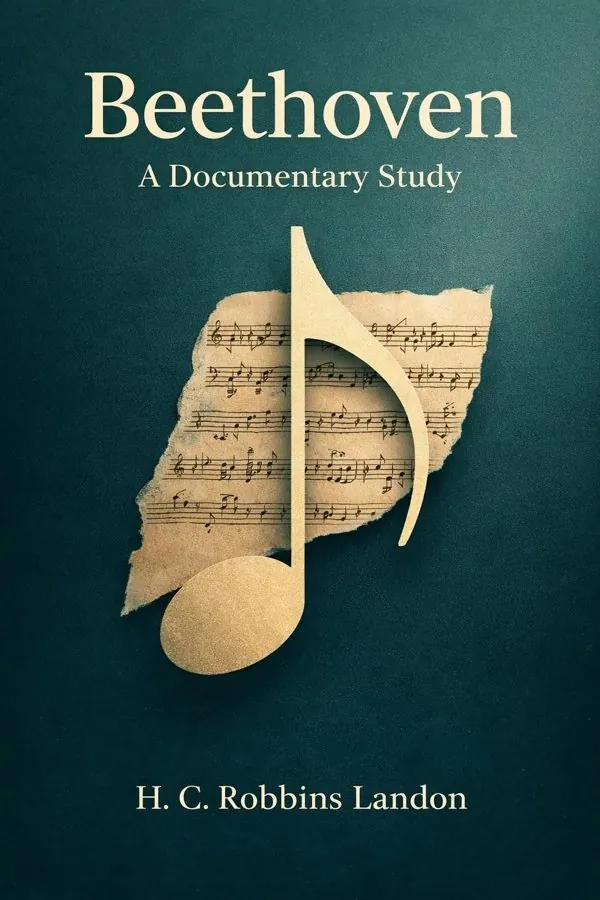
Beethoven: A Documentary Study: Summary & Key Insights
 10 min11 chaptersAudio available
What Is Beethoven: A Documentary Study About?
Beethoven: A Documentary Study by H. C. Robbins Landon is a music_film book spanning 11 pages. This authoritative documentary study by H. C. Robbins Landon presents a comprehensive exploration of Ludwig van Beethoven’s life, music, and historical context. Drawing on letters, manuscripts, and iconography, Landon provides a richly detailed portrait of the composer’s creative process, personal struggles, and enduring influence on Western classical music. The book combines scholarly rigor with accessible commentary, making it a key reference for both musicologists and general readers interested in Beethoven’s world.
This FizzRead summary covers all 11 key chapters of Beethoven: A Documentary Study in approximately 10 minutes, distilling the most important ideas, arguments, and takeaways from H. C. Robbins Landon's work. Also available as an audio summary and Key Quotes Podcast.
Beethoven: A Documentary Study
This authoritative documentary study by H. C. Robbins Landon presents a comprehensive exploration of Ludwig van Beethoven’s life, music, and historical context. Drawing on letters, manuscripts, and iconography, Landon provides a richly detailed portrait of the composer’s creative process, personal struggles, and enduring influence on Western classical music. The book combines scholarly rigor with accessible commentary, making it a key reference for both musicologists and general readers interested in Beethoven’s world.
Who Should Read Beethoven: A Documentary Study?
This book is perfect for anyone interested in music_film and looking to gain actionable insights in a short read. Whether you're a student, professional, or lifelong learner, the key ideas from Beethoven: A Documentary Study by H. C. Robbins Landon will help you think differently.
- ✓Readers who enjoy music_film and want practical takeaways
- ✓Professionals looking to apply new ideas to their work and life
- ✓Anyone who wants the core insights of Beethoven: A Documentary Study in just 10 minutes
Want the full summary?
Get instant access to this book summary and 100K+ more with Fizz Moment.
Get Free SummaryAvailable on App Store • Free to download
Key Chapters
Beethoven’s story begins in Bonn, a small yet culturally active city along the Rhine, where he was born in 1770 into a family whose ambitions exceeded their means. His grandfather, also named Ludwig, had achieved modest renown as a musician at the Bonn court, but his father Johann, though talented, lacked discipline and succumbed to alcoholism. Into this unstable domestic world young Ludwig was thrust, a prodigy whose gifts soon became apparent to everyone except perhaps the father who sought to exploit them.
Through documentary evidence—church records, school reports, and letters from his early mentors—we can trace how Beethoven’s musical education evolved under conditions both harsh and inspiring. He was drilled mercilessly at the keyboard, forced to practice late into the night, yet he also absorbed the lively intellectual atmosphere of Bonn’s court chapel, where he encountered the music of Haydn and Mozart. His earliest patrons, such as Count Waldstein, recognized in him a young man whose temperament and independence marked him as exceptional. The boy’s first compositions, preserved in fragmentary manuscripts, already show signs of a restless experimenter unwilling to follow convention blindly.
In these formative years, we see the genesis of Beethoven’s dual nature—the disciplined craftsman shaped by Enlightenment virtues and the revolutionary spirit driven to challenge every rule. This tension would define his entire creative journey, turning a provincial keyboard virtuoso into the architect of musical modernity.
In 1792, following the death of his mentor in Bonn and on the urging of his patrons, Beethoven left his birthplace for Vienna—the heart of European music. Letters from this period convey both his excitement and his anxiety. He arrived armed with introductions to Joseph Haydn and the hope of building a career as a composer and piano virtuoso. The Vienna Beethoven entered was simultaneously brilliant and precarious—a city balancing Enlightenment sophistication with the tremors of Revolutionary France echoing across Europe.
Beethoven studied briefly under Haydn, though the relationship was uneasy. Their letters reveal a dynamic mix of respect and frustration: Haydn recognized his student’s immense promise but also his uncompromising attitude. Other teachers, like Albrechtsberger and Salieri, broadened his technical skills, but even then Beethoven was pursuing his own path. Through early dedications and correspondence, we trace his careful cultivation of patrons such as Prince Lichnowsky, whose salon became a central platform for his emerging reputation.
By the mid-1790s, the youthful Bonn musician had become a sensation in Vienna’s social circles—admired for his improvisations that left audiences awestruck. Yet behind the acclaim, the letters and journals portray him as restive, disdainful of superficial society, already seeking music that spoke not to polite taste but to the depths of the human spirit.
+ 9 more chapters — available in the FizzRead app
All Chapters in Beethoven: A Documentary Study
About the Author
H. C. Robbins Landon (1926–2009) was an American musicologist and historian best known for his extensive research on classical composers such as Haydn and Beethoven. His work, including numerous books and recordings, significantly advanced modern understanding of 18th- and early 19th-century music.
Get This Summary in Your Preferred Format
Read or listen to the Beethoven: A Documentary Study summary by H. C. Robbins Landon anytime, anywhere. FizzRead offers multiple formats so you can learn on your terms — all free.
Available formats: App · Audio · PDF · EPUB — All included free with FizzRead
Download Beethoven: A Documentary Study PDF and EPUB Summary
Key Quotes from Beethoven: A Documentary Study
“Beethoven’s story begins in Bonn, a small yet culturally active city along the Rhine, where he was born in 1770 into a family whose ambitions exceeded their means.”
“In 1792, following the death of his mentor in Bonn and on the urging of his patrons, Beethoven left his birthplace for Vienna—the heart of European music.”
Frequently Asked Questions about Beethoven: A Documentary Study
Beethoven: A Documentary Study by H. C. Robbins Landon is a music_film book that explores key ideas across 11 chapters. This authoritative documentary study by H. C. Robbins Landon presents a comprehensive exploration of Ludwig van Beethoven’s life, music, and historical context. Drawing on letters, manuscripts, and iconography, Landon provides a richly detailed portrait of the composer’s creative process, personal struggles, and enduring influence on Western classical music. The book combines scholarly rigor with accessible commentary, making it a key reference for both musicologists and general readers interested in Beethoven’s world.
You Might Also Like

Cinema Speculation
Quentin Tarantino
10 min
Deep Listening: A Composer's Sound Practice
Pauline Oliveros
10 min
Dylan Goes Electric!: Newport, Seeger, Dylan, and the Night That Split the Sixties
Elijah Wald
10 min
Future Frames
Maria Walsh
10 min
Hamilton: The Revolution: Being the Complete Libretto of the Broadway Musical, with a True Account of Its Creation, and Concise Remarks on Hip-Hop, the Power of Stories, and the New America
Lin-Manuel Miranda, Jeremy McCarter
10 min
Hit Men: Power Brokers and Fast Money Inside the Music Business
Fredric Dannen
10 minBrowse by Category
Ready to read Beethoven: A Documentary Study?
Get the full summary and 100K+ more books with Fizz Moment.