
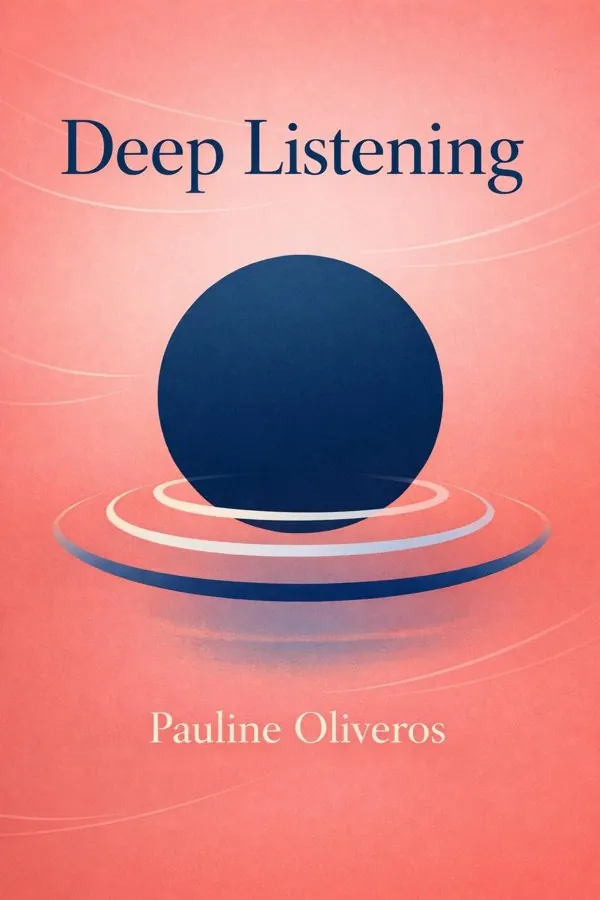
Deep Listening: A Composer's Sound Practice: Summary & Key Insights
 10 min7 chaptersAudio available
What Is Deep Listening: A Composer's Sound Practice About?
Deep Listening: A Composer's Sound Practice by Pauline Oliveros is a music_film book spanning 7 pages. Deep Listening es una práctica desarrollada por la compositora Pauline Oliveros que combina la escucha consciente, la improvisación y la meditación sonora. El libro explora cómo la atención plena al sonido puede expandir la percepción, fomentar la creatividad y conectar a los oyentes con su entorno acústico y con los demás. Incluye ejercicios, reflexiones y métodos para cultivar una escucha profunda tanto en la música como en la vida cotidiana.
This FizzRead summary covers all 7 key chapters of Deep Listening: A Composer's Sound Practice in approximately 10 minutes, distilling the most important ideas, arguments, and takeaways from Pauline Oliveros's work. Also available as an audio summary and Key Quotes Podcast.
Deep Listening: A Composer's Sound Practice
Deep Listening es una práctica desarrollada por la compositora Pauline Oliveros que combina la escucha consciente, la improvisación y la meditación sonora. El libro explora cómo la atención plena al sonido puede expandir la percepción, fomentar la creatividad y conectar a los oyentes con su entorno acústico y con los demás. Incluye ejercicios, reflexiones y métodos para cultivar una escucha profunda tanto en la música como en la vida cotidiana.
Who Should Read Deep Listening: A Composer's Sound Practice?
This book is perfect for anyone interested in music_film and looking to gain actionable insights in a short read. Whether you're a student, professional, or lifelong learner, the key ideas from Deep Listening: A Composer's Sound Practice by Pauline Oliveros will help you think differently.
- ✓Readers who enjoy music_film and want practical takeaways
- ✓Professionals looking to apply new ideas to their work and life
- ✓Anyone who wants the core insights of Deep Listening: A Composer's Sound Practice in just 10 minutes
Want the full summary?
Get instant access to this book summary and 100K+ more with Fizz Moment.
Get Free SummaryAvailable on App Store • Free to download
Key Chapters
Listening is a creative act. Unlike hearing, which happens automatically, listening requires attention and intention. In my life as a composer, I learned that the quality of listening—open, inclusive, nonjudgmental—determines the quality of what is created. Deep Listening calls for awareness of everything: the immediate sound of an instrument, the distant hum of a city, the resonance of one’s own heartbeat. It is an expansive process that dissolves the boundaries between self and world.
To listen deeply is to engage all faculties of perception. It involves mental focus, sensory openness, and, above all, compassion. When we extend our listening outward, we also turn inward, discovering the subtle harmonies that link body, mind, and environment. Through sustained practice, we begin to recognize patterns in sound and meaning that were previously unnoticed. We move from isolated perception to participation in the symphony of existence. Listening becomes a means of connecting with life itself.
In my workshops, I often ask participants to distinguish between the sounds they immediately identify and those they initially miss. When attention shifts, new layers reveal themselves: overtones, echoes, rhythmic microstructures. This awareness can permeate every aspect of daily life—how one listens to another person, to silence, to the changing tone of the air at dusk. Every sound becomes part of a continuous composition in which we are both audience and performer.
The distinction between hearing and listening is foundational. Hearing is physiological, while listening is psychological, emotional, and spiritual. Deep Listening engages consciousness; it transforms sound into meaning through awareness. Most of us move through our days enveloped in sound but detached from it. We hear, but do not truly listen.
My own awakening to this difference occurred during recording sessions in resonant spaces such as underground cisterns. The extreme reverberation forced me and my collaborators to listen differently—to wait, to respond, to merge with the space’s own voice. That experience taught me that sound is not separate from the listener or the environment; it is a field in which all three coexist. Listening with full attention activates a sense of unity that transcends the merely auditory.
One of the core principles of Deep Listening practice is that every act of listening is an act of consciousness. When we listen with awareness, we become aware of listening itself—we experience attention as a creative force. That shift opens doors to intuition, empathy, and expanded identity. Listening becomes a mirror of consciousness, revealing how we relate to the world.
+ 5 more chapters — available in the FizzRead app
All Chapters in Deep Listening: A Composer's Sound Practice
About the Author
Pauline Oliveros (1932–2016) fue una compositora, acordeonista y pionera de la música experimental estadounidense. Fundadora del Deep Listening Institute, su trabajo influyó profundamente en la música contemporánea, la improvisación y la conciencia sonora. Fue una de las primeras figuras en integrar la meditación y la ecología acústica en la práctica musical.
Get This Summary in Your Preferred Format
Read or listen to the Deep Listening: A Composer's Sound Practice summary by Pauline Oliveros anytime, anywhere. FizzRead offers multiple formats so you can learn on your terms — all free.
Available formats: App · Audio · PDF · EPUB — All included free with FizzRead
Download Deep Listening: A Composer's Sound Practice PDF and EPUB Summary
Key Quotes from Deep Listening: A Composer's Sound Practice
“Unlike hearing, which happens automatically, listening requires attention and intention.”
“The distinction between hearing and listening is foundational.”
Frequently Asked Questions about Deep Listening: A Composer's Sound Practice
Deep Listening: A Composer's Sound Practice by Pauline Oliveros is a music_film book that explores key ideas across 7 chapters. Deep Listening es una práctica desarrollada por la compositora Pauline Oliveros que combina la escucha consciente, la improvisación y la meditación sonora. El libro explora cómo la atención plena al sonido puede expandir la percepción, fomentar la creatividad y conectar a los oyentes con su entorno acústico y con los demás. Incluye ejercicios, reflexiones y métodos para cultivar una escucha profunda tanto en la música como en la vida cotidiana.
You Might Also Like
Beethoven: A Documentary Study
H. C. Robbins Landon
10 min
Cinema Speculation
Quentin Tarantino
10 min
Dylan Goes Electric!: Newport, Seeger, Dylan, and the Night That Split the Sixties
Elijah Wald
10 min
Future Frames
Maria Walsh
10 min
Hamilton: The Revolution: Being the Complete Libretto of the Broadway Musical, with a True Account of Its Creation, and Concise Remarks on Hip-Hop, the Power of Stories, and the New America
Lin-Manuel Miranda, Jeremy McCarter
10 min
Hit Men: Power Brokers and Fast Money Inside the Music Business
Fredric Dannen
10 minBrowse by Category
Ready to read Deep Listening: A Composer's Sound Practice?
Get the full summary and 100K+ more books with Fizz Moment.