
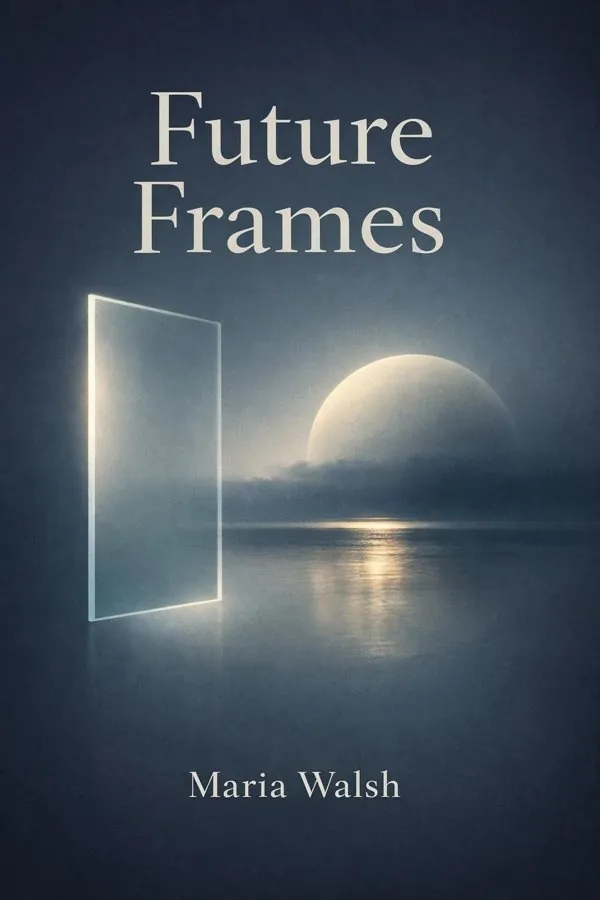
Future Frames: Summary & Key Insights
by Maria Walsh
 10 min10 chaptersAudio available
What Is Future Frames About?
Future Frames by Maria Walsh is a music_film book spanning 10 pages. Future Frames is a scholarly exploration of contemporary art and moving image practices, examining how artists engage with time, memory, and subjectivity through video and film. Maria Walsh analyzes works by key figures in the field, situating them within philosophical and psychoanalytic frameworks to reveal how the moving image reshapes our understanding of identity and perception.
This FizzRead summary covers all 10 key chapters of Future Frames in approximately 10 minutes, distilling the most important ideas, arguments, and takeaways from Maria Walsh's work. Also available as an audio summary and Key Quotes Podcast.
Future Frames
Future Frames is a scholarly exploration of contemporary art and moving image practices, examining how artists engage with time, memory, and subjectivity through video and film. Maria Walsh analyzes works by key figures in the field, situating them within philosophical and psychoanalytic frameworks to reveal how the moving image reshapes our understanding of identity and perception.
Who Should Read Future Frames?
This book is perfect for anyone interested in music_film and looking to gain actionable insights in a short read. Whether you're a student, professional, or lifelong learner, the key ideas from Future Frames by Maria Walsh will help you think differently.
- ✓Readers who enjoy music_film and want practical takeaways
- ✓Professionals looking to apply new ideas to their work and life
- ✓Anyone who wants the core insights of Future Frames in just 10 minutes
Want the full summary?
Get instant access to this book summary and 100K+ more with Fizz Moment.
Get Free SummaryAvailable on App Store • Free to download
Key Chapters
To grasp why contemporary moving image art matters, we must look back at its genealogies. In the 1960s and 1970s, video art emerged as a radical intervention against cinematic convention and television’s mass culture. Artists like Nam June Paik and Vito Acconci were among the first to use video to question systems of control, surveillance, and spectatorship. Their works were not narrative entertainments but reflexive experiments in perception, often turning the camera upon itself or the viewer.
As technology evolved from analog to digital, and from single-channel screens to immersive installations, so did the viewer’s position. The spectator ceased to be a static observer; instead, she became a moving participant within spatial-temporal environments of projection. My concern in tracing this history is to reveal how each technological shift has demanded a new ethics of viewing. What do we owe to the images we see, and what do they demand from us? Contemporary video installations—whether multi-screen environments or site-specific projections—require us to inhabit image-time physically, almost bodily, in ways that recall phenomenological accounts of being-in-the-world.
This historical trajectory leads directly to the conceptual core of *Future Frames*: the idea that moving images are not just artifacts of visual culture but agents of subjectivity formation. They rebuild, through their temporal textures, how we conceive of duration, presence, and remembrance. The history of moving image art is thus not a linear progress of technology but a spiral of questions—each generation of artists revisiting, reframing, and intensifying our encounter with time itself.
Philosophy and psychoanalysis form the undercurrent of my approach throughout *Future Frames*. From Bergson, I borrow the notion of duration—not as measured clock-time but as lived time, an unfolding that resists segmentation. Bergson’s concept helps us see how moving image art, particularly slow cinema or looped video, refuses linear narrative and instead mirrors psychological or affective experience.
From Freud and Lacan, I engage ideas of repetition, the gaze, and the unconscious. The psychoanalytic lens is invaluable here because the moving image often functions as a scene of fantasy, desire, or trauma. The gaze is never neutral: it is structured by the unconscious, shaped by cultural codes, and sustained through pleasure and anxiety. In feminist theory, the concept of the gaze has been productively expanded to critique power and gender in visual representation, and many of the artists within this book—such as those exploring self-portraiture or identity politics—work precisely within that contested terrain.
I draw also upon Deleuze’s philosophy of cinema, particularly his differentiation between movement-image and time-image. The latter, in Deleuze’s sense, articulates the moment when film ceases to narrate external movement and begins to think through internal time. For contemporary artists who manipulate video duration or repetition, time-image becomes a mode of reflecting on consciousness itself.
The aim of assembling these theoretical frameworks is not to impose academic rigidity but to open interpretive space. The moving image demands a language capable of expressing flux and contradiction. Thus, philosophy provides the syntax; psychoanalysis provides the semantics of desire and loss.
+ 8 more chapters — available in the FizzRead app
All Chapters in Future Frames
About the Author
Maria Walsh is an art critic, writer, and academic specializing in contemporary art and film theory. She teaches at Chelsea College of Arts, University of the Arts London, and has published widely on aesthetics, psychoanalysis, and moving image art.
Get This Summary in Your Preferred Format
Read or listen to the Future Frames summary by Maria Walsh anytime, anywhere. FizzRead offers multiple formats so you can learn on your terms — all free.
Available formats: App · Audio · PDF · EPUB — All included free with FizzRead
Download Future Frames PDF and EPUB Summary
Key Quotes from Future Frames
“To grasp why contemporary moving image art matters, we must look back at its genealogies.”
“Philosophy and psychoanalysis form the undercurrent of my approach throughout *Future Frames*.”
Frequently Asked Questions about Future Frames
Future Frames by Maria Walsh is a music_film book that explores key ideas across 10 chapters. Future Frames is a scholarly exploration of contemporary art and moving image practices, examining how artists engage with time, memory, and subjectivity through video and film. Maria Walsh analyzes works by key figures in the field, situating them within philosophical and psychoanalytic frameworks to reveal how the moving image reshapes our understanding of identity and perception.
You Might Also Like
Beethoven: A Documentary Study
H. C. Robbins Landon
10 min
Cinema Speculation
Quentin Tarantino
10 min
Deep Listening: A Composer's Sound Practice
Pauline Oliveros
10 min
Dylan Goes Electric!: Newport, Seeger, Dylan, and the Night That Split the Sixties
Elijah Wald
10 min
Hamilton: The Revolution: Being the Complete Libretto of the Broadway Musical, with a True Account of Its Creation, and Concise Remarks on Hip-Hop, the Power of Stories, and the New America
Lin-Manuel Miranda, Jeremy McCarter
10 min
Hit Men: Power Brokers and Fast Money Inside the Music Business
Fredric Dannen
10 minBrowse by Category
Ready to read Future Frames?
Get the full summary and 100K+ more books with Fizz Moment.