
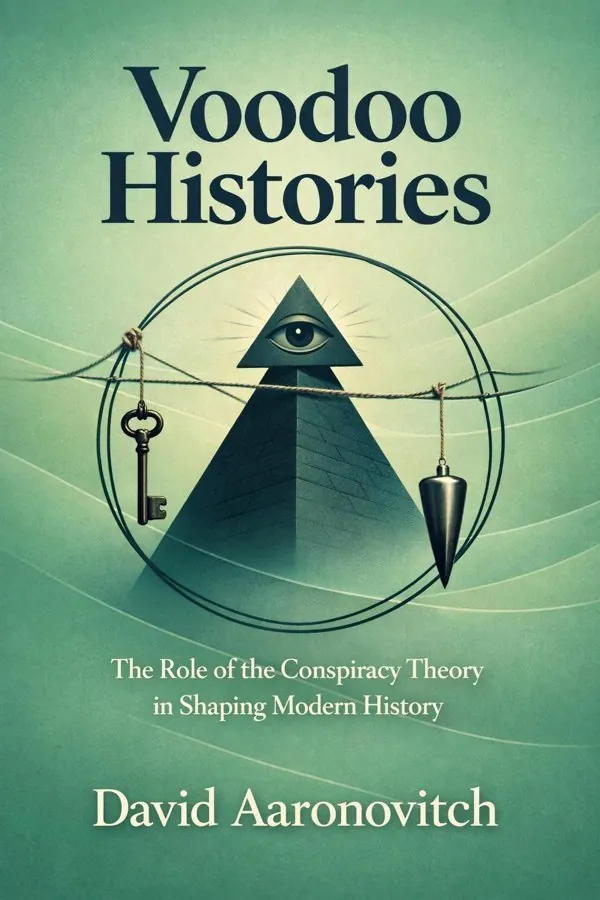
Voodoo Histories: The Role of the Conspiracy Theory in Shaping Modern History: Summary & Key Insights
 10 min7 chaptersAudio available
What Is Voodoo Histories: The Role of the Conspiracy Theory in Shaping Modern History About?
Voodoo Histories: The Role of the Conspiracy Theory in Shaping Modern History by David Aaronovitch is a sociology book spanning 7 pages. This book explores the origins, development, and cultural impact of conspiracy theories throughout modern history. David Aaronovitch examines how such narratives—from the Protocols of the Elders of Zion to modern political conspiracies—have influenced public perception and political discourse. Through historical analysis and journalistic investigation, he reveals how misinformation and paranoia have repeatedly shaped societies and events.
This FizzRead summary covers all 7 key chapters of Voodoo Histories: The Role of the Conspiracy Theory in Shaping Modern History in approximately 10 minutes, distilling the most important ideas, arguments, and takeaways from David Aaronovitch's work. Also available as an audio summary and Key Quotes Podcast.
Voodoo Histories: The Role of the Conspiracy Theory in Shaping Modern History
This book explores the origins, development, and cultural impact of conspiracy theories throughout modern history. David Aaronovitch examines how such narratives—from the Protocols of the Elders of Zion to modern political conspiracies—have influenced public perception and political discourse. Through historical analysis and journalistic investigation, he reveals how misinformation and paranoia have repeatedly shaped societies and events.
Who Should Read Voodoo Histories: The Role of the Conspiracy Theory in Shaping Modern History?
This book is perfect for anyone interested in sociology and looking to gain actionable insights in a short read. Whether you're a student, professional, or lifelong learner, the key ideas from Voodoo Histories: The Role of the Conspiracy Theory in Shaping Modern History by David Aaronovitch will help you think differently.
- ✓Readers who enjoy sociology and want practical takeaways
- ✓Professionals looking to apply new ideas to their work and life
- ✓Anyone who wants the core insights of Voodoo Histories: The Role of the Conspiracy Theory in Shaping Modern History in just 10 minutes
Want the full summary?
Get instant access to this book summary and 100K+ more with Fizz Moment.
Get Free SummaryAvailable on App Store • Free to download
Key Chapters
To trace the genealogy of modern conspiracy thinking, I begin in the wake of the French Revolution. Few events so utterly unsettled the established order. For contemporaries unprepared to accept that ordinary men and women could overthrow monarchy and church, explanation required an external force—an evil intelligence pulling the strings. Thus were born the first coherent conspiracy narratives of the modern age: the notion that secret societies, particularly the Freemasons and the Illuminati, had orchestrated Revolution itself.
In examining tracts like Augustin Barruel’s *Memoirs Illustrating the History of Jacobinism*, one sees the essential features that would recur for centuries. There is the belief in an elite network, the insistence on secrecy as proof, and the moral absolutism that divides the world into manipulators and victims. These early stories served a purpose: they restored moral order to an incomprehensible event. Yet they also implanted a pernicious habit of mind. They taught people to distrust appearances and to imagine coordination where there was chaos. The anti-Masonic campaigns of the early nineteenth century—spread across Europe and America—extended this mindset, using conspiracy to rationalize political anxiety.
From these origins, the seed of modern paranoia was sown: the conviction that the world is governed by the hidden schemes of the few rather than the decisions, follies, and passions of the many.
Few stories in this field are more significant than that of *The Protocols of the Elders of Zion*. Fabricated in tsarist Russia at the turn of the twentieth century, it claimed to reveal the minutes of a secret meeting of Jewish leaders plotting world domination. In truth, it was a plagiarized assembly of political satire and xenophobic fantasy. Yet its dissemination proved catastrophic.
I trace how, despite repeated debunking—from *The Times*’ exposé in 1921 to courtroom denunciations—it refused to die. Instead, it migrated, entering the bloodstream of European and later global antisemitism. What animated its endurance was not ignorance alone, but need: people wanted to believe it. Whether in the salons of Russian aristocrats fearing revolution, or in the propagandist machinery of Nazi Germany, the text served as a moral license for hatred.
By following the Protocols through the twentieth century—to Henry Ford’s America, to Middle Eastern pamphlets, and to the internet—I show how conspiracy theories adapt to every age’s anxieties. Facts, unfortunately, do not cure myth when myth fulfills an emotional function. For believers, the exposure of the forgery becomes itself another proof: only a powerful cabal could suppress such ‘truth.’ The lesson of the Protocols is stark. Falsehood, once weaponized, becomes almost indestructible. What was born as political fabrication ended as an instrument of genocide.
+ 5 more chapters — available in the FizzRead app
All Chapters in Voodoo Histories: The Role of the Conspiracy Theory in Shaping Modern History
About the Author
David Aaronovitch is a British journalist, broadcaster, and author known for his work with The Times and his commentary on politics and media. He has written extensively on conspiracy theories, political culture, and historical interpretation.
Get This Summary in Your Preferred Format
Read or listen to the Voodoo Histories: The Role of the Conspiracy Theory in Shaping Modern History summary by David Aaronovitch anytime, anywhere. FizzRead offers multiple formats so you can learn on your terms — all free.
Available formats: App · Audio · PDF · EPUB — All included free with FizzRead
Download Voodoo Histories: The Role of the Conspiracy Theory in Shaping Modern History PDF and EPUB Summary
Key Quotes from Voodoo Histories: The Role of the Conspiracy Theory in Shaping Modern History
“To trace the genealogy of modern conspiracy thinking, I begin in the wake of the French Revolution.”
“Few stories in this field are more significant than that of *The Protocols of the Elders of Zion*.”
Frequently Asked Questions about Voodoo Histories: The Role of the Conspiracy Theory in Shaping Modern History
Voodoo Histories: The Role of the Conspiracy Theory in Shaping Modern History by David Aaronovitch is a sociology book that explores key ideas across 7 chapters. This book explores the origins, development, and cultural impact of conspiracy theories throughout modern history. David Aaronovitch examines how such narratives—from the Protocols of the Elders of Zion to modern political conspiracies—have influenced public perception and political discourse. Through historical analysis and journalistic investigation, he reveals how misinformation and paranoia have repeatedly shaped societies and events.
You Might Also Like
Between the World and Me
Ta-Nehisi Coates
10 min
Half the Sky
Nicholas D. Kristof, Sheryl WuDunn
10 min
Men Explain Things To Me
Rebecca Solnit
10 min
Rational Ritual
Michael Suk-Young Chwe
10 min
The New Jim Crow
Michelle Alexander
10 min
Beyond Culture
Edward T. Hall
10 minBrowse by Category
Ready to read Voodoo Histories: The Role of the Conspiracy Theory in Shaping Modern History?
Get the full summary and 100K+ more books with Fizz Moment.