
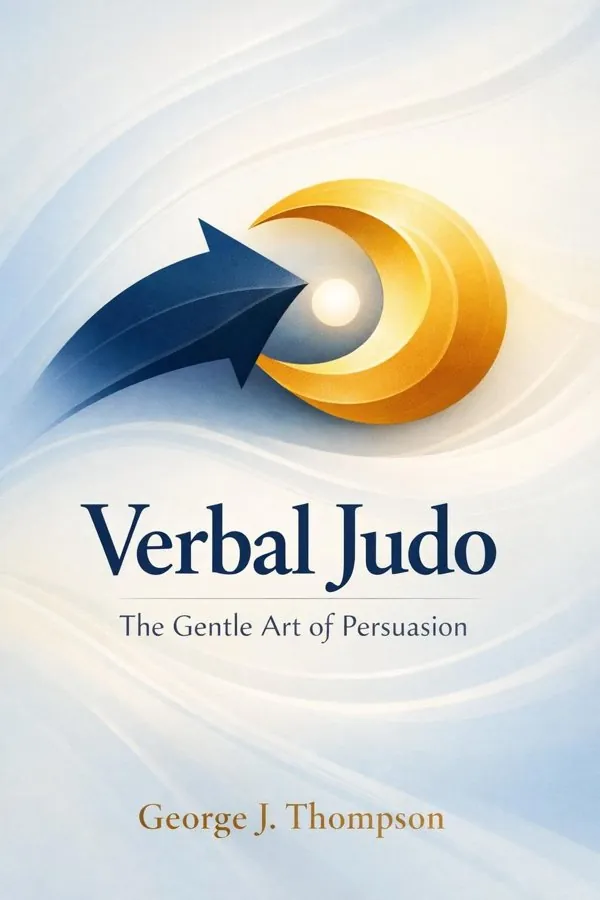
Verbal Judo: The Gentle Art of Persuasion: Summary & Key Insights
 10 min6 chaptersAudio available
What Is Verbal Judo: The Gentle Art of Persuasion About?
Verbal Judo: The Gentle Art of Persuasion by George J. Thompson is a communication book spanning 6 pages. Verbal Judo: The Gentle Art of Persuasion es un libro que enseña técnicas de comunicación basadas en la empatía y el autocontrol para manejar conflictos y situaciones difíciles. El autor, George J. Thompson, combina su experiencia en artes marciales y lingüística para ofrecer estrategias que permiten redirigir la agresión verbal y convertirla en diálogo constructivo. El texto se centra en cómo escuchar activamente, mantener la calma y usar el lenguaje para influir positivamente en los demás.
This FizzRead summary covers all 6 key chapters of Verbal Judo: The Gentle Art of Persuasion in approximately 10 minutes, distilling the most important ideas, arguments, and takeaways from George J. Thompson's work. Also available as an audio summary and Key Quotes Podcast.
Verbal Judo: The Gentle Art of Persuasion
Verbal Judo: The Gentle Art of Persuasion es un libro que enseña técnicas de comunicación basadas en la empatía y el autocontrol para manejar conflictos y situaciones difíciles. El autor, George J. Thompson, combina su experiencia en artes marciales y lingüística para ofrecer estrategias que permiten redirigir la agresión verbal y convertirla en diálogo constructivo. El texto se centra en cómo escuchar activamente, mantener la calma y usar el lenguaje para influir positivamente en los demás.
Who Should Read Verbal Judo: The Gentle Art of Persuasion?
This book is perfect for anyone interested in communication and looking to gain actionable insights in a short read. Whether you're a student, professional, or lifelong learner, the key ideas from Verbal Judo: The Gentle Art of Persuasion by George J. Thompson will help you think differently.
- ✓Readers who enjoy communication and want practical takeaways
- ✓Professionals looking to apply new ideas to their work and life
- ✓Anyone who wants the core insights of Verbal Judo: The Gentle Art of Persuasion in just 10 minutes
Want the full summary?
Get instant access to this book summary and 100K+ more with Fizz Moment.
Get Free SummaryAvailable on App Store • Free to download
Key Chapters
One of the earliest lessons I learned, both in the dojo and on the streets, was that losing your temper means losing control. Too often, we react to provocation without pausing to think. We let the other person dictate our behavior. In physical combat, such impulsiveness can cost you balance; in verbal encounters, it can cost you credibility. The heart of Verbal Judo is emotional control — the ability to remain centered even when chaos brews around you.
To respond rather than react means to bring professionalism into play. A professional never lets an interaction get personal. You cannot prevent people from insulting or challenging you, but you can control whether you allow those words to alter your composure. Responding requires a conscious decision: to act strategically, guided by principle, instead of being swept away by emotion. I’ve seen countless situations escalate unnecessarily simply because someone ‘took the bait.’ A verbal warrior uses empathy and forethought as shields against that temptation.
This is not weakness. It’s true strength. When you respond with calm precision, you shift the field of conflict. Your opponent operates emotionally; you operate tactically. The difference is profound. Professionals, especially in high-stress roles like law enforcement, must remember that their authority comes not from louder voices or firmer threats, but from self-possession. Your tone, posture, and word choice communicate volumes before you even utter a sentence. The one who maintains control sets the terms of communication.
As you practice this way of thinking, you begin to recognize that every encounter is an opportunity to build trust or to destroy it. Responding with professionalism — not judgment or defensiveness — preserves both your integrity and the dignity of others. That is the moral center of Verbal Judo.
Empathy is not a buzzword in Verbal Judo; it’s the foremost tactical skill. When I say empathy, I don’t mean sympathy or indulgence. I mean the deliberate effort to see the world through another’s eyes. If you don’t understand where someone is coming from, you cannot hope to redirect their energy.
In many conflicts, what people truly seek is validation. They want to know they’ve been heard. When they sense that you’re genuinely trying to understand their viewpoint, their resistance often diminishes. I recall countless moments as a police officer where a simple statement—‘I can see why you’re upset’—completely altered the tone of the interaction. The words themselves are not magical; it’s the sincerity behind them that unlocks their power.
Empathy allows you to gather information that pure argumentation never could. While the aggressive communicator tries to overpower opponents, the empathetic communicator absorbs, interprets, and guides. Listening actively means focusing on both words and emotions. It means noting body language, tone, and rhythm. Through empathy, you uncover what lies beneath the surface: fear, frustration, shame, loneliness.
Only after such understanding can persuasion take place. The paradox of Verbal Judo is that by conceding your need to ‘win,’ you actually gain the upper hand. Once the other person feels heard, they relax enough to consider your perspective. This doesn’t mean surrendering your position—it means building a bridge over which your message can travel intact.
To be empathetic is to be curious rather than judgmental. Every conversation becomes an opportunity to learn. This mindset not only defuses conflict but expands your own human awareness.
+ 4 more chapters — available in the FizzRead app
All Chapters in Verbal Judo: The Gentle Art of Persuasion
About the Author
George J. Thompson fue un profesor de inglés y oficial de policía estadounidense. Fundó el Instituto Verbal Judo, donde desarrolló un método de comunicación que combina principios de artes marciales y psicología aplicada. Su trabajo ha influido en la formación de profesionales en seguridad, educación y atención al cliente.
Get This Summary in Your Preferred Format
Read or listen to the Verbal Judo: The Gentle Art of Persuasion summary by George J. Thompson anytime, anywhere. FizzRead offers multiple formats so you can learn on your terms — all free.
Available formats: App · Audio · PDF · EPUB — All included free with FizzRead
Download Verbal Judo: The Gentle Art of Persuasion PDF and EPUB Summary
Key Quotes from Verbal Judo: The Gentle Art of Persuasion
“One of the earliest lessons I learned, both in the dojo and on the streets, was that losing your temper means losing control.”
“Empathy is not a buzzword in Verbal Judo; it’s the foremost tactical skill.”
Frequently Asked Questions about Verbal Judo: The Gentle Art of Persuasion
Verbal Judo: The Gentle Art of Persuasion by George J. Thompson is a communication book that explores key ideas across 6 chapters. Verbal Judo: The Gentle Art of Persuasion es un libro que enseña técnicas de comunicación basadas en la empatía y el autocontrol para manejar conflictos y situaciones difíciles. El autor, George J. Thompson, combina su experiencia en artes marciales y lingüística para ofrecer estrategias que permiten redirigir la agresión verbal y convertirla en diálogo constructivo. El texto se centra en cómo escuchar activamente, mantener la calma y usar el lenguaje para influir positivamente en los demás.
You Might Also Like

Magic Words: The Science and Secrets Behind Seven Words That Motivate, Engage, and Influence
Tim David
10 min
Talking Across The Divide: How to Communicate with People You Disagree with and Maybe Even Change the World
Justin Lee
10 min
The Exceptional Presenter: A Proven Formula to Open Up! and Own the Room
Timothy J. Koegel
10 min
4 Essential Keys to Effective Communication in Love, Life, Work--Anywhere!: Including the 12-Day Communication Challenge!
Bento C. Leal III
10 min
Active Listening Techniques: 30 Practical Tools to Hone Your Communication Skills
Nisha Gupta
10 min
Bargaining for Advantage: Negotiation Strategies for Reasonable People
G. Richard Shell
10 minBrowse by Category
Ready to read Verbal Judo: The Gentle Art of Persuasion?
Get the full summary and 100K+ more books with Fizz Moment.