
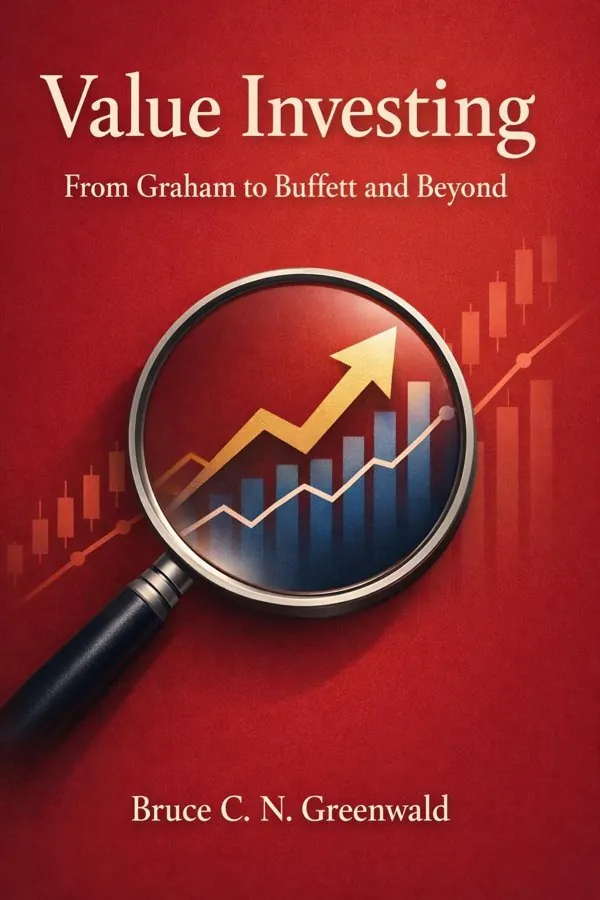
Value Investing: From Graham to Buffett and Beyond: Summary & Key Insights
 10 min5 chaptersAudio available
What Is Value Investing: From Graham to Buffett and Beyond About?
Value Investing: From Graham to Buffett and Beyond by Bruce C. N. Greenwald is a finance book spanning 5 pages. This book provides a comprehensive framework for understanding and applying the principles of value investing as developed by Benjamin Graham and refined by Warren Buffett. It explores valuation techniques, competitive advantage analysis, and the psychology of investing, offering readers a rigorous approach to identifying undervalued companies and achieving long-term returns.
This FizzRead summary covers all 5 key chapters of Value Investing: From Graham to Buffett and Beyond in approximately 10 minutes, distilling the most important ideas, arguments, and takeaways from Bruce C. N. Greenwald's work. Also available as an audio summary and Key Quotes Podcast.
Value Investing: From Graham to Buffett and Beyond
This book provides a comprehensive framework for understanding and applying the principles of value investing as developed by Benjamin Graham and refined by Warren Buffett. It explores valuation techniques, competitive advantage analysis, and the psychology of investing, offering readers a rigorous approach to identifying undervalued companies and achieving long-term returns.
Who Should Read Value Investing: From Graham to Buffett and Beyond?
This book is perfect for anyone interested in finance and looking to gain actionable insights in a short read. Whether you're a student, professional, or lifelong learner, the key ideas from Value Investing: From Graham to Buffett and Beyond by Bruce C. N. Greenwald will help you think differently.
- ✓Readers who enjoy finance and want practical takeaways
- ✓Professionals looking to apply new ideas to their work and life
- ✓Anyone who wants the core insights of Value Investing: From Graham to Buffett and Beyond in just 10 minutes
Want the full summary?
Get instant access to this book summary and 100K+ more with Fizz Moment.
Get Free SummaryAvailable on App Store • Free to download
Key Chapters
Benjamin Graham’s genius was in formalizing an idea that had floated unarticulated in the minds of prudent financiers for centuries: that investing is most intelligent when it is most businesslike. Graham taught us to think of a stock not as a piece of paper with a fluctuating price, but as a proportional ownership stake in a real enterprise. Once you adopt that mindset, everything changes. You cease to care about daily movements and instead ask a deeper question: what is this business truly worth?
The determination of intrinsic value is both an art and a science. Graham relied on a company's assets, tangible and measurable. He compared those assets to the market price and asked whether the investor was being offered a bargain that provided a cushion—a "margin of safety"—against inevitable errors in estimation and the vagaries of business cycles. If intrinsic value exceeded price by a meaningful margin, you bought; if not, you waited. The waiting was not a passive act but a disciplined commitment to rationality.
In practice, Graham’s methods emphasized liquidation value—what a company’s assets could be sold for in a worst-case scenario—and reproduction cost, the expense that would be required to rebuild a similar enterprise from scratch. Such asset-based measures anchor the investor to reality when markets veer into exuberance or despair. They provide a floor beneath the price—a baseline below which long-term losses become improbable.
Yet even as Graham’s framework proved timeless, its application evolved. Inflation, technological change, and the rise of intangible assets rendered many balance sheet values less reliable as sole indicators of worth. That is why Buffett's refinement—his emphasis on earnings power and economic franchises—represented a necessary evolution of the discipline. But the core remains unchanged: value investing begins with grounding oneself in business fundamentals and never paying more than what the facts justify.
Through this approach, the margin of safety becomes not merely a number but a mindset: a philosophy of patience, skepticism, and humility—the rarest and most profitable of investor virtues.
When we shift from Benjamin Graham’s focus on assets to the framework that I and my colleagues develop in this book, we move toward a richer measure of value: earnings power value, or EPV. The essential insight is that the worth of a business lies not in what it owns but in what it can earn sustainably. To estimate EPV, we normalize earnings—stripping out cyclical effects, accounting irregularities, and transitory bursts of luck—and then discount those stable earnings by a reasonable required rate of return. The result is a measure of value independent of uncertain future growth.
Why this approach matters is simple: most investors overpay for growth. They extrapolate recent trends far into the future, assuming that high growth rates will persist indefinitely. In reality, competition, technological change, and the law of large numbers inevitably erode extraordinary growth. By contrast, EPV focuses on what can be defended: current normalized profitability given the existing competitive landscape.
This concept ties directly to Buffett’s adaptation of Graham’s ideas. Buffett realized that some companies possess economic advantages—what he calls "moats"—that allow them to earn above-average returns for long periods. Such businesses generate more cash than competitors because they have cost advantages, superior brand loyalty, regulatory barriers, or network effects that prevent easy imitation.
In valuing such companies, we can distinguish between three layers of worth: the asset value, the earnings power value, and the franchise value. The first two reflect what exists today; the third captures the sustainable advantage that allows a company to earn beyond the normal competitive return. Recognizing this distinction is crucial. Paying a fair price for a superior franchise can be better than paying a cheap price for mediocrity.
The practical process involves restoring accounting data to economic reality. We adjust for depreciation, off-balance-sheet obligations, or inflated goodwill. We identify maintenance capital expenditures—the spending required merely to sustain current operations—and separate them from growth capex. Once we arrive at normalized free cash flow, we apply a capitalization rate consistent with stable, not speculative, expectations. The result is a grounded, defensible estimate of intrinsic value that can serve as the foundation for rational investment decisions.
Through mastery of EPV, the investor learns to see beyond the noise of market forecasts. Value ceases to be a moving target and becomes an enduring anchor of understanding.
+ 3 more chapters — available in the FizzRead app
All Chapters in Value Investing: From Graham to Buffett and Beyond
About the Author
Bruce C. N. Greenwald is a professor at Columbia Business School, known for his expertise in value investing and economics. He has taught generations of investors and authored several influential works on business strategy and valuation.
Get This Summary in Your Preferred Format
Read or listen to the Value Investing: From Graham to Buffett and Beyond summary by Bruce C. N. Greenwald anytime, anywhere. FizzRead offers multiple formats so you can learn on your terms — all free.
Available formats: App · Audio · PDF · EPUB — All included free with FizzRead
Download Value Investing: From Graham to Buffett and Beyond PDF and EPUB Summary
Key Quotes from Value Investing: From Graham to Buffett and Beyond
“Benjamin Graham’s genius was in formalizing an idea that had floated unarticulated in the minds of prudent financiers for centuries: that investing is most intelligent when it is most businesslike.”
“When we shift from Benjamin Graham’s focus on assets to the framework that I and my colleagues develop in this book, we move toward a richer measure of value: earnings power value, or EPV.”
Frequently Asked Questions about Value Investing: From Graham to Buffett and Beyond
Value Investing: From Graham to Buffett and Beyond by Bruce C. N. Greenwald is a finance book that explores key ideas across 5 chapters. This book provides a comprehensive framework for understanding and applying the principles of value investing as developed by Benjamin Graham and refined by Warren Buffett. It explores valuation techniques, competitive advantage analysis, and the psychology of investing, offering readers a rigorous approach to identifying undervalued companies and achieving long-term returns.
More by Bruce C. N. Greenwald

You Might Also Like



Browse by Category
Ready to read Value Investing: From Graham to Buffett and Beyond?
Get the full summary and 100K+ more books with Fizz Moment.