
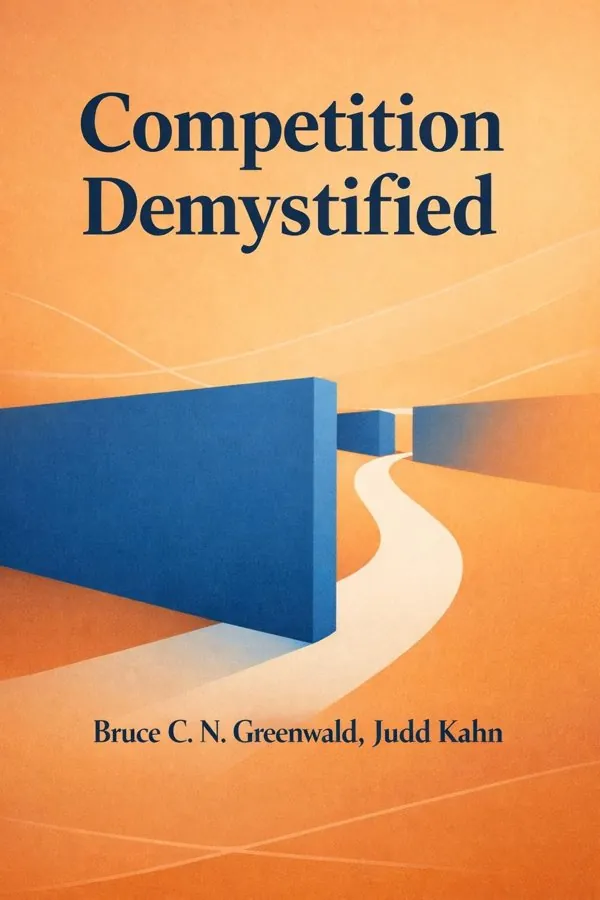
Competition Demystified: A Radically Simplified Approach to Business Strategy: Summary & Key Insights
by Bruce C. N. Greenwald, Judd Kahn
 10 min12 chaptersAudio available
What Is Competition Demystified: A Radically Simplified Approach to Business Strategy About?
Competition Demystified: A Radically Simplified Approach to Business Strategy by Bruce C. N. Greenwald, Judd Kahn is a strategy book spanning 12 pages. Competition Demystified presents a simplified framework for understanding business strategy and competitive advantage. Bruce Greenwald and Judd Kahn challenge Michael Porter's complex models by focusing on barriers to entry as the central determinant of competition. The book provides practical tools for analyzing industries and developing strategies based on real-world competitive dynamics.
This FizzRead summary covers all 12 key chapters of Competition Demystified: A Radically Simplified Approach to Business Strategy in approximately 10 minutes, distilling the most important ideas, arguments, and takeaways from Bruce C. N. Greenwald, Judd Kahn's work. Also available as an audio summary and Key Quotes Podcast.
Competition Demystified: A Radically Simplified Approach to Business Strategy
Competition Demystified presents a simplified framework for understanding business strategy and competitive advantage. Bruce Greenwald and Judd Kahn challenge Michael Porter's complex models by focusing on barriers to entry as the central determinant of competition. The book provides practical tools for analyzing industries and developing strategies based on real-world competitive dynamics.
Who Should Read Competition Demystified: A Radically Simplified Approach to Business Strategy?
This book is perfect for anyone interested in strategy and looking to gain actionable insights in a short read. Whether you're a student, professional, or lifelong learner, the key ideas from Competition Demystified: A Radically Simplified Approach to Business Strategy by Bruce C. N. Greenwald, Judd Kahn will help you think differently.
- ✓Readers who enjoy strategy and want practical takeaways
- ✓Professionals looking to apply new ideas to their work and life
- ✓Anyone who wants the core insights of Competition Demystified: A Radically Simplified Approach to Business Strategy in just 10 minutes
Want the full summary?
Get instant access to this book summary and 100K+ more with Fizz Moment.
Get Free SummaryAvailable on App Store • Free to download
Key Chapters
The business world loves the language of rivalry—the race, the battle, the fight. Yet beneath this drama lies a simpler structure that economics captures elegantly: firms compete through entry and exit. When profits in a market are high, new competitors are drawn in until returns normalize. When conditions sour, firms withdraw. This ebb and flow creates balance. But when something stops competitors from entering, that balance breaks, and an incumbent can earn sustained returns above the cost of capital.
That something is what I call a barrier to entry. Competition, stripped to its essence, is about how easy or hard it is for rivals to enter your market. Everything else—brand, cost advantage, regulation—matters only insofar as it influences that ease or difficulty.
In true competition, no firm maintains an advantage for long. Price wars erode margins, customers shift loyalties, and capital seeks the highest return. Understanding this discipline of the market explains why many seemingly strong businesses fade. They were never protected. Recognizing this dynamic allows a strategist not to mistake temporary performance for enduring position. The art of strategy begins with seeing whether your success can attract imitators—and what will stop them when they arrive.
Barriers to entry come in various forms, but they share one effect: they make imitation costly or slow. The most familiar barrier is scale. When large investments reduce per-unit costs, and when markets are local or finite, incumbents can enjoy lower costs than new entrants. Think of Wal-Mart’s early regional dominance: its density of stores reduced logistics costs, making it almost impossible for a rival to compete locally without replicating its entire infrastructure.
Another powerful barrier is customer captivity, a term I prefer to loyalty. Captivity arises when customers find it costly to switch. This can come from habits, brand attachment, or embedded relationships. Coca-Cola’s consumers, for instance, are not merely choosing a taste—they’re choosing identity. Switching costs can also be contractual or technical, as with Intel’s relationships with computer manufacturers who optimize designs around its chips.
Proprietary technology forms yet another barrier, particularly when protected by intellectual property or tacit know-how. Intel’s production processes or pharmaceutical companies’ patents exemplify this. Finally, government regulation can create barriers—sometimes explicitly, through licensing or quota systems, and sometimes implicitly, through compliance costs that discourage small entrants.
Each barrier interacts with the others, but the key is persistence. Temporary cost or marketing advantages cannot protect profits for long. Only when the barrier prevents or slows new competition does it become a true engine of sustainable advantage.
+ 10 more chapters — available in the FizzRead app
All Chapters in Competition Demystified: A Radically Simplified Approach to Business Strategy
About the Authors
Bruce C. N. Greenwald is a professor at Columbia Business School, known for his expertise in economics and business strategy. Judd Kahn is a business consultant and co-author specializing in corporate analysis and management theory.
Get This Summary in Your Preferred Format
Read or listen to the Competition Demystified: A Radically Simplified Approach to Business Strategy summary by Bruce C. N. Greenwald, Judd Kahn anytime, anywhere. FizzRead offers multiple formats so you can learn on your terms — all free.
Available formats: App · Audio · PDF · EPUB — All included free with FizzRead
Download Competition Demystified: A Radically Simplified Approach to Business Strategy PDF and EPUB Summary
Key Quotes from Competition Demystified: A Radically Simplified Approach to Business Strategy
“The business world loves the language of rivalry—the race, the battle, the fight.”
“Barriers to entry come in various forms, but they share one effect: they make imitation costly or slow.”
Frequently Asked Questions about Competition Demystified: A Radically Simplified Approach to Business Strategy
Competition Demystified: A Radically Simplified Approach to Business Strategy by Bruce C. N. Greenwald, Judd Kahn is a strategy book that explores key ideas across 12 chapters. Competition Demystified presents a simplified framework for understanding business strategy and competitive advantage. Bruce Greenwald and Judd Kahn challenge Michael Porter's complex models by focusing on barriers to entry as the central determinant of competition. The book provides practical tools for analyzing industries and developing strategies based on real-world competitive dynamics.
You Might Also Like

Mastery
Robert Greene
10 min
Cut Costs Not Corners: A Practical Guide to Staying Competitive and Improving Profits
Colin Barrow
10 min
Good Strategy/Bad Strategy: The Difference and Why It Matters
Richard P. Rumelt
10 min
On Grand Strategy
John Lewis Gaddis
10 min
The Six Disciplines of Digital Transformation
George Westerman
10 min
7 Powers: The Foundations of Business Strategy
Hamilton Helmer
10 minFeatured In
Browse by Category
Ready to read Competition Demystified: A Radically Simplified Approach to Business Strategy?
Get the full summary and 100K+ more books with Fizz Moment.