
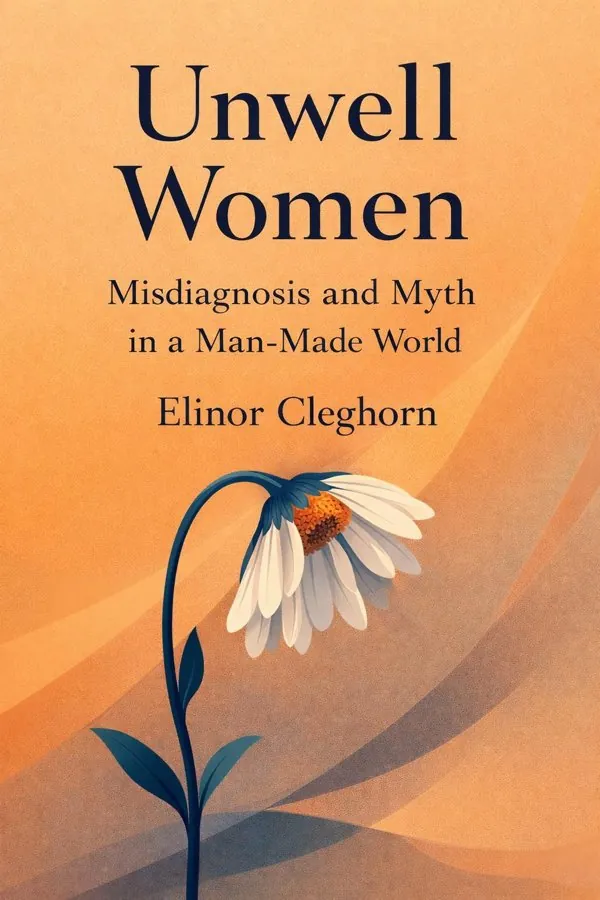
Unwell Women: Misdiagnosis and Myth in a Man-Made World: Summary & Key Insights
 10 min10 chaptersAudio available
What Is Unwell Women: Misdiagnosis and Myth in a Man-Made World About?
Unwell Women: Misdiagnosis and Myth in a Man-Made World by Elinor Cleghorn is a health_med book spanning 10 pages. Unwell Women: Misdiagnosis and Myth in a Man-Made World is a groundbreaking history of women’s health that explores how medicine has understood and treated women’s bodies from ancient times to the present. Elinor Cleghorn examines the myths, biases, and misdiagnoses that have shaped women’s experiences of illness, revealing how medical science has long been influenced by male-centered perspectives on the body and disease.
This FizzRead summary covers all 10 key chapters of Unwell Women: Misdiagnosis and Myth in a Man-Made World in approximately 10 minutes, distilling the most important ideas, arguments, and takeaways from Elinor Cleghorn's work. Also available as an audio summary and Key Quotes Podcast.
Unwell Women: Misdiagnosis and Myth in a Man-Made World
Unwell Women: Misdiagnosis and Myth in a Man-Made World is a groundbreaking history of women’s health that explores how medicine has understood and treated women’s bodies from ancient times to the present. Elinor Cleghorn examines the myths, biases, and misdiagnoses that have shaped women’s experiences of illness, revealing how medical science has long been influenced by male-centered perspectives on the body and disease.
Who Should Read Unwell Women: Misdiagnosis and Myth in a Man-Made World?
This book is perfect for anyone interested in health_med and looking to gain actionable insights in a short read. Whether you're a student, professional, or lifelong learner, the key ideas from Unwell Women: Misdiagnosis and Myth in a Man-Made World by Elinor Cleghorn will help you think differently.
- ✓Readers who enjoy health_med and want practical takeaways
- ✓Professionals looking to apply new ideas to their work and life
- ✓Anyone who wants the core insights of Unwell Women: Misdiagnosis and Myth in a Man-Made World in just 10 minutes
Want the full summary?
Get instant access to this book summary and 100K+ more with Fizz Moment.
Get Free SummaryAvailable on App Store • Free to download
Key Chapters
Medicine’s origins already carried the seeds of misconception. In the world of Hippocrates and Galen, the female body was defined by lack, by deviation from the male norm. Ancient Greek physicians described women as moist, unstable, and ruled by their womb—an organ believed to wander inside the body, triggering madness and disease. This idea, known as hysteria, would haunt women for centuries. Such thinkers saw anatomy not as a system of equality but of hierarchy: man as the standard, woman as his watery opposite.
When I revisited these early texts, what struck me was how deeply metaphor shaped medical reasoning. The womb wasn’t just an organ; it was a symbol of disorder. Physicians wrote of migrations, suffocation, and hysteria as if the body itself were possessed. Women’s feelings, moods, and reproductive rhythms were fused into one pathology. The notion that biology dictated temperament allowed medicine to see every inconvenience in a woman’s life—pain, menstruation, menopause—as evidence of moral or emotional instability.
This wasn’t simply superstition—it was culture cementing power. By defining women through their reproductive capacity, early medicine reduced them to functions, controlled through men’s interpretation. And though those models have faded, the residue remains whenever a woman’s pain is dismissed as emotional, when her suffering is translated back into metaphor instead of medicine.
Following the collapse of classical empires, the care of the body merged with theology. Women’s illnesses became moral symbols—signs of temptation, punishment, or divine design. In the medieval imagination, purity was the path to health, sin the route to disease. A fever could be read as divine correction; childbirth pain was a biblical inheritance. These frames made medicine an extension of morality, shaping centuries of judgment about women’s suffering.
In Renaissance anatomy, the rediscovery of classical ideas married art with observation. Male anatomists like Vesalius mapped the body with precision, yet those maps still told one story: the woman as derivative man. Female reproductive organs were imagined as inward versions of the male’s, folded and hidden. Even scientific illustration affirmed hierarchy—the woman’s body dissected yet imbued with shame. When I looked at those drawings, I saw a paradox: enlightenment blended with exclusion. The more the body was studied, the more symbolic control deepened.
That era’s fascination with hysteria continued under a new guise. Physicians viewed the womb as a source of disorder still, but now cloaked in Christian guilt. Illness and sexuality were tied together, and women’s bodily knowledge—midwives, healers, wise women—was persecuted as witchcraft. Thus medicine distanced itself from lived female expertise, embedding moral suspicion into clinical observation. The medical woman vanished from legitimacy; her voice was branded sorcery.
+ 8 more chapters — available in the FizzRead app
All Chapters in Unwell Women: Misdiagnosis and Myth in a Man-Made World
About the Author
Elinor Cleghorn is a British historian specializing in culture and medicine. Her interest in women’s health history arose from her own experience with an autoimmune disease. She has worked in academic research and cultural outreach, and Unwell Women is her first book.
Get This Summary in Your Preferred Format
Read or listen to the Unwell Women: Misdiagnosis and Myth in a Man-Made World summary by Elinor Cleghorn anytime, anywhere. FizzRead offers multiple formats so you can learn on your terms — all free.
Available formats: App · Audio · PDF · EPUB — All included free with FizzRead
Download Unwell Women: Misdiagnosis and Myth in a Man-Made World PDF and EPUB Summary
Key Quotes from Unwell Women: Misdiagnosis and Myth in a Man-Made World
“Medicine’s origins already carried the seeds of misconception.”
“Following the collapse of classical empires, the care of the body merged with theology.”
Frequently Asked Questions about Unwell Women: Misdiagnosis and Myth in a Man-Made World
Unwell Women: Misdiagnosis and Myth in a Man-Made World by Elinor Cleghorn is a health_med book that explores key ideas across 10 chapters. Unwell Women: Misdiagnosis and Myth in a Man-Made World is a groundbreaking history of women’s health that explores how medicine has understood and treated women’s bodies from ancient times to the present. Elinor Cleghorn examines the myths, biases, and misdiagnoses that have shaped women’s experiences of illness, revealing how medical science has long been influenced by male-centered perspectives on the body and disease.
You Might Also Like
On Immunity
Eula Biss
10 min
The Three-Body Problem
Liu Cixin
10 min
Community Health Volunteer Toolkit: Training and Practical Activities
World Health Organization
10 min
Healing Back Pain: The Mind-Body Connection
John E. Sarno
10 min
Health Literacy for All: Practical Guides to Communicate Health Information (Compilations)
World Health Organization
10 min
The Complete Guide to Sports Supplements: An Evidence-Based Review
Anita Bean
10 minBrowse by Category
Ready to read Unwell Women: Misdiagnosis and Myth in a Man-Made World?
Get the full summary and 100K+ more books with Fizz Moment.