
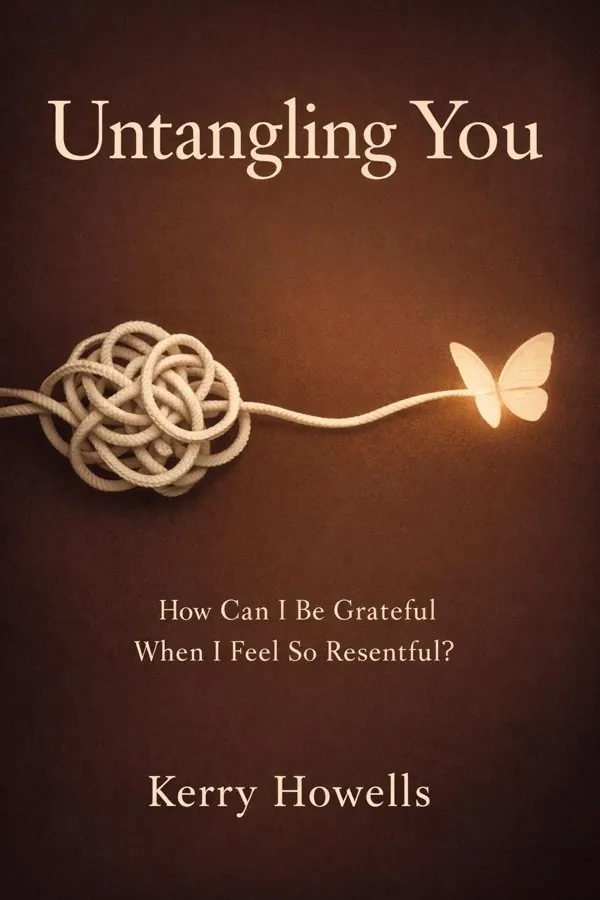
Untangling You: How Can I Be Grateful When I Feel So Resentful?: Summary & Key Insights
 10 min10 chaptersAudio available
What Is Untangling You: How Can I Be Grateful When I Feel So Resentful? About?
Untangling You: How Can I Be Grateful When I Feel So Resentful? by Kerry Howells is a positive_psych book spanning 10 pages. Untangling You explores the complex relationship between gratitude and resentment, offering practical guidance on how to cultivate gratitude even in challenging relationships and circumstances. Drawing on decades of research and teaching experience, Kerry Howells provides reflective exercises and real-life examples to help readers move from resentment toward a more balanced and grateful mindset.
This FizzRead summary covers all 10 key chapters of Untangling You: How Can I Be Grateful When I Feel So Resentful? in approximately 10 minutes, distilling the most important ideas, arguments, and takeaways from Kerry Howells's work. Also available as an audio summary and Key Quotes Podcast.
Untangling You: How Can I Be Grateful When I Feel So Resentful?
Untangling You explores the complex relationship between gratitude and resentment, offering practical guidance on how to cultivate gratitude even in challenging relationships and circumstances. Drawing on decades of research and teaching experience, Kerry Howells provides reflective exercises and real-life examples to help readers move from resentment toward a more balanced and grateful mindset.
Who Should Read Untangling You: How Can I Be Grateful When I Feel So Resentful??
This book is perfect for anyone interested in positive_psych and looking to gain actionable insights in a short read. Whether you're a student, professional, or lifelong learner, the key ideas from Untangling You: How Can I Be Grateful When I Feel So Resentful? by Kerry Howells will help you think differently.
- ✓Readers who enjoy positive_psych and want practical takeaways
- ✓Professionals looking to apply new ideas to their work and life
- ✓Anyone who wants the core insights of Untangling You: How Can I Be Grateful When I Feel So Resentful? in just 10 minutes
Want the full summary?
Get instant access to this book summary and 100K+ more with Fizz Moment.
Get Free SummaryAvailable on App Store • Free to download
Key Chapters
Resentment is a complex emotion. It can simmer quietly in the background of our relationships, or it can flare up when we feel disrespected, overlooked, or betrayed. At its core, resentment often arises when we perceive a gap between what we believe we deserve and what we actually receive. In my years of working with educators and leaders, I’ve seen how resentment feeds on unmet expectations and unspoken pain. It corrodes trust, consumes attention, and narrows the lens through which we see others. When resentment becomes a habit, our inner landscape changes—we begin to justify our bitterness as protection. But ultimately, that protection isolates us.
Resentment also distorts reciprocity. Where genuine gratitude sees another’s contribution as a gift, resentment interprets it as insufficient or conditional. This emotion roots itself in comparison, pride, and perceived injustice. The tragedy of resentment is that it locks us in a loop. We replay old events, reinforcing our position rather than seeking understanding. It keeps us tethered to the past, depriving us of the capacity to experience present moments fully.
The first step in untangling resentment is acknowledgment. We must recognize what it does to our wellbeing and relationships. Only then can we begin to understand that resentment often hides deeper unmet needs: the need for recognition, fairness, or agency. When we approach resentment with curiosity rather than judgment, we find the key to transformation. We realize that it’s not our enemy—it’s a signal pointing us toward something unresolved within.
Gratitude, in contrast, is not a mere feeling of thankfulness that arises spontaneously when life goes well. It is an intentional practice, a perspective cultivated through awareness. Many confine gratitude to simple gestures—saying thank you, keeping a journal, or focusing on the positive. While these are valuable, they skim only the surface. True gratitude asks us to acknowledge both the gifts and the challenges of our experiences. It does not deny pain or demand perfection; it invites integration.
Over the decades, I have seen gratitude act as a transformative catalyst. When we choose to see what remains valuable—even in difficulty—we shift our internal narrative. Gratitude broadens our emotional horizon, allowing empathy and humility to grow. Importantly, gratitude is relational. It reminds us that we are not self-sufficient; that our lives are interwoven with the contributions of others. In an educational setting, gratitude enhances learning because it directs attention away from competition and toward mutual respect.
Therefore, practicing gratitude means stepping into vulnerability. It requires admitting dependence, acknowledging others’ impact, and accepting imperfection—both theirs and our own. In doing so, we recover a sense of connection that resentment has obscured.
+ 8 more chapters — available in the FizzRead app
All Chapters in Untangling You: How Can I Be Grateful When I Feel So Resentful?
About the Author
Kerry Howells is an Australian educator, researcher, and author specializing in gratitude and its role in education and leadership. She has taught at the University of Tasmania and has written extensively on how gratitude can transform personal and professional relationships.
Get This Summary in Your Preferred Format
Read or listen to the Untangling You: How Can I Be Grateful When I Feel So Resentful? summary by Kerry Howells anytime, anywhere. FizzRead offers multiple formats so you can learn on your terms — all free.
Available formats: App · Audio · PDF · EPUB — All included free with FizzRead
Download Untangling You: How Can I Be Grateful When I Feel So Resentful? PDF and EPUB Summary
Key Quotes from Untangling You: How Can I Be Grateful When I Feel So Resentful?
“It can simmer quietly in the background of our relationships, or it can flare up when we feel disrespected, overlooked, or betrayed.”
“Gratitude, in contrast, is not a mere feeling of thankfulness that arises spontaneously when life goes well.”
Frequently Asked Questions about Untangling You: How Can I Be Grateful When I Feel So Resentful?
Untangling You: How Can I Be Grateful When I Feel So Resentful? by Kerry Howells is a positive_psych book that explores key ideas across 10 chapters. Untangling You explores the complex relationship between gratitude and resentment, offering practical guidance on how to cultivate gratitude even in challenging relationships and circumstances. Drawing on decades of research and teaching experience, Kerry Howells provides reflective exercises and real-life examples to help readers move from resentment toward a more balanced and grateful mindset.
You Might Also Like
Don't Sweat the Small Stuff... and It's All Small Stuff
Richard Carlson
10 min
Option B
Sheryl Sandberg & Adam Grant
10 min
Hallelujah Anyway: Rediscovering Mercy
Anne Lamott
10 min
I Can Do It: How to Use Affirmations to Change Your Life
Louise Hay
10 min
The Coffee Bean: A Simple Lesson to Create Positive Change
Jon Gordon, Damon West
10 min
The Happiness Hypothesis: Finding Modern Truth in Ancient Wisdom
Jonathan Haidt
10 minBrowse by Category
Ready to read Untangling You: How Can I Be Grateful When I Feel So Resentful??
Get the full summary and 100K+ more books with Fizz Moment.