
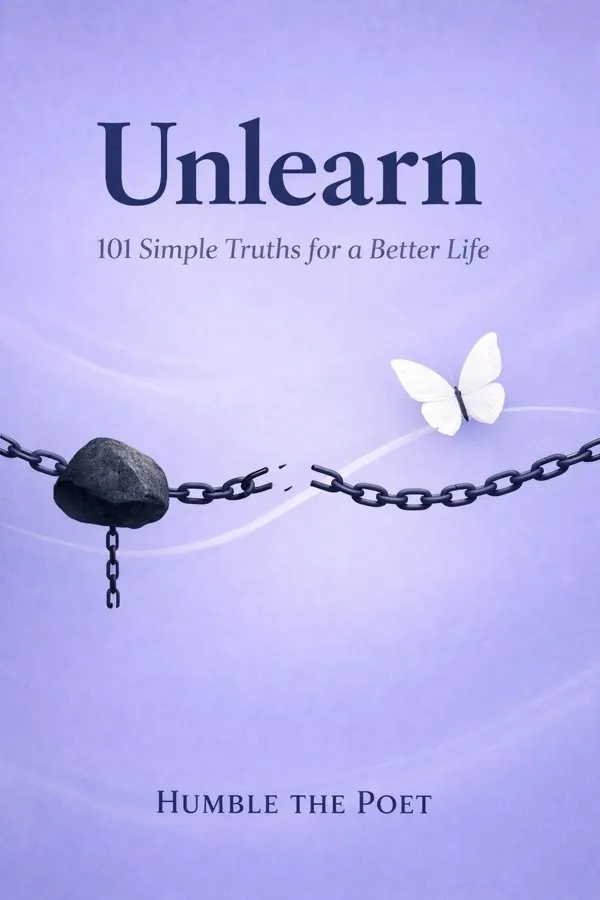
Unlearn: 101 Simple Truths for a Better Life: Summary & Key Insights
 10 min9 chaptersAudio available
Key Takeaways from Unlearn: 101 Simple Truths for a Better Life
One of the quickest ways to lose yourself is to spend your life performing for an audience that is never fully satisfied.
Comfort feels safe, but it rarely transforms us.
Success is dangerous when you never stop to decide what it means.
You cannot build a peaceful life on a foundation of self-rejection.
Two people can live through similar events and come away with completely different realities.
What Is Unlearn: 101 Simple Truths for a Better Life About?
Unlearn: 101 Simple Truths for a Better Life by Humble the Poet is a mindset book spanning 9 pages. Unlearn: 101 Simple Truths for a Better Life is not a traditional self-help book built on rigid formulas or polished promises. Instead, Humble the Poet offers a direct, honest invitation to question the beliefs, habits, and social scripts that quietly shape our lives. Drawing from his experience as a former schoolteacher, artist, spoken word performer, and public thinker, he argues that many of the ideas we cling to about success, love, happiness, and identity are inherited rather than chosen. The real work of growth, he suggests, is not just learning more, but letting go of what no longer serves us. What makes this book matter is its refreshing refusal to romanticize comfort or pretend that personal change is neat and easy. Humble the Poet writes with vulnerability, humor, and hard-earned clarity, encouraging readers to embrace discomfort, set boundaries, accept themselves, and redefine success on their own terms. His authority comes less from academic distance and more from lived experience: he has wrestled with insecurity, expectation, and reinvention himself. The result is a practical, motivating guide for anyone who feels trapped by old patterns and ready to build a more honest life.
This FizzRead summary covers all 9 key chapters of Unlearn: 101 Simple Truths for a Better Life in approximately 10 minutes, distilling the most important ideas, arguments, and takeaways from Humble the Poet's work. Also available as an audio summary and Key Quotes Podcast.
Unlearn: 101 Simple Truths for a Better Life
Unlearn: 101 Simple Truths for a Better Life is not a traditional self-help book built on rigid formulas or polished promises. Instead, Humble the Poet offers a direct, honest invitation to question the beliefs, habits, and social scripts that quietly shape our lives. Drawing from his experience as a former schoolteacher, artist, spoken word performer, and public thinker, he argues that many of the ideas we cling to about success, love, happiness, and identity are inherited rather than chosen. The real work of growth, he suggests, is not just learning more, but letting go of what no longer serves us.
What makes this book matter is its refreshing refusal to romanticize comfort or pretend that personal change is neat and easy. Humble the Poet writes with vulnerability, humor, and hard-earned clarity, encouraging readers to embrace discomfort, set boundaries, accept themselves, and redefine success on their own terms. His authority comes less from academic distance and more from lived experience: he has wrestled with insecurity, expectation, and reinvention himself. The result is a practical, motivating guide for anyone who feels trapped by old patterns and ready to build a more honest life.
Who Should Read Unlearn: 101 Simple Truths for a Better Life?
This book is perfect for anyone interested in mindset and looking to gain actionable insights in a short read. Whether you're a student, professional, or lifelong learner, the key ideas from Unlearn: 101 Simple Truths for a Better Life by Humble the Poet will help you think differently.
- ✓Readers who enjoy mindset and want practical takeaways
- ✓Professionals looking to apply new ideas to their work and life
- ✓Anyone who wants the core insights of Unlearn: 101 Simple Truths for a Better Life in just 10 minutes
Want the full summary?
Get instant access to this book summary and 100K+ more with Fizz Moment.
Get Free SummaryAvailable on App Store • Free to download
Key Chapters
One of the quickest ways to lose yourself is to spend your life performing for an audience that is never fully satisfied. Humble the Poet argues that many people mistake approval for purpose. We follow career paths, relationships, lifestyles, and timelines not because they reflect our deepest values, but because they are rewarded by family, culture, or society. On the surface, this can look like success. Underneath, it often feels like exhaustion, resentment, and quiet disconnection.
A central insight in Unlearn is that expectations are often borrowed, not chosen. We inherit ideas about what a “good” life should look like: a stable job, a respectable title, the right partner, the right milestones by the right age. But inherited expectations can suffocate individuality. Humble the Poet draws on his own life, including his shift away from a conventional teaching career, to show how difficult yet necessary it is to question these scripts.
In practical terms, this means learning to notice where your decisions are driven by fear of disappointing others. Are you pursuing a goal because it matters to you, or because it helps you look acceptable? Are you staying in situations that drain you because they make sense on paper? Small acts of honesty matter here: journaling about your real desires, saying no without overexplaining, or pausing before major decisions to ask whose dream you are serving.
The takeaway is simple but powerful: define success by alignment, not applause. This week, identify one expectation you’ve been carrying that does not truly belong to you, and take one concrete step toward releasing it.
Comfort feels safe, but it rarely transforms us. One of the book’s strongest truths is that real growth almost always begins in friction: uncertainty, awkwardness, rejection, vulnerability, or failure. Humble the Poet challenges the modern obsession with convenience and ease, arguing that when we arrange our lives to avoid discomfort at all costs, we also avoid the conditions that build courage, resilience, and depth.
Discomfort is not a sign that something is wrong. Often, it is evidence that something important is happening. Learning a new skill is uncomfortable because incompetence comes before mastery. Honest conversations are uncomfortable because truth threatens the fragile peace built on avoidance. Leaving an identity that no longer fits is uncomfortable because even misery can feel safer than change.
This idea has practical consequences in everyday life. If you want deeper relationships, you must risk being seen. If you want a more meaningful career, you may have to endure uncertainty, criticism, or temporary instability. If you want stronger mental habits, you must sit with feelings instead of numbing them. None of this is glamorous, but it is transformative.
Humble the Poet does not suggest that all pain is noble or that suffering should be chased. Rather, he asks readers to stop treating discomfort as automatic danger. There is a difference between harm and healthy challenge. Going to therapy, starting over, asking for help, speaking up, or trying and failing in public may all feel uncomfortable, but they can move your life forward.
Actionable takeaway: the next time something meaningful feels uncomfortable, resist the impulse to retreat immediately. Ask yourself, “Is this harming me, or is this stretching me?” Then choose one discomfort this week that supports the person you want to become.
Success is dangerous when you never stop to decide what it means. In Unlearn, Humble the Poet challenges the popular idea that success is a universal formula built from money, status, recognition, productivity, and external validation. He suggests that if you adopt society’s definition without questioning it, you may spend years climbing a ladder only to discover it was leaning against the wrong wall.
Many people chase visible achievements because they are easy to measure. Titles, income, followers, possessions, and praise provide instant signals that we are doing well. But these markers often hide a deeper emptiness. A life can look impressive from the outside and still feel disconnected from joy, meaning, health, and integrity. The author encourages readers to ask harder questions: Does this success leave me more free or more trapped? Does it deepen my relationships or make me more isolated? Does it reflect my values, or just my conditioning?
Redefining success may mean prioritizing peace over prestige, time over income, creativity over predictability, or authenticity over image. For one person, success might be building a business. For another, it might be healing from burnout, becoming emotionally available, or creating a slower and more intentional life. The key is ownership. A self-defined life is harder to compare, but easier to respect.
You can apply this by creating your own metrics. Instead of asking only, “What did I achieve?” ask, “How did I feel? Did I act in line with my values? Did I make space for what matters most?” Those questions shift success from performance to alignment.
Actionable takeaway: write your own definition of success in one sentence, without using the words money, status, or approval. Revisit your current goals and remove one that no longer fits that definition.
You cannot build a peaceful life on a foundation of self-rejection. Humble the Poet emphasizes that many of our struggles do not come only from external hardship, but from the exhausting effort to edit ourselves into someone more acceptable. We hide parts of our personality, deny our emotions, compare our bodies, minimize our stories, and chase impossible standards in the hope that eventually we will feel worthy. But worthiness does not arrive at the end of self-erasure.
Self-acceptance in this book is not passive resignation or an excuse to avoid growth. It is the honest recognition of who you are, where you are, and what you carry. It means seeing your wounds without making them your identity, and acknowledging your imperfections without turning them into evidence of failure. Acceptance is what allows change to become compassionate rather than punishing.
Authenticity grows from this acceptance. When you are no longer spending all your energy trying to appear perfect, you can show up more fully in your work, relationships, and choices. This might look like admitting when you are struggling, wearing what feels like you instead of what is approved, speaking in your own voice, or refusing to shrink to make others comfortable. Authenticity is often less dramatic than people imagine. It is made of small honest decisions repeated over time.
Practically, self-acceptance can begin with the language you use toward yourself. Notice whether your inner voice is cruel, dismissive, or impossible to satisfy. Replace constant self-correction with curiosity. Instead of “What is wrong with me?” try “What am I needing right now?”
Actionable takeaway: identify one part of yourself you have been treating like a problem to hide. This week, practice meeting it with honesty rather than shame, and let one trusted person see you more clearly.
Two people can live through similar events and come away with completely different realities. That is the power of perspective. In Unlearn, Humble the Poet reminds readers that while we cannot control everything that happens to us, we do have influence over the meaning we assign to our experiences. This does not mean ignoring pain or pretending everything happens for a reason. It means recognizing that interpretation can either imprison us or help us move.
Perspective is especially important when dealing with setbacks. Rejection can be seen as proof of worthlessness or as redirection. Criticism can be heard as a personal attack or as information. Failure can become identity or education. The author encourages readers to stop assuming their first emotional reaction is the full truth. Often, the stories we tell ourselves are harsher than the facts.
A powerful application of this idea is in conflict and relationships. We often assume others are acting from malice when they may be acting from fear, insecurity, ignorance, or pain. Shifting perspective does not require excusing bad behavior, but it can reduce unnecessary suffering and help us respond more wisely. The same is true internally. Instead of seeing your anxiety as weakness, you might understand it as a nervous system trying to protect you.
This mindset can be trained through reflection. Ask: What else could this mean? What am I not seeing? If I were speaking to someone I love, how would I frame this moment? Such questions interrupt automatic negativity and make room for possibility.
Actionable takeaway: choose one recent situation that upset you and write down three alternative interpretations of it. You do not need to deny the difficulty. You only need to stop treating one painful narrative as the only available truth.
Many people confuse love with endless availability, but without boundaries, love quickly turns into resentment. Humble the Poet stresses that relationships are healthiest when they are shaped by clarity, honesty, and self-respect. Boundaries are not walls that shut people out. They are guidelines that protect what matters, define what is acceptable, and allow care to exist without self-betrayal.
A common misunderstanding is that setting boundaries is selfish or harsh. In reality, the absence of boundaries often leads to people-pleasing, emotional exhaustion, and hidden anger. When you constantly say yes out of guilt, avoid difficult conversations, or tolerate repeated disrespect to keep the peace, the relationship may remain intact on the surface while trust erodes underneath. Boundaries prevent that erosion by making expectations visible.
Boundaries can take many forms. They may mean limiting access to your time, refusing to engage in disrespectful communication, asking for space when overwhelmed, or ending cycles of rescuing people who refuse responsibility. They can also mean emotional honesty: telling someone when their behavior hurts you instead of pretending you are fine. The goal is not control. You cannot control other people. The goal is to communicate what you will and will not participate in.
The book also suggests that better boundaries improve self-worth. Every time you honor your limits, you teach yourself that your needs matter. This changes how you show up in all relationships, from family to friendships to work.
Actionable takeaway: identify one relationship where you feel drained or resentful. Ask yourself what boundary is missing. Then express one clear, respectful limit in simple language, without apologizing for having needs.
Control can feel like protection, but often it is just anxiety wearing a strategy. Humble the Poet explores how much suffering comes from our demand that life unfold according to plan. We want certainty in love, predictability in work, guarantees in health, and assurance that effort will always produce the outcomes we prefer. But life rarely honors those contracts. The tighter we cling, the more fragile we become.
Letting go of control does not mean becoming careless or passive. It means learning the difference between responsibility and obsession. You can prepare, act, communicate, and do your best, but you cannot command every result. You cannot control how others perceive you, whether opportunities arrive on your timeline, or whether change disrupts your plans. Trying to control the uncontrollable drains energy that could be spent on presence, adaptability, and wise action.
This insight is especially useful in relationships and ambition. You may be able to show love, but not force someone to heal. You may be able to create meaningful work, but not control who recognizes it. You may be able to make a careful plan, but not prevent uncertainty. Freedom grows when you stop measuring yourself by outcomes that were never fully yours to govern.
A practical way to apply this idea is to separate situations into two columns: what is within your influence, and what is not. Focus your effort on your values, preparation, and response. Release the fantasy that enough worry will create certainty.
Actionable takeaway: the next time you feel overwhelmed, name one thing you can do, one thing you can communicate, and one thing you must surrender. Then put your energy only into the first two.
Much of life is lost not because it is empty, but because our attention is elsewhere. Humble the Poet highlights gratitude and presence as antidotes to the restless habit of living in comparison, regret, or anticipation. We often tell ourselves that peace will begin later, after the next achievement, relationship, purchase, or transformation. But that habit keeps satisfaction permanently out of reach.
Presence means inhabiting the moment you are actually in. It means tasting your food instead of scrolling, listening instead of rehearsing your response, noticing your breath instead of racing toward the next obligation. Gratitude deepens that presence by retraining attention toward what is already valuable. This is not toxic positivity or denial of struggle. It is a disciplined refusal to let scarcity thinking erase what is real and good.
The book suggests that many people miss their lives because they are too busy evaluating them. We compare our daily experience to curated images, imagined futures, and idealized versions of what should be happening. Gratitude interrupts that loop. It reminds us that enoughness is often found in simple things: a healthy conversation, a walk, a quiet morning, laughter, rest, honest work, a body carrying us through the day.
Practicing presence can be very concrete. Put your phone away during meals. Take five conscious breaths before entering a meeting or your home. End the day by writing three specific things that were good, useful, or beautiful. Over time, these small acts build a different relationship with life.
Actionable takeaway: create one daily ritual of presence that takes less than five minutes. Repeat it for a week and notice whether your mind becomes less frantic and more available to the life in front of you.
Personal growth is often imagined as addition: more knowledge, more tools, more confidence, more discipline. Humble the Poet offers a subtler truth: growth also requires subtraction. We must unlearn false beliefs, outdated identities, inherited shame, defensive habits, and stories that once protected us but now keep us small. Becoming better is not just about becoming more. It is about becoming truer.
This is why transformation can feel disorienting. When you unlearn, you are not simply replacing a bad habit with a good one. You are loosening the grip of patterns that may have shaped you for years. For example, someone who learned to people-please for safety may struggle to set boundaries even after understanding why they matter. Someone raised to equate productivity with worth may feel guilty when resting. Insight alone is not enough. Repetition, patience, and self-awareness are required.
The book’s structure of short truths reflects this ongoing process. Change rarely happens in one dramatic breakthrough. More often, it happens in repeated moments of remembering: remembering not to chase approval, not to fear discomfort, not to confuse noise with meaning. Growth is circular. Old fears reappear. New layers reveal themselves. That does not mean you are failing. It means you are human.
The most useful mindset here is humility. You will outgrow beliefs you once defended. You will discover blind spots. You will need to apologize, restart, and revise. That is not weakness; it is maturity.
Actionable takeaway: make a list of three beliefs you want to unlearn and three new truths you want to practice instead. Revisit the list weekly. Treat personal growth not as a finish line, but as an ongoing relationship with honesty.
All Chapters in Unlearn: 101 Simple Truths for a Better Life
About the Author
Humble the Poet, born Kanwer Singh, is a Canadian author, spoken word artist, rapper, and creative thinker from Toronto. He first worked as a schoolteacher before leaving that career to pursue art and storytelling full time, a decision that deeply influenced his writing about identity, fear, purpose, and personal freedom. Known for blending poetic language with practical life insight, he has built a wide audience through books, performances, videos, and interviews focused on self-awareness and emotional growth. His style is direct, reflective, and grounded in lived experience rather than abstract theory. Across his work, Humble the Poet encourages people to question social conditioning, embrace discomfort, and live with more honesty, courage, and authenticity.
Get This Summary in Your Preferred Format
Read or listen to the Unlearn: 101 Simple Truths for a Better Life summary by Humble the Poet anytime, anywhere. FizzRead offers multiple formats so you can learn on your terms — all free.
Available formats: App · Audio · PDF · EPUB — All included free with FizzRead
Download Unlearn: 101 Simple Truths for a Better Life PDF and EPUB Summary
Key Quotes from Unlearn: 101 Simple Truths for a Better Life
“One of the quickest ways to lose yourself is to spend your life performing for an audience that is never fully satisfied.”
“Comfort feels safe, but it rarely transforms us.”
“Success is dangerous when you never stop to decide what it means.”
“You cannot build a peaceful life on a foundation of self-rejection.”
“Two people can live through similar events and come away with completely different realities.”
Frequently Asked Questions about Unlearn: 101 Simple Truths for a Better Life
Unlearn: 101 Simple Truths for a Better Life by Humble the Poet is a mindset book that explores key ideas across 9 chapters. Unlearn: 101 Simple Truths for a Better Life is not a traditional self-help book built on rigid formulas or polished promises. Instead, Humble the Poet offers a direct, honest invitation to question the beliefs, habits, and social scripts that quietly shape our lives. Drawing from his experience as a former schoolteacher, artist, spoken word performer, and public thinker, he argues that many of the ideas we cling to about success, love, happiness, and identity are inherited rather than chosen. The real work of growth, he suggests, is not just learning more, but letting go of what no longer serves us. What makes this book matter is its refreshing refusal to romanticize comfort or pretend that personal change is neat and easy. Humble the Poet writes with vulnerability, humor, and hard-earned clarity, encouraging readers to embrace discomfort, set boundaries, accept themselves, and redefine success on their own terms. His authority comes less from academic distance and more from lived experience: he has wrestled with insecurity, expectation, and reinvention himself. The result is a practical, motivating guide for anyone who feels trapped by old patterns and ready to build a more honest life.
More by Humble the Poet
You Might Also Like
Browse by Category
Ready to read Unlearn: 101 Simple Truths for a Better Life?
Get the full summary and 100K+ more books with Fizz Moment.