
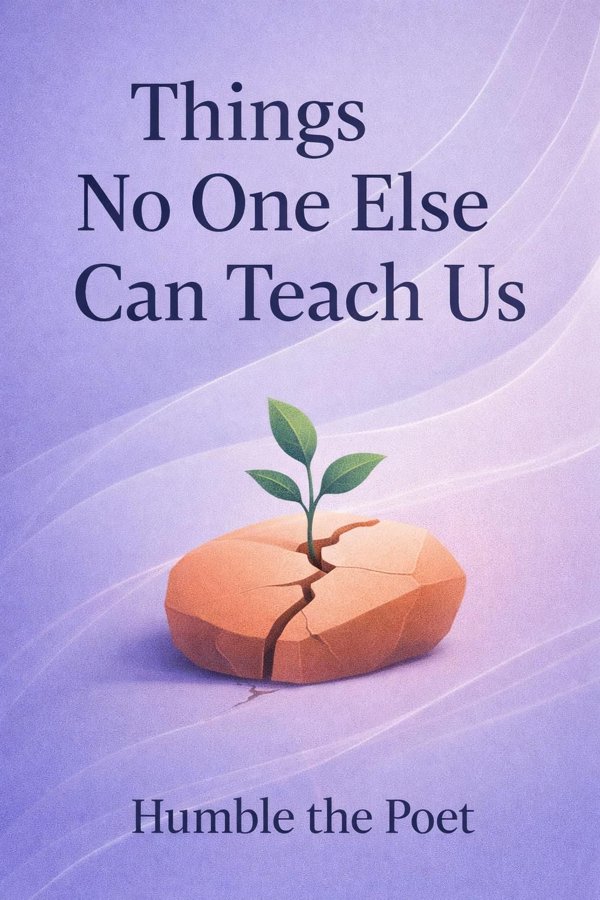
Things No One Else Can Teach Us: Summary & Key Insights
 10 min9 chaptersAudio available
Key Takeaways from Things No One Else Can Teach Us
Much of our suffering comes not from reality itself, but from the gap between reality and our expectations of how life should unfold.
A life built on other people’s definitions of success will eventually feel like a costume.
Failure hurts most when we mistake an outcome for a definition of who we are.
Pain is often the lesson we never wanted but most needed.
Self-responsibility begins when we stop making our healing someone else’s job.
What Is Things No One Else Can Teach Us About?
Things No One Else Can Teach Us by Humble the Poet is a self_awareness book spanning 11 pages. Things No One Else Can Teach Us is a deeply personal guide to growth, resilience, and honest self-awareness. In this book, Humble the Poet argues that some of life’s most important lessons cannot be handed to us by parents, teachers, gurus, or social media wisdom. They must be lived through. Pain, failure, heartbreak, insecurity, uncertainty, and disappointment often feel like obstacles, but Humble shows how they can become our most powerful teachers when we stop resisting them and start listening to what they reveal. What makes this book stand out is its directness. Rather than offering polished clichés or pretending that growth is easy, Humble writes from lived experience. As a former teacher who left a stable career to become an artist, writer, and speaker, he understands what it means to disappoint expectations, face fear, and rebuild identity from the ground up. His authority comes not from perfection, but from reflection. This book matters because it challenges readers to stop outsourcing wisdom. It encourages us to take responsibility for our choices, question inherited beliefs, and become more compassionate, grounded, and authentic in the way we live.
This FizzRead summary covers all 9 key chapters of Things No One Else Can Teach Us in approximately 10 minutes, distilling the most important ideas, arguments, and takeaways from Humble the Poet's work. Also available as an audio summary and Key Quotes Podcast.
Things No One Else Can Teach Us
Things No One Else Can Teach Us is a deeply personal guide to growth, resilience, and honest self-awareness. In this book, Humble the Poet argues that some of life’s most important lessons cannot be handed to us by parents, teachers, gurus, or social media wisdom. They must be lived through. Pain, failure, heartbreak, insecurity, uncertainty, and disappointment often feel like obstacles, but Humble shows how they can become our most powerful teachers when we stop resisting them and start listening to what they reveal.
What makes this book stand out is its directness. Rather than offering polished clichés or pretending that growth is easy, Humble writes from lived experience. As a former teacher who left a stable career to become an artist, writer, and speaker, he understands what it means to disappoint expectations, face fear, and rebuild identity from the ground up. His authority comes not from perfection, but from reflection.
This book matters because it challenges readers to stop outsourcing wisdom. It encourages us to take responsibility for our choices, question inherited beliefs, and become more compassionate, grounded, and authentic in the way we live.
Who Should Read Things No One Else Can Teach Us?
This book is perfect for anyone interested in self_awareness and looking to gain actionable insights in a short read. Whether you're a student, professional, or lifelong learner, the key ideas from Things No One Else Can Teach Us by Humble the Poet will help you think differently.
- ✓Readers who enjoy self_awareness and want practical takeaways
- ✓Professionals looking to apply new ideas to their work and life
- ✓Anyone who wants the core insights of Things No One Else Can Teach Us in just 10 minutes
Want the full summary?
Get instant access to this book summary and 100K+ more with Fizz Moment.
Get Free SummaryAvailable on App Store • Free to download
Key Chapters
Much of our suffering comes not from reality itself, but from the gap between reality and our expectations of how life should unfold. Humble the Poet emphasizes that expectations often operate quietly in the background. We expect people to understand us without explanation, success to arrive on schedule, relationships to heal neatly, and hard work to guarantee specific outcomes. When life refuses to follow our script, frustration grows.
The problem is not hope or ambition. The problem is attachment to a predetermined version of events. Expectations can make us blind to what is actually happening and to what is still possible. A missed opportunity may redirect us toward work that suits us better. A breakup may reveal unhealthy patterns we were unwilling to confront. A detour may expose strengths we would never have discovered on the original path.
This idea is especially relevant in modern life, where comparison intensifies expectation. Social media makes other people’s lives look linear and rewarding, which can make our own messy reality feel like failure. Humble urges readers to stop measuring life against fantasy. The more rigidly we cling to “how it should be,” the less able we are to adapt, appreciate, and grow.
A practical way to apply this is to notice disappointment and ask: what expectation was underneath it? If a friend lets you down, maybe the pain comes partly from an unspoken belief that they should always show up in your preferred way. If your career stalls, maybe you expected progress to look faster or cleaner than real life allows.
Actionable takeaway: When disappointment hits, pause and identify the expectation you were holding. Replace “this shouldn’t be happening” with “this is happening—what can I learn from it?”
A life built on other people’s definitions of success will eventually feel like a costume. One of Humble the Poet’s core lessons is that many people chase recognition, stability, status, or approval without ever asking whether those goals genuinely belong to them. For years, society teaches us to admire titles, salaries, applause, and conventional milestones. But external validation is unreliable. Even when we get what we wanted, it often fails to create lasting peace.
Humble’s own path reflects this tension. Leaving a respected teaching career to pursue a creative life meant giving up certainty and confronting judgment, both from others and from himself. That shift forced him to ask difficult questions: What if success is not about looking impressive? What if it is about alignment? What if a meaningful life matters more than a respectable one?
Redefining success does not mean rejecting achievement. It means making sure your achievements reflect your values. For one person, success might be artistic freedom. For another, it might be raising a healthy family, having time sovereignty, serving a community, or doing work with integrity. The danger is not ambition, but imitation.
In practical terms, this requires a personal audit. Many people are exhausted because they are pursuing goals they never consciously chose. A promotion, a lifestyle upgrade, or public recognition may feel hollow if it costs mental health, relationships, or authenticity. Humble encourages readers to separate genuine desire from inherited ambition.
You can begin by writing down your current goals and asking why each one matters. If the answer depends mostly on impressing others, feeling superior, or avoiding shame, it may be time to revise your definition.
Actionable takeaway: Create your own success statement in one sentence, based on your values rather than public approval, and use it as a filter for future decisions.
Failure hurts most when we mistake an outcome for a definition of who we are. Humble the Poet reframes failure as feedback rather than final judgment. We are conditioned to avoid mistakes because school, family pressure, and social comparison teach us that failure is embarrassing. But in reality, failure is one of life’s most honest instructors. It exposes weak assumptions, fragile ego, poor preparation, and unrealistic timelines. It also reveals courage, because failure only happens when we risk something that matters.
The deeper lesson is that failure strips away illusion. If a project collapses, a relationship ends, or a dream takes longer than expected, we are forced to confront what we do not know and what we still need to develop. That confrontation can feel humiliating, but it is also clarifying. People who try to avoid failure often end up avoiding growth.
Consider everyday examples. Someone launches a business and discovers that passion alone does not create a sustainable model. Someone enters a relationship believing chemistry is enough and learns that communication and emotional maturity matter more. Someone changes careers and realizes talent must be matched by discipline. None of these failures make the person worthless. They make them more informed.
Humble’s point is not to romanticize failure, but to use it. Instead of asking, “Why did this happen to me?” ask, “What is this showing me?” That shift transforms shame into curiosity. It also helps separate behavior from identity. You failed at something; you are not a failure.
A useful practice is keeping a failure journal. After a setback, write what happened, what assumptions were wrong, what skills were missing, and what you will do differently next time. Reflection turns pain into instruction.
Actionable takeaway: After every setback, extract three lessons before you let yourself make a conclusion about your worth.
Pain is often the lesson we never wanted but most needed. Humble the Poet suggests that discomfort, heartbreak, rejection, and loss are not automatically meaningful, but they can become meaningful if we choose to engage them honestly. Many people spend enormous energy trying to numb pain, outrun it, or package it into a motivational slogan before they have actually processed it. But unexamined pain tends to repeat itself.
Pain gets our attention in ways comfort never does. It reveals our attachments, our fears, our unmet needs, and the stories we tell ourselves. A betrayal may expose where we ignored red flags. Burnout may reveal a life driven by performance rather than purpose. Loneliness may uncover how guarded we have become. Pain does not guarantee wisdom, but it creates the conditions for it.
This idea matters because modern culture often treats pain as failure. We are encouraged to “move on” quickly, perform resilience, and remain productive. Humble offers a more human approach: sit with the wound long enough to understand what it is saying. This does not mean wallowing. It means listening. The goal is not to become identified with suffering, but to become informed by it.
A practical application is to notice recurring forms of pain. If you repeatedly end up in one-sided relationships, the pain may be teaching you about boundaries or self-worth. If criticism devastates you, it may point to a dependence on approval. If uncertainty triggers panic, pain may be revealing your need for control.
Healing becomes more effective when pain is translated into insight. You may need journaling, therapy, prayer, conversation, or solitude. The method matters less than the honesty.
Actionable takeaway: The next time pain shows up, ask one gentle question: “What truth is this discomfort trying to make visible?”
Self-responsibility begins when we stop making our healing someone else’s job. Humble the Poet does not deny that people can wound us, systems can limit us, and circumstances can be unfair. But he insists that growth starts when we take ownership of our responses, patterns, and choices. Blame can explain our pain, but it cannot transform it.
This is one of the book’s most empowering ideas. Many people remain emotionally stuck because they wait for closure, apology, rescue, or perfect conditions before changing. They give away too much authority over their peace. Self-responsibility does not mean self-blame. It means recognizing that while we do not control everything that happens, we do control the work of understanding ourselves and choosing how to move forward.
For example, if someone repeatedly violates your boundaries, their behavior is theirs, but maintaining access to you is your decision. If you constantly seek validation from people who cannot give it, that pattern deserves your attention. If your mind keeps rehearsing resentment, you may need to develop tools for emotional regulation rather than simply waiting for the past to feel different.
Responsibility also applies to beliefs. Many of our habits and reactions come from old conditioning. We inherit ideas about love, masculinity, femininity, success, and worth. Yet inherited does not mean permanent. Humble challenges readers to examine which narratives they continue to obey long after those narratives stopped serving them.
One practical habit is to replace victim-language with ownership-language where appropriate. Instead of “I had no choice,” ask “What choices did I avoid because they were uncomfortable?” Instead of “That’s just how I am,” ask “What have I practiced for so long that it now feels like identity?”
Actionable takeaway: Choose one recurring problem in your life and list the parts of it that are within your influence. Start there.
You cannot build a meaningful life while constantly performing a version of yourself designed for acceptance. Humble the Poet argues that authenticity is not a branding exercise or a license to be impulsive. It is the ongoing practice of being truthful about who you are, what you feel, what you need, and what no longer fits. That truthfulness almost always requires vulnerability.
Vulnerability is difficult because it risks rejection. If we show our confusion, tenderness, insecurity, or unmet needs, others may misunderstand or dismiss us. So many people learn to hide behind competence, humor, toughness, or people-pleasing. The problem is that hiding may protect us from judgment, but it also blocks intimacy and self-respect. If no one knows the real you, approval will never feel fully nourishing.
Humble emphasizes that authenticity is not about dramatic confession; it is about alignment. It means your public self and private self do not feel like strangers. In practice, that can look like admitting when something hurts, saying no without overexplaining, expressing care without pretending indifference, or pursuing work that feels real instead of impressive.
This also matters in relationships. Many conflicts persist because people communicate from image rather than honesty. Instead of saying, “I felt unimportant when you ignored me,” they act distant and hope to be chased. Instead of saying, “I’m scared to start over,” they criticize others who took the risk. Vulnerability creates the possibility of clarity.
A useful way to practice authenticity is in small moments. Tell the truth when a simple social lie would be easier. Admit uncertainty. Let trusted people see your process, not just your polished outcome.
Actionable takeaway: This week, have one conversation in which you replace image management with honest expression, even if your voice shakes.
Growth is not only about learning more; it is also about letting go of what no longer deserves authority in your life. Humble the Poet highlights the importance of unlearning inherited beliefs, outdated identities, and habitual narratives. Many of us live according to scripts we never consciously examined: I must always be strong. Love must be earned. Rest is laziness. Success means security. Asking for help is weakness. These beliefs can shape entire lives while remaining invisible.
Unlearning is uncomfortable because old stories often provided belonging or protection. A belief may have helped you survive childhood, navigate community expectations, or avoid shame. But a survival strategy can become a prison when it outlives its purpose. The same emotional armor that once kept you safe may now stop you from connecting, trusting, or evolving.
Relearning means consciously replacing reflexive narratives with more truthful ones. For instance, someone raised to equate worth with productivity may need to relearn that rest supports contribution. Someone taught to suppress emotion may need to relearn that feeling deeply is not weakness. Someone who internalized rejection may need to relearn that another person’s inability to love well is not proof of personal deficiency.
This process is ongoing. New circumstances expose old programming. A career shift may trigger stories about inadequacy. A healthy relationship may activate beliefs that love must feel chaotic to be real. Humble encourages readers to stay curious about their internal scripts rather than blindly obey them.
Practical tools include journaling the beliefs behind your strongest emotional reactions, challenging them with evidence, and identifying who taught them to you. Once named, a belief becomes easier to question.
Actionable takeaway: Write down one sentence you have carried for years about yourself or life, then ask, “Is this true, useful, and mine?”
Perspective changes not because life becomes easier, but because we learn to see more clearly. Humble the Poet connects gratitude, love, and compassion as practices that expand our view beyond ego, scarcity, and resentment. Gratitude is not denial of difficulty. It is the discipline of noticing what still exists alongside difficulty: support, breath, possibility, beauty, lessons, and connection. Without that discipline, the mind easily fixates on what is absent.
Compassion deepens this perspective by softening judgment, especially toward ourselves and others. Many people are harsh because harshness feels like control. But shame rarely produces lasting transformation. Compassion allows us to face our flaws without collapsing under them. It also helps us understand that other people’s hurtful behavior often emerges from their own pain, immaturity, or fear. This understanding does not excuse harm, but it can reduce the poison of bitterness.
Love, in Humble’s framing, is not just romance. It is a way of relating to life with openness and generosity. It shows up as patience, listening, forgiveness, service, and presence. In an anxious and performative world, love is radical because it asks us to move from self-protection toward connection.
These practices are especially useful during uncertainty and stress. Gratitude can interrupt spirals of entitlement or despair. Compassion can keep us from treating a bad day as proof that we are broken. Love can remind us that meaning is often found less in achievement than in how we show up for people.
Try simple daily practices: list three things you are thankful for, offer yourself the same understanding you would offer a friend, and perform one generous act without seeking recognition.
Actionable takeaway: End each day by naming one thing you appreciated, one person you can understand better, and one way you chose love over ego.
Certainty is comforting, but it is also an illusion that keeps many people small. Humble the Poet argues that life does not become meaningful when all questions are answered; it becomes meaningful when we learn how to move through uncertainty with courage and wisdom. The future is always partly hidden. Relationships change, careers evolve, identities shift, and plans fail. If we insist on guarantees before acting, we may never begin.
Embracing uncertainty does not mean becoming reckless or passive. It means accepting that control has limits and that wisdom lies in how we respond, not in our ability to predict everything. Practical wisdom, in this context, is the combination of self-awareness, humility, and action. It asks: What is true right now? What matters most? What small step can I take despite incomplete information?
This is where the book becomes especially useful. Humble does not offer abstract philosophy detached from daily life. He encourages grounded practices: reflect before reacting, question ego-driven motives, be honest about fear, ask better questions, and make decisions based on values rather than panic. When uncertainty appears, many people either freeze or grasp for false certainty. Practical wisdom chooses presence instead.
Consider someone unsure whether to leave a job, end a relationship, or start over in a new city. They may not get total clarity in advance. But they can notice patterns, gather information, imagine consequences, seek counsel, and listen to the difference between fear and intuition. Wisdom often arrives through movement, not endless analysis.
The broader message is liberating: you do not need perfect certainty to live well. You need self-trust, reflection, and the willingness to adapt as reality unfolds.
Actionable takeaway: When facing uncertainty, stop asking for guarantees and ask, “What is the next honest step I can take with the information I have?”
All Chapters in Things No One Else Can Teach Us
About the Author
Humble the Poet, born Kanwer Singh, is a Canadian author, spoken word artist, rapper, and former schoolteacher. He first gained attention through his poetry and videos, which combine blunt honesty, emotional intelligence, and accessible life philosophy. Before fully pursuing a creative career, he worked as a teacher, an experience that shaped his interest in how people learn, struggle, and grow. Over time, he built an international audience by addressing topics such as self-worth, relationships, identity, success, and healing in a voice that feels both streetwise and thoughtful. His work stands out for rejecting polished self-help clichés in favor of hard-earned insight and personal reflection. Across his books, performances, and media presence, Humble the Poet encourages people to question inherited beliefs and live with greater authenticity and courage.
Get This Summary in Your Preferred Format
Read or listen to the Things No One Else Can Teach Us summary by Humble the Poet anytime, anywhere. FizzRead offers multiple formats so you can learn on your terms — all free.
Available formats: App · Audio · PDF · EPUB — All included free with FizzRead
Download Things No One Else Can Teach Us PDF and EPUB Summary
Key Quotes from Things No One Else Can Teach Us
“Much of our suffering comes not from reality itself, but from the gap between reality and our expectations of how life should unfold.”
“A life built on other people’s definitions of success will eventually feel like a costume.”
“Failure hurts most when we mistake an outcome for a definition of who we are.”
“Pain is often the lesson we never wanted but most needed.”
“Self-responsibility begins when we stop making our healing someone else’s job.”
Frequently Asked Questions about Things No One Else Can Teach Us
Things No One Else Can Teach Us by Humble the Poet is a self_awareness book that explores key ideas across 9 chapters. Things No One Else Can Teach Us is a deeply personal guide to growth, resilience, and honest self-awareness. In this book, Humble the Poet argues that some of life’s most important lessons cannot be handed to us by parents, teachers, gurus, or social media wisdom. They must be lived through. Pain, failure, heartbreak, insecurity, uncertainty, and disappointment often feel like obstacles, but Humble shows how they can become our most powerful teachers when we stop resisting them and start listening to what they reveal. What makes this book stand out is its directness. Rather than offering polished clichés or pretending that growth is easy, Humble writes from lived experience. As a former teacher who left a stable career to become an artist, writer, and speaker, he understands what it means to disappoint expectations, face fear, and rebuild identity from the ground up. His authority comes not from perfection, but from reflection. This book matters because it challenges readers to stop outsourcing wisdom. It encourages us to take responsibility for our choices, question inherited beliefs, and become more compassionate, grounded, and authentic in the way we live.
More by Humble the Poet
You Might Also Like
Rising Strong
Brené Brown
10 min
You Do You
Sarah Knight
10 min
Master Your Emotions: A Practical Guide to Overcome Negativity and Better Manage Your Feelings
Thibaut Meurisse
10 min
The Mountain Is You: Transforming Self-Sabotage Into Self-Mastery
Brianna Wiest
10 min
101 Essays That Will Change The Way You Think
Brianna Wiest
10 min
A Radical Awakening: Turn Pain into Power, Embrace Your Truth, Live Free
Shefali Tsabary
10 minBrowse by Category
Ready to read Things No One Else Can Teach Us?
Get the full summary and 100K+ more books with Fizz Moment.