
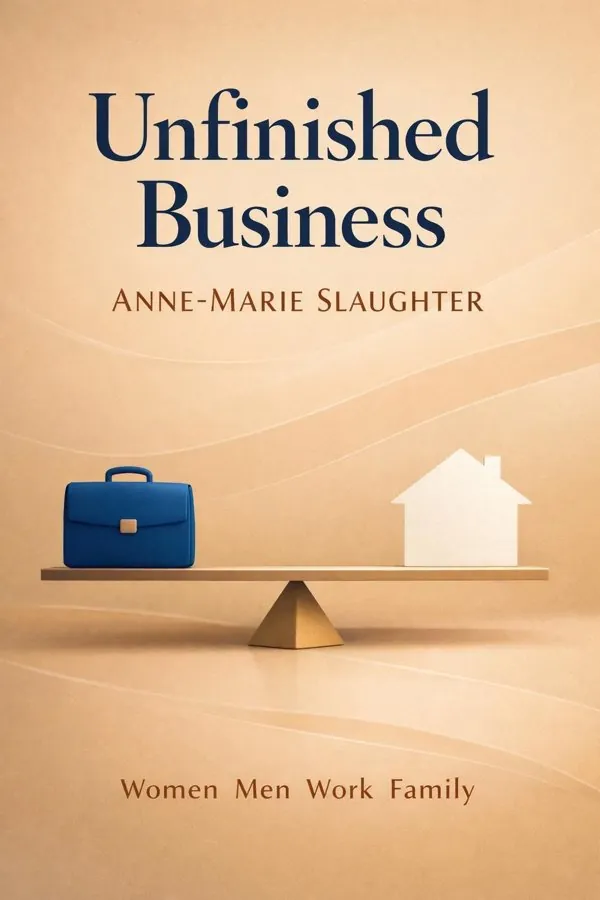
Unfinished Business: Women Men Work Family: Summary & Key Insights
 10 min10 chaptersAudio available
What Is Unfinished Business: Women Men Work Family About?
Unfinished Business: Women Men Work Family by Anne-Marie Slaughter is a sociology book spanning 10 pages. Unfinished Business es un libro de no ficción que explora cómo las estructuras laborales y sociales modernas fallan en apoyar la igualdad de género y el equilibrio entre trabajo y familia. Anne-Marie Slaughter analiza su propia experiencia y propone reformas para crear un sistema más equitativo que permita a hombres y mujeres compartir responsabilidades familiares y profesionales.
This FizzRead summary covers all 10 key chapters of Unfinished Business: Women Men Work Family in approximately 10 minutes, distilling the most important ideas, arguments, and takeaways from Anne-Marie Slaughter's work. Also available as an audio summary and Key Quotes Podcast.
Unfinished Business: Women Men Work Family
Unfinished Business es un libro de no ficción que explora cómo las estructuras laborales y sociales modernas fallan en apoyar la igualdad de género y el equilibrio entre trabajo y familia. Anne-Marie Slaughter analiza su propia experiencia y propone reformas para crear un sistema más equitativo que permita a hombres y mujeres compartir responsabilidades familiares y profesionales.
Who Should Read Unfinished Business: Women Men Work Family?
This book is perfect for anyone interested in sociology and looking to gain actionable insights in a short read. Whether you're a student, professional, or lifelong learner, the key ideas from Unfinished Business: Women Men Work Family by Anne-Marie Slaughter will help you think differently.
- ✓Readers who enjoy sociology and want practical takeaways
- ✓Professionals looking to apply new ideas to their work and life
- ✓Anyone who wants the core insights of Unfinished Business: Women Men Work Family in just 10 minutes
Want the full summary?
Get instant access to this book summary and 100K+ more with Fizz Moment.
Get Free SummaryAvailable on App Store • Free to download
Key Chapters
Early in my career, I measured success the way most high achievers do: through professional recognition. Titles, promotions, and the approval of peers seemed to mark the trajectory of a meaningful life. But when I chose to leave my position in Washington to return home to my teenage sons, I realized how deeply skewed our societal definitions had become. In doing what felt right for my family, I was perceived as opting out or stepping back. Why did caring for family count as diminished ambition? Why is caregiving treated as a deviation from success rather than one of its central expressions?
Reevaluating success means rebalancing the scales between career and care, between public achievement and private responsibility. We have, for too long, praised self-sufficiency while neglecting the fundamental interdependence that defines human life. True success, as I’ve come to understand it, lies in contributing meaningfully in both domains—supporting others as well as advancing personally. That redefinition opens pathways for both women and men to thrive without feeling trapped in outdated roles.
When success is measured by care as well as career, systems of reward change. Employers must recognize that employees’ capacity to contribute at work depends on how supported they are at home. Politicians must realize that economic growth depends on care work as much as paid labor. And individuals must learn to value the invisible scaffolding of care that allows society to function. To redeem that notion of success is to transform not just individual lives, but the moral fabric of our economy.
If there is one central insight of this book, it is that care is work—and our failure to value it properly destabilizes everything else. The modern economy runs on an invisible infrastructure of unpaid or underpaid caregiving, from mothers tending infants to home health aides supporting the elderly. These caregivers form the backbone of productivity, yet they receive neither the recognition nor the compensation that reflect their essential contribution.
We refer to traits associated with care—empathy, patience, relational awareness—as 'soft skills', but they are anything but soft. They are the skills that bind communities and sustain human capital. Yet economists rarely include them in models of growth, and workplaces remain structured as if workers were unencumbered by dependents, as if care were a peripheral concern rather than a central human function. That illusion exacts a cost: exhausted families, gender imbalances, and a workforce increasingly disconnected from the rhythms of life.
To build a 'care economy' worthy of the name, we must correct this market failure. That means rethinking compensation for caregiving professions, creating social supports such as paid family leave, and respecting care work as a public good. It also means acknowledging how privilege operates: for generations, professional women like me have relied on the undervalued labor of other women—often women of color and immigrants—to sustain our own careers. Real equality demands that we close that moral gap by honoring care at every level, not outsourcing it to the least empowered among us.
+ 8 more chapters — available in the FizzRead app
All Chapters in Unfinished Business: Women Men Work Family
About the Author
Anne-Marie Slaughter es una académica y analista política estadounidense, conocida por su trabajo en temas de política exterior y equidad de género. Fue directora de planificación de políticas en el Departamento de Estado de EE. UU. y presidenta de New America, un centro de pensamiento con sede en Washington D.C.
Get This Summary in Your Preferred Format
Read or listen to the Unfinished Business: Women Men Work Family summary by Anne-Marie Slaughter anytime, anywhere. FizzRead offers multiple formats so you can learn on your terms — all free.
Available formats: App · Audio · PDF · EPUB — All included free with FizzRead
Download Unfinished Business: Women Men Work Family PDF and EPUB Summary
Key Quotes from Unfinished Business: Women Men Work Family
“Early in my career, I measured success the way most high achievers do: through professional recognition.”
“If there is one central insight of this book, it is that care is work—and our failure to value it properly destabilizes everything else.”
Frequently Asked Questions about Unfinished Business: Women Men Work Family
Unfinished Business: Women Men Work Family by Anne-Marie Slaughter is a sociology book that explores key ideas across 10 chapters. Unfinished Business es un libro de no ficción que explora cómo las estructuras laborales y sociales modernas fallan en apoyar la igualdad de género y el equilibrio entre trabajo y familia. Anne-Marie Slaughter analiza su propia experiencia y propone reformas para crear un sistema más equitativo que permita a hombres y mujeres compartir responsabilidades familiares y profesionales.
You Might Also Like

Between the World and Me
Ta-Nehisi Coates
10 min
Half the Sky
Nicholas D. Kristof, Sheryl WuDunn
10 min
Men Explain Things To Me
Rebecca Solnit
10 min
Rational Ritual
Michael Suk-Young Chwe
10 min
The New Jim Crow
Michelle Alexander
10 min
Beyond Culture
Edward T. Hall
10 minBrowse by Category
Ready to read Unfinished Business: Women Men Work Family?
Get the full summary and 100K+ more books with Fizz Moment.