
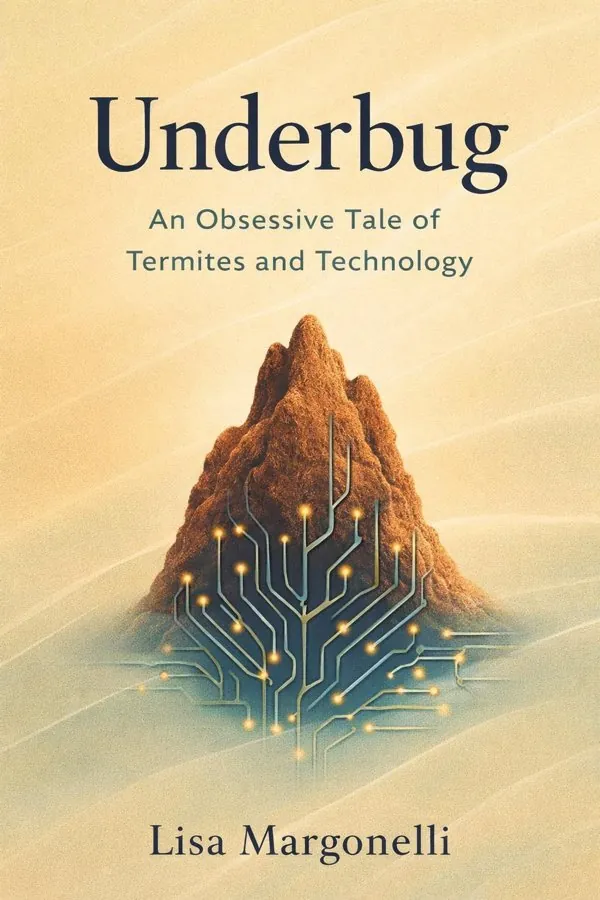
Underbug: An Obsessive Tale of Termites and Technology: Summary & Key Insights
 10 min8 chaptersAudio available
What Is Underbug: An Obsessive Tale of Termites and Technology About?
Underbug: An Obsessive Tale of Termites and Technology by Lisa Margonelli is a popular_sci book spanning 8 pages. Underbug explores the hidden world of termites and the surprising ways their social organization and engineering feats inspire new technologies. Lisa Margonelli blends science writing, field reporting, and philosophical reflection to examine how termite behavior challenges our understanding of intelligence, cooperation, and the boundaries between biology and technology.
This FizzRead summary covers all 8 key chapters of Underbug: An Obsessive Tale of Termites and Technology in approximately 10 minutes, distilling the most important ideas, arguments, and takeaways from Lisa Margonelli's work. Also available as an audio summary and Key Quotes Podcast.
Underbug: An Obsessive Tale of Termites and Technology
Underbug explores the hidden world of termites and the surprising ways their social organization and engineering feats inspire new technologies. Lisa Margonelli blends science writing, field reporting, and philosophical reflection to examine how termite behavior challenges our understanding of intelligence, cooperation, and the boundaries between biology and technology.
Who Should Read Underbug: An Obsessive Tale of Termites and Technology?
This book is perfect for anyone interested in popular_sci and looking to gain actionable insights in a short read. Whether you're a student, professional, or lifelong learner, the key ideas from Underbug: An Obsessive Tale of Termites and Technology by Lisa Margonelli will help you think differently.
- ✓Readers who enjoy popular_sci and want practical takeaways
- ✓Professionals looking to apply new ideas to their work and life
- ✓Anyone who wants the core insights of Underbug: An Obsessive Tale of Termites and Technology in just 10 minutes
Want the full summary?
Get instant access to this book summary and 100K+ more with Fizz Moment.
Get Free SummaryAvailable on App Store • Free to download
Key Chapters
My journey began in the fluorescent corridors of entomology labs, where scientists worked tirelessly over Petri dishes and tiny tubes of soil teeming with life. Termites are elusive subjects, living most of their lives underground or within wood, wrapped in privacy. The researchers I met—biologists, ecologists, and even computer scientists—were often philosophical about their work. What fascinated them wasn’t just what termites did, but how they did it. How could an organism with no brain bigger than a pinhead participate in collective acts of construction and agriculture that sustain whole ecosystems?
In these labs, under the microscopy of scientific observation, I saw that studying termites was both a challenge and a metaphor. Termite research sits at the intersection of chaos and coordination, where tiny actions accumulate into systemic intelligence. Scientists often spoke of the termites as if they were both alien and intimate—life forms that obeyed rules beyond our logic, yet paradoxically, rules that could illuminate our own social structures. Talking to them, I began to realize that termite science is really a practice of humility: the acknowledgement that intelligence can emerge from networks rather than individuals.
The meticulousness of these researchers—collecting colonies, setting up controlled experiments, analyzing patterns of tunneling and behavior—was its own meditation. It taught me that to understand termites, one had to slow down, to learn patience, to accept that nature reveals itself only on its own schedule. Their curiosity drove me deeper into termite worlds, and it was this human fascination, as much as the insects themselves, that became the engine of 'Underbug.'
Standing before a termite mound for the first time, I couldn’t help but feel small. These massive earthen towers, often taller than a person, breathe. Inside them, temperature and humidity remain constant despite desert extremes. They are monuments of architecture without architects—built not by command but by collective instinct.
What’s stunning is the sophistication: tunnels angled for ventilation, chimneys channeling airflow, chambers for farming fungus that the termites depend upon. Each termite adds a grain of soil, responding to chemical cues laid by others, and somehow the result is a living structure. Scientists studying these mounds learned that they function as organs. They inhale and exhale, channeling gases to sustain the colony’s respiration. They maintain an ideal microclimate for fungal agriculture. In these self-regulating systems lies a natural lesson in sustainability and bio-inspired design. Human architects and engineers have already begun to mimic termite ventilation systems, designing energy-efficient buildings that ‘breathe’ naturally.
For me, these mounds became a metaphor for human ambition subdued by ecological wisdom. The termites don’t overbuild; they adjust continuously. Their architecture doesn’t defy nature—it collaborates with it. Observing them, I realized that the line between engineering and living could be porous. The termites’ towers illustrate that intelligence doesn’t need central planning; it can take the form of environmental attunement, of collective sensitivity. Their cities are alive with feedback loops—something our cities could learn from.
+ 6 more chapters — available in the FizzRead app
All Chapters in Underbug: An Obsessive Tale of Termites and Technology
About the Author
Lisa Margonelli is an American science writer and journalist known for her works on energy, technology, and society. She has written for publications such as The Atlantic, Wired, and Scientific American, and is the author of 'Oil on the Brain' and 'Underbug'.
Get This Summary in Your Preferred Format
Read or listen to the Underbug: An Obsessive Tale of Termites and Technology summary by Lisa Margonelli anytime, anywhere. FizzRead offers multiple formats so you can learn on your terms — all free.
Available formats: App · Audio · PDF · EPUB — All included free with FizzRead
Download Underbug: An Obsessive Tale of Termites and Technology PDF and EPUB Summary
Key Quotes from Underbug: An Obsessive Tale of Termites and Technology
“My journey began in the fluorescent corridors of entomology labs, where scientists worked tirelessly over Petri dishes and tiny tubes of soil teeming with life.”
“Standing before a termite mound for the first time, I couldn’t help but feel small.”
Frequently Asked Questions about Underbug: An Obsessive Tale of Termites and Technology
Underbug: An Obsessive Tale of Termites and Technology by Lisa Margonelli is a popular_sci book that explores key ideas across 8 chapters. Underbug explores the hidden world of termites and the surprising ways their social organization and engineering feats inspire new technologies. Lisa Margonelli blends science writing, field reporting, and philosophical reflection to examine how termite behavior challenges our understanding of intelligence, cooperation, and the boundaries between biology and technology.
You Might Also Like

Structures: Or Why Things Don"t Fall Down
J.E. Gordon
10 min
The Road to Wigan Pier
George Orwell
10 min
Bonk: The Curious Coupling of Science and Sex
Mary Roach
10 min
First Bite: How We Learn to Eat
Bee Wilson
10 min
In Pursuit Of The Unknown: 17 Equations That Changed The World
Ian Stewart
10 min
Napoleon's Buttons: 17 Molecules That Changed History
Penny Le Couteur and Jay Burreson
10 minBrowse by Category
Ready to read Underbug: An Obsessive Tale of Termites and Technology?
Get the full summary and 100K+ more books with Fizz Moment.