
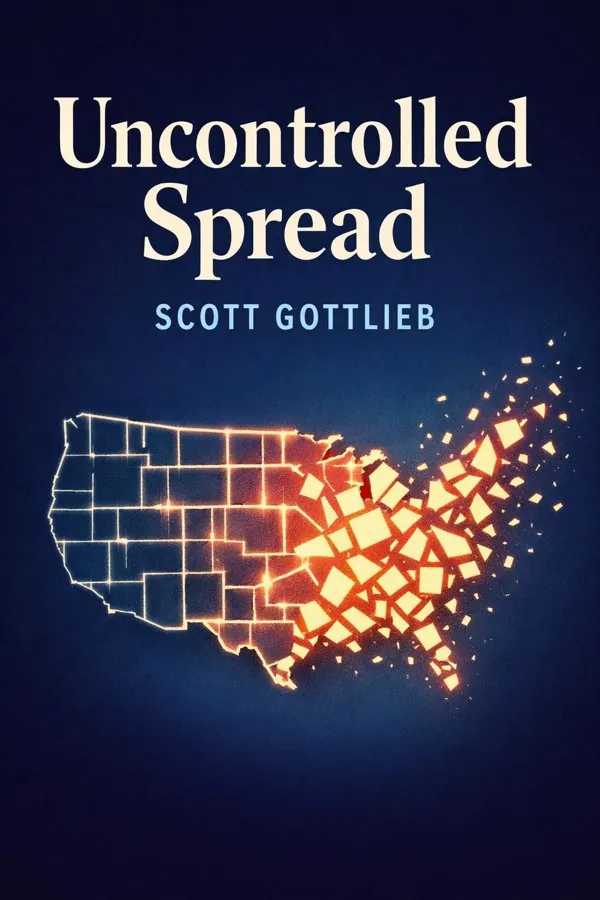
Uncontrolled Spread: Why COVID-19 Crushed Us and How We Can Defeat the Next Pandemic: Summary & Key Insights
 10 min10 chaptersAudio available
What Is Uncontrolled Spread: Why COVID-19 Crushed Us and How We Can Defeat the Next Pandemic About?
Uncontrolled Spread: Why COVID-19 Crushed Us and How We Can Defeat the Next Pandemic by Scott Gottlieb is a health_med book spanning 10 pages. In this book, former FDA commissioner Scott Gottlieb examines the systemic failures that allowed COVID-19 to devastate the United States. He analyzes how public health institutions, political decisions, and scientific communication broke down, and offers a roadmap for reforming pandemic preparedness to prevent future crises.
This FizzRead summary covers all 10 key chapters of Uncontrolled Spread: Why COVID-19 Crushed Us and How We Can Defeat the Next Pandemic in approximately 10 minutes, distilling the most important ideas, arguments, and takeaways from Scott Gottlieb's work. Also available as an audio summary and Key Quotes Podcast.
Uncontrolled Spread: Why COVID-19 Crushed Us and How We Can Defeat the Next Pandemic
In this book, former FDA commissioner Scott Gottlieb examines the systemic failures that allowed COVID-19 to devastate the United States. He analyzes how public health institutions, political decisions, and scientific communication broke down, and offers a roadmap for reforming pandemic preparedness to prevent future crises.
Who Should Read Uncontrolled Spread: Why COVID-19 Crushed Us and How We Can Defeat the Next Pandemic?
This book is perfect for anyone interested in health_med and looking to gain actionable insights in a short read. Whether you're a student, professional, or lifelong learner, the key ideas from Uncontrolled Spread: Why COVID-19 Crushed Us and How We Can Defeat the Next Pandemic by Scott Gottlieb will help you think differently.
- ✓Readers who enjoy health_med and want practical takeaways
- ✓Professionals looking to apply new ideas to their work and life
- ✓Anyone who wants the core insights of Uncontrolled Spread: Why COVID-19 Crushed Us and How We Can Defeat the Next Pandemic in just 10 minutes
Want the full summary?
Get instant access to this book summary and 100K+ more with Fizz Moment.
Get Free SummaryAvailable on App Store • Free to download
Key Chapters
The COVID‑19 story begins, not in Seattle or New York, but in Wuhan. Through December 2019 and January 2020, intelligence and health agencies around the world received early reports that a novel coronavirus was spreading in China. The U.S. had both the means and the knowledge to interpret those signals. We had the intelligence community’s global reach and the CDC’s epidemiological expertise. And yet, our early detection mechanisms were paralyzed—not because people didn’t care, but because our institutions were simply not designed for speed or uncertainty.
In the initial weeks, I watched with growing frustration as evidence accumulated but no coherent response emerged. Travel screening systems failed to catch asymptomatic carriers. Customs declarations were meaningless. Public health authorities clung to the idea that containment was still feasible, even as the virus silently seeded major American cities. The bureaucratic culture of the CDC favored thorough deliberation over rapid adaptation. It’s a valuable trait in normal times—but disastrous when each day counts.
Meanwhile, political leaders hesitated, in part because early intelligence was ambiguous and filtered through procedural channels that delayed decisive action. In *Uncontrolled Spread*, I recount how classified briefings and interagency communications reflected a hope that the crisis would remain regional. But pandemics don’t wait for paperwork. By the time leaders recognized COVID‑19’s true transmissibility, containment was already impossible.
This missed opportunity underscores a larger point: we lacked a national capacity for rapid threat assessment. Unlike defense agencies accustomed to acting under uncertainty, public health institutions demanded near-perfect evidence before escalating responses. That epistemic rigidity cost lives. The lesson is clear—next time, we must empower structures that can act on imperfect information, recalibrating as data improves, rather than waiting for bureaucratic consensus.
One of the most painful discoveries during COVID‑19 was that the U.S. did not have one public health system—it had hundreds, loosely connected and often working at cross purposes. The CDC, the FDA, the Department of Health and Human Services, and state health departments each operated under independent mandates. This fragmentation created deadly friction.
As I describe in the book, the CDC’s historic mission was never to manage national emergencies—it was to conduct research, surveillance, and guidance. That model made sense in calmer times. But in a pandemic, its authority evaporated into confusion. The FDA, on the other hand, was responsible for regulating diagnostics and therapeutics, yet its processes were optimized for safety reviews over months, not emergency decisions over days. When the two agencies tried to coordinate, their mutual caution froze innovation.
Our early testing crisis exemplified this dysfunction. The CDC created the first federal diagnostic kits, but the kits were contaminated due to a manufacturing oversight. Instead of immediately enlisting private labs to design alternatives, the bureaucracy doubled down on internal processes. Weeks passed as infections spread unchecked. The root problem wasn’t bad people—it was a system built for incremental management, not wartime mobilization.
Through these events, I argue that pandemic preparedness must be redefined as a national security function. In military crises, we wouldn’t allow multiple uncoordinated chains of command. Yet that’s exactly what we did in health emergencies. To be prepared, we need a central authority capable of interlinking all agencies, ensuring unity of mission and accountability of action.
+ 8 more chapters — available in the FizzRead app
All Chapters in Uncontrolled Spread: Why COVID-19 Crushed Us and How We Can Defeat the Next Pandemic
About the Author
Scott Gottlieb is an American physician and public health expert who served as the 23rd Commissioner of the U.S. Food and Drug Administration from 2017 to 2019. He is known for his work on health policy, drug regulation, and pandemic response.
Get This Summary in Your Preferred Format
Read or listen to the Uncontrolled Spread: Why COVID-19 Crushed Us and How We Can Defeat the Next Pandemic summary by Scott Gottlieb anytime, anywhere. FizzRead offers multiple formats so you can learn on your terms — all free.
Available formats: App · Audio · PDF · EPUB — All included free with FizzRead
Download Uncontrolled Spread: Why COVID-19 Crushed Us and How We Can Defeat the Next Pandemic PDF and EPUB Summary
Key Quotes from Uncontrolled Spread: Why COVID-19 Crushed Us and How We Can Defeat the Next Pandemic
“The COVID‑19 story begins, not in Seattle or New York, but in Wuhan.”
“One of the most painful discoveries during COVID‑19 was that the U.”
Frequently Asked Questions about Uncontrolled Spread: Why COVID-19 Crushed Us and How We Can Defeat the Next Pandemic
Uncontrolled Spread: Why COVID-19 Crushed Us and How We Can Defeat the Next Pandemic by Scott Gottlieb is a health_med book that explores key ideas across 10 chapters. In this book, former FDA commissioner Scott Gottlieb examines the systemic failures that allowed COVID-19 to devastate the United States. He analyzes how public health institutions, political decisions, and scientific communication broke down, and offers a roadmap for reforming pandemic preparedness to prevent future crises.
You Might Also Like

On Immunity
Eula Biss
10 min
The Three-Body Problem
Liu Cixin
10 min
Community Health Volunteer Toolkit: Training and Practical Activities
World Health Organization
10 min
Healing Back Pain: The Mind-Body Connection
John E. Sarno
10 min
Health Literacy for All: Practical Guides to Communicate Health Information (Compilations)
World Health Organization
10 min
The Complete Guide to Sports Supplements: An Evidence-Based Review
Anita Bean
10 minBrowse by Category
Ready to read Uncontrolled Spread: Why COVID-19 Crushed Us and How We Can Defeat the Next Pandemic?
Get the full summary and 100K+ more books with Fizz Moment.