
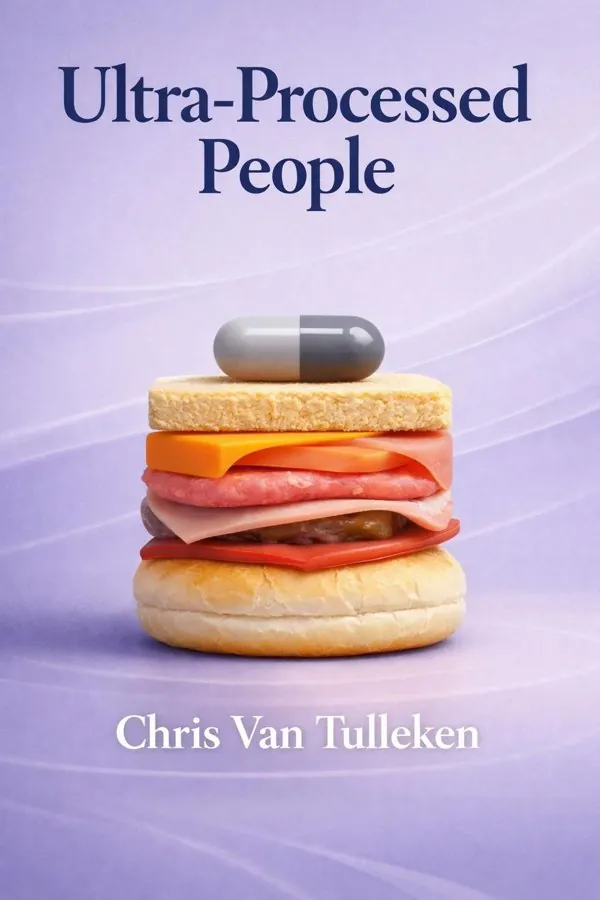
Ultra-Processed People: Why Do We All Eat Stuff That Isn’t Food … and Why Can’t We Stop?: Summary & Key Insights
 10 min10 chaptersAudio available
What Is Ultra-Processed People: Why Do We All Eat Stuff That Isn’t Food … and Why Can’t We Stop? About?
Ultra-Processed People: Why Do We All Eat Stuff That Isn’t Food … and Why Can’t We Stop? by Chris Van Tulleken is a health_med book spanning 10 pages. In this groundbreaking work, Dr. Chris van Tulleken explores how ultra-processed foods—industrial formulations of ingredients derived from foods—have come to dominate modern diets and reshape human health. Drawing on scientific research and personal experimentation, he reveals how these products alter our biology, drive overeating, and contribute to the global obesity and chronic disease crisis. The book challenges readers to rethink what we consider 'food' and to understand the powerful economic and social forces behind the modern food industry.
This FizzRead summary covers all 10 key chapters of Ultra-Processed People: Why Do We All Eat Stuff That Isn’t Food … and Why Can’t We Stop? in approximately 10 minutes, distilling the most important ideas, arguments, and takeaways from Chris Van Tulleken's work. Also available as an audio summary and Key Quotes Podcast.
Ultra-Processed People: Why Do We All Eat Stuff That Isn’t Food … and Why Can’t We Stop?
In this groundbreaking work, Dr. Chris van Tulleken explores how ultra-processed foods—industrial formulations of ingredients derived from foods—have come to dominate modern diets and reshape human health. Drawing on scientific research and personal experimentation, he reveals how these products alter our biology, drive overeating, and contribute to the global obesity and chronic disease crisis. The book challenges readers to rethink what we consider 'food' and to understand the powerful economic and social forces behind the modern food industry.
Who Should Read Ultra-Processed People: Why Do We All Eat Stuff That Isn’t Food … and Why Can’t We Stop??
This book is perfect for anyone interested in health_med and looking to gain actionable insights in a short read. Whether you're a student, professional, or lifelong learner, the key ideas from Ultra-Processed People: Why Do We All Eat Stuff That Isn’t Food … and Why Can’t We Stop? by Chris Van Tulleken will help you think differently.
- ✓Readers who enjoy health_med and want practical takeaways
- ✓Professionals looking to apply new ideas to their work and life
- ✓Anyone who wants the core insights of Ultra-Processed People: Why Do We All Eat Stuff That Isn’t Food … and Why Can’t We Stop? in just 10 minutes
Want the full summary?
Get instant access to this book summary and 100K+ more with Fizz Moment.
Get Free SummaryAvailable on App Store • Free to download
Key Chapters
To understand the effects of ultra-processed foods not just from a theoretical standpoint but through lived experience, I transformed myself into both doctor and patient. For a month, I consumed a diet where 80 percent of my calories came from UPFs — the kind of foods that make up most modern supermarket shelves: breakfast cereals, snack bars, packaged breads, ready meals, and flavoured yogurts.
At first, it was almost fun. The convenience was alluring, the flavours intense. But within days I began to feel the difference. I was hungrier, more irritable, and sluggish in ways I hadn’t anticipated. I gained weight quickly — nearly seven kilograms by the end of the month — and brain scans revealed something far more profound: my reward centres had lit up as if I were consuming addictive substances. Neuroscientific studies have shown that hyper-palatable combinations of fat, sugar, and salt uniquely stimulate dopamine release, hijacking the brain’s normal mechanisms for satiety.
The experiment wasn’t meant as self-punishment; it was an act of translation. By turning my body into a case study, I wanted to demonstrate what the science already tells us but what the food industry prefers to keep vague: UPFs are not inert calories. They change our metabolism and psychology in ways that natural foods do not. My appetite regulation became distorted, my sleep worsened, and I felt increasingly detached from my own hunger cues. These weren’t just subjective impressions — they were the predictable outcomes of a system that treats food as data, optimized to make us consume more and crave more.
That month of eating didn’t just alter my body; it transformed my perception of modern eating. It showed me that personal willpower is no match for industrial design. When everything around you is created to override your biology, no amount of discipline can fix the problem alone.
At the center of the book lies a deceptively simple question: what exactly counts as ultra-processed? The answer lies in the NOVA classification system, a framework developed by researchers at the University of São Paulo. Unlike calorie-based or nutrient-based definitions, NOVA categorizes foods by how much they are transformed from their original state.
Ultra-processed foods occupy the fourth and highest level of this scale. They are industrial formulations of ingredients extracted from whole foods, often recombined with synthetic additives and assembled in factories rather than kitchens. Their purpose is convenience, consistency, and profit, not nourishment. A loaf of traditional sourdough made from flour, water, and salt is minimally processed; a packaged ‘whole-grain’ loaf stuffed with emulsifiers, stabilizers, and artificial scents is ultra-processed.
The distinction matters because processing isn’t inherently bad. Cooking, fermenting, grinding — these are deeply human acts. Ultra-processing, however, takes the act away from human hands and embeds it within an industrial logic. When food becomes data — measured in shelf life, margins, and sensory optimization — the human element disappears. What remains is a product designed to stimulate rather than sustain.
Understanding this boundary allows us to see that we are not the intended consumers in the traditional sense — we are data points in an optimization loop. This understanding reframes food choices not as personal moral decisions, but as consequences of an economic model built on manipulating biology for profit.
+ 8 more chapters — available in the FizzRead app
All Chapters in Ultra-Processed People: Why Do We All Eat Stuff That Isn’t Food … and Why Can’t We Stop?
About the Author
Dr. Chris van Tulleken is a British infectious diseases doctor, broadcaster, and author. He is known for his work on public health and nutrition, as well as for presenting BBC programs on medicine and science. He studied medicine at Oxford University and holds a PhD in molecular virology. His research and media work focus on how modern environments affect human health.
Get This Summary in Your Preferred Format
Read or listen to the Ultra-Processed People: Why Do We All Eat Stuff That Isn’t Food … and Why Can’t We Stop? summary by Chris Van Tulleken anytime, anywhere. FizzRead offers multiple formats so you can learn on your terms — all free.
Available formats: App · Audio · PDF · EPUB — All included free with FizzRead
Download Ultra-Processed People: Why Do We All Eat Stuff That Isn’t Food … and Why Can’t We Stop? PDF and EPUB Summary
Key Quotes from Ultra-Processed People: Why Do We All Eat Stuff That Isn’t Food … and Why Can’t We Stop?
“To understand the effects of ultra-processed foods not just from a theoretical standpoint but through lived experience, I transformed myself into both doctor and patient.”
“At the center of the book lies a deceptively simple question: what exactly counts as ultra-processed?”
Frequently Asked Questions about Ultra-Processed People: Why Do We All Eat Stuff That Isn’t Food … and Why Can’t We Stop?
Ultra-Processed People: Why Do We All Eat Stuff That Isn’t Food … and Why Can’t We Stop? by Chris Van Tulleken is a health_med book that explores key ideas across 10 chapters. In this groundbreaking work, Dr. Chris van Tulleken explores how ultra-processed foods—industrial formulations of ingredients derived from foods—have come to dominate modern diets and reshape human health. Drawing on scientific research and personal experimentation, he reveals how these products alter our biology, drive overeating, and contribute to the global obesity and chronic disease crisis. The book challenges readers to rethink what we consider 'food' and to understand the powerful economic and social forces behind the modern food industry.
You Might Also Like

On Immunity
Eula Biss
10 min
The Three-Body Problem
Liu Cixin
10 min
Community Health Volunteer Toolkit: Training and Practical Activities
World Health Organization
10 min
Healing Back Pain: The Mind-Body Connection
John E. Sarno
10 min
Health Literacy for All: Practical Guides to Communicate Health Information (Compilations)
World Health Organization
10 min
The Complete Guide to Sports Supplements: An Evidence-Based Review
Anita Bean
10 minBrowse by Category
Ready to read Ultra-Processed People: Why Do We All Eat Stuff That Isn’t Food … and Why Can’t We Stop??
Get the full summary and 100K+ more books with Fizz Moment.