
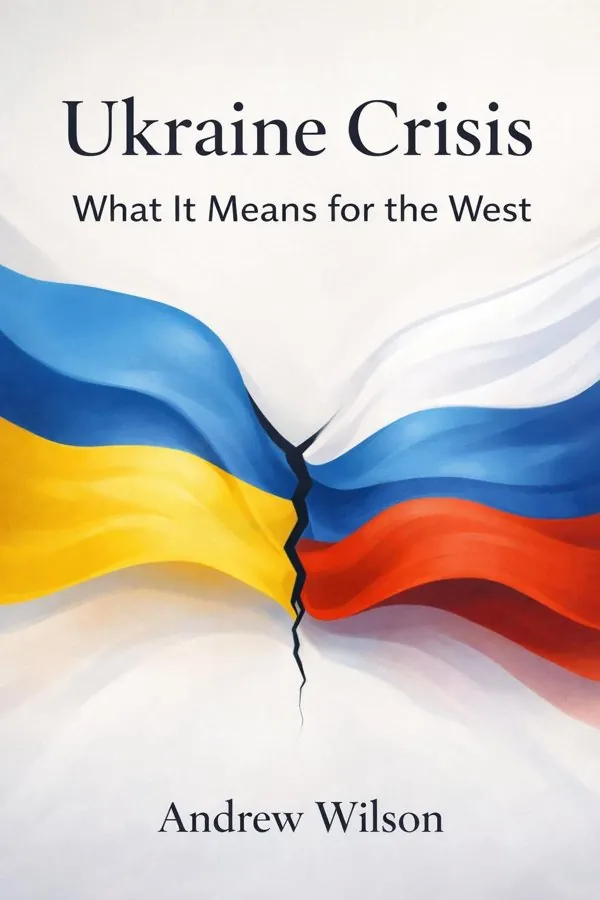
Ukraine Crisis: What It Means for the West: Summary & Key Insights
 10 min6 chaptersAudio available
What Is Ukraine Crisis: What It Means for the West About?
Ukraine Crisis: What It Means for the West by Andrew Wilson is a politics book spanning 6 pages. In this incisive analysis, Andrew Wilson, a leading expert on Ukrainian politics, examines the roots and repercussions of the 2013–2014 Euromaidan uprising and Russia’s subsequent intervention. Drawing on firsthand experience and deep regional expertise, Wilson explores how the crisis reshaped relations between Ukraine, Russia, and the West, and what it reveals about the future of European security.
This FizzRead summary covers all 6 key chapters of Ukraine Crisis: What It Means for the West in approximately 10 minutes, distilling the most important ideas, arguments, and takeaways from Andrew Wilson's work. Also available as an audio summary and Key Quotes Podcast.
Ukraine Crisis: What It Means for the West
In this incisive analysis, Andrew Wilson, a leading expert on Ukrainian politics, examines the roots and repercussions of the 2013–2014 Euromaidan uprising and Russia’s subsequent intervention. Drawing on firsthand experience and deep regional expertise, Wilson explores how the crisis reshaped relations between Ukraine, Russia, and the West, and what it reveals about the future of European security.
Who Should Read Ukraine Crisis: What It Means for the West?
This book is perfect for anyone interested in politics and looking to gain actionable insights in a short read. Whether you're a student, professional, or lifelong learner, the key ideas from Ukraine Crisis: What It Means for the West by Andrew Wilson will help you think differently.
- ✓Readers who enjoy politics and want practical takeaways
- ✓Professionals looking to apply new ideas to their work and life
- ✓Anyone who wants the core insights of Ukraine Crisis: What It Means for the West in just 10 minutes
Want the full summary?
Get instant access to this book summary and 100K+ more with Fizz Moment.
Get Free SummaryAvailable on App Store • Free to download
Key Chapters
To understand the crisis, we have to return to 1991, when Ukraine emerged from the shadow of the Soviet Union. Independence brought enthusiasm but also confusion: the institutional memory of democracy was thin, and regional identities were divergent. In the west, there was a strong European orientation—rooted in experiences under Polish and Austro-Hungarian rule. In the east and south, heavily industrialized and Russophone regions maintained deep economic and cultural ties to Moscow. This duality would become the axis around which Ukraine’s politics revolved.
During the 1990s, successive governments oscillated between reform and regression, seeking support from both Brussels and Moscow. The country’s oligarchic system consolidated early, with industrial magnates dominating party structures and media networks. As I emphasize in the book, this hybrid system produced a pseudo-democratic façade: elections occurred, but the power of informal networks outweighed the institutions. By the time of the Orange Revolution in 2004, Ukraine had already been wrestling for more than a decade with an unresolved question—was it to integrate with Europe or to remain tethered to Russia’s sphere of influence? The revolution briefly promised change but did not break the cycle of corruption and factionalism, leaving the door open for disillusionment and, later, for Viktor Yanukovych’s comeback.
Seen in historical perspective, the Euromaidan was not an anomaly but the latest manifestation of Ukraine’s long struggle to define its post-Soviet identity. The country’s failure to fully implement reforms after 2004 meant that when Yanukovych decided to turn away from the European Union, his betrayal touched a deep nerve. Ukrainians saw it not just as a political maneuver but as the negation of all their previous sacrifices. That awakening propelled the events of 2013 toward confrontation, revealing the unfinished project of nation-building that had been deferred for two decades.
Viktor Yanukovych’s presidency, beginning in 2010, epitomized the blending of personal power with systemic dysfunction. My research traced how his rule was shaped not only by his own authoritarian instincts but by the convergence of oligarchic interests determined to shield their wealth from European transparency. When Yanukovych first took office, he pledged stability and modernization. In practice, however, he consolidated power around himself and his ‘family’—a close circle of loyalists who monopolized key ministries and economic sectors.
The central moment came in late 2013 when Yanukovych chose to suspend preparations for signing the EU Association Agreement, a policy seen as the culmination of Ukraine’s European trajectory. This was a decision crafted under direct pressure from Moscow, which offered financial incentives and the threat of economic sanctions. The reversal was not merely pragmatic— it symbolized a rejection of Europe and an embrace of Russian tutelage. For many Ukrainians, it was the ultimate humiliation: their leadership had canceled the promise of modernization in exchange for opaque deals that perpetuated the status quo.
What followed was a domino effect. Disillusionment ignited anger, and anger found expression on the streets. Yanukovych underestimated the civic consciousness that had grown since the Orange Revolution. Believing that intimidation would suffice, his regime reacted with violence rather than dialogue. The greater his repression, the more the society united. This chapter of the book illustrates how corruption and authoritarianism can destroy even fragile legitimacy, how foreign policy decisions intertwine with domestic moral collapse, and how that dynamic made confrontation inevitable. When power is based on fear and enrichment rather than accountability, it cannot withstand a nation’s demand for dignity.
+ 4 more chapters — available in the FizzRead app
All Chapters in Ukraine Crisis: What It Means for the West
About the Author
Andrew Wilson is a Senior Policy Fellow at the European Council on Foreign Relations and Reader in Ukrainian Studies at University College London’s School of Slavonic and East European Studies. He is widely recognized for his scholarship on post-Soviet politics and Ukrainian affairs.
Get This Summary in Your Preferred Format
Read or listen to the Ukraine Crisis: What It Means for the West summary by Andrew Wilson anytime, anywhere. FizzRead offers multiple formats so you can learn on your terms — all free.
Available formats: App · Audio · PDF · EPUB — All included free with FizzRead
Download Ukraine Crisis: What It Means for the West PDF and EPUB Summary
Key Quotes from Ukraine Crisis: What It Means for the West
“To understand the crisis, we have to return to 1991, when Ukraine emerged from the shadow of the Soviet Union.”
“Viktor Yanukovych’s presidency, beginning in 2010, epitomized the blending of personal power with systemic dysfunction.”
Frequently Asked Questions about Ukraine Crisis: What It Means for the West
Ukraine Crisis: What It Means for the West by Andrew Wilson is a politics book that explores key ideas across 6 chapters. In this incisive analysis, Andrew Wilson, a leading expert on Ukrainian politics, examines the roots and repercussions of the 2013–2014 Euromaidan uprising and Russia’s subsequent intervention. Drawing on firsthand experience and deep regional expertise, Wilson explores how the crisis reshaped relations between Ukraine, Russia, and the West, and what it reveals about the future of European security.
You Might Also Like
Antifa: The Anti-Fascist Handbook
Mark Bray
10 min
Attack from Within: How Disinformation Is Sabotaging America
Barbara McQuade
10 min
Coercion, Capital, and European States, AD 990–1992
Charles Tilly
10 min
Digital Democracy: Concepts, Methodologies, Tools, and Applications
Various Authors
10 min
Fascism
Stanley G. Payne
10 min
Fire And Fury: Inside The Trump White House
Michael Wolff
10 minBrowse by Category
Ready to read Ukraine Crisis: What It Means for the West?
Get the full summary and 100K+ more books with Fizz Moment.