
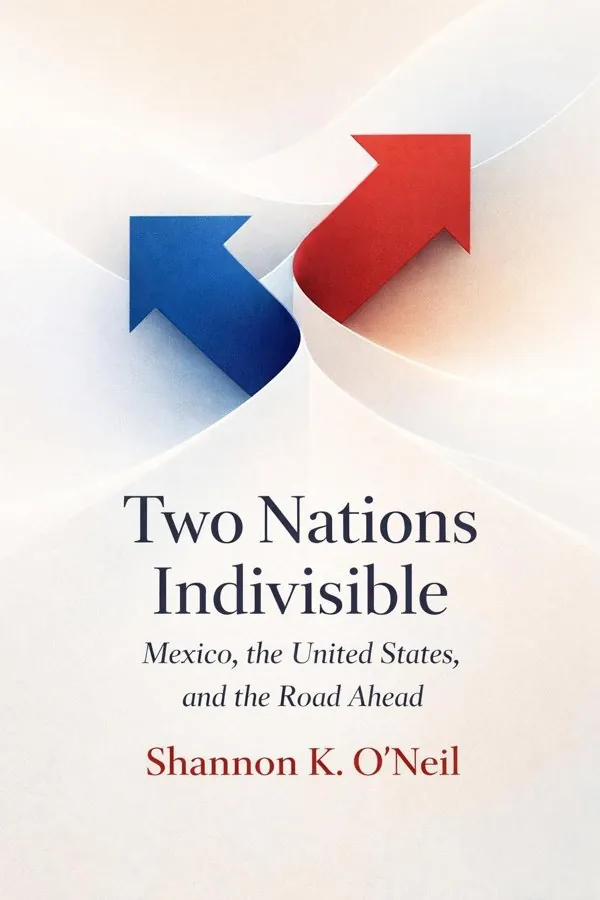
Two Nations Indivisible: Mexico, the United States, and the Road Ahead: Summary & Key Insights
 10 min9 chaptersAudio available
Key Takeaways from Two Nations Indivisible: Mexico, the United States, and the Road Ahead
The border may look fixed on a map, but the relationship behind it has always been fluid, contested, and deeply consequential.
One of the book's most striking insights is that Mexico has transformed more quickly than many outsiders have noticed.
If politics still talks in national terms, the economy often behaves as if the two countries are parts of one production system.
Migration is often framed as a problem to contain, but O'Neil asks readers to see it as a force that has remade both societies.
Violence crosses borders even when sovereignty does not.
What Is Two Nations Indivisible: Mexico, the United States, and the Road Ahead About?
Two Nations Indivisible: Mexico, the United States, and the Road Ahead by Shannon K. O'Neil is a politics book spanning 11 pages. Two Nations Indivisible argues that Mexico and the United States can no longer be understood as separate national stories loosely connected by a border. Shannon K. O'Neil shows that the two countries are already deeply intertwined through trade, migration, manufacturing, security, energy, culture, and everyday family life. Her central claim is both simple and urgent: the future of North America depends on recognizing this interdependence and building smarter policies around it. What makes the book especially important is its timing and perspective. Public debate in the United States often reduces Mexico to immigration crises, drug violence, or border politics. O'Neil pushes past these narrow frames to reveal a more complex reality: Mexico is a transforming democracy, a major economic partner, and a country whose success directly affects U.S. prosperity and stability. She argues that outdated assumptions lead to bad policy, while cooperation can unlock growth and security on both sides. O'Neil writes with authority as a leading expert on Latin America and U.S.-Mexico relations at the Council on Foreign Relations. Her analysis combines history, policy insight, and economic evidence to make a persuasive case for a more realistic and constructive partnership.
This FizzRead summary covers all 9 key chapters of Two Nations Indivisible: Mexico, the United States, and the Road Ahead in approximately 10 minutes, distilling the most important ideas, arguments, and takeaways from Shannon K. O'Neil's work. Also available as an audio summary and Key Quotes Podcast.
Two Nations Indivisible: Mexico, the United States, and the Road Ahead
Two Nations Indivisible argues that Mexico and the United States can no longer be understood as separate national stories loosely connected by a border. Shannon K. O'Neil shows that the two countries are already deeply intertwined through trade, migration, manufacturing, security, energy, culture, and everyday family life. Her central claim is both simple and urgent: the future of North America depends on recognizing this interdependence and building smarter policies around it.
What makes the book especially important is its timing and perspective. Public debate in the United States often reduces Mexico to immigration crises, drug violence, or border politics. O'Neil pushes past these narrow frames to reveal a more complex reality: Mexico is a transforming democracy, a major economic partner, and a country whose success directly affects U.S. prosperity and stability. She argues that outdated assumptions lead to bad policy, while cooperation can unlock growth and security on both sides.
O'Neil writes with authority as a leading expert on Latin America and U.S.-Mexico relations at the Council on Foreign Relations. Her analysis combines history, policy insight, and economic evidence to make a persuasive case for a more realistic and constructive partnership.
Who Should Read Two Nations Indivisible: Mexico, the United States, and the Road Ahead?
This book is perfect for anyone interested in politics and looking to gain actionable insights in a short read. Whether you're a student, professional, or lifelong learner, the key ideas from Two Nations Indivisible: Mexico, the United States, and the Road Ahead by Shannon K. O'Neil will help you think differently.
- ✓Readers who enjoy politics and want practical takeaways
- ✓Professionals looking to apply new ideas to their work and life
- ✓Anyone who wants the core insights of Two Nations Indivisible: Mexico, the United States, and the Road Ahead in just 10 minutes
Want the full summary?
Get instant access to this book summary and 100K+ more with Fizz Moment.
Get Free SummaryAvailable on App Store • Free to download
Key Chapters
One of the book's most striking insights is that Mexico has transformed more quickly than many outsiders have noticed. For decades, the country was associated with one-party dominance under the PRI, weak accountability, and a political system built on centralized control. O'Neil argues that this image is now badly outdated. Mexico's modern political story is one of democratic competition, stronger institutions, civic activism, and expanding public debate.
This democratic transformation matters because politics shapes everything else: economic reform, social policy, local governance, and the credibility of the state. As elections became more competitive and power shifted among parties, governors, legislators, courts, journalists, and citizens gained new influence. This did not solve every problem. Corruption, uneven rule of law, and local political capture remain serious concerns. But the core change is real: Mexico is not the closed political system many foreigners still imagine.
O'Neil uses this transformation to challenge simplistic thinking. If U.S. policymakers treat Mexico as passive or politically backward, they miss the fact that it is a sovereign democracy with internal debates and domestic constraints. For business leaders, this means recognizing regional variation, electoral competition, and policy complexity. For citizens, it means understanding that reform in Mexico is often driven internally, not imposed from abroad.
A useful application is to read headlines about Mexico with a more nuanced lens. Instead of asking whether Mexico is "stable" or "unstable," ask which institutions are strengthening, where reform is advancing, and how democratic pressures are reshaping policy. The actionable takeaway: replace stereotypes with institutional analysis. To understand Mexico today, follow its elections, courts, state governments, and civil society as seriously as its crises.
If politics still talks in national terms, the economy often behaves as if the two countries are parts of one production system. O'Neil argues that U.S.-Mexico economic integration is not a future possibility but a current reality. Trade agreements, supply chains, investment flows, and cross-border manufacturing have linked workers and companies so tightly that prosperity in one country increasingly depends on competitiveness in the other.
This is especially visible in manufacturing. A product assembled in the United States may include components made in Mexico, and Mexican exports often contain substantial U.S. content. That means trade between the two nations is not simply one side selling finished goods to the other. It is a collaborative process in which value is created jointly. Industries such as automobiles, electronics, aerospace, and agriculture illustrate this interdependence. Border delays, regulatory confusion, or political hostility do not just hurt one side; they weaken the entire regional production chain.
O'Neil pushes readers to move beyond zero-sum thinking. The common fear that Mexico's growth automatically comes at the expense of American workers misses how integrated production can strengthen North America's position against global competitors. Investments in logistics, customs modernization, education, and infrastructure can create shared gains. Likewise, when violence or institutional weakness disrupts commerce in Mexico, U.S. businesses and consumers feel the effects.
A practical application is to think of the border less as a wall between economies and more as a seam in a larger manufacturing platform. Policymakers should prioritize efficient crossings and common standards; companies should plan regionally rather than nationally. The actionable takeaway: when assessing jobs, trade, or industrial strategy, evaluate U.S. and Mexican capacity together, because competitiveness now depends on both.
Migration is often framed as a problem to contain, but O'Neil asks readers to see it as a force that has remade both societies. Millions of people, families, and communities stretch across the U.S.-Mexico border through work, remittances, marriages, language, education, and culture. These ties are not incidental. They are one of the main reasons the two countries are, in practice, socially interdependent.
The book emphasizes that migration has economic and demographic dimensions as well as human ones. In the United States, Mexican and Mexican American communities contribute labor, entrepreneurship, tax revenue, and cultural vitality. In Mexico, migration has long shaped local economies through remittances and knowledge transfer. At the same time, migration patterns evolve. O'Neil shows that public debate often freezes them in place, even when fertility rates, labor markets, and enforcement conditions are changing the flow itself.
This perspective matters because bad policy often comes from incomplete narratives. If migration is seen only through the lens of illegality, policymakers miss how labor demand, family reunification, and regional development interact. Employers depend on cross-border labor systems; schools educate bilingual populations; cities are transformed by transnational ties. Even identity becomes shared, as millions of people navigate both nations at once.
In practical terms, communities can respond better by investing in integration rather than denial: bilingual education, fair labor standards, legal pathways, and local institutions that reflect demographic reality. Individuals can also rethink immigration debates by asking what roles migrants already play in the economy and social fabric. The actionable takeaway: treat migration not merely as border management, but as a long-term social reality that requires humane, economically literate, and future-oriented policy.
Violence crosses borders even when sovereignty does not. O'Neil argues that security challenges between Mexico and the United States are deeply interconnected, making unilateral strategies both politically tempting and practically insufficient. Drug trafficking, arms flows, money laundering, organized crime, and weak justice systems form a shared security ecosystem. Focusing only on one side of the border obscures how demand, supply, corruption, and enforcement failures reinforce one another.
A central strength of the book is that it avoids simplistic blame. Mexico's security crisis cannot be understood without acknowledging the role of U.S. drug consumption, the southbound flow of weapons, and financial systems that enable criminal profits. At the same time, Mexico's own institutional weaknesses, local corruption, and uneven law enforcement capacity are crucial parts of the problem. O'Neil's point is not that responsibility is equal in every area, but that responsibility is undeniably shared.
This has direct policy implications. Border fortification alone cannot dismantle transnational criminal networks. Nor can military-style crackdowns succeed without courts, police reform, and prosecutorial capacity. Real progress depends on intelligence sharing, judicial cooperation, anti-corruption efforts, financial monitoring, and institution-building. Everyday examples include tracing weapons sales, coordinating customs inspections, and improving local policing where violence disrupts trade and civil life.
For citizens, the broader lesson is to resist political narratives that promise quick fixes through walls, raids, or slogans. Security is not achieved by theatrical toughness; it is built through capable institutions on both sides. The actionable takeaway: support policies that combine enforcement with institutional reform, and judge security strategies by whether they reduce incentives and capacity for crime across the entire cross-border system.
Nature rarely respects political lines, and neither do modern energy systems. O'Neil highlights how the United States and Mexico are linked not only through commerce and migration but also through shared environmental pressures and energy opportunities. Air quality, water use, climate risks, electricity infrastructure, and fossil fuel markets all create practical reasons for cooperation, whether or not politics is ready to admit it.
Mexico's energy sector has long been central to its national identity, but O'Neil shows that energy policy is also part of the broader North American story. Reform, investment, and cross-border infrastructure can increase efficiency, support growth, and deepen strategic integration. At the same time, environmental challenges such as drought, pollution, and climate stress affect communities on both sides of the border. A river, emissions plume, or heat wave does not stop for customs inspection.
The larger argument is that shared geography creates shared incentives. Coordinated energy policy can strengthen competitiveness by lowering costs and improving reliability. Joint environmental planning can reduce conflict over scarce resources and prepare regions for climate-related disruption. Border communities especially illustrate this reality: factories need power, farms need water, and cities need sustainable growth strategies. If each country acts in isolation, both become more vulnerable.
A practical application is to think about infrastructure regionally. Electricity grids, pipelines, water agreements, and environmental monitoring all benefit from binational planning. Businesses can factor environmental resilience into supply-chain decisions; policymakers can align regulation to support clean and secure energy flows. The actionable takeaway: treat energy and environmental policy as shared strategic concerns, not domestic issues with occasional cross-border side effects.
Sometimes the biggest barrier between neighboring countries is not distance but imagination. O'Neil argues that Americans and Mexicans often misunderstand one another in ways that distort policy and shrink opportunity. In the United States, Mexico is too often reduced to a narrow set of images: migrants, cartels, corruption, or cheap labor. In Mexico, the United States can appear alternately domineering, hypocritical, or indifferent. These caricatures contain fragments of truth, but they are too partial to guide serious decisions.
The cost of these misperceptions is high. They make electorates more receptive to fear-based rhetoric, discourage investment, and undermine support for long-term cooperation. They also create strategic blind spots. If Americans fail to see Mexico as a growing middle-income democracy and manufacturing power, they miss one of their most important partners. If Mexicans see the United States only through intervention or anti-immigrant politics, they may overlook how deeply local prosperity depends on bilateral ties.
O'Neil's analysis suggests that perception is not a cosmetic issue; it shapes what leaders believe is politically possible. Better understanding can widen the policy menu. Student exchanges, media coverage, business partnerships, and subnational cooperation all matter because they expose citizens to realities more complex than campaign slogans. Border states and major cities often understand this better than national politicians do, because they experience interdependence directly.
A practical step is to diversify your information sources. Read reporting from both countries, examine economic data, and pay attention to regional differences within Mexico and the United States. The actionable takeaway: challenge every one-dimensional narrative about the other country. More accurate perception is not just morally preferable; it is strategically essential.
Domestic reform in Mexico is often treated as Mexico's business alone, yet O'Neil makes clear that its outcomes reverberate across North America. Improvements in rule of law, education, taxation, infrastructure, competition policy, and governance do more than strengthen Mexico internally. They also make the entire region more productive, secure, and attractive to investment. A more capable Mexican state is not a distant foreign policy goal for the United States; it is a practical regional interest.
This argument is particularly important because it reframes the bilateral relationship. Instead of seeing Mexico mainly as a source of challenges to manage, O'Neil encourages readers to see it as a country whose successful modernization creates mutual gains. Stronger institutions support safer supply chains, broader consumer markets, lower transaction costs, and more reliable partnerships. For example, judicial reform can improve contract enforcement, infrastructure reform can speed trade, and education reform can raise the value of regional production.
At the same time, reform is hard. Mexico faces entrenched interests, uneven local capacity, and the difficulty of translating policy changes into everyday outcomes. O'Neil does not romanticize this process. Her point is that reform should be understood as ongoing, contested, and consequential, not as a single event that either succeeded or failed.
For policymakers and investors, the practical lesson is to track institutional quality, not just headline growth rates. For citizens, it means understanding why developments in Mexican governance matter beyond Mexico's borders. The actionable takeaway: pay attention to reforms in justice, education, infrastructure, and competition policy, because these are not abstract domestic issues—they help determine the future strength of North America as a whole.
The most important question in the book is not whether Mexico and the United States are interconnected—they already are—but whether their leaders will act like it. O'Neil's vision of the road ahead is grounded in a simple idea: interdependence can produce either shared prosperity or recurring crisis, depending on whether policy catches up to reality. Geography guarantees closeness; strategy determines whether that closeness becomes an advantage.
She argues that the United States faces a choice. It can continue to approach Mexico episodically, focusing only when there is a border surge, cartel violence, or political controversy. Or it can build a long-term framework based on competitiveness, institutional cooperation, mobility, and mutual respect. The second path requires more disciplined thinking. It means seeing Mexico not as an afterthought in U.S. foreign policy, but as a core partner in economic growth, regional resilience, and global positioning.
The same principle applies beyond government. Businesses can invest with a North American mindset. Universities can deepen exchanges. Local officials can build cross-border problem-solving networks. Citizens can reject narratives that profit from division. O'Neil's road ahead is not utopian; it is pragmatic. The countries do not need to erase differences to work together effectively. They need to recognize that many of their most urgent problems and most promising opportunities are already shared.
The actionable takeaway is to adopt a partnership test: when evaluating any major issue involving Mexico and the United States, ask whether the proposed solution reflects the reality of interdependence. If it does not, it is probably too narrow to work.
All Chapters in Two Nations Indivisible: Mexico, the United States, and the Road Ahead
About the Author
Shannon K. O'Neil is a prominent scholar and policy expert specializing in Latin America, with particular emphasis on Mexico, trade, democracy, and U.S. foreign relations in the region. She has served as a senior fellow for Latin America Studies at the Council on Foreign Relations, where her work has focused on how political and economic change in Latin America shapes the United States and the wider world. O'Neil is widely recognized for her clear analysis of U.S.-Mexico integration, including issues such as migration, manufacturing, institutional reform, and regional competitiveness. Her writing bridges academic research and practical policymaking, making complex international issues accessible to broader audiences. In Two Nations Indivisible, she brings that expertise to a timely argument about why the future of the United States and Mexico must be understood together.
Get This Summary in Your Preferred Format
Read or listen to the Two Nations Indivisible: Mexico, the United States, and the Road Ahead summary by Shannon K. O'Neil anytime, anywhere. FizzRead offers multiple formats so you can learn on your terms — all free.
Available formats: App · Audio · PDF · EPUB — All included free with FizzRead
Download Two Nations Indivisible: Mexico, the United States, and the Road Ahead PDF and EPUB Summary
Key Quotes from Two Nations Indivisible: Mexico, the United States, and the Road Ahead
“The border may look fixed on a map, but the relationship behind it has always been fluid, contested, and deeply consequential.”
“One of the book's most striking insights is that Mexico has transformed more quickly than many outsiders have noticed.”
“If politics still talks in national terms, the economy often behaves as if the two countries are parts of one production system.”
“Migration is often framed as a problem to contain, but O'Neil asks readers to see it as a force that has remade both societies.”
“Violence crosses borders even when sovereignty does not.”
Frequently Asked Questions about Two Nations Indivisible: Mexico, the United States, and the Road Ahead
Two Nations Indivisible: Mexico, the United States, and the Road Ahead by Shannon K. O'Neil is a politics book that explores key ideas across 9 chapters. Two Nations Indivisible argues that Mexico and the United States can no longer be understood as separate national stories loosely connected by a border. Shannon K. O'Neil shows that the two countries are already deeply intertwined through trade, migration, manufacturing, security, energy, culture, and everyday family life. Her central claim is both simple and urgent: the future of North America depends on recognizing this interdependence and building smarter policies around it. What makes the book especially important is its timing and perspective. Public debate in the United States often reduces Mexico to immigration crises, drug violence, or border politics. O'Neil pushes past these narrow frames to reveal a more complex reality: Mexico is a transforming democracy, a major economic partner, and a country whose success directly affects U.S. prosperity and stability. She argues that outdated assumptions lead to bad policy, while cooperation can unlock growth and security on both sides. O'Neil writes with authority as a leading expert on Latin America and U.S.-Mexico relations at the Council on Foreign Relations. Her analysis combines history, policy insight, and economic evidence to make a persuasive case for a more realistic and constructive partnership.
You Might Also Like
Antifa: The Anti-Fascist Handbook
Mark Bray
10 min
Attack from Within: How Disinformation Is Sabotaging America
Barbara McQuade
10 min
Coercion, Capital, and European States, AD 990–1992
Charles Tilly
10 min
Digital Democracy: Concepts, Methodologies, Tools, and Applications
Various Authors
10 min
Fascism
Stanley G. Payne
10 min
Fire And Fury: Inside The Trump White House
Michael Wolff
10 minBrowse by Category
Ready to read Two Nations Indivisible: Mexico, the United States, and the Road Ahead?
Get the full summary and 100K+ more books with Fizz Moment.