
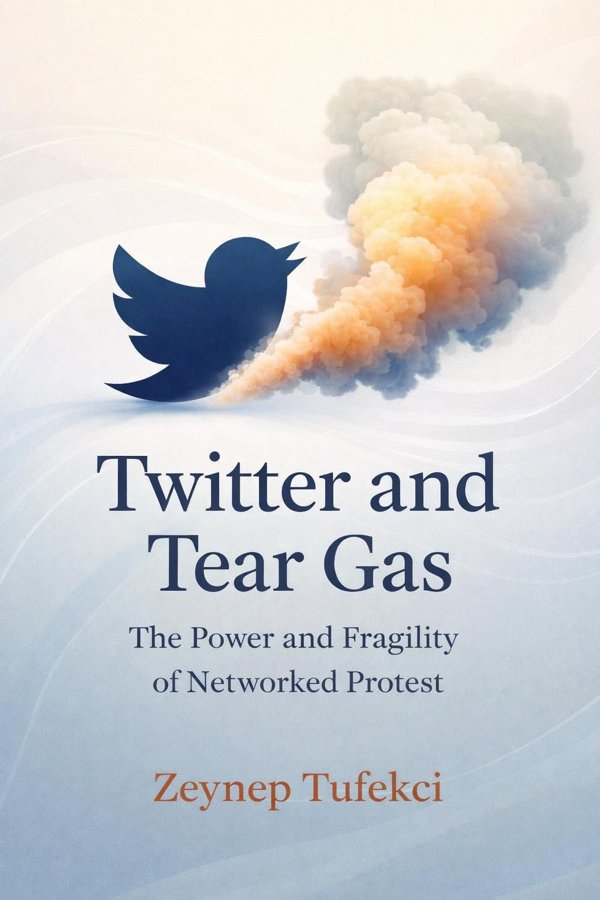
Twitter and Tear Gas: The Power and Fragility of Networked Protest: Summary & Key Insights
 10 min6 chaptersAudio available
What Is Twitter and Tear Gas: The Power and Fragility of Networked Protest About?
Twitter and Tear Gas: The Power and Fragility of Networked Protest by Zeynep Tufekci is a sociology book spanning 6 pages. In this groundbreaking work, sociologist Zeynep Tufekci examines how digital technologies have transformed social movements. Drawing on firsthand research from protests around the world—from the Arab Spring to Occupy Wall Street—she explores how social media empowers activists to organize rapidly but also exposes them to new vulnerabilities. Tufekci argues that while online networks can mobilize people at unprecedented speed, they often lack the organizational depth needed for long-term change.
This FizzRead summary covers all 6 key chapters of Twitter and Tear Gas: The Power and Fragility of Networked Protest in approximately 10 minutes, distilling the most important ideas, arguments, and takeaways from Zeynep Tufekci's work. Also available as an audio summary and Key Quotes Podcast.
Twitter and Tear Gas: The Power and Fragility of Networked Protest
In this groundbreaking work, sociologist Zeynep Tufekci examines how digital technologies have transformed social movements. Drawing on firsthand research from protests around the world—from the Arab Spring to Occupy Wall Street—she explores how social media empowers activists to organize rapidly but also exposes them to new vulnerabilities. Tufekci argues that while online networks can mobilize people at unprecedented speed, they often lack the organizational depth needed for long-term change.
Who Should Read Twitter and Tear Gas: The Power and Fragility of Networked Protest?
This book is perfect for anyone interested in sociology and looking to gain actionable insights in a short read. Whether you're a student, professional, or lifelong learner, the key ideas from Twitter and Tear Gas: The Power and Fragility of Networked Protest by Zeynep Tufekci will help you think differently.
- ✓Readers who enjoy sociology and want practical takeaways
- ✓Professionals looking to apply new ideas to their work and life
- ✓Anyone who wants the core insights of Twitter and Tear Gas: The Power and Fragility of Networked Protest in just 10 minutes
Want the full summary?
Get instant access to this book summary and 100K+ more with Fizz Moment.
Get Free SummaryAvailable on App Store • Free to download
Key Chapters
When I first studied earlier social movements—the civil rights struggle in the United States, the Polish Solidarity movement, or the South African anti-apartheid struggle—I was struck by their deeply organized nature. They had clear leadership, membership structures, and internal decision-making processes that evolved over time. Their communication networks were slow but deliberate; their relationships, though harder to form, were strong.
In contrast, the digital era ushered in movements that could assemble masses in days or even hours. Facebook events replaced flyers; hashtags replaced phone trees. The speed and scale were astonishing, but something crucial changed along the way: the infrastructure for sustaining commitment weakened. When no one needs to ask for time, money, or risk before showing up, participation surges—but so does volatility. People can join instantaneously, but they can also leave just as quickly.
This shift from hierarchical organization to networked coordination redefined the meaning of participation. Movements no longer needed centralized leadership, but they also struggled to develop coherence. No one voice defined the message, and while this openness fostered creativity, it also left movements vulnerable to noise and division. The pre-digital organizations that survived repression had built resilient networks precisely because they were forged in adversity. By contrast, digital-era movements could become victims of their own rapid success, lacking the slow institutional muscle developed through years of organizing.
Thus, we entered an era where movements could ignite faster than ever before yet often flicker out just as fast. Understanding this transformation is crucial to understanding the promise—and fragility—of our networked age.
I will never forget standing in Cairo’s Tahrir Square, surrounded by people whose courage was amplified by the glow of their phones. Here, the chant of liberation was shared in real time with millions beyond Egypt’s borders. Twitter feeds were flooded with updates, videos, and pleas for solidarity. Facebook pages coordinated meeting points and safety routes. The same digital networks that once carried gossip and satire were now highways of revolutionary energy.
The story of the Arab Spring reveals how social media can collapse the distance between private grievances and public action. When individuals realize that thousands share their frustrations—and that these frustrations are visible—it alters the calculus of fear. What used to be isolated whispers became a chorus made visible to the world. This visibility energized people to overcome the psychological barriers of repression.
Yet, the same speed that enabled mobilization also masked the absence of organizational foundations. Dictators fell, but institutions did not emerge in their place. Online coordination had been enough to fill the square, but it was not enough to fill the void after the square emptied. Movements that lacked internal deliberation structures found themselves unable to navigate the complexities of transition. This was not due to the failure of individuals but to the structural characteristics of digital-era collective action.
As I observed firsthand, the internet democratized the microphone but not necessarily the organizational know-how essential for long-term governance. The Egyptian activists were skilled digital communicators; they were not always prepared for the slow, messy, and enduring work of reconstruction. This pattern—rapid success followed by stagnation—would echo across continents in the years to come.
+ 4 more chapters — available in the FizzRead app
All Chapters in Twitter and Tear Gas: The Power and Fragility of Networked Protest
About the Author
Zeynep Tufekci is a Turkish-American sociologist and writer whose research focuses on the social implications of technology, digital activism, and the public sphere. She is a professor at Columbia University and a contributing writer for The New York Times, known for her insightful analysis of the intersection between technology and society.
Get This Summary in Your Preferred Format
Read or listen to the Twitter and Tear Gas: The Power and Fragility of Networked Protest summary by Zeynep Tufekci anytime, anywhere. FizzRead offers multiple formats so you can learn on your terms — all free.
Available formats: App · Audio · PDF · EPUB — All included free with FizzRead
Download Twitter and Tear Gas: The Power and Fragility of Networked Protest PDF and EPUB Summary
Key Quotes from Twitter and Tear Gas: The Power and Fragility of Networked Protest
“They had clear leadership, membership structures, and internal decision-making processes that evolved over time.”
“I will never forget standing in Cairo’s Tahrir Square, surrounded by people whose courage was amplified by the glow of their phones.”
Frequently Asked Questions about Twitter and Tear Gas: The Power and Fragility of Networked Protest
Twitter and Tear Gas: The Power and Fragility of Networked Protest by Zeynep Tufekci is a sociology book that explores key ideas across 6 chapters. In this groundbreaking work, sociologist Zeynep Tufekci examines how digital technologies have transformed social movements. Drawing on firsthand research from protests around the world—from the Arab Spring to Occupy Wall Street—she explores how social media empowers activists to organize rapidly but also exposes them to new vulnerabilities. Tufekci argues that while online networks can mobilize people at unprecedented speed, they often lack the organizational depth needed for long-term change.
You Might Also Like

Between the World and Me
Ta-Nehisi Coates
10 min
Half the Sky
Nicholas D. Kristof, Sheryl WuDunn
10 min
Men Explain Things To Me
Rebecca Solnit
10 min
Rational Ritual
Michael Suk-Young Chwe
10 min
The New Jim Crow
Michelle Alexander
10 min
Beyond Culture
Edward T. Hall
10 minBrowse by Category
Ready to read Twitter and Tear Gas: The Power and Fragility of Networked Protest?
Get the full summary and 100K+ more books with Fizz Moment.