
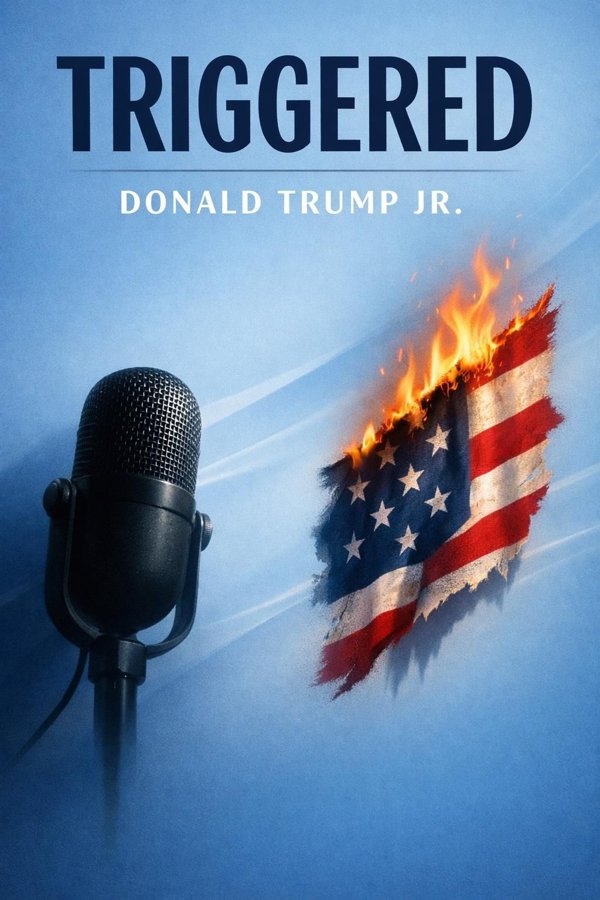
Triggered: How the Left Thrives on Hate and Wants to Silence Us: Summary & Key Insights
 10 min10 chaptersAudio available
Key Takeaways from Triggered: How the Left Thrives on Hate and Wants to Silence Us
Political identity often begins long before a person enters politics, and Trump Jr.
One of the book’s central claims is that media bias is not occasional error but a structural feature of modern political coverage.
People often become political not through theory but through collision, and Trump Jr.
At the heart of Triggered is the argument that progressive ideology increasingly operates through moral intimidation rather than persuasion.
The most urgent theme in the book is the belief that free speech is being narrowed not only by government pressure but by social, corporate, and cultural enforcement.
What Is Triggered: How the Left Thrives on Hate and Wants to Silence Us About?
Triggered: How the Left Thrives on Hate and Wants to Silence Us by Donald Trump Jr. is a politics book spanning 10 pages. Triggered is Donald Trump Jr.’s forceful defense of modern conservatism and his critique of what he sees as the cultural and political dominance of the American left. Part memoir, part political argument, and part media indictment, the book explores how public debate has become shaped by outrage, ideological policing, and selective standards for who gets heard and who gets condemned. Drawing on his upbringing in the Trump family, his years in business, and his visible role in the 2016 presidential campaign and beyond, Trump Jr. argues that conservatives are routinely caricatured by journalists, celebrities, academics, and political opponents who claim tolerance while punishing dissent. The book matters because it captures the tone, grievances, and messaging style of a major wing of contemporary American politics. Whether readers agree with him or not, Triggered offers insight into how many conservatives interpret media bias, cancel culture, identity politics, and the battle over free speech. Trump Jr.’s authority comes less from scholarly distance than from direct immersion in political combat, making this a revealing look at one side of America’s widening cultural divide.
This FizzRead summary covers all 10 key chapters of Triggered: How the Left Thrives on Hate and Wants to Silence Us in approximately 10 minutes, distilling the most important ideas, arguments, and takeaways from Donald Trump Jr.'s work. Also available as an audio summary and Key Quotes Podcast.
Triggered: How the Left Thrives on Hate and Wants to Silence Us
Triggered is Donald Trump Jr.’s forceful defense of modern conservatism and his critique of what he sees as the cultural and political dominance of the American left. Part memoir, part political argument, and part media indictment, the book explores how public debate has become shaped by outrage, ideological policing, and selective standards for who gets heard and who gets condemned. Drawing on his upbringing in the Trump family, his years in business, and his visible role in the 2016 presidential campaign and beyond, Trump Jr. argues that conservatives are routinely caricatured by journalists, celebrities, academics, and political opponents who claim tolerance while punishing dissent. The book matters because it captures the tone, grievances, and messaging style of a major wing of contemporary American politics. Whether readers agree with him or not, Triggered offers insight into how many conservatives interpret media bias, cancel culture, identity politics, and the battle over free speech. Trump Jr.’s authority comes less from scholarly distance than from direct immersion in political combat, making this a revealing look at one side of America’s widening cultural divide.
Who Should Read Triggered: How the Left Thrives on Hate and Wants to Silence Us?
This book is perfect for anyone interested in politics and looking to gain actionable insights in a short read. Whether you're a student, professional, or lifelong learner, the key ideas from Triggered: How the Left Thrives on Hate and Wants to Silence Us by Donald Trump Jr. will help you think differently.
- ✓Readers who enjoy politics and want practical takeaways
- ✓Professionals looking to apply new ideas to their work and life
- ✓Anyone who wants the core insights of Triggered: How the Left Thrives on Hate and Wants to Silence Us in just 10 minutes
Want the full summary?
Get instant access to this book summary and 100K+ more with Fizz Moment.
Get Free SummaryAvailable on App Store • Free to download
Key Chapters
Political identity often begins long before a person enters politics, and Trump Jr. presents his family life as the training ground for his worldview. He argues that growing up as a Trump meant living under intense scrutiny, constant criticism, and public assumptions that success must have come easily. In his telling, those experiences taught him not comfort but toughness. He describes his father as someone shaped by competition, negotiation, and public combat, and he suggests that this example influenced his own belief that survival in business and politics requires a thick skin.
This family background matters because it explains the emotional tone of the book. Trump Jr. does not write like an analyst observing events from afar; he writes like someone who believes conflict is normal and that elite disapproval is often a sign that you are challenging entrenched interests. He frames adversity as clarifying rather than defeating. Criticism, in this worldview, becomes proof that powerful institutions are trying to control the narrative.
In practical terms, this idea applies beyond politics. Many people face workplaces, institutions, or social environments where they feel stereotyped before they speak. Trump Jr.’s argument is that resilience begins when you stop treating outside approval as the measure of your worth. Instead of asking how to avoid criticism, ask what principles are worth enduring criticism for.
Actionable takeaway: Identify one area of your life where fear of judgment shapes your choices, and practice responding from conviction rather than from a need for acceptance.
One of the book’s central claims is that media bias is not occasional error but a structural feature of modern political coverage. Trump Jr. argues that journalists often present themselves as neutral referees while selectively framing stories in ways that disadvantage conservatives and protect progressives. In his view, the problem is not merely hostile opinion pieces but an entire ecosystem of headlines, omissions, tone, and repetition that turns political reporting into narrative management.
He points to the treatment of his father’s campaign and presidency as evidence. Statements were, he argues, often stripped of context, controversies were amplified unevenly, and corrections rarely received the same attention as initial accusations. This creates a powerful asymmetry: once a damaging interpretation enters the public conversation, it can shape impressions permanently even if later challenged. The result is a population that believes it is consuming facts while actually absorbing curated assumptions.
The broader lesson is that media literacy now requires more than reading the news. It requires comparing outlets, watching for emotional framing, and distinguishing verified reporting from ideological storytelling. A reader does not need to share Trump Jr.’s politics to recognize the danger of any information system in which gatekeepers claim objectivity while smuggling in value judgments.
In daily life, this means slowing down before reacting to viral clips, inflammatory headlines, or social-media outrage. Ask what is missing, who benefits from the framing, and whether alternative interpretations have been seriously considered.
Actionable takeaway: For one week, follow the same political story through three ideologically different sources and note how framing changes your perception.
People often become political not through theory but through collision, and Trump Jr. describes his own political awakening as emerging from firsthand exposure to public attacks, campaign pressures, and cultural hostility toward conservatives. Rather than portraying politics as an abstract contest of policies, he presents it as a fight over legitimacy: who gets to define decency, intelligence, and acceptable citizenship in America.
According to Trump Jr., entering the campaign world made him see how quickly establishment institutions could mobilize against outsiders. He suggests that many Americans experienced a similar awakening during the 2016 election cycle, realizing that elite approval was distributed according to ideology rather than fairness. What looked from a distance like ordinary political disagreement appeared, from inside the arena, as a coordinated effort to shame, isolate, and delegitimize dissenting voices.
This idea helps explain the emotional force of populist politics. Voters are not always responding only to tax plans, trade policy, or judicial appointments; they are also reacting to the feeling that they have been mocked, ignored, or treated as morally backward. Political engagement becomes personal when people believe institutions look down on them.
For readers, the key insight is that political convictions often harden when people sense condescension from those who claim to be tolerant. If you want better civic dialogue, you must understand not just what people believe, but what experiences made them believe it. Listening to the path behind a viewpoint is often more revealing than debating the viewpoint itself.
Actionable takeaway: Reflect on one moment that changed your political outlook and identify whether it was driven more by policy details or by a personal experience of trust or betrayal.
At the heart of Triggered is the argument that progressive ideology increasingly operates through moral intimidation rather than persuasion. Trump Jr. contends that the modern left presents itself as compassionate and inclusive while dividing people into rigid categories of victimhood and guilt. In his view, this framework discourages individual responsibility, treats disagreement as harm, and replaces open debate with ideological compliance.
He is especially critical of identity-based politics, arguing that it reduces citizens to race, gender, class, or other group labels instead of encouraging common national purpose. He sees this as politically effective but socially corrosive. If individuals are taught to interpret every interaction through oppression narratives, then compromise becomes betrayal and disagreement becomes evidence of malice. That dynamic, he suggests, makes democratic coexistence harder.
A practical example appears in institutional settings such as schools, corporations, and universities, where language codes, diversity trainings, or public statements can sometimes pressure people to signal virtue rather than discuss reality honestly. Trump Jr.’s warning is that when ideology becomes mandatory, truth becomes secondary to performance.
Whether one agrees with his diagnosis or not, the underlying concern is important: any political movement can become dangerous when it stops trying to convince and starts trying to stigmatize. A healthy society should allow people to challenge prevailing norms without fearing immediate moral exile.
Actionable takeaway: When evaluating a political claim, ask whether it invites honest discussion or pressures you to agree by making disagreement seem immoral.
The most urgent theme in the book is the belief that free speech is being narrowed not only by government pressure but by social, corporate, and cultural enforcement. Trump Jr. argues that many powerful institutions now reward ideological conformity and punish dissent through deplatforming, public shaming, employment consequences, and reputational attacks. In this environment, formal rights may remain intact while practical freedom shrinks.
His concern is not limited to famous political figures. He suggests ordinary people increasingly self-censor at work, on campus, online, and even among friends because they fear being mislabeled or professionally damaged. That fear changes the culture. Once enough people stay silent, the loudest activists appear to represent consensus, and controversial ideas become unsayable without ever being defeated on the merits.
This argument has broad relevance in the digital age. Social platforms amplify mob dynamics, employers respond rapidly to controversy, and short clips can detach comments from context. A society committed to free inquiry must therefore protect not just the right to speak, but the norm that disagreement should be answered with argument rather than annihilation.
In practice, defending free speech means applying standards consistently. If you support expression only for views you already share, you are defending preference, not liberty. Strong speech cultures require patience, proportion, and a willingness to tolerate offense without demanding suppression.
Actionable takeaway: Support one concrete norm of open dialogue in your workplace, school, or community, such as charitable disagreement, context before judgment, and due process before punishment.
Public backlash is one of the book’s most personal themes, and Trump Jr. portrays himself as a recurring target of outrage campaigns designed to discredit, embarrass, and isolate him. He describes a cycle in which comments are interpreted in the harshest possible way, online anger escalates, media outlets amplify the most negative framing, and opponents use the resulting controversy as proof of guilt. In his account, the process is less about truth than about exhaustion.
The larger point is that modern public life often runs on incentives that reward overreaction. Digital platforms elevate emotional content, and political opponents gain from keeping adversaries permanently on the defensive. That means reputation can be damaged not only by what someone says, but by how efficiently critics can manufacture scandal around it. Trump Jr. argues that this tactic is intended to make people retreat from public engagement altogether.
There is a useful lesson here for anyone navigating a reputation-based environment. Not every criticism is fair, and not every viral narrative deserves surrender. At the same time, public backlash tests clarity. It forces people to decide which values are core, which mistakes require correction, and which attacks should simply be endured without panic.
For leaders, creators, or professionals, the challenge is learning how to absorb criticism without becoming reckless or cynical. Strength is not the refusal to ever apologize; it is the ability to distinguish legitimate accountability from manipulative outrage.
Actionable takeaway: Before responding to criticism, separate it into three categories: fair, exaggerated, and malicious, then address each category with a different level of attention.
Trump Jr. treats humor and provocation as more than stylistic choices; he sees them as tools for resisting ideological control. In his view, political correctness depends partly on fear, and satire breaks that fear by refusing to treat elite assumptions as sacred. A joke can expose hypocrisy faster than a policy paper because it punctures status. That is why humor becomes politically threatening when it targets the people who are used to setting the rules.
He also acknowledges, implicitly and sometimes explicitly, that provocation attracts backlash. But he frames that backlash as revealing. If a culture tolerates mockery in one direction and condemns it in another, then its stated principles are not really universal. The response to humor can therefore expose hidden power structures: who gets protected, who gets caricatured, and who is expected to absorb contempt quietly.
In everyday communication, humor can lower defenses, energize allies, and make difficult topics more approachable. Yet it also carries risk. Without context or trust, provocative language can alienate listeners who might otherwise be persuadable. The strategic question is not whether to be provocative, but when provocation advances truth and when it merely produces heat.
Readers can apply this idea by thinking more carefully about tone. Effective dissent often mixes seriousness with wit because people remember what surprises them. But the goal should still be persuasion or exposure, not just performance.
Actionable takeaway: Use humor to challenge hypocrisy, but pair it with enough clarity that your audience understands the principle behind the joke.
Another major argument in Triggered is that political conflict in America cannot be understood only through ideology; it is also rooted in economic pressure and cultural displacement. Trump Jr. argues that many working and middle-class Americans feel abandoned by political leaders who speak the language of compassion while pursuing policies that weaken local industries, devalue national borders, and dismiss traditional communities as backward. In his telling, populist anger grows when people believe elites profit from systems whose costs are pushed onto everyone else.
He links cultural frustration with economic unease. A town that loses jobs often also loses confidence, stability, and a sense of future. When such communities are then mocked by media, ignored by policymakers, or lectured by urban professionals, resentment deepens. Trump Jr. suggests that this combination of material loss and cultural contempt helps explain why many voters rallied to an anti-establishment message.
This perspective highlights an important political reality: people want both prosperity and respect. Statistics about national growth mean little if individuals feel insecure, replaceable, or scorned. Effective leadership must therefore speak not just to markets but to belonging.
Applied broadly, this idea urges readers to look beneath slogans. Debates about trade, immigration, manufacturing, and energy are not merely technical disputes; they reflect competing visions of who a nation should prioritize and what kind of continuity it owes its citizens.
Actionable takeaway: When assessing a policy, ask two questions: who benefits economically, and which communities bear the hidden social or cultural costs?
Trump Jr. presents his father’s presidency as a disruptive challenge to both political orthodoxy and institutional complacency. In his account, the administration’s significance lies not only in specific policies but in its willingness to confront assumptions that many Republicans and Democrats had accepted for years. Trade deals, border enforcement, judicial appointments, deregulation, and foreign policy rhetoric are framed as evidence that an outsider presidency could break habits the establishment had treated as untouchable.
The book suggests that this disruption explains the intensity of elite resistance. When a political figure threatens not just opposing policies but the status, credibility, and control of existing institutions, opposition becomes existential. Trump Jr. argues that many attacks on the presidency reflected panic over lost gatekeeping power as much as principled disagreement.
This idea matters because democratic politics often advances through disruption. Sometimes institutions need outsiders to expose routines that insiders no longer question. Of course, disruption also creates volatility, uncertainty, and backlash. The challenge is distinguishing productive disruption, which renews accountability, from destructive disruption, which weakens trust without building alternatives.
For readers, the lesson is to evaluate political leadership on multiple levels. Ask not only whether a leader is polished, but whether he or she changes outcomes, challenges stale assumptions, and gives neglected constituencies a voice. Style influences perception, but institutional impact shapes history.
Actionable takeaway: When judging any presidency or political movement, separate your assessment into three categories: policy results, institutional effects, and cultural symbolism.
Triggered closes around a broader strategic message: conservatism cannot survive by apologizing for itself. Trump Jr. argues that the right must stop accepting the left’s moral framing and instead articulate its own positive vision rooted in free speech, individual responsibility, national sovereignty, economic opportunity, and cultural self-respect. Defensive politics, in his view, invites endless retreat. Confidence is necessary not because conservatives are always correct, but because any movement that treats its principles as embarrassments will eventually abandon them.
He suggests that future conservative success depends on building institutions as well as winning elections. Media platforms, educational alternatives, cultural voices, and grassroots communities all matter because politics is downstream from the stories people hear every day about identity, fairness, merit, and freedom. If one side dominates those stories, policy victories alone will not last.
This is also an argument about posture. Trump Jr. believes many Americans are hungry for leaders who reject elite disdain instead of negotiating with it. That does not mean permanent outrage; it means refusing to let opponents define the boundaries of respectable thought. A movement with confidence can engage criticism without absorbing its accusers’ assumptions.
For readers across the political spectrum, the broader lesson is that durable ideas need institutions, language, and courage. Values fade when they are not defended publicly and lived consistently.
Actionable takeaway: Clarify the top three principles you would defend even under social pressure, and then look for one organization, publication, or community that actively supports them.
All Chapters in Triggered: How the Left Thrives on Hate and Wants to Silence Us
About the Author
Donald Trump Jr. is an American businessman, political figure, and author best known as the eldest son of former U.S. President Donald J. Trump. He served as an executive at the Trump Organization, where he was involved in real estate development, branding, and business operations. Over time, he became one of the most visible public advocates for his father’s political agenda, playing a major role in campaign events, media appearances, and conservative activism. Known for his blunt communication style and strong presence on social media, Trump Jr. has positioned himself as a vocal critic of mainstream media, progressive politics, and cancel culture. Through books, speeches, and commentary, he has become an influential voice within populist and nationalist circles of the modern American right.
Get This Summary in Your Preferred Format
Read or listen to the Triggered: How the Left Thrives on Hate and Wants to Silence Us summary by Donald Trump Jr. anytime, anywhere. FizzRead offers multiple formats so you can learn on your terms — all free.
Available formats: App · Audio · PDF · EPUB — All included free with FizzRead
Download Triggered: How the Left Thrives on Hate and Wants to Silence Us PDF and EPUB Summary
Key Quotes from Triggered: How the Left Thrives on Hate and Wants to Silence Us
“Political identity often begins long before a person enters politics, and Trump Jr.”
“One of the book’s central claims is that media bias is not occasional error but a structural feature of modern political coverage.”
“People often become political not through theory but through collision, and Trump Jr.”
“At the heart of Triggered is the argument that progressive ideology increasingly operates through moral intimidation rather than persuasion.”
“The most urgent theme in the book is the belief that free speech is being narrowed not only by government pressure but by social, corporate, and cultural enforcement.”
Frequently Asked Questions about Triggered: How the Left Thrives on Hate and Wants to Silence Us
Triggered: How the Left Thrives on Hate and Wants to Silence Us by Donald Trump Jr. is a politics book that explores key ideas across 10 chapters. Triggered is Donald Trump Jr.’s forceful defense of modern conservatism and his critique of what he sees as the cultural and political dominance of the American left. Part memoir, part political argument, and part media indictment, the book explores how public debate has become shaped by outrage, ideological policing, and selective standards for who gets heard and who gets condemned. Drawing on his upbringing in the Trump family, his years in business, and his visible role in the 2016 presidential campaign and beyond, Trump Jr. argues that conservatives are routinely caricatured by journalists, celebrities, academics, and political opponents who claim tolerance while punishing dissent. The book matters because it captures the tone, grievances, and messaging style of a major wing of contemporary American politics. Whether readers agree with him or not, Triggered offers insight into how many conservatives interpret media bias, cancel culture, identity politics, and the battle over free speech. Trump Jr.’s authority comes less from scholarly distance than from direct immersion in political combat, making this a revealing look at one side of America’s widening cultural divide.
You Might Also Like
Antifa: The Anti-Fascist Handbook
Mark Bray
10 min
Attack from Within: How Disinformation Is Sabotaging America
Barbara McQuade
10 min
Coercion, Capital, and European States, AD 990–1992
Charles Tilly
10 min
Digital Democracy: Concepts, Methodologies, Tools, and Applications
Various Authors
10 min
Fascism
Stanley G. Payne
10 min
Fire And Fury: Inside The Trump White House
Michael Wolff
10 minBrowse by Category
Ready to read Triggered: How the Left Thrives on Hate and Wants to Silence Us?
Get the full summary and 100K+ more books with Fizz Moment.