
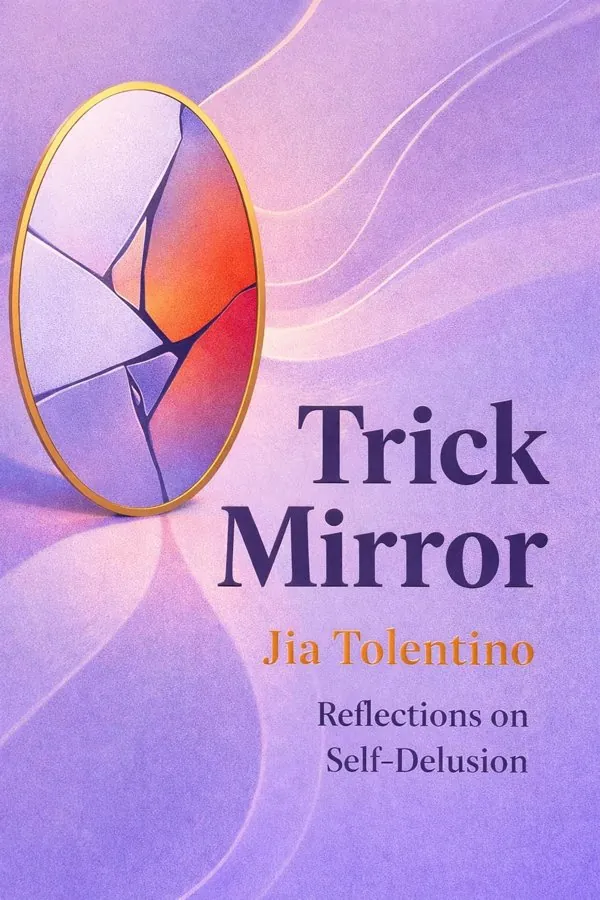
Trick Mirror: Reflections on Self-Delusion: Summary & Key Insights
 10 min9 chaptersAudio available
What Is Trick Mirror: Reflections on Self-Delusion About?
Trick Mirror: Reflections on Self-Delusion by Jia Tolentino is a sociology book spanning 9 pages. Trick Mirror is a collection of nine essays by Jia Tolentino that explore the ways in which self-delusion shapes contemporary culture. Through sharp analysis and personal reflection, Tolentino examines topics such as the internet’s influence on identity, the commercialization of feminism, the myth of the self-made woman, and the contradictions of modern life. The essays blend memoir, cultural criticism, and social commentary, offering a vivid portrait of the millennial experience in the digital age.
This FizzRead summary covers all 9 key chapters of Trick Mirror: Reflections on Self-Delusion in approximately 10 minutes, distilling the most important ideas, arguments, and takeaways from Jia Tolentino's work. Also available as an audio summary and Key Quotes Podcast.
Trick Mirror: Reflections on Self-Delusion
Trick Mirror is a collection of nine essays by Jia Tolentino that explore the ways in which self-delusion shapes contemporary culture. Through sharp analysis and personal reflection, Tolentino examines topics such as the internet’s influence on identity, the commercialization of feminism, the myth of the self-made woman, and the contradictions of modern life. The essays blend memoir, cultural criticism, and social commentary, offering a vivid portrait of the millennial experience in the digital age.
Who Should Read Trick Mirror: Reflections on Self-Delusion?
This book is perfect for anyone interested in sociology and looking to gain actionable insights in a short read. Whether you're a student, professional, or lifelong learner, the key ideas from Trick Mirror: Reflections on Self-Delusion by Jia Tolentino will help you think differently.
- ✓Readers who enjoy sociology and want practical takeaways
- ✓Professionals looking to apply new ideas to their work and life
- ✓Anyone who wants the core insights of Trick Mirror: Reflections on Self-Delusion in just 10 minutes
Want the full summary?
Get instant access to this book summary and 100K+ more with Fizz Moment.
Get Free SummaryAvailable on App Store • Free to download
Key Chapters
In this first essay, I map my own relationship to the web—beginning with the early utopian promise of the internet and following its slow transformation into an engine of self-commodification. I recall joining online spaces that once seemed to democratize identity, only to realize that every platform eventually reshapes the self to fit a market logic. The 'I' becomes not a locus of liberation but a marketing instrument, a brand, a theatrical persona. The web trains us to mistake self-expression for self-understanding. Authenticity, once a virtue, turns into performance art.
I write about the structures that make this possible: social media rewards visibility, algorithms amplify outrage, and metrics become moral indicators. The result is a society where reactions substitute for reflection. I’m as implicated as anyone—I’ve performed sincerity online, presented versions of myself that felt real until they didn’t. The internet teaches us to curate our lives with the perfection of a magazine spread, then punishes us for fakery. This essay is a reckoning with that impossible bind.
Years before I became a writer, I appeared on a short-lived reality television show. It was supposed to be fun—an adventure, maybe even empowering. Instead, it became a masterclass in the mechanics of narrative manipulation. Reality television, I discovered, isn’t about reality at all; it’s about the production of archetypes. Participants are edited into exaggerations of themselves, their contradictions flattened for entertainment. I was cast as a version of me that wasn’t quite true, yet once I saw myself on-screen, something inside me changed. I began to internalize the story I had been edited into.
That experience became a metaphor for how media shapes our understanding of who we are. The same forces that govern reality TV—editing, exaggeration, emotional escalation—govern much of social media and contemporary life. We are constantly urged to narrate ourselves, to dramatize our existence into something consumable. Under those conditions, truth becomes elastic, intimacy becomes spectacle, and identity becomes a role you play convincingly enough to believe yourself.
+ 7 more chapters — available in the FizzRead app
All Chapters in Trick Mirror: Reflections on Self-Delusion
About the Author
Jia Tolentino is a staff writer at The New Yorker and a former editor at Jezebel and The Hairpin. Born in Toronto and raised in Texas, she is known for her incisive essays on culture, technology, and identity. Trick Mirror, her debut book, was widely acclaimed for its insight and wit, establishing her as one of the leading voices of her generation.
Get This Summary in Your Preferred Format
Read or listen to the Trick Mirror: Reflections on Self-Delusion summary by Jia Tolentino anytime, anywhere. FizzRead offers multiple formats so you can learn on your terms — all free.
Available formats: App · Audio · PDF · EPUB — All included free with FizzRead
Download Trick Mirror: Reflections on Self-Delusion PDF and EPUB Summary
Key Quotes from Trick Mirror: Reflections on Self-Delusion
“In this first essay, I map my own relationship to the web—beginning with the early utopian promise of the internet and following its slow transformation into an engine of self-commodification.”
“Years before I became a writer, I appeared on a short-lived reality television show.”
Frequently Asked Questions about Trick Mirror: Reflections on Self-Delusion
Trick Mirror: Reflections on Self-Delusion by Jia Tolentino is a sociology book that explores key ideas across 9 chapters. Trick Mirror is a collection of nine essays by Jia Tolentino that explore the ways in which self-delusion shapes contemporary culture. Through sharp analysis and personal reflection, Tolentino examines topics such as the internet’s influence on identity, the commercialization of feminism, the myth of the self-made woman, and the contradictions of modern life. The essays blend memoir, cultural criticism, and social commentary, offering a vivid portrait of the millennial experience in the digital age.
You Might Also Like

Between the World and Me
Ta-Nehisi Coates
10 min
Half the Sky
Nicholas D. Kristof, Sheryl WuDunn
10 min
Men Explain Things To Me
Rebecca Solnit
10 min
Rational Ritual
Michael Suk-Young Chwe
10 min
The New Jim Crow
Michelle Alexander
10 min
Beyond Culture
Edward T. Hall
10 minBrowse by Category
Ready to read Trick Mirror: Reflections on Self-Delusion?
Get the full summary and 100K+ more books with Fizz Moment.