
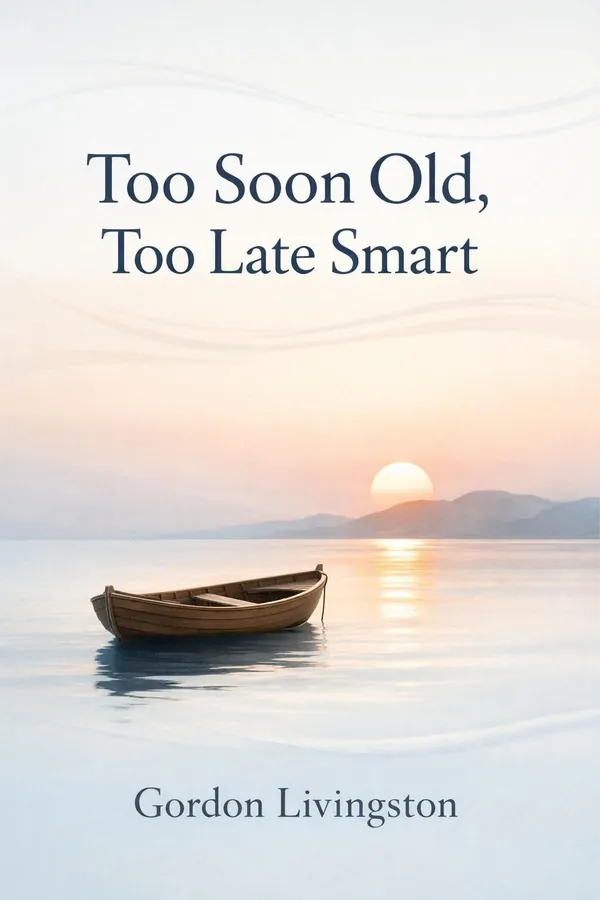
Too Soon Old, Too Late Smart: Summary & Key Insights
 10 min9 chaptersAudio available
Key Takeaways from Too Soon Old, Too Late Smart
Wisdom often arrives only after pain has made denial impossible.
Much of human misery begins when we confuse our expectations with the world as it is.
Character is measured in behavior, not in intention.
Pleasure may soothe us, but meaning sustains us.
Lasting love depends less on finding the perfect person than on becoming capable of loving well.
What Is Too Soon Old, Too Late Smart About?
Too Soon Old, Too Late Smart by Gordon Livingston is a psychology book. Too Soon Old, Too Late Smart is a compact but deeply resonant book of wisdom from psychiatrist Gordon Livingston, who distills decades of clinical practice, military service, and personal grief into thirty short lessons about how to live well. Rather than offering abstract philosophy or quick-fix self-help, Livingston writes with hard-earned clarity about the realities people spend their lives trying to avoid: disappointment, loss, fear, loneliness, broken expectations, and the limits of control. His central insight is that a meaningful life is not built by waiting for ideal circumstances, but by choosing responsibility, love, courage, and action in the midst of uncertainty. What makes the book matter is its unusual combination of emotional honesty and practical guidance. Livingston is not preaching from a distance; he has known war, the deaths of loved ones, and the daily struggles of patients searching for relief. That experience gives his reflections unusual authority. He writes as someone who understands both suffering and resilience. The result is a humane, accessible book that helps readers question their assumptions, confront self-deception, and make wiser choices before life’s deepest lessons arrive too late.
This FizzRead summary covers all 9 key chapters of Too Soon Old, Too Late Smart in approximately 10 minutes, distilling the most important ideas, arguments, and takeaways from Gordon Livingston's work. Also available as an audio summary and Key Quotes Podcast.
Too Soon Old, Too Late Smart
Too Soon Old, Too Late Smart is a compact but deeply resonant book of wisdom from psychiatrist Gordon Livingston, who distills decades of clinical practice, military service, and personal grief into thirty short lessons about how to live well. Rather than offering abstract philosophy or quick-fix self-help, Livingston writes with hard-earned clarity about the realities people spend their lives trying to avoid: disappointment, loss, fear, loneliness, broken expectations, and the limits of control. His central insight is that a meaningful life is not built by waiting for ideal circumstances, but by choosing responsibility, love, courage, and action in the midst of uncertainty.
What makes the book matter is its unusual combination of emotional honesty and practical guidance. Livingston is not preaching from a distance; he has known war, the deaths of loved ones, and the daily struggles of patients searching for relief. That experience gives his reflections unusual authority. He writes as someone who understands both suffering and resilience. The result is a humane, accessible book that helps readers question their assumptions, confront self-deception, and make wiser choices before life’s deepest lessons arrive too late.
Who Should Read Too Soon Old, Too Late Smart?
This book is perfect for anyone interested in psychology and looking to gain actionable insights in a short read. Whether you're a student, professional, or lifelong learner, the key ideas from Too Soon Old, Too Late Smart by Gordon Livingston will help you think differently.
- ✓Readers who enjoy psychology and want practical takeaways
- ✓Professionals looking to apply new ideas to their work and life
- ✓Anyone who wants the core insights of Too Soon Old, Too Late Smart in just 10 minutes
Want the full summary?
Get instant access to this book summary and 100K+ more with Fizz Moment.
Get Free SummaryAvailable on App Store • Free to download
Key Chapters
Wisdom often arrives only after pain has made denial impossible. That is the emotional premise of Too Soon Old, Too Late Smart, a book built around thirty brief truths that describe the human condition with unusual bluntness. Gordon Livingston does not present life as a puzzle that can be solved once and for all. Instead, he shows that much of suffering comes from resisting basic realities: people change, plans fail, losses come, and happiness cannot be outsourced to luck, status, or other people’s approval.
Livingston’s reflections emerge from years of listening to patients, serving in war, and enduring personal tragedy. Because of that background, the book avoids sentimentality. Its lessons are concise but weighty, touching on love, fear, purpose, grief, courage, forgiveness, and responsibility. He repeatedly returns to a core idea: the quality of our lives depends less on what happens to us than on how honestly and actively we respond. Many people wait for clarity before acting, or for pain to disappear before engaging with life again. Livingston argues the opposite. We mature when we stop bargaining with reality and begin living within it.
A practical example is the person who keeps postponing important decisions until they feel completely certain. They may delay leaving a dead-end job, apologizing to someone they hurt, or seeking help for depression. But certainty rarely comes first. More often, action creates clarity. Another example is the habit of comparing one’s life to an imagined ideal, which breeds resentment and passivity. Livingston reminds readers that real life unfolds in the imperfect present, not in fantasy.
The larger contribution of this introduction is that it invites humility. We are all vulnerable to illusion, avoidance, and self-protection. Yet we are also capable of honesty, love, and deliberate change. Actionable takeaway: identify one uncomfortable truth you have been postponing, write it down plainly, and take one concrete step this week that aligns your life with that reality.
Much of human misery begins when we confuse our expectations with the world as it is. Livingston uses the metaphor of a wrong map to illustrate how people move through life guided by internal assumptions that no longer fit reality. We carry ideas about how marriage should feel, what success should look like, how fair life ought to be, or who we believe ourselves to be. Trouble begins when the terrain changes and we keep following the old map.
This insight is psychologically powerful because expectations shape emotional responses. If you expect your career to progress in a straight line, setbacks feel like evidence of failure rather than normal features of life. If you expect people to behave according to your values, betrayal or disappointment can seem intolerable. The issue is not having hopes or plans; it is mistaking them for guarantees. Emotional resilience depends on revising our maps when reality gives us new information.
Consider someone who enters a relationship convinced that love should eliminate conflict. When disagreements emerge, they may conclude the relationship is broken, when in fact conflict is normal and can deepen intimacy if handled honestly. Or take a parent who imagines their child will fulfill a specific path. When the child chooses differently, the parent suffers not because the child is failing, but because the parent’s map is too rigid. In therapy, Livingston observed that many people remain trapped not by circumstances alone, but by outdated narratives about what their lives were supposed to be.
Adapting our maps requires curiosity, not self-condemnation. It means asking: What is actually true now? What assumptions am I clinging to? What would a more accurate map include? This mindset reduces unnecessary suffering and makes wiser choices possible. It does not erase pain, but it prevents pain from being multiplied by illusion.
Actionable takeaway: choose one area of frustration in your life and separate the facts from your expectations. Then revise your “map” by writing three statements that describe the situation as it truly is, not as you wish it were.
Character is measured in behavior, not in intention. One of Livingston’s clearest themes is that people often judge themselves by what they mean to do while judging others by what they actually do. That difference creates self-deception. We may think of ourselves as loving, disciplined, generous, or brave, but those identities are only real to the extent that our actions repeatedly embody them.
This principle matters especially in conversations about happiness and mental health. Livingston, as a psychiatrist, understood that medication can relieve symptoms and stabilize people in crisis, but it cannot by itself create meaning. A life of purpose comes from engagement: work, service, love, responsibility, creativity, and honest effort. People who feel empty often search for a feeling that will motivate action. Livingston reverses the order. Action often precedes feeling. We do not wait to feel purposeful before acting purposefully; we act, and purpose grows from the doing.
In everyday life, this shows up in simple but revealing ways. A person may claim family is their top priority, yet spend no attentive time with loved ones. Another may say they want health, yet continually avoid sleep, exercise, and medical care. Someone may insist they value friendship, but never initiate contact or show up in times of need. These are not minor inconsistencies; they are evidence that our lived values differ from our stated values.
This idea is not meant to shame but to clarify. If identity is built through action, then change is always possible. You do not need a new personality before beginning a better life. You need repeated behaviors that express the person you want to become. Integrity grows from alignment between word and deed.
Actionable takeaway: list the three values you most want to define your life. For each one, name one visible weekly behavior that proves the value is real, and begin measuring yourself by those actions rather than your intentions.
Pleasure may soothe us, but meaning sustains us. Livingston challenges the common fantasy that happiness is mainly a product of comfort, ease, or the absence of distress. In his view, people become most vulnerable when they organize life around avoiding pain. A meaningful life includes difficulty, sacrifice, and uncertainty, yet still feels worth living because it is connected to something larger than immediate gratification.
This is an important distinction in psychology. Comfort is episodic and unstable. It depends heavily on circumstances and quickly becomes normalized. Meaning, by contrast, often emerges from commitment: raising children, caring for others, building mastery, enduring hardship with dignity, or contributing to a cause. Such activities are not always pleasant, but they generate depth, coherence, and self-respect. Many people who feel restless or depressed are not simply lacking pleasure; they are lacking engagement with purposes that require them.
A familiar example is the professional who has achieved income and status but feels inexplicably empty. From the outside, life looks successful. Internally, there may be no sense of service, growth, or emotional investment. Another example is the retiree who loses structure and declines psychologically, not because work was enjoyable every day, but because it provided usefulness and direction. Livingston’s point is that a human life cannot be reduced to mood management.
In practical terms, this means asking better questions. Instead of “How do I feel right now?” ask “What am I serving?” Instead of “How do I eliminate discomfort?” ask “What difficulty is worth enduring?” Meaning often asks more from us, but it also gives more back. It creates a durable form of well-being rooted in contribution and connection.
Actionable takeaway: identify one part of your life that provides comfort but little meaning, and one activity that feels demanding but significant. Reduce the first slightly and make more room for the second over the next seven days.
Lasting love depends less on finding the perfect person than on becoming capable of loving well. Livingston writes about love without romantic illusion. He does not deny its power or necessity, but he insists that love survives through daily choices: attention, honesty, loyalty, generosity, restraint, and forgiveness. Many people treat love as a feeling that should sustain itself automatically. When the feeling fluctuates, they assume something has gone wrong. Livingston suggests that mature love is more deliberate than that.
This perspective is liberating because it shifts love from fate to practice. Attraction may be spontaneous, but trust is built. Intimacy requires listening, accurate perception, and the courage to see another person as they are rather than as a projection of our needs. Relationships often suffer because each person wants to be understood while making little effort to understand. Resentment grows in the silence between assumptions. Love weakens when neglected not by dramatic betrayal alone, but by repeated failures of presence.
Practical examples are everywhere. A couple may live together for years but drift apart because they stop speaking honestly about fear, disappointment, or desire. A parent may provide materially yet fail to express affection in ways a child can feel. A friendship may fade not because of conflict, but because no one maintains contact with intention. Livingston’s message is that love is visible in habits: showing up, telling the truth kindly, noticing what matters to the other person, and choosing repair over pride.
This also applies to self-respect. We often cannot offer stable love to others if we are ruled by shame, bitterness, or emotional avoidance. Loving well requires emotional maturity: boundaries, accountability, and the willingness to act with care even when it is inconvenient.
Actionable takeaway: choose one important relationship and perform one concrete act of deliberate love this week—initiate an honest conversation, express specific gratitude, apologize sincerely, or give undistracted time without devices.
Grief is not a detour from life; it is part of the price of loving anything deeply. Livingston writes about loss with exceptional credibility because his insights are not theoretical. He knew bereavement personally, and this gives his words a rare combination of tenderness and realism. He does not offer hollow reassurance that pain passes neatly or that every tragedy yields an uplifting lesson. Instead, he shows that grief changes us, and that healing means learning to live truthfully in the presence of absence.
One of his central ideas is that people often compound grief by resisting it. We want a timetable, a technique, or a narrative that will return us to who we were before the loss. But some losses permanently alter identity. The question is not how to erase sorrow, but how to carry it without becoming only sorrow. This involves remembering, mourning, and gradually reconnecting with life, even when doing so feels disloyal to the person or future we lost.
Examples include the death of a spouse, the end of a long marriage, infertility, illness, or the collapse of a cherished dream. In each case, there is not only the loss itself but also the loss of the imagined future attached to it. Livingston reminds readers that grief deserves respect. Avoiding it through numbness, busyness, addiction, or forced positivity may delay pain, but it also delays integration.
At the same time, he does not romanticize suffering. To honor loss is not to stop living. We continue by keeping faith with what mattered: the love itself, the lessons learned, the values that survive. Resilience does not mean being untouched. It means remaining open to meaning after being wounded.
Actionable takeaway: if you are carrying a loss, set aside time to name exactly what was lost, what it meant to you, and one life-giving act you can take now that honors that bond without denying your own future.
Freedom becomes real only when we stop blaming circumstances for every part of our lives. Livingston repeatedly emphasizes personal responsibility, not as a harsh moral slogan but as the foundation of dignity. We do not control everything that happens to us. Trauma, injustice, illness, and bad luck are real. But even within limits, we retain responsibility for the interpretations we nurture, the habits we reinforce, and the choices we continue making.
This distinction is crucial in psychology because victimhood can become an identity as well as a condition. When people define themselves solely by what has been done to them, they may protect themselves from guilt but also give away agency. Livingston does not deny suffering; he asks what we do next. Responsibility begins where excuses end. It is the shift from “Why is this happening to me?” to “Given that this is true, how will I respond?”
A practical example is someone who grew up in chaos and now struggles in adult relationships. Their history matters and deserves compassion. Yet if they refuse therapy, avoid accountability, and repeatedly choose harmful partners, the past is no longer the whole explanation. Another example is professional dissatisfaction. It may be true that a workplace is unfair, but if a person spends years complaining without learning skills, setting boundaries, or making plans to leave, they remain trapped partly by inaction.
Taking responsibility can feel frightening because it removes the comfort of passivity. But it is also empowering. The moment you accept that your actions matter, even in small ways, change becomes possible. Responsibility is not self-blame. It is ownership of the part that is yours.
Actionable takeaway: identify one recurring problem in your life and write two columns: what is outside your control and what is within it. Commit to one action from the second column within the next 48 hours.
Many lives are organized less by desire than by avoidance. Livingston shows how fear quietly governs decisions: fear of rejection, failure, loneliness, embarrassment, aging, dependence, or death. Left unexamined, fear narrows experience until safety becomes a prison. People then confuse the absence of risk with the presence of peace, though the result is often stagnation and regret.
What makes fear so powerful is that it can appear rational. We tell ourselves we are being careful, realistic, or practical. Sometimes we are. But often we are refusing the uncertainty required for growth. Livingston does not advocate recklessness. He advocates courage, which is not the lack of fear but the willingness to move in the direction of value despite fear. This applies to relationships, career changes, honesty, creativity, and confronting mortality itself.
For instance, a person may stay in a loveless relationship because leaving would mean facing solitude and starting over. Another may hide their ambitions because trying and failing feels unbearable. Someone may postpone difficult medical conversations because naming reality makes it more frightening. In each case, fear promises protection but extracts a cost: lost time, diminished authenticity, and a life shaped by evasion.
The antidote is gradual exposure to truth and action. Courage grows through practice. Small acts of honesty make larger ones possible. Naming a fear reduces its shadow power. Moving toward what matters, even imperfectly, restores aliveness. Livingston’s wisdom here is especially important because fear never disappears completely. If we wait for total confidence, we wait forever.
Actionable takeaway: name one fear that has been limiting a meaningful part of your life. Then design the smallest possible courageous act related to it—a conversation, an appointment, an application, a boundary—and complete it within one week.
One of the saddest truths in Livingston’s book is that life often teaches its lessons after the easiest opportunities to act have passed. Hence the title: we become old before we become wise. The point is not despair, but urgency. Time is the hidden force in every decision. Delayed apologies harden relationships. Deferred risks reduce options. Unspoken love can become permanent silence. The longer we postpone living according to what we know, the costlier that delay becomes.
Psychologically, people delay because they imagine there will be a better moment—when they are less busy, more secure, less afraid, more certain. But the future rarely delivers ideal conditions. Meanwhile, habits calcify. Bodies age. Children grow. Parents die. Opportunities expire. Livingston’s message is that wisdom matters only when translated into timely action.
Examples are painfully common. A person spends years meaning to repair a family rift, only to lose the chance through death or distance. Another keeps waiting to pursue meaningful work until financial security is complete, then discovers they no longer have the energy or freedom they once did. Someone intends to be more present with their children but continues prioritizing work until the season of childhood has passed. Regret often has less to do with catastrophe than with neglect.
This idea does not mean rushing every decision. Reflection matters. But procrastination disguised as prudence can quietly steal a life. The remedy is to treat time as morally significant. If something truly matters, it belongs on the calendar, not just in intention. We do not need perfect readiness; we need honest priority.
Actionable takeaway: ask yourself, “What do I already know I should do?” Pick the answer that has been waiting longest, and schedule a specific first step with a date and time before the day ends.
All Chapters in Too Soon Old, Too Late Smart
About the Author
Gordon Livingston, M.D., was an American psychiatrist, essayist, and former Army officer whose writing combined clinical insight with personal candor. A graduate of West Point, he served in Vietnam and was awarded the Bronze Star for valor. After his military service, he earned his medical degree from Johns Hopkins School of Medicine and built a career in psychiatry, practicing in Columbia, Maryland. Livingston also became a widely read columnist and contributor to publications including The Washington Post, the San Francisco Chronicle, the Baltimore Sun, and Reader’s Digest. His work is distinguished by its brevity, emotional honesty, and hard-earned wisdom, shaped not only by decades of listening to patients but also by his own encounters with grief, loss, and resilience.
Get This Summary in Your Preferred Format
Read or listen to the Too Soon Old, Too Late Smart summary by Gordon Livingston anytime, anywhere. FizzRead offers multiple formats so you can learn on your terms — all free.
Available formats: App · Audio · PDF · EPUB — All included free with FizzRead
Download Too Soon Old, Too Late Smart PDF and EPUB Summary
Key Quotes from Too Soon Old, Too Late Smart
“Wisdom often arrives only after pain has made denial impossible.”
“Much of human misery begins when we confuse our expectations with the world as it is.”
“Character is measured in behavior, not in intention.”
“Pleasure may soothe us, but meaning sustains us.”
“Lasting love depends less on finding the perfect person than on becoming capable of loving well.”
Frequently Asked Questions about Too Soon Old, Too Late Smart
Too Soon Old, Too Late Smart by Gordon Livingston is a psychology book that explores key ideas across 9 chapters. Too Soon Old, Too Late Smart is a compact but deeply resonant book of wisdom from psychiatrist Gordon Livingston, who distills decades of clinical practice, military service, and personal grief into thirty short lessons about how to live well. Rather than offering abstract philosophy or quick-fix self-help, Livingston writes with hard-earned clarity about the realities people spend their lives trying to avoid: disappointment, loss, fear, loneliness, broken expectations, and the limits of control. His central insight is that a meaningful life is not built by waiting for ideal circumstances, but by choosing responsibility, love, courage, and action in the midst of uncertainty. What makes the book matter is its unusual combination of emotional honesty and practical guidance. Livingston is not preaching from a distance; he has known war, the deaths of loved ones, and the daily struggles of patients searching for relief. That experience gives his reflections unusual authority. He writes as someone who understands both suffering and resilience. The result is a humane, accessible book that helps readers question their assumptions, confront self-deception, and make wiser choices before life’s deepest lessons arrive too late.
You Might Also Like
The Body Keeps the Score
Bessel van der Kolk
10 min
Surrounded by Idiots
Thomas Erikson
10 min
Emotional Intelligence
Daniel Goleman
10 min
Attached
Amir Levine
10 min
Why Does He Do That
Lundy Bancroft
10 min
Women Who Run with the Wolves
Clarissa Pinkola Estés
10 minBrowse by Category
Ready to read Too Soon Old, Too Late Smart?
Get the full summary and 100K+ more books with Fizz Moment.