
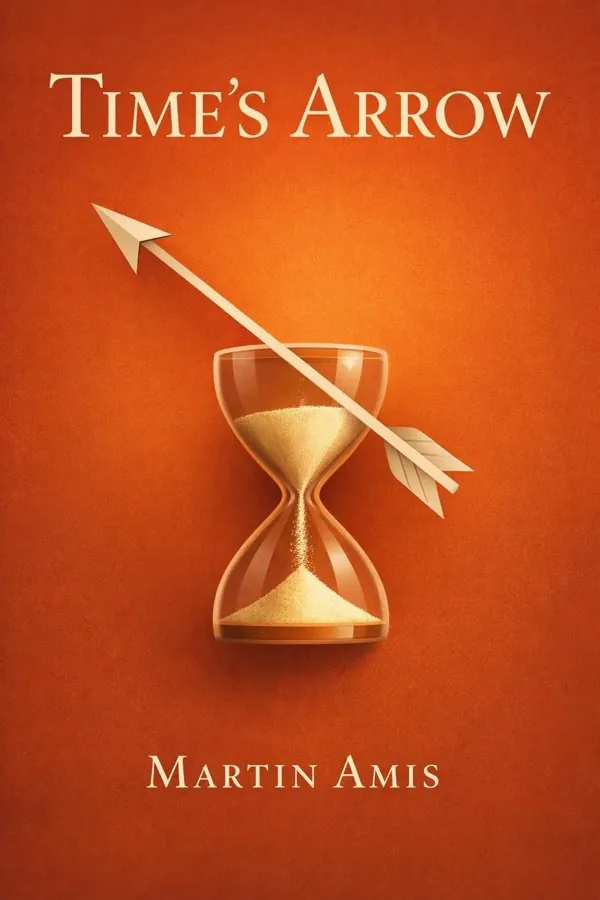
Time's Arrow: Summary & Key Insights
by Martin Amis
 10 min9 chapters
Key Takeaways from Time's Arrow
What if the most truthful way to tell a life were to start at its end?
A person’s identity is often less stable than the stories they tell about themselves.
Sometimes literature shocks us not by showing horror directly, but by rearranging the conditions under which we recognize it.
We often imagine innocence as something that can be recovered if only we go back far enough.
One of the novel’s strangest achievements is that its narrator is both intimate and ignorant.
What Is Time's Arrow About?
Time's Arrow by Martin Amis is a bestsellers book spanning 4 pages. Martin Amis’s Time's Arrow is one of the most daring novels of the late twentieth century: a story told entirely backward, beginning with a man’s death and moving in reverse toward his birth. On the surface, it follows the life of Tod Friendly, an aging doctor in America. But as time rewinds, his identity shifts, his relationships reorder themselves, and a buried past slowly emerges. What first seems strange and darkly comic becomes morally devastating when the reader realizes that this backward life conceals involvement in the Holocaust. By reversing chronology, Amis does more than experiment with form. He forces us to confront how narrative shapes morality, how memory hides guilt, and how evil can look almost innocent when cause and effect are distorted. The novel’s unusual structure creates disorientation, but that confusion is purposeful: it mirrors the evasions, denials, and self-deceptions that often surround historical atrocity. Amis, celebrated for his intellectual precision, satirical force, and stylistic boldness, uses this ingenious premise to explore guilt, complicity, innocence, and the human longing to undo what cannot be undone. Time's Arrow is brief, haunting, and unforgettable.
This FizzRead summary covers all 9 key chapters of Time's Arrow in approximately 10 minutes, distilling the most important ideas, arguments, and takeaways from Martin Amis's work.
Time's Arrow
Martin Amis’s Time's Arrow is one of the most daring novels of the late twentieth century: a story told entirely backward, beginning with a man’s death and moving in reverse toward his birth. On the surface, it follows the life of Tod Friendly, an aging doctor in America. But as time rewinds, his identity shifts, his relationships reorder themselves, and a buried past slowly emerges. What first seems strange and darkly comic becomes morally devastating when the reader realizes that this backward life conceals involvement in the Holocaust. By reversing chronology, Amis does more than experiment with form. He forces us to confront how narrative shapes morality, how memory hides guilt, and how evil can look almost innocent when cause and effect are distorted. The novel’s unusual structure creates disorientation, but that confusion is purposeful: it mirrors the evasions, denials, and self-deceptions that often surround historical atrocity. Amis, celebrated for his intellectual precision, satirical force, and stylistic boldness, uses this ingenious premise to explore guilt, complicity, innocence, and the human longing to undo what cannot be undone. Time's Arrow is brief, haunting, and unforgettable.
Who Should Read Time's Arrow?
This book is perfect for anyone interested in bestsellers and looking to gain actionable insights in a short read. Whether you're a student, professional, or lifelong learner, the key ideas from Time's Arrow by Martin Amis will help you think differently.
- ✓Readers who enjoy bestsellers and want practical takeaways
- ✓Professionals looking to apply new ideas to their work and life
- ✓Anyone who wants the core insights of Time's Arrow in just 10 minutes
Want the full summary?
Get instant access to this book summary and 100K+ more with Fizz Moment.
Get Free SummaryAvailable on App Store • Free to download
Key Chapters
What if the most truthful way to tell a life were to start at its end? Time's Arrow opens not with birth, promise, or becoming, but with death. Tod Friendly dies, and from that moment the novel begins running backward. This reversal instantly unsettles everything readers expect from storytelling. Instead of moving from innocence to experience, growth to decline, or choice to consequence, we move from consequence back toward the choices that made it possible. The result is not just formal cleverness. It changes the moral temperature of every scene.
An inner narrator observes Tod’s life but does not fully understand it. He seems attached to Tod and yet separate from him, as if conscience, witness, and passenger have been trapped inside the same body. Because time moves backward, ordinary actions appear bizarre. Doctors seem to harm patients in order to make them healthy. Food appears to rise from plates into mouths and return to stores. Human interaction becomes unfamiliar and eerie. This estrangement serves a purpose: it forces us to see ordinary life from a radically altered angle, making us question how much meaning depends on sequence.
In practical terms, Amis is demonstrating something readers can apply beyond fiction: outcomes often hide the processes that created them. We tend to judge events by where they end, not by how they were built. In organizations, politics, and personal life, starting with the visible result and tracing backward can reveal hidden motives, compromises, and responsibilities. A collapsed relationship, a public scandal, or a toxic workplace rarely begins where it seems to begin.
Actionable takeaway: When facing a troubling outcome in your own life, reverse the story. Start with the ending and ask what choices, evasions, and habits made it possible.
A person’s identity is often less stable than the stories they tell about themselves. As Time's Arrow moves backward through Tod Friendly’s American years, the narrator encounters a life that appears, at first glance, respectable and even benevolent. Tod is a doctor. He has lovers, routines, habits, and social roles. Yet because time is reversed, these activities become grotesquely distorted. Healing looks like injury. Intimacy looks like abandonment before attachment. Charity and cruelty exchange masks. The backward world turns everyday life into an elaborate misunderstanding.
This section of the novel reveals that Tod Friendly is not a whole self but a constructed one. His American identity is layered over earlier names and histories. The more the novel reverses, the more the reader senses that this apparently ordinary existence is a refuge built on concealment. The narrator, unable to grasp the truth directly, keeps trying to assemble a coherent human being out of fragments. That effort mirrors the reader’s own task: to recognize how identity can be used as camouflage.
The idea has real-world relevance. Many people curate versions of themselves designed to suppress embarrassment, guilt, or contradiction. Institutions do this too. A company may promote a humane public image while hiding exploitative practices. A nation may celebrate freedom while burying the history of violence that enabled its success. A family can tell a story of decency while silently organizing itself around an old betrayal.
Amis shows that hidden identity is not merely private deception; it is a moral structure. The false self allows the past to remain unexamined and therefore powerful. What looks like reinvention may actually be avoidance.
Actionable takeaway: Examine the stories you or others use to describe a life. Ask not only who someone claims to be, but what earlier truths that identity might be protecting.
Sometimes literature shocks us not by showing horror directly, but by rearranging the conditions under which we recognize it. The novel reaches its most devastating power when Tod Friendly’s earlier identity is revealed as Odilo Unverdorben, a Nazi doctor involved in the machinery of Auschwitz. Because time is moving backward, the camps initially appear to do the opposite of what they actually did. Smoke seems to gather back into chimneys. Bodies seem to be restored. Crowds appear to emerge into life rather than be processed toward death. The reversal creates a sickening illusion of healing and creation.
This is Amis’s boldest and riskiest move. He does not reverse history to soften evil, but to expose how dependent moral judgment is on temporal order. In forward time, Auschwitz is a system of industrial murder. In backward time, it grotesquely resembles a place where the dead are reconstructed and sent out into the world. The reader knows this is false, and that gap between what is shown and what is known produces unbearable tension. We are made to feel the obscenity of trying to narrate atrocity into innocence.
The practical application is not about Holocaust equivalence; it is about moral literacy. Harm is often disguised by language, bureaucracy, and reframing. In modern settings, layoffs become “streamlining,” surveillance becomes “safety,” and cruelty becomes “policy.” The ethical challenge is to resist narratives that invert victims and perpetrators or present destruction as necessity.
Amis insists that style cannot solve history, but it can force us to look at our own interpretive habits. Are we too ready to accept systems as normal because they are orderly, technical, or efficient?
Actionable takeaway: Whenever a system presents harm as progress, pause and restore the real direction of cause and effect. Ask who is being diminished, erased, or sacrificed.
We often imagine innocence as something that can be recovered if only we go back far enough. Time's Arrow tests that fantasy and finally rejects it. As the novel moves backward toward childhood and birth, it seems to approach a state before guilt, before action, before history. The reader might feel an almost desperate hope that reversing time can undo corruption, that beneath the adult criminal there was once an untouched child untouched by evil. Yet Amis complicates this hope. The novel’s movement toward infancy does not redeem what came later. It only intensifies the tragedy of what human beings can become.
The backward structure creates the illusion of cleansing. Wounds close. Age recedes. Damage seems to repair itself. But moral reality does not work that way. No narrative trick can erase the consequences of atrocity. Even as the character returns to earlier stages of life, the reader carries forward knowledge of what he did. This creates one of the novel’s deepest ironies: chronological innocence is not moral innocence. To have once been young does not absolve what one later chose.
This insight matters outside literature because people often seek comfort in origin stories. We excuse ourselves or others by pointing to pain, youth, circumstances, or potential. These contexts matter, but they do not eliminate accountability. In leadership, parenting, and civic life, understanding where someone came from should deepen judgment, not replace it.
Amis also challenges the sentimental belief that history naturally bends toward purification. It does not. Without memory and responsibility, even a return to beginnings becomes another form of denial.
Actionable takeaway: Let compassion for origins coexist with honesty about outcomes. Understand how someone became who they are, but do not confuse explanation with absolution.
One of the novel’s strangest achievements is that its narrator is both intimate and ignorant. He lives inside Tod Friendly, sees what Tod sees, and experiences the world through him. Yet he does not fully understand the life he is witnessing. This creates the sensation of a divided self, as though consciousness has split into actor and observer, body and moral residue. The narrator’s confusion is not a flaw in the novel; it is one of its central meanings.
This split consciousness suggests that the self is not unified. People can act in one register while interpreting themselves in another. They can commit, justify, suppress, and dissociate all at once. The narrator becomes a kind of displaced conscience, a witness trapped in reverse time and denied clear access to guilt. He senses patterns, feels revulsion and attraction, and gradually approaches knowledge without ever mastering it. That makes him deeply human. Most people do not confront their worst truths directly. They circle them.
In everyday life, split conscience appears whenever we say, “Part of me knew,” or “I wasn’t being honest with myself.” A manager signs off on a harmful decision while privately feeling unease. A citizen benefits from injustice while claiming distance from it. A family member maintains peace by pretending not to notice abuse. Inner division allows functioning, but it also enables moral failure.
Amis dramatizes this divided state brilliantly. The narrator cannot stop the life he inhabits, but his uneasy presence keeps the novel from becoming coldly mechanical. He represents the human struggle to know what we are implicated in.
Actionable takeaway: Pay attention to inner dissonance. When your actions and your private understanding diverge, treat that discomfort as information, not noise.
The way something is described can determine whether it appears monstrous, ordinary, or even admirable. Time's Arrow is a masterclass in how language and structure can distort moral perception. Because events unfold backward, the narrator often uses terms that seem fitting within reversed time but horrifying in their implications. Destructive acts acquire the appearance of restoration. Violence becomes procedure. Atrocity starts to resemble order. The novel shows that evil does not always announce itself with dramatic cruelty; it often hides behind tone, framing, and euphemism.
This insight is especially powerful in relation to the Holocaust, where bureaucratic language historically helped make mass murder administratively manageable. Amis does not reproduce official jargon so much as expose the general mechanism by which reality can be linguistically rearranged. If words can make murder look like sanitation or progress, then reading itself becomes an ethical task. We must learn to hear what is being smuggled into apparently neutral description.
The application is immediate. Contemporary discourse is full of softening language. Civilian deaths become “collateral damage.” Manipulation becomes “messaging.” Exploitation becomes “optimization.” Even in personal relationships, people rename selfishness as honesty or control as care. The issue is not merely semantics. Language shapes whether responsibility is felt.
Amis reminds us that style is never innocent. How we frame an event influences whether we recognize its human cost. Readers therefore have a duty to decode polished narratives, especially when they justify power or erase suffering.
Actionable takeaway: Whenever language seems unusually clean, technical, or reassuring, ask what raw human reality it may be trying to sanitize.
Art can reorder experience, but it cannot reverse reality. That tension sits at the heart of Time's Arrow. The novel performs an impossible operation: it makes time move backward and allows readers to feel, however briefly, the fantasy that destruction might be undone. Yet the deeper the book goes, the clearer it becomes that this reversal offers no true consolation. The dead are not restored. The camps are not redeemed. The moral stain remains. The novel’s brilliance lies in making us experience the desire for reversal while also exposing its futility.
This matters because humans are irresistibly drawn to undoing. We replay conversations, imagine alternative decisions, and long for resets after betrayal, cruelty, or failure. Whole societies do this as well. They seek redemptive narratives that skip over accountability and move directly to renewal. But repair is not the same as reversal. A wound can be tended, memory can be honored, justice can be pursued, but the original harm does not vanish.
Amis’s novel therefore becomes a meditation on the limits of representation. Literature can illuminate, disturb, and sharpen moral understanding, but it cannot cleanse history. That humility gives the book its seriousness. Rather than pretending that art redeems atrocity, Amis uses art to make denial harder.
In practical life, this distinction is crucial. Apologies matter, but they are not erasers. Reforms matter, but they do not negate what victims endured. Personal growth matters, but it does not cancel earlier harm.
Actionable takeaway: Replace the wish to undo the past with the harder work of acknowledging it fully, making amends where possible, and refusing comforting false reversals.
One of the most chilling lessons of Time's Arrow is that evil does not always arrive in the form of chaos or obvious savagery. It can wear the face of education, discipline, and professional competence. Tod Friendly, and earlier Odilo Unverdorben, is a doctor. Medicine ordinarily symbolizes care, intelligence, and trust. By linking healing with a perpetrator of mass murder, Amis forces readers to confront a terrifying reality: expertise is morally empty unless guided by conscience.
The backward structure intensifies this point. Clinical procedures are stripped of their usual meanings and made strange, reminding us that technical skill alone cannot tell us whether an action serves life or destroys it. In the concentration camp setting, science, order, and institutional purpose become instruments of inhumanity. The same capacities that can relieve suffering can also be organized toward cruelty.
This lesson extends far beyond medicine. Lawyers, engineers, financiers, educators, and technologists can all participate in harmful systems while appearing respectable. A data scientist can optimize addictive platforms. An accountant can conceal corruption. A civil servant can administer discriminatory rules efficiently. The danger lies in confusing professionalism with virtue.
Amis pushes readers to ask not only whether a system functions, but what it is functioning for. Efficiency, precision, and expertise become dangerous when detached from ethical scrutiny. The novel is therefore an indictment not only of monstrous ideology but of ordinary competence enlisted in its service.
Actionable takeaway: In your own work, do not stop at asking whether something can be done well. Ask whether it should be done at all, and who may be harmed by your excellence.
Some books ask to be understood. Time's Arrow asks to be actively reconstructed. Because events run backward, the reader must constantly translate what is happening into forward time. That process turns reading into ethical labor. You cannot remain passive. You must interpret, infer, and correct appearances. The novel therefore becomes not only a story about moral inversion but an exercise in resisting it.
This is one reason the book remains so powerful. It trains the reader to distrust first impressions, especially when those impressions are produced by elegant form or persuasive narration. Something can appear coherent and still be false. Something can feel restorative and still conceal violence. By forcing readers to mentally reorder events, Amis cultivates habits of suspicion that are morally useful. He teaches us to look twice.
These habits matter in modern life, where people are constantly fed narratives through media, politics, branding, and ideology. A viral clip omits context. A polished speech reframes wrongdoing as necessity. A public figure offers a compelling personal story that distracts from structural harm. To read the world well, we often need to reverse-engineer it: identify what came before, who benefits, and what has been omitted.
The novel also rewards rereading because once you know where it is heading, earlier passages deepen in significance. That too mirrors life. Understanding often comes late, and maturity involves learning to reinterpret what once seemed ordinary.
Actionable takeaway: Practice reading situations the way this novel teaches you to read stories: slow down, reconstruct the sequence, question the framing, and seek the hidden moral logic underneath appearances.
All Chapters in Time's Arrow
About the Author
Martin Amis (1949–2023) was a British novelist, essayist, memoirist, and critic widely regarded as one of the most important literary stylists of his generation. Born in Oxford, he was the son of novelist Kingsley Amis, but he developed a voice entirely his own: witty, abrasive, elegant, and intellectually fearless. He gained major recognition with novels such as Money, London Fields, The Information, and Time's Arrow, works known for their dark comedy, verbal precision, and sharp examination of modern culture, power, and moral corruption. Amis also wrote influential nonfiction on politics, history, and literature. Across his career, he earned admiration for combining formal innovation with emotional and philosophical seriousness. His work remains central to contemporary English-language fiction.
Get This Summary in Your Preferred Format
Read or listen to the Time's Arrow summary by Martin Amis anytime, anywhere. FizzRead offers multiple formats so you can learn on your terms — all free.
Available formats: App · Audio · PDF · EPUB — All included free with FizzRead
Download Time's Arrow PDF and EPUB Summary
Key Quotes from Time's Arrow
“What if the most truthful way to tell a life were to start at its end?”
“A person’s identity is often less stable than the stories they tell about themselves.”
“Sometimes literature shocks us not by showing horror directly, but by rearranging the conditions under which we recognize it.”
“We often imagine innocence as something that can be recovered if only we go back far enough.”
“One of the novel’s strangest achievements is that its narrator is both intimate and ignorant.”
Frequently Asked Questions about Time's Arrow
Time's Arrow by Martin Amis is a bestsellers book that explores key ideas across 9 chapters. Martin Amis’s Time's Arrow is one of the most daring novels of the late twentieth century: a story told entirely backward, beginning with a man’s death and moving in reverse toward his birth. On the surface, it follows the life of Tod Friendly, an aging doctor in America. But as time rewinds, his identity shifts, his relationships reorder themselves, and a buried past slowly emerges. What first seems strange and darkly comic becomes morally devastating when the reader realizes that this backward life conceals involvement in the Holocaust. By reversing chronology, Amis does more than experiment with form. He forces us to confront how narrative shapes morality, how memory hides guilt, and how evil can look almost innocent when cause and effect are distorted. The novel’s unusual structure creates disorientation, but that confusion is purposeful: it mirrors the evasions, denials, and self-deceptions that often surround historical atrocity. Amis, celebrated for his intellectual precision, satirical force, and stylistic boldness, uses this ingenious premise to explore guilt, complicity, innocence, and the human longing to undo what cannot be undone. Time's Arrow is brief, haunting, and unforgettable.
More by Martin Amis

You Might Also Like
The Godfather
Mario Puzo
10 min
The Handmaid's Tale
Margaret Atwood
10 min
The Hunger Games
Suzanne Collins
10 min
The Nightingale
Kristin Hannah
10 min
The Seven Husbands of Evelyn Hugo
Taylor Jenkins Reid
10 min
Backwater Justice
Fern Michaels
10 minBrowse by Category
Ready to read Time's Arrow?
Get the full summary and 100K+ more books with Fizz Moment.