
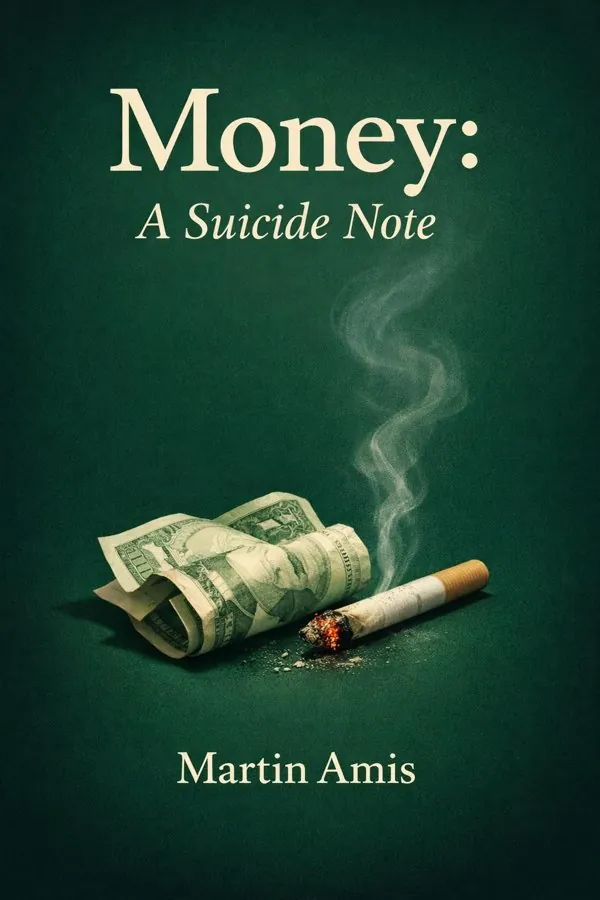
Money: A Suicide Note: Summary & Key Insights
by Martin Amis
 10 min9 chaptersAudio available
Key Takeaways from Money: A Suicide Note
A person can be ruined not only by suffering too little, but by wanting too much.
In Amis’s novel, it acts as fantasy fuel, a social language, and a substitute religion.
The most destructive relationships are often the ones that confirm what we already fear about ourselves.
One of the novel’s most daring moves is its refusal to stay inside ordinary realism.
Self-destruction rarely arrives all at once; it accumulates through ignored warnings.
What Is Money: A Suicide Note About?
Money: A Suicide Note by Martin Amis is a classics book spanning 4 pages. Martin Amis’s Money: A Suicide Note is one of the defining satirical novels of late 20th-century Britain: loud, funny, abrasive, and uncomfortably perceptive. First published in 1984, it follows John Self, a successful commercial director whose life is powered by appetite. He drinks too much, spends too much, eats too much, watches too much, and thinks too little. When he is drawn into the promise of a glamorous film project that shuttles him between London and New York, his already unstable world begins to fracture under the pressure of greed, vanity, and deception. What makes the novel matter is not simply its portrait of excess, but its understanding of money as a psychological force. In Amis’s hands, money is not just currency; it is desire, fantasy, manipulation, status, and self-delusion. John Self becomes the perfect emblem of a culture that mistakes consumption for freedom. Amis, one of Britain’s sharpest stylists and satirists, brings extraordinary verbal energy to that diagnosis. The result is a novel that is both comic and tragic: a brilliantly exaggerated portrait of one man’s collapse and a lasting critique of modern consumer culture.
This FizzRead summary covers all 9 key chapters of Money: A Suicide Note in approximately 10 minutes, distilling the most important ideas, arguments, and takeaways from Martin Amis's work. Also available as an audio summary and Key Quotes Podcast.
Money: A Suicide Note
Martin Amis’s Money: A Suicide Note is one of the defining satirical novels of late 20th-century Britain: loud, funny, abrasive, and uncomfortably perceptive. First published in 1984, it follows John Self, a successful commercial director whose life is powered by appetite. He drinks too much, spends too much, eats too much, watches too much, and thinks too little. When he is drawn into the promise of a glamorous film project that shuttles him between London and New York, his already unstable world begins to fracture under the pressure of greed, vanity, and deception.
What makes the novel matter is not simply its portrait of excess, but its understanding of money as a psychological force. In Amis’s hands, money is not just currency; it is desire, fantasy, manipulation, status, and self-delusion. John Self becomes the perfect emblem of a culture that mistakes consumption for freedom. Amis, one of Britain’s sharpest stylists and satirists, brings extraordinary verbal energy to that diagnosis. The result is a novel that is both comic and tragic: a brilliantly exaggerated portrait of one man’s collapse and a lasting critique of modern consumer culture.
Who Should Read Money: A Suicide Note?
This book is perfect for anyone interested in classics and looking to gain actionable insights in a short read. Whether you're a student, professional, or lifelong learner, the key ideas from Money: A Suicide Note by Martin Amis will help you think differently.
- ✓Readers who enjoy classics and want practical takeaways
- ✓Professionals looking to apply new ideas to their work and life
- ✓Anyone who wants the core insights of Money: A Suicide Note in just 10 minutes
Want the full summary?
Get instant access to this book summary and 100K+ more with Fizz Moment.
Get Free SummaryAvailable on App Store • Free to download
Key Chapters
A person can be ruined not only by suffering too little, but by wanting too much. That is the central joke and warning of John Self, the narrator of Money: A Suicide Note. Self is an advertising director in London, a man professionally trained to manufacture desire and personally enslaved by it. His life is a sequence of compulsions: alcohol, junk food, pornography, cigarettes, casual sex, television, taxis, and endless spending. He consumes not because these things satisfy him, but because they briefly silence the emptiness underneath.
Amis makes Self grotesque on purpose. He is coarse, impulsive, and often ridiculous. Yet he is never just a cartoon. He embodies a wider social logic in which identity is built out of purchases, cravings, and surfaces. Self’s job is to persuade others to confuse wanting with living, and that confusion shapes his inner world. He does not ask what is meaningful, only what is available. He does not seek intimacy, only stimulation. He has money, or thinks he does, and assumes that abundance equals power.
This idea remains strikingly relevant. Today, excess may look different—streaming, scrolling, online shopping, food delivery, lifestyle branding—but the pattern is familiar. Many people still drift into the habit of using consumption to regulate mood or avoid reflection. Self shows what happens when appetite becomes a worldview.
Amis’s insight is that excess does not expand the self; it erodes it. The more Self indulges, the less coherent he becomes. Pleasure without restraint becomes numbness. Freedom without discipline becomes dependency.
Actionable takeaway: Notice where convenience, indulgence, or entertainment has stopped being enjoyable and started becoming automatic. Choose one area of overconsumption in your life and create a clear boundary around it before appetite begins to shape your identity.
Money is rarely just money. In Amis’s novel, it acts as fantasy fuel, a social language, and a substitute religion. John Self believes money can protect him from humiliation, buy him status, and keep reality at a distance. He treats it as a solvent that dissolves limits. If he feels bad, he spends. If he feels insecure, he spends. If he wants to prove himself, he spends even more.
The brilliance of the novel lies in showing how money reshapes perception. Self does not simply own things; he interprets the world through price, scale, and transaction. Hotels, bars, restaurants, flights, film budgets, and advertising deals become signs of worth. Even human relationships begin to look like negotiations. People can be used, bought off, or upgraded. Desire becomes monetized, and morality becomes optional.
Amis is satirizing the culture of the 1980s, but his point extends far beyond that decade. In many modern societies, money carries an almost magical promise: control, reinvention, immunity, prestige. Yet the novel repeatedly exposes that promise as unstable. Self’s attachment to money is not confidence; it is fear in expensive clothing. He wants money because he lacks an inner center. He mistakes purchasing power for selfhood.
This dynamic shows up in ordinary life whenever people tie self-esteem too closely to salary, lifestyle, or visible success. Ambition itself is not the problem. The problem begins when money stops being a tool and becomes the measure of reality. Then every setback feels existential, and every purchase becomes emotional theater.
Amis asks readers to see the psychology beneath greed. Financial obsession often masks insecurity, confusion, and dependency. Wealth can enlarge options, but it cannot answer basic questions of meaning or character.
Actionable takeaway: Reframe money as an instrument rather than an identity. Write down three things money can help you do and three things it can never provide—such as integrity, love, or self-respect—to keep your priorities clear.
The most destructive relationships are often the ones that confirm what we already fear about ourselves. John Self’s relationship with Selina Street is not a romance in any redemptive sense; it is a cycle of lust, manipulation, humiliation, and mutual bad faith. Selina is glamorous, opaque, and emotionally predatory, but the novel never lets Self off the hook. He is complicit in the arrangement because it satisfies his appetite for drama and degradation.
Their relationship works as a private version of the book’s wider social satire. Just as advertising sells fantasy by exploiting insecurity, Selina exerts power through performance, ambiguity, and emotional leverage. Self wants possession, reassurance, and stimulation all at once. What he gets instead is instability. He cannot tell whether he is loved, used, desired, mocked, or all four. That uncertainty gradually eats away at him.
Amis presents love here as entangled with vanity. Self does not truly know Selina because he barely knows himself. He approaches intimacy with the same logic he applies to consumption: acquire, enjoy, repeat. But relationships are not products, and people do not become manageable simply because one desires them intensely. The result is emotional chaos. Self oscillates between dependence and resentment, longing and disgust.
The novel’s insight is deeply practical. People often remain in unhealthy relationships not because they are happy, but because the relationship mirrors an internal disorder they find familiar. If someone believes they deserve confusion, they may mistake instability for passion. If someone fears stillness, they may cling to conflict.
Amis shows that betrayal is not only what others do to us. It can also describe the way we abandon our own judgment in pursuit of validation. Self keeps participating in what harms him because he lacks the discipline to choose dignity over desire.
Actionable takeaway: If a relationship repeatedly leaves you confused, diminished, or dependent, stop asking only whether you want the person. Ask what version of yourself the relationship encourages—and whether that version deserves your loyalty.
Self-destruction rarely arrives all at once; it accumulates through ignored warnings. As Money progresses, John Self’s world becomes increasingly unstable. The film project that promises prestige and profit begins to look dubious. Financial assumptions unravel. Trust evaporates. What once felt like swagger hardens into paranoia. Self senses that he is being manipulated, but because he has built his life on manipulation, he has no stable ground from which to resist it.
This collapse is not merely plot machinery. It is the moral architecture of the novel. Self has spent years living as if consequences could be postponed indefinitely. He eats, drinks, borrows, and desires as though tomorrow were someone else’s problem. But reality eventually demands payment. Greed, vanity, and carelessness generate not freedom but vulnerability. The man who thinks he controls everything through money discovers how easily he can be played.
Amis is especially good at showing how external fraud meets internal weakness. Self is deceived by others, but he is also deceived by his own appetites. He believes what flatters him. He trusts what promises enlargement. He ignores what requires discipline. In this sense, the con works because it resonates with his character.
That pattern is familiar outside fiction. Many bad decisions—financial, professional, relational—do not occur because people lack information, but because they accept the version of reality that best feeds their ego. The too-good opportunity, the glamorous partnership, the unsustainable lifestyle, the convenient lie: these become attractive when someone wants fantasy more than truth.
The novel’s title points toward this endpoint. Self’s downfall is not a sudden act but a long collaboration with his own undoing. The suicide note is written in habits before it is visible in events.
Actionable takeaway: When an opportunity strongly appeals to your vanity or urgency, pause before committing. Ask: What facts am I avoiding because the fantasy is so appealing? A slower decision is often a safer one.
The most powerful forms of persuasion do not force us; they teach us to want. John Self works in advertising, and that profession is central to Amis’s critique. Advertising in Money is not just background detail. It represents a whole cultural system built on the conversion of insecurity into appetite. The ad man studies weakness, repackages fantasy, and sells identity through products. Self is both practitioner and victim of that system.
This is why the novel feels so modern. Long before social media algorithms and influencer branding, Amis understood that commercial culture shapes emotional life. Self lives in a world saturated by slogans, screens, images, and appetites. Entertainment, commerce, and desire bleed together. He no longer knows where his wants come from because they have been externally scripted for him. His tastes are less personal than programmed.
The practical relevance is obvious. Today, much of daily life is organized around attention capture. Platforms, advertisements, and branded experiences compete to tell us what to desire, how to look, what success means, and what kind of person we should become. The result can be psychic exhaustion and chronic comparison. Like Self, people can end up living reactively, always chasing the next purchase, upgrade, or image.
Amis’s deeper point is that manufactured desire weakens autonomy. If your wants are constantly being shaped from outside, then your life may feel active while remaining fundamentally unchosen. Freedom requires not only options, but the ability to distinguish authentic values from implanted cravings.
The novel therefore encourages a more skeptical relationship to media. What promise is being sold? What insecurity is being targeted? What mood is being created? What kind of person does this message assume you should be? These questions restore agency.
Actionable takeaway: For one week, pay close attention to the commercial messages you absorb each day. Note which emotions they target—fear, envy, aspiration, loneliness, status—and use that awareness to separate your real needs from manufactured wants.
We often speak as if the mind makes decisions and the body simply follows. Money rejects that separation. John Self’s body is one of the novel’s most important texts. It groans, swells, aches, craves, and malfunctions. He eats badly, sleeps badly, drinks heavily, and treats physical sensation as either an inconvenience or a trigger for more indulgence. His body becomes the running ledger of his choices.
Amis uses this physicality for comedy, but also for judgment. Self is not a purely intellectual failure; he is a bodily one. He lives against his own organism. The body registers what the mind refuses to admit: exhaustion, dependency, deterioration, disgust. In this sense, the novel is not only about economics and culture, but about embodiment. A life of endless appetite leaves marks. The self cannot remain abstract when it is carried by flesh.
This idea has practical force because modern people often normalize forms of low-level self-harm under the banner of lifestyle: chronic overstimulation, poor sleep, stress eating, compulsive drinking, sedentary routines, digital overload. None of these instantly destroys a person, but together they can create the same pattern Amis satirizes: a life arranged around immediate relief rather than long-term vitality.
Money suggests that bodily neglect and moral confusion often reinforce each other. When someone is constantly tired, intoxicated, inflamed, or overstimulated, reflection becomes harder. Impulse wins. Discipline weakens. Shame accumulates. The person becomes easier to manipulate, including by their own habits.
Amis does not preach health in a simplistic way. Rather, he shows that the body is where truth eventually appears. You can lie about your values, but your routines will reveal them.
Actionable takeaway: Treat one bodily habit as a moral signal rather than a minor inconvenience. Improve sleep, drinking, or food patterns in one concrete way, and observe how physical steadiness affects judgment, mood, and self-command.
The funniest books are often the least forgiving. Money is riotously comic, but its humor is not decorative. Amis uses exaggeration, verbal energy, vulgarity, and absurdity to expose corruption that might otherwise seem ordinary. John Self’s voice is grossly entertaining, and that entertainment is strategic. We laugh at him, with him, and then uneasily at ourselves and the world that made him possible.
Satire works here because direct moralizing would be too simple for the novel’s subject. Consumer culture is seductive. Greed is often glamorous. Self-indulgence can look like freedom. Comedy allows Amis to enter that seductive world without endorsing it. The joke carries the critique. By making excess ridiculous, he restores moral perspective.
This is one reason the novel remains powerful. It does not merely state that modern life can be shallow, manipulative, and obscene. It stages those qualities in language. Readers feel the overload. They inhabit Self’s appetites and confusions. They are entertained into awareness. That is a particularly effective kind of criticism because it bypasses defensiveness. Laughter can reveal what argument alone cannot.
In everyday life, humor can serve a similar function. People often recognize harmful patterns only when they become absurd enough to be seen clearly. A household budget, a workplace culture, a dating routine, or a screen habit may look normal from inside but ridiculous from outside. Comedy creates that distance. It punctures self-importance.
Amis also demonstrates that satire is strongest when it remains morally alert. Cruel mockery is easy; illuminating comedy is harder. Money succeeds because beneath the wit lies a serious concern with dignity, truth, and the costs of living badly.
Actionable takeaway: When you feel trapped in a pattern of excess or self-importance, describe it in the most brutally comic terms possible. Humor can help you see what solemnity allows you to excuse.
A great satire ages by changing its costume, not its target. Money is rooted in the greed and spectacle of the 1980s, yet it feels uncannily current because it identifies habits that have only intensified: branding as identity, attention as currency, entertainment as anesthesia, and desire as a system of endless escalation. John Self belongs to his decade, but he also anticipates the overstimulated modern consumer.
Today’s forms of excess may involve fewer smoky bars and more screens, subscriptions, online gambling, luxury aspiration, processed convenience, and digital self-display. But the underlying structure remains the same. People are surrounded by mechanisms designed to monetize impulse. Public life rewards performance. Private insecurity can be instantly converted into consumption. The self becomes a project of display and appetite.
What gives the novel lasting power is its refusal to isolate these trends as merely social. Amis shows how culture and character interact. Systems of manipulation thrive because they appeal to real weaknesses: vanity, loneliness, laziness, envy, fear of insignificance. Self is not just a victim of his age; he is a collaborator with it. That is why the book still stings. It asks readers not only to criticize modern culture, but to examine their own willingness to be bought, distracted, or flattered.
For contemporary readers, the novel can function as both diagnosis and warning. It invites skepticism toward glamorous narratives of success. It also reminds us that self-command matters more, not less, in a culture of unlimited temptation. Discipline is not old-fashioned repression. It is a way of protecting freedom from colonization by appetite.
Actionable takeaway: Identify one modern convenience or pleasure that subtly weakens your agency—doomscrolling, impulse buying, constant delivery, attention fragmentation—and practice limiting it. The aim is not purity, but reclaiming the ability to choose rather than merely react.
All Chapters in Money: A Suicide Note
About the Author
Martin Amis (1949–2023) was a British novelist, essayist, memoirist, and critic widely regarded as one of the most distinctive literary voices of his generation. The son of novelist Kingsley Amis, he emerged in the 1970s and quickly became known for his flamboyant prose, comic ferocity, and sharp analysis of modern culture. His fiction often explored excess, vanity, violence, media, and moral decay, combining technical brilliance with biting social satire. Among his best-known works are Money, London Fields, The Information, and Time’s Arrow, a formally daring novel about the Holocaust. Amis also published influential nonfiction, including essays on politics, literature, and contemporary life. Admired for his style and debated for his provocations, he remained a central figure in English-language literature for decades.
Get This Summary in Your Preferred Format
Read or listen to the Money: A Suicide Note summary by Martin Amis anytime, anywhere. FizzRead offers multiple formats so you can learn on your terms — all free.
Available formats: App · Audio · PDF · EPUB — All included free with FizzRead
Download Money: A Suicide Note PDF and EPUB Summary
Key Quotes from Money: A Suicide Note
“A person can be ruined not only by suffering too little, but by wanting too much.”
“In Amis’s novel, it acts as fantasy fuel, a social language, and a substitute religion.”
“The most destructive relationships are often the ones that confirm what we already fear about ourselves.”
“One of the novel’s most daring moves is its refusal to stay inside ordinary realism.”
“Self-destruction rarely arrives all at once; it accumulates through ignored warnings.”
Frequently Asked Questions about Money: A Suicide Note
Money: A Suicide Note by Martin Amis is a classics book that explores key ideas across 9 chapters. Martin Amis’s Money: A Suicide Note is one of the defining satirical novels of late 20th-century Britain: loud, funny, abrasive, and uncomfortably perceptive. First published in 1984, it follows John Self, a successful commercial director whose life is powered by appetite. He drinks too much, spends too much, eats too much, watches too much, and thinks too little. When he is drawn into the promise of a glamorous film project that shuttles him between London and New York, his already unstable world begins to fracture under the pressure of greed, vanity, and deception. What makes the novel matter is not simply its portrait of excess, but its understanding of money as a psychological force. In Amis’s hands, money is not just currency; it is desire, fantasy, manipulation, status, and self-delusion. John Self becomes the perfect emblem of a culture that mistakes consumption for freedom. Amis, one of Britain’s sharpest stylists and satirists, brings extraordinary verbal energy to that diagnosis. The result is a novel that is both comic and tragic: a brilliantly exaggerated portrait of one man’s collapse and a lasting critique of modern consumer culture.
More by Martin Amis

You Might Also Like





Browse by Category
Ready to read Money: A Suicide Note?
Get the full summary and 100K+ more books with Fizz Moment.