
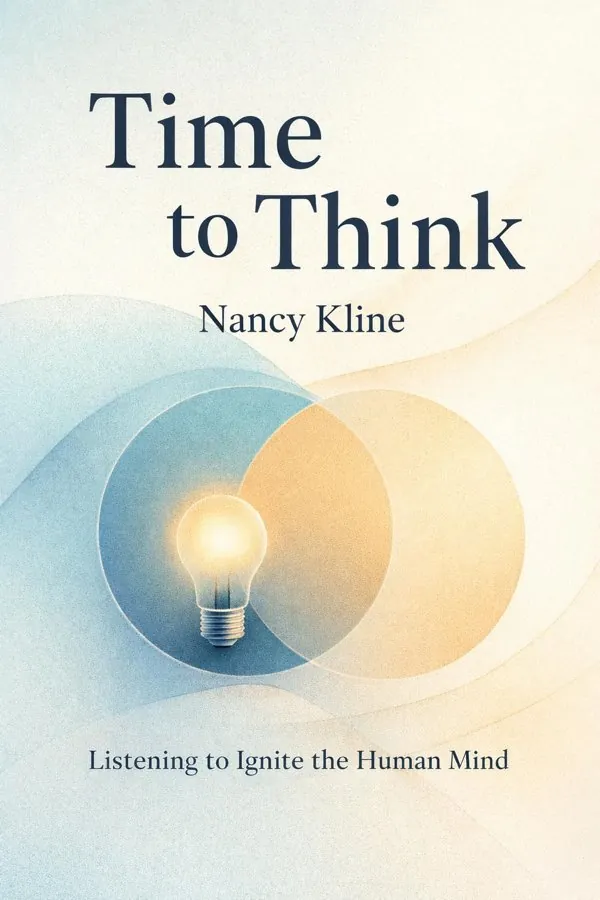
Time to Think: Listening to Ignite the Human Mind: Summary & Key Insights
by Nancy Kline
 10 min7 chaptersAudio available
What Is Time to Think: Listening to Ignite the Human Mind About?
Time to Think: Listening to Ignite the Human Mind by Nancy Kline is a communication book spanning 7 pages. Time to Think is a book about how to create high-quality thinking environments through deep listening. Nancy Kline introduces the concept of the 'Thinking Environment,' a set of conditions that foster clarity, creativity, and independent thought. Through practical examples and clear principles, the author demonstrates how genuine attention and the absence of interruption can transform communication, leadership, and personal relationships.
This FizzRead summary covers all 7 key chapters of Time to Think: Listening to Ignite the Human Mind in approximately 10 minutes, distilling the most important ideas, arguments, and takeaways from Nancy Kline's work. Also available as an audio summary and Key Quotes Podcast.
Time to Think: Listening to Ignite the Human Mind
Time to Think is a book about how to create high-quality thinking environments through deep listening. Nancy Kline introduces the concept of the 'Thinking Environment,' a set of conditions that foster clarity, creativity, and independent thought. Through practical examples and clear principles, the author demonstrates how genuine attention and the absence of interruption can transform communication, leadership, and personal relationships.
Who Should Read Time to Think: Listening to Ignite the Human Mind?
This book is perfect for anyone interested in communication and looking to gain actionable insights in a short read. Whether you're a student, professional, or lifelong learner, the key ideas from Time to Think: Listening to Ignite the Human Mind by Nancy Kline will help you think differently.
- ✓Readers who enjoy communication and want practical takeaways
- ✓Professionals looking to apply new ideas to their work and life
- ✓Anyone who wants the core insights of Time to Think: Listening to Ignite the Human Mind in just 10 minutes
Want the full summary?
Get instant access to this book summary and 100K+ more with Fizz Moment.
Get Free SummaryAvailable on App Store • Free to download
Key Chapters
The first discovery I made, and the one that reshaped all the others, is that the quality of a person’s thinking depends directly on the quality of attention they receive. Most of us think we are listening when, in truth, we are waiting for our turn to speak. But when someone listens to us with full attention—without interruption, without judgment, holding the belief that we are capable of brilliance—our thinking changes. It quickens, matures, and reaches heights we did not expect.
Attention in the Thinking Environment is not a polite silence; it is a creative act. It conveys respect and concentration so profound that it releases another mind into its own originality. When you offer someone your whole attention, your presence becomes a mirror in which their best thinking appears. I often tell people that listening, in this way, is not passive but catalytic. It ignites the mind.
Imagine, then, what happens in organizations or families where no one truly listens. Ideas shrink. Voices retreat. Hierarchies solidify. But introduce attention as an intentional practice, and suddenly people dare to think aloud again. Innovation returns not because you imposed it, but because you removed the biggest barrier—distraction. Attention tells the speaker, 'You matter. Your mind matters.' The result is a quality of thought that no command or incentive can produce.
From that original insight grew ten interdependent behaviors that characterize a Thinking Environment. Each one contributes to the conditions in which people think for themselves with depth and courage. I discovered them not in theory but through years of watching what enabled thinking to flourish.
At the heart are *Attention* and *Equality*. Attention, as we have seen, means listening with respect and without interruption. Equality means valuing every voice—not in identical ways, but with an equal right to think and to be heard. Even in hierarchies or formal structures, the Thinking Environment insists that for the purpose of thinking, everyone is equal. The moment someone is silenced, the thinking of the group contracts.
Then comes *Ease* and *Appreciation*. Ease removes internal rush, the anxiety that chokes expression. When we slow down, thought deepens. Appreciation, meanwhile, disciplines the mind toward balance. Organizations often claim to value challenge, but without appreciation, challenge becomes destructive. A mind that knows it is valued becomes more courageous and more accurate.
*Encouragement* and *Feelings* follow as natural allies. It takes courage to think differently, especially in cultures that reward compliance. Encouragement in this context does not flatter; it actively prevents competition. Feelings, too, are not sidetracks to thinking—they are part of it. When emotion is acknowledged instead of suppressed, clarity returns.
Two further components ensure that thinking remains both true and fresh: *Information* and *Diversity*. Without accurate information, thinking falters. Without diverse perspectives, thinking stagnates. I often say that sameness is the enemy of accuracy. Therefore, the Thinking Environment prizes difference. It asks that every voice, every story, every angle be welcomed, for truth often hides in the margins.
Finally, we come to *Incisive Questions*. These questions release the mind from limiting assumptions. When we identify and challenge the assumptions that hold us captive—such as 'I can’t say that' or 'They won’t listen'—our thinking expands. A well-formed incisive question doesn’t give an answer; it opens a path.
Together, these ten components form a living ecology. Remove one, and the environment weakens. Practice them, and people’s minds unfold.
+ 5 more chapters — available in the FizzRead app
All Chapters in Time to Think: Listening to Ignite the Human Mind
About the Author
Nancy Kline is a British-American consultant, writer, and speaker, and the founder of Time to Think, an organization dedicated to improving the quality of thinking in individuals and organizations. Her work focuses on listening, attention, and creating environments that promote independent thinking.
Get This Summary in Your Preferred Format
Read or listen to the Time to Think: Listening to Ignite the Human Mind summary by Nancy Kline anytime, anywhere. FizzRead offers multiple formats so you can learn on your terms — all free.
Available formats: App · Audio · PDF · EPUB — All included free with FizzRead
Download Time to Think: Listening to Ignite the Human Mind PDF and EPUB Summary
Key Quotes from Time to Think: Listening to Ignite the Human Mind
“The first discovery I made, and the one that reshaped all the others, is that the quality of a person’s thinking depends directly on the quality of attention they receive.”
“From that original insight grew ten interdependent behaviors that characterize a Thinking Environment.”
Frequently Asked Questions about Time to Think: Listening to Ignite the Human Mind
Time to Think: Listening to Ignite the Human Mind by Nancy Kline is a communication book that explores key ideas across 7 chapters. Time to Think is a book about how to create high-quality thinking environments through deep listening. Nancy Kline introduces the concept of the 'Thinking Environment,' a set of conditions that foster clarity, creativity, and independent thought. Through practical examples and clear principles, the author demonstrates how genuine attention and the absence of interruption can transform communication, leadership, and personal relationships.
You Might Also Like

Magic Words: The Science and Secrets Behind Seven Words That Motivate, Engage, and Influence
Tim David
10 min
Talking Across The Divide: How to Communicate with People You Disagree with and Maybe Even Change the World
Justin Lee
10 min
The Exceptional Presenter: A Proven Formula to Open Up! and Own the Room
Timothy J. Koegel
10 min
4 Essential Keys to Effective Communication in Love, Life, Work--Anywhere!: Including the 12-Day Communication Challenge!
Bento C. Leal III
10 min
Active Listening Techniques: 30 Practical Tools to Hone Your Communication Skills
Nisha Gupta
10 min
Bargaining for Advantage: Negotiation Strategies for Reasonable People
G. Richard Shell
10 minBrowse by Category
Ready to read Time to Think: Listening to Ignite the Human Mind?
Get the full summary and 100K+ more books with Fizz Moment.