
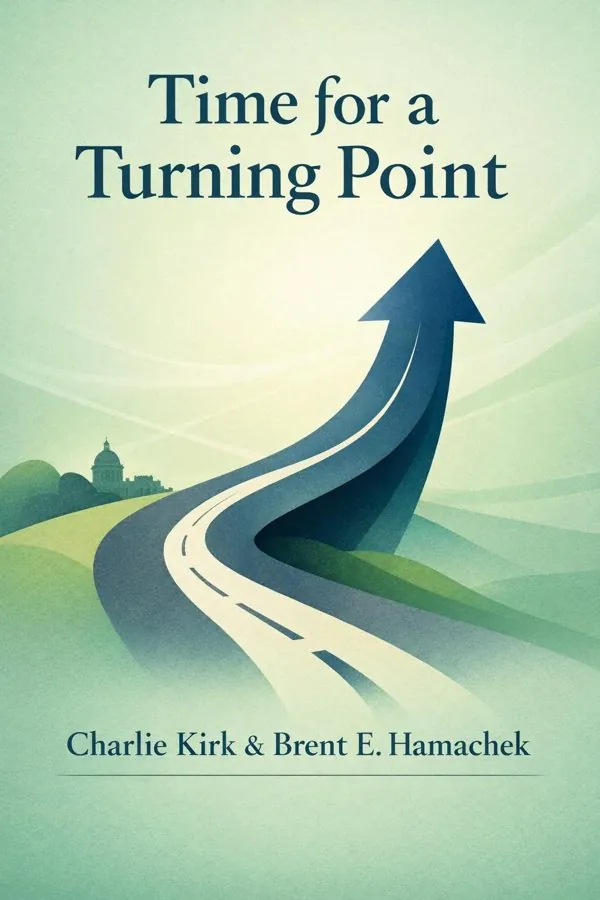
Time for a Turning Point: Setting a Course Toward Free Markets and Limited Government for Future Generations: Summary & Key Insights
by Charlie Kirk, Brent E. Hamachek
 10 min10 chaptersAudio available
Key Takeaways from Time for a Turning Point: Setting a Course Toward Free Markets and Limited Government for Future Generations
A nation’s future is rarely stronger than its memory of its beginnings.
The most dangerous political change is often the one that feels normal because it happens gradually.
Prosperity does not emerge from command; it emerges from freedom, incentives, and voluntary exchange.
Political battles are often won long before ballots are cast, in classrooms, campuses, and cultural institutions.
Freedom is not self-renewing; it survives only when each generation chooses to preserve it.
What Is Time for a Turning Point: Setting a Course Toward Free Markets and Limited Government for Future Generations About?
Time for a Turning Point: Setting a Course Toward Free Markets and Limited Government for Future Generations by Charlie Kirk, Brent E. Hamachek is a politics book spanning 10 pages. In Time for a Turning Point, Charlie Kirk and Brent E. Hamachek argue that the United States has reached a decisive moment: either it recommits to free markets, limited government, and personal responsibility, or it continues down a path of dependency, centralization, and cultural decline. Written as both a political warning and a rallying cry, the book presents a distinctly conservative case that America’s strength has always come from individual liberty, constitutional restraint, and moral confidence rather than bureaucratic expansion. The authors contend that many of today’s most serious problems, from economic stagnation to civic fragmentation, have been worsened by government overreach and a weakening belief in the principles that once defined the nation. Kirk brings the perspective of a prominent youth activist and founder of Turning Point USA, while Hamachek adds the structure of a policy-minded commentator and business thinker. Together, they offer not just criticism, but a blueprint for political engagement, cultural renewal, and generational stewardship. For readers seeking a clear statement of modern conservative thought, this book lays out both the diagnosis and the proposed cure.
This FizzRead summary covers all 10 key chapters of Time for a Turning Point: Setting a Course Toward Free Markets and Limited Government for Future Generations in approximately 10 minutes, distilling the most important ideas, arguments, and takeaways from Charlie Kirk, Brent E. Hamachek's work. Also available as an audio summary and Key Quotes Podcast.
Time for a Turning Point: Setting a Course Toward Free Markets and Limited Government for Future Generations
In Time for a Turning Point, Charlie Kirk and Brent E. Hamachek argue that the United States has reached a decisive moment: either it recommits to free markets, limited government, and personal responsibility, or it continues down a path of dependency, centralization, and cultural decline. Written as both a political warning and a rallying cry, the book presents a distinctly conservative case that America’s strength has always come from individual liberty, constitutional restraint, and moral confidence rather than bureaucratic expansion. The authors contend that many of today’s most serious problems, from economic stagnation to civic fragmentation, have been worsened by government overreach and a weakening belief in the principles that once defined the nation. Kirk brings the perspective of a prominent youth activist and founder of Turning Point USA, while Hamachek adds the structure of a policy-minded commentator and business thinker. Together, they offer not just criticism, but a blueprint for political engagement, cultural renewal, and generational stewardship. For readers seeking a clear statement of modern conservative thought, this book lays out both the diagnosis and the proposed cure.
Who Should Read Time for a Turning Point: Setting a Course Toward Free Markets and Limited Government for Future Generations?
This book is perfect for anyone interested in politics and looking to gain actionable insights in a short read. Whether you're a student, professional, or lifelong learner, the key ideas from Time for a Turning Point: Setting a Course Toward Free Markets and Limited Government for Future Generations by Charlie Kirk, Brent E. Hamachek will help you think differently.
- ✓Readers who enjoy politics and want practical takeaways
- ✓Professionals looking to apply new ideas to their work and life
- ✓Anyone who wants the core insights of Time for a Turning Point: Setting a Course Toward Free Markets and Limited Government for Future Generations in just 10 minutes
Want the full summary?
Get instant access to this book summary and 100K+ more with Fizz Moment.
Get Free SummaryAvailable on App Store • Free to download
Key Chapters
A nation’s future is rarely stronger than its memory of its beginnings. One of the book’s central claims is that America cannot recover its civic confidence unless it first remembers the philosophical and moral foundations that shaped its creation. Kirk and Hamachek argue that the United States emerged from a powerful blend of classical liberalism, biblical ethics, Enlightenment thinking, and practical self-government. In their view, concepts such as natural rights, limited state power, private property, and personal accountability were not accidental features of the American experiment; they were its operating system.
The authors stress that these ideas matter because modern political debates often treat freedom as a gift from government rather than a preexisting right government is supposed to protect. That shift, they argue, changes citizens into clients and leaders into managers of dependence. By revisiting the Founders’ assumptions, the book invites readers to see the Constitution not as an obstacle to progress, but as a framework designed to restrain concentrated power and preserve liberty across generations.
In practical terms, this means reading history with seriousness rather than sentimentality. It means asking whether current policies honor federalism, separation of powers, and civic virtue, or whether they bypass them in the name of efficiency. A local school board decision, a federal spending package, or a speech about “rights” all look different when filtered through founding principles.
The actionable takeaway is simple: study the ideas behind America’s institutions, then use them as a standard for judging current political proposals instead of accepting every expansion of power as inevitable.
The most dangerous political change is often the one that feels normal because it happens gradually. Kirk and Hamachek argue that the federal government has expanded far beyond its original constitutional scope, taking on roles once left to families, communities, markets, churches, and states. In their telling, what began as a limited mechanism for protecting rights has evolved into a sprawling administrative system that regulates behavior, redistributes resources, and shapes culture.
The authors do not claim all government is illegitimate. Instead, they distinguish between necessary government and excessive government. Necessary government protects borders, enforces laws, secures contracts, and preserves order. Excessive government, by contrast, promises to solve every social problem, often creating new inefficiencies, debt burdens, and perverse incentives along the way. The more functions government assumes, they argue, the less room remains for voluntary institutions and individual initiative.
This idea becomes concrete in everyday life. Small business owners face complex compliance burdens. Parents encounter top-down educational mandates. Workers see tax and regulatory structures influence hiring, wages, and entrepreneurship. Citizens become accustomed to asking what Washington will do next rather than what communities can do themselves.
The authors urge readers to think in terms of tradeoffs. Every new agency, rule, subsidy, or entitlement comes with hidden costs: reduced autonomy, bureaucratic waste, and diminished local problem-solving. Even well-intentioned policies can centralize power in ways that are difficult to reverse.
The actionable takeaway is to assess public policy not only by its stated goal, but by whether it increases dependence, weakens civil society, or transfers too much decision-making authority away from individuals and local institutions.
Prosperity does not emerge from command; it emerges from freedom, incentives, and voluntary exchange. A major theme of the book is that free markets are not merely efficient economic systems, but moral systems that recognize the dignity of human choice and reward productive contribution. Kirk and Hamachek argue that when individuals are free to innovate, invest, compete, and exchange value, society benefits through lower prices, better products, more opportunity, and wider prosperity.
The authors challenge the common assumption that markets are inherently exploitative while government intervention is inherently compassionate. In their view, markets channel ambition toward service: a business succeeds only by persuading others that it offers something useful. By contrast, political systems can reward lobbying, favoritism, and dependency rather than merit and value creation. They acknowledge that markets are imperfect, but insist that centralized planning is far worse because it concentrates power and suppresses experimentation.
Examples are easy to see. Technological innovation, entrepreneurial startups, and consumer abundance often result from competitive pressure, not bureaucratic design. A local restaurant adapts faster to customer needs than a centralized food program. A startup can solve a problem in months that a government office might study for years. Even job creation flourishes where regulation and taxation do not punish risk-taking.
The book’s defense of markets is also cultural. It links economic liberty to self-respect, arguing that earning, building, and owning cultivate responsibility. In that sense, capitalism is portrayed not just as a wealth engine, but as a teacher of discipline and initiative.
The actionable takeaway is to support policies and personal habits that expand economic freedom: reduce unnecessary regulation, value entrepreneurship, and recognize that opportunity grows when people are trusted to create rather than managed from above.
Political battles are often won long before ballots are cast, in classrooms, campuses, and cultural institutions. Kirk and Hamachek argue that education is not merely about academic skill; it is one of the primary ways a society transmits its values, assumptions, and sense of national identity. For that reason, they view modern education as a strategic front in the larger contest over America’s future.
According to the book, too many schools and universities have moved away from civic literacy, open inquiry, and respect for the American founding, replacing them with ideological frameworks that encourage grievance, dependency, and hostility toward free enterprise. The concern is not simply partisan imbalance, but the erosion of confidence in objective truth, merit, and constitutional self-government. Students who are taught to distrust their country, the authors suggest, are less likely to preserve its institutions.
The practical consequences reach beyond campus politics. Educational assumptions shape future voters, journalists, business leaders, and bureaucrats. If young Americans graduate believing markets are exploitative, speech is dangerous, and government is the primary source of justice, public policy will follow. Conversely, when students understand rights, responsibilities, economic tradeoffs, and historical complexity, they are more capable of sustaining a free society.
The authors emphasize parental engagement, school choice, civic education, and ideological diversity as corrective measures. A family discussing history at home, a community supporting charter schools, or a student questioning one-sided instruction are all examples of cultural resistance.
The actionable takeaway is to treat education as a long-term civic investment: learn what children are being taught, support institutions that value truth and liberty, and cultivate intellectual resilience instead of passive acceptance.
Freedom is not self-renewing; it survives only when each generation chooses to preserve it. Kirk and Hamachek frame politics not just as a fight over present policies, but as an intergenerational responsibility. They argue that today’s leaders and citizens are trustees, not owners, of the American experiment. Debt, entitlement expansion, moral confusion, and institutional decay are therefore not abstract problems. They are burdens passed to people who had no say in creating them.
This generational lens gives the book much of its urgency. The authors worry that younger Americans are being handed fewer economic opportunities, more centralized governance, weaker civic knowledge, and a culture less confident in the value of liberty. In that context, defending free markets and limited government becomes an act of stewardship rather than nostalgia. The goal is not to recreate the past exactly, but to ensure that future citizens still have room to exercise responsibility, pursue prosperity, and govern themselves.
The idea applies to personal as well as public life. Families shape values. Community organizations model citizenship. Entrepreneurs create opportunity. Voters choose whether to reward short-term promises or long-term sustainability. Even attitudes toward borrowing, work, and consumption have generational effects.
One useful example is fiscal policy. Deficit spending may buy political convenience today, but it shifts costs forward through inflation, taxes, and reduced flexibility. Similarly, weakening standards in education may lower immediate conflict while leaving future adults less prepared for self-rule.
The actionable takeaway is to judge decisions by a simple question: will this strengthen or weaken the capacity of the next generation to live freely, responsibly, and prosperously?
Ideas become meaningful when they shape policy. Kirk and Hamachek do not stop at broad philosophical claims; they argue that free markets and limited government should guide concrete reforms across taxation, regulation, education, healthcare, and federal spending. Their underlying point is that public policy should flow from clear first principles rather than from political fashion or bureaucratic inertia.
In this framework, good policy expands choice, decentralizes authority, rewards work, and restrains government from substituting itself for civil society. Tax policy should encourage productivity and investment rather than penalize success. Regulatory reform should remove barriers that prevent small businesses from competing. Education policy should empower parents and students instead of protecting institutional monopolies. Spending decisions should recognize that every public dollar is first taken from private citizens or borrowed from future ones.
The authors are especially skeptical of one-size-fits-all national solutions. They prefer local experimentation and state-level flexibility, believing that diverse communities can solve problems more effectively when they are free to adapt rather than comply. This principle also makes failure less catastrophic; when policy is decentralized, bad ideas do less damage and good ones can spread organically.
For readers, the key lesson is that slogans are insufficient. Saying one supports liberty is easy; the harder question is whether one supports the tax, school, zoning, licensing, or spending reforms that liberty requires. The book pushes readers to connect values with legislation.
The actionable takeaway is to evaluate specific policy proposals through a consistent test: do they increase choice, accountability, and local control, or do they deepen centralization and dependency?
A free society cannot endure on economics alone; it also depends on character. One of the book’s more foundational arguments is that liberty requires a moral culture capable of self-restraint, honesty, responsibility, and respect for truth. Kirk and Hamachek reject the idea that politics can be separated neatly from ethics. In their view, when personal discipline erodes, the demand for government management rises. People who cannot govern themselves increasingly invite others to govern them.
This moral dimension is central to the authors’ conservative outlook. They see family stability, religious conviction, personal accountability, and civic virtue not as private lifestyle preferences, but as the social infrastructure of freedom. Markets function better when people honor contracts. Communities flourish when citizens volunteer and care for neighbors. Constitutional norms survive when leaders believe there are limits they should not cross, even when they can.
The authors are not arguing that government should coerce virtue into existence. Rather, they contend that law and liberty work best when supported by a culture that values responsibility over entitlement and duty over self-indulgence. A society that celebrates consumption but neglects discipline may remain wealthy for a while, but it grows politically fragile. Moral confusion eventually spills into economics and governance.
In daily life, this means that citizenship begins before politics. Habits such as keeping commitments, raising children responsibly, serving one’s community, and telling the truth all contribute to a society less dependent on regulation and enforcement.
The actionable takeaway is to treat personal character as a civic act: strengthen the habits, institutions, and relationships that make freedom sustainable rather than assuming policy alone can rescue a culture.
Political change rarely starts with elites deciding to surrender power. It starts when ordinary citizens become informed, organized, and persistent. Kirk and Hamachek place strong emphasis on activism, especially among younger Americans, arguing that conservative principles will remain abstract unless they are translated into visible public engagement. The book presents activism not as outrage for its own sake, but as disciplined participation in the institutions that shape culture and policy.
This includes voting, of course, but it goes further. Students can challenge ideological conformity on campus. Parents can attend school board meetings. Workers and entrepreneurs can support policies that defend economic liberty. Citizens can build local networks, support advocacy organizations, and communicate clearly in their communities. The authors believe that if progressives have been successful in influencing education, media, and bureaucracy, it is partly because they treated politics as a long-term organizing project.
Importantly, the book frames activism as educational. People become more effective advocates when they understand constitutional limits, economic tradeoffs, and rhetorical persuasion. Emotional reaction may energize a movement briefly, but durable influence requires knowledge, consistency, and credible leadership.
A practical example is local engagement. National politics dominates headlines, but zoning boards, school districts, county commissions, and state legislatures often make decisions with immediate effects on taxes, speech, curriculum, and enterprise. Citizens who ignore these arenas leave them open to organized interests.
The actionable takeaway is to choose one sphere of practical involvement this month, such as attending a local meeting, studying a policy issue, joining a civic organization, or helping educate peers, and turn beliefs into sustained participation.
Political movements gain power not only by advancing their own ideas, but by weakening confidence in competing ones. Kirk and Hamachek argue that defenders of limited government face serious resistance from institutions and narratives that portray freedom as unfair, tradition as oppressive, and market outcomes as evidence of systemic injustice. In their view, the challenge is not merely electoral opposition but a broader cultural environment that normalizes centralization while casting skepticism toward it as harsh or outdated.
The authors contend that this opposition succeeds when conservatives fail to communicate in moral and human terms. If the defense of free markets sounds like a defense of greed, or if limited government sounds like indifference to suffering, then the public debate is already skewed. The book therefore insists that ideas must be framed not only around efficiency, but around dignity, agency, fairness, and long-term flourishing.
Examples of this challenge appear in media narratives, campus discourse, corporate messaging, and public policy debates. Language itself becomes contested: equality can be redefined to mean equal outcomes, rights can be detached from responsibilities, and compassion can be equated with expanding state control. The result is conceptual drift that makes principled argument more difficult.
To respond effectively, the authors suggest clarity, courage, and patience. Rather than retreating from controversy, advocates of liberty must explain why dispersed power protects the vulnerable better than concentrated power does, and why incentives, families, and communities matter.
The actionable takeaway is to practice articulating conservative ideas in accessible moral language, showing how freedom serves real people, especially those who are most harmed when bureaucracy replaces opportunity.
A movement cannot succeed by criticism alone; people need a future worth building. The book concludes with a forward-looking vision in which America regains confidence by recommitting to constitutional limits, economic dynamism, cultural responsibility, and citizen-led renewal. Kirk and Hamachek insist that the goal is not merely to shrink government mechanically, but to expand the space in which individuals, families, communities, and businesses can thrive.
This vision is optimistic rather than fatalistic. The authors believe decline is reversible if enough people reject passivity and recover belief in the country’s founding principles. They imagine an America where entrepreneurship is easier, education is less ideological, public debt is addressed seriously, and civic institutions are strengthened rather than replaced by distant administrations. In such a society, freedom is not chaos but ordered liberty, a condition in which people can pursue meaningful lives without constant state direction.
The appeal of this vision lies in its coherence. Economic freedom supports innovation. Moral responsibility supports social trust. Constitutional limits prevent abuse. Civic engagement keeps institutions accountable. None of these elements stands alone; each reinforces the others. The future, as the authors present it, depends on rebuilding this ecosystem rather than relying on any single leader or policy fix.
For readers, the chapter functions as a challenge to move from diagnosis to construction. It asks not simply what is wrong with modern America, but what kind of communities, institutions, and habits must be built to make freedom workable again.
The actionable takeaway is to adopt a builder’s mindset: support reforms and institutions that create long-term capacity for liberty instead of focusing only on short-term political victories.
All Chapters in Time for a Turning Point: Setting a Course Toward Free Markets and Limited Government for Future Generations
About the Authors
Charlie Kirk is a conservative activist, speaker, and author best known as the founder and president of Turning Point USA, a nonprofit organization focused on promoting free markets, limited government, and conservative ideas among students and young Americans. Through campus outreach, media appearances, and political commentary, he has become a prominent voice in contemporary American conservatism. Brent E. Hamachek is a writer, speaker, consultant, and commentator whose work often explores politics, economics, leadership, and public policy. He brings a business-minded and analytical perspective to ideological debates. Together, Kirk and Hamachek combine activism and argumentation, producing books that aim to defend constitutional principles, economic liberty, and civic responsibility for a new generation of readers.
Get This Summary in Your Preferred Format
Read or listen to the Time for a Turning Point: Setting a Course Toward Free Markets and Limited Government for Future Generations summary by Charlie Kirk, Brent E. Hamachek anytime, anywhere. FizzRead offers multiple formats so you can learn on your terms — all free.
Available formats: App · Audio · PDF · EPUB — All included free with FizzRead
Download Time for a Turning Point: Setting a Course Toward Free Markets and Limited Government for Future Generations PDF and EPUB Summary
Key Quotes from Time for a Turning Point: Setting a Course Toward Free Markets and Limited Government for Future Generations
“A nation’s future is rarely stronger than its memory of its beginnings.”
“The most dangerous political change is often the one that feels normal because it happens gradually.”
“Prosperity does not emerge from command; it emerges from freedom, incentives, and voluntary exchange.”
“Political battles are often won long before ballots are cast, in classrooms, campuses, and cultural institutions.”
“Freedom is not self-renewing; it survives only when each generation chooses to preserve it.”
Frequently Asked Questions about Time for a Turning Point: Setting a Course Toward Free Markets and Limited Government for Future Generations
Time for a Turning Point: Setting a Course Toward Free Markets and Limited Government for Future Generations by Charlie Kirk, Brent E. Hamachek is a politics book that explores key ideas across 10 chapters. In Time for a Turning Point, Charlie Kirk and Brent E. Hamachek argue that the United States has reached a decisive moment: either it recommits to free markets, limited government, and personal responsibility, or it continues down a path of dependency, centralization, and cultural decline. Written as both a political warning and a rallying cry, the book presents a distinctly conservative case that America’s strength has always come from individual liberty, constitutional restraint, and moral confidence rather than bureaucratic expansion. The authors contend that many of today’s most serious problems, from economic stagnation to civic fragmentation, have been worsened by government overreach and a weakening belief in the principles that once defined the nation. Kirk brings the perspective of a prominent youth activist and founder of Turning Point USA, while Hamachek adds the structure of a policy-minded commentator and business thinker. Together, they offer not just criticism, but a blueprint for political engagement, cultural renewal, and generational stewardship. For readers seeking a clear statement of modern conservative thought, this book lays out both the diagnosis and the proposed cure.
You Might Also Like
Antifa: The Anti-Fascist Handbook
Mark Bray
10 min
Attack from Within: How Disinformation Is Sabotaging America
Barbara McQuade
10 min
Coercion, Capital, and European States, AD 990–1992
Charles Tilly
10 min
Digital Democracy: Concepts, Methodologies, Tools, and Applications
Various Authors
10 min
Fascism
Stanley G. Payne
10 min
Fire And Fury: Inside The Trump White House
Michael Wolff
10 minBrowse by Category
Ready to read Time for a Turning Point: Setting a Course Toward Free Markets and Limited Government for Future Generations?
Get the full summary and 100K+ more books with Fizz Moment.