
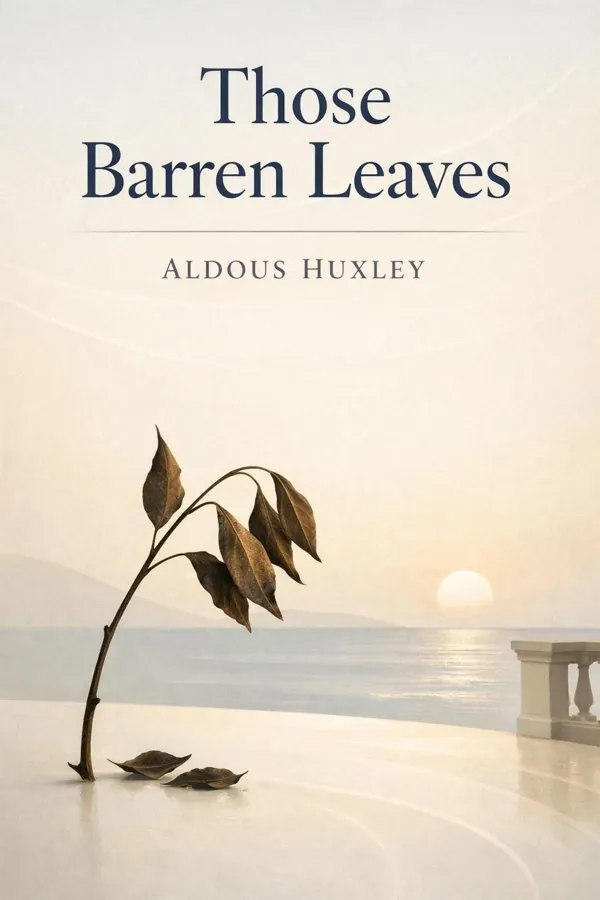
Those Barren Leaves: Summary & Key Insights
 10 min9 chaptersAudio available
Key Takeaways from Those Barren Leaves
A cultivated environment can hide a deeply uncultivated soul.
Intelligence can expose illusion without helping us escape it.
The desire to escape society often masks a deeper inability to live well within oneself.
Emotional intensity is not the same as emotional truth.
Most social worlds survive by mutual agreement not to look too closely.
What Is Those Barren Leaves About?
Those Barren Leaves by Aldous Huxley is a classics book spanning 5 pages. Aldous Huxley’s Those Barren Leaves is a sharp, elegant satire about people who have filled their lives with culture, conversation, and cultivated taste, yet remain painfully empty at the center. Set largely in an Italian villa owned by the flamboyant and wealthy Mrs. Aldwinkle, the novel gathers artists, intellectuals, social climbers, and spiritual seekers into a kind of human laboratory. There, Huxley observes what happens when refinement replaces sincerity and when the pursuit of beauty becomes a defense against genuine feeling. The result is both comic and quietly devastating. What makes the novel endure is its uncanny relevance. Huxley examines performance, status, distraction, emotional posturing, and the modern hunger for meaning—concerns that feel just as alive now as they did in the 1920s. His characters speak brilliantly, think restlessly, and often fail completely to live wisely. That tension gives the book its force. Huxley, one of the twentieth century’s great literary minds, wrote with rare intelligence about the gap between what people know and how they actually behave. In Those Barren Leaves, he turns that insight into a dazzling critique of civilized emptiness.
This FizzRead summary covers all 9 key chapters of Those Barren Leaves in approximately 10 minutes, distilling the most important ideas, arguments, and takeaways from Aldous Huxley's work. Also available as an audio summary and Key Quotes Podcast.
Those Barren Leaves
Aldous Huxley’s Those Barren Leaves is a sharp, elegant satire about people who have filled their lives with culture, conversation, and cultivated taste, yet remain painfully empty at the center. Set largely in an Italian villa owned by the flamboyant and wealthy Mrs. Aldwinkle, the novel gathers artists, intellectuals, social climbers, and spiritual seekers into a kind of human laboratory. There, Huxley observes what happens when refinement replaces sincerity and when the pursuit of beauty becomes a defense against genuine feeling. The result is both comic and quietly devastating.
What makes the novel endure is its uncanny relevance. Huxley examines performance, status, distraction, emotional posturing, and the modern hunger for meaning—concerns that feel just as alive now as they did in the 1920s. His characters speak brilliantly, think restlessly, and often fail completely to live wisely. That tension gives the book its force. Huxley, one of the twentieth century’s great literary minds, wrote with rare intelligence about the gap between what people know and how they actually behave. In Those Barren Leaves, he turns that insight into a dazzling critique of civilized emptiness.
Who Should Read Those Barren Leaves?
This book is perfect for anyone interested in classics and looking to gain actionable insights in a short read. Whether you're a student, professional, or lifelong learner, the key ideas from Those Barren Leaves by Aldous Huxley will help you think differently.
- ✓Readers who enjoy classics and want practical takeaways
- ✓Professionals looking to apply new ideas to their work and life
- ✓Anyone who wants the core insights of Those Barren Leaves in just 10 minutes
Want the full summary?
Get instant access to this book summary and 100K+ more with Fizz Moment.
Get Free SummaryAvailable on App Store • Free to download
Key Chapters
A cultivated environment can hide a deeply uncultivated soul. At the center of Those Barren Leaves stands Mrs. Aldwinkle, a wealthy woman determined to turn her Italian villa into a living monument to art, conversation, and civilization. She surrounds herself with talented, eccentric, and supposedly elevated guests, hoping that the right setting and the right people will produce a superior form of life. But Huxley quickly reveals the irony: the villa is less a sanctuary of genuine culture than a stage on which everyone performs an idea of refinement.
Mrs. Aldwinkle represents a familiar temptation—the belief that beauty, taste, and intellectual company can substitute for self-knowledge. Her project is not entirely foolish; environments do shape us, and thoughtful surroundings can encourage better habits. Yet Huxley insists that no arrangement of décor, music, books, or guests can redeem inner confusion. The villa becomes a symbolic space where conversation replaces action, aesthetic pose replaces feeling, and social theater replaces intimacy.
This insight applies far beyond aristocratic Italy. People still curate lives through status objects, social circles, and carefully constructed identities. A beautifully designed home, a sophisticated reading list, or a public image of cultural depth can be enriching, but they can also become disguises. We may start treating life as something to display rather than experience.
Huxley’s point is not that art is worthless, but that art without honesty becomes decorative emptiness. Culture can deepen life only when it is tied to humility, self-examination, and real contact with others.
Actionable takeaway: Examine the “villa” in your own life—the spaces, routines, and symbols you use to signal meaning—and ask whether they support genuine growth or merely aestheticize your avoidance.
Intelligence can expose illusion without helping us escape it. Francis Chelifer is one of Huxley’s most penetrating creations: a man capable of seeing through pretension, vanity, and self-deception, yet unable to convert that insight into a meaningful life. He is perceptive, analytical, and often devastatingly accurate in his judgments. Through him, Huxley examines one of the novel’s deepest concerns: intellect is not the same as wisdom.
Chelifer’s irony protects him from naivete, but it also traps him in passivity. He understands the absurdity of the world around him—the inflated egos, the fashionable emotions, the spiritual fads—but his brilliance does not free him from futility. Instead, his clarity often results in paralysis. He dissects experience so thoroughly that action seems compromised before it begins. The mind becomes an instrument of critique rather than of transformation.
This is one of Huxley’s most modern insights. Many people today are highly articulate about systems, psychology, hypocrisy, and social performance. They can diagnose problems in institutions, relationships, and culture with astonishing precision. Yet analysis alone rarely produces change. A person can know why they are unhappy, why a relationship is unhealthy, or why a workplace is corrosive, and still remain stuck.
Chelifer reminds us that self-awareness can become a sophisticated excuse. If we mistake understanding for action, we may end up admiring our insight while our lives remain untouched. Huxley does not mock intelligence itself; he mocks detached intelligence that refuses risk, commitment, and vulnerability.
Actionable takeaway: When you catch yourself explaining your life better than you are living it, choose one concrete act—however small—that converts insight into behavior.
The desire to escape society often masks a deeper inability to live well within oneself. Mr. Calamy is one of the novel’s most serious figures, a man weary of superficiality and hungry for something more authentic. Unlike those who are content to play social games, he feels the spiritual exhaustion of modern life. He wants silence, truth, inwardness, perhaps even renewal. In him, Huxley explores the longing that arises when intellect and pleasure no longer satisfy.
Calamy’s dissatisfaction is genuine, which sets him apart from the more performative characters. Yet Huxley does not romanticize his yearning. Withdrawal from a shallow world is not automatically wisdom. A person may reject noise, fashion, and empty sociability and still carry restlessness, vanity, and confusion into solitude. Calamy senses that civilized life has become artificial, but sensing the problem does not guarantee that he has found the solution.
The novel treats his search with sympathy because it identifies a real human need: the need for meaning not based on status, stimulation, or endless conversation. Many readers will recognize this impulse today in burnout, digital fatigue, overwork, or disappointment with self-conscious urban sophistication. The temptation is to imagine that a retreat, a new philosophy, or a dramatic life change will instantly create depth.
Huxley’s subtler message is that meaning depends less on changing scenery than on changing relation—to self, to thought, to desire, and to others. Escape may provide distance, but not necessarily transformation.
Actionable takeaway: If you feel drawn to “get away from it all,” pair any external change with an internal practice—journaling, meditation, honest conversation, or disciplined reflection—so that retreat becomes renewal rather than another form of avoidance.
Emotional intensity is not the same as emotional truth. Through Miss Thriplow, Huxley explores the performative side of feeling—the way people can become attached not to genuine emotion, but to the drama of appearing sensitive, deep, or romantically afflicted. She embodies a type that remains instantly recognizable: the person who treats life as a sequence of heightened moods and emotionally charged scenes, often without the grounding force of real self-understanding.
Huxley’s satire here is subtle and important. He is not mocking emotion itself; he is mocking sentimentality, the stylized imitation of emotion that flatters the ego. Miss Thriplow experiences and expresses feeling in ways that seem vivid, but her inner life is entangled with posture, fantasy, and self-display. She does not simply feel; she curates her feeling. That habit makes sincerity difficult, because every experience is partly converted into a performance.
This pattern is familiar in modern life. Social media, therapeutic language, and public self-expression can encourage people to narrate emotions before they have actually understood them. A disappointment becomes an identity. A passing attraction becomes a grand story. A mood becomes proof of depth. When this happens, emotion no longer helps us encounter reality; it helps us dramatize ourselves.
Huxley suggests that true feeling is quieter, less ornamental, and more morally demanding. It requires attention, honesty, and sometimes embarrassment. Real emotion asks us to listen, repair, endure, and change—not just to emote.
Actionable takeaway: The next time you feel a strong emotion, resist the urge to immediately perform or narrate it. First ask: What actually happened, what do I really feel, and what responsible action does this feeling call for?
Laughter can be one of the most serious forms of truth-telling. Huxley does not write Those Barren Leaves as a solemn philosophical treatise; he writes it as a satire. That choice matters. Satire allows him to expose vanity, pretension, and spiritual emptiness without preaching. By exaggerating social habits and sharpening dialogue, he reveals the absurd structures people build around themselves to avoid facing reality.
In the novel, wit functions like a scalpel. Huxley cuts through sentimental illusions by making them look ridiculous. The inflated conversation, the forced sophistication, the cultural posturing, the pseudo-spiritual gestures—all become comic not because they are harmless, but because they are painfully recognizable. Humor becomes a form of moral diagnosis. It reveals disproportion: people making grand claims with tiny souls, dramatic gestures with trivial substance.
This method is still powerful today. Satire often sees what sincerity misses. In workplaces, media culture, elite institutions, or intellectual scenes, absurdity can become normalized so completely that only comedy reveals it. A satirical lens helps us notice jargon that disguises emptiness, branding that imitates values, and emotional performances that conceal indifference.
But Huxley’s satire is not merely cruel. Beneath the mockery lies disappointment in human waste: wasted intelligence, wasted sensitivity, wasted opportunity for real connection. He laughs because people could live more honestly than they do.
For readers, the challenge is to accept satire personally. It is easy to see everyone else in Huxley’s caricatures. It is harder—and more useful—to notice where our own habits of display, irony, and self-importance might deserve the same treatment.
Actionable takeaway: When a satirical portrait makes you laugh, pause before dismissing it as “about other people.” Ask what part of your own behavior the joke might be exposing.
Aesthetic refinement can enrich life, but when detached from moral seriousness it becomes a dead end. Throughout Those Barren Leaves, Huxley returns to people who admire beauty, cultivate taste, and pursue elevated experiences, yet remain stunted in judgment and barren in feeling. The novel is not anti-art; it is anti-idolatry. Huxley opposes the notion that aesthetic sensibility by itself can save a life.
This distinction is crucial. Art can sharpen perception, enlarge sympathy, and deepen experience. But it can also become a refuge for the ego. Characters in the novel use culture as insulation: a way to avoid ordinary duties, emotional honesty, and ethical commitment. They confuse responsiveness to beauty with depth of character. Huxley repeatedly punctures that confusion.
Modern readers can apply this insight broadly. It is possible to have excellent taste and poor priorities; to discuss literature, film, architecture, or music with sophistication while neglecting kindness, courage, or responsibility. Cultural literacy may give the appearance of substance, but substance depends on what one does with perception. Beauty should awaken relation, not replace it.
Huxley suggests that aesthetic life becomes fruitful only when integrated with discipline, compassion, and truthfulness. Otherwise it decays into stylization. A person may know what is elegant without knowing what is good. The result is not civilization but ornamented emptiness.
Actionable takeaway: Let your encounters with art lead to action. After reading, listening, or viewing something beautiful, ask what it calls you to notice, repair, appreciate, or practice in actual life.
People often use brilliant talk to avoid saying anything real. One of Huxley’s great gifts is his ear for conversation—not only for what characters say, but for how speech becomes a social shield. In Those Barren Leaves, dialogue sparkles with wit, intelligence, opinion, and verbal performance. Yet much of this conversation serves not to connect, but to deflect. Words become a way of maintaining distance while appearing intimate or profound.
The villa’s social life runs on this paradox. Guests discuss ideas, art, feelings, spirituality, and civilization, but their exchanges frequently conceal insecurity, rivalry, seduction, or boredom. Conversation functions as a socially acceptable substitute for genuine encounter. To speak cleverly is easier than to speak honestly; to debate culture is safer than to admit loneliness, confusion, envy, or fear.
This pattern remains familiar in contemporary life. Many educated environments reward fluency more than sincerity. People learn to speak in persuasive, informed, and psychologically aware ways while revealing very little of themselves. Meetings, dinners, podcasts, online threads, and even intimate relationships can become arenas for display rather than mutual understanding.
Huxley does not deny the pleasure of intelligent talk. He clearly delights in language. But he warns that eloquence can be sterile when it never risks vulnerability. Real connection often begins where performance breaks down—where speech becomes simpler, more direct, and less flattering to the speaker.
Actionable takeaway: In your next meaningful conversation, replace one polished opinion with one honest admission. Notice whether truth, not cleverness, creates the deeper bond.
Having time, money, and education does not protect people from despair; it may simply give them more elaborate ways to avoid it. Huxley sets his novel among the privileged not because emptiness belongs only to the elite, but because privilege makes certain forms of emptiness highly visible. The characters of Those Barren Leaves possess leisure, mobility, cultural access, and social freedom. Yet far from producing fulfillment, these advantages often intensify aimlessness.
Without necessity to structure their lives, they drift into cultivated distraction. They fill the day with talk, flirtation, posturing, projects, and impressions. Huxley shows how comfort can become spiritually dangerous when it removes friction without supplying purpose. Privilege expands options, but options alone do not create meaning. In fact, endless possibility can dissolve commitment.
This theme speaks strongly to modern conditions. Many people are surrounded by entertainment, information, convenience, and choice, yet feel chronically dissatisfied. The problem is not simply material abundance, but the absence of orienting values. When life is organized around consumption, stimulation, and self-expression, the self may become more fragmented, not more free.
Huxley’s critique is especially sharp because he refuses simplistic moralism. He does not say suffering is inherently ennobling or that comfort is shameful. He says that a life without discipline, service, or inward seriousness easily becomes barren, however elegant its setting.
Actionable takeaway: If your life feels scattered despite outward advantages, introduce one chosen constraint—a commitment, routine, responsibility, or service practice—that turns freedom into purpose.
All Chapters in Those Barren Leaves
About the Author
Aldous Huxley (1894–1963) was an English writer, essayist, and public intellectual whose work ranged across fiction, philosophy, science, religion, and psychology. Born into a distinguished intellectual family, he developed into one of the twentieth century’s most versatile and probing literary minds. Huxley first gained recognition for satirical novels that examined modern society, class, and culture, including Crome Yellow, Antic Hay, and Those Barren Leaves. He later became internationally famous for Brave New World, his enduring dystopian masterpiece. Over time, his interests expanded to include mysticism, consciousness, and human potential, reflected in works such as The Perennial Philosophy and The Doors of Perception. Throughout his career, Huxley combined stylistic brilliance with a relentless curiosity about how people think, believe, and live.
Get This Summary in Your Preferred Format
Read or listen to the Those Barren Leaves summary by Aldous Huxley anytime, anywhere. FizzRead offers multiple formats so you can learn on your terms — all free.
Available formats: App · Audio · PDF · EPUB — All included free with FizzRead
Download Those Barren Leaves PDF and EPUB Summary
Key Quotes from Those Barren Leaves
“A cultivated environment can hide a deeply uncultivated soul.”
“Intelligence can expose illusion without helping us escape it.”
“The desire to escape society often masks a deeper inability to live well within oneself.”
“Emotional intensity is not the same as emotional truth.”
“Most social worlds survive by mutual agreement not to look too closely.”
Frequently Asked Questions about Those Barren Leaves
Those Barren Leaves by Aldous Huxley is a classics book that explores key ideas across 9 chapters. Aldous Huxley’s Those Barren Leaves is a sharp, elegant satire about people who have filled their lives with culture, conversation, and cultivated taste, yet remain painfully empty at the center. Set largely in an Italian villa owned by the flamboyant and wealthy Mrs. Aldwinkle, the novel gathers artists, intellectuals, social climbers, and spiritual seekers into a kind of human laboratory. There, Huxley observes what happens when refinement replaces sincerity and when the pursuit of beauty becomes a defense against genuine feeling. The result is both comic and quietly devastating. What makes the novel endure is its uncanny relevance. Huxley examines performance, status, distraction, emotional posturing, and the modern hunger for meaning—concerns that feel just as alive now as they did in the 1920s. His characters speak brilliantly, think restlessly, and often fail completely to live wisely. That tension gives the book its force. Huxley, one of the twentieth century’s great literary minds, wrote with rare intelligence about the gap between what people know and how they actually behave. In Those Barren Leaves, he turns that insight into a dazzling critique of civilized emptiness.
More by Aldous Huxley
You Might Also Like
Browse by Category
Ready to read Those Barren Leaves?
Get the full summary and 100K+ more books with Fizz Moment.