
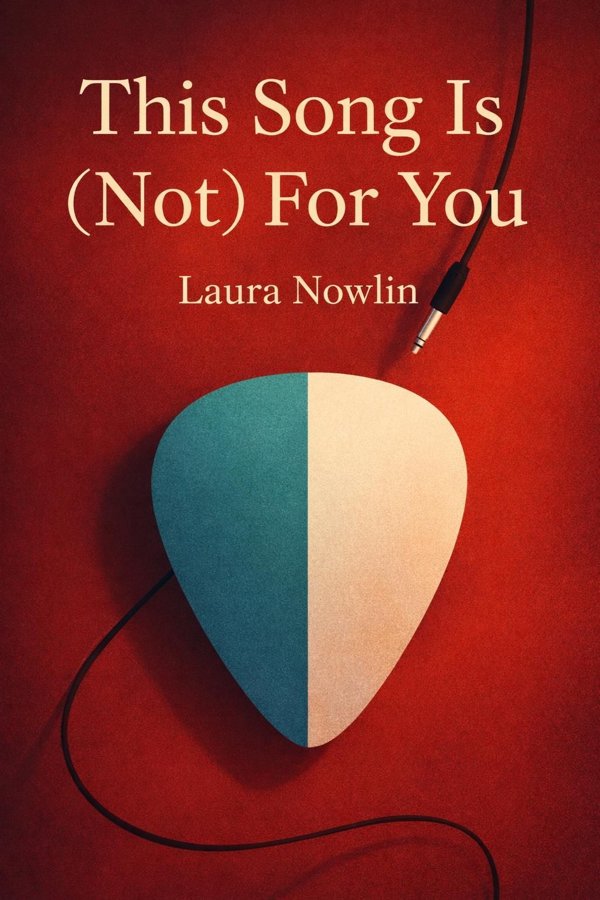
This Song Is (Not) For You: Summary & Key Insights
by Laura Nowlin
 10 min8 chaptersAudio available
Key Takeaways from This Song Is (Not) For You
Sometimes the first place we are truly seen is not in conversation, but in creation.
Wanting something deeply does not make it simple, and Sam’s emotional journey is built on that painful truth.
Love becomes most confusing when the available labels feel too small.
Silence is often mistaken for emptiness, but some of the deepest emotional lives are the least loudly expressed.
Art matters most when it says what ordinary speech cannot.
What Is This Song Is (Not) For You About?
This Song Is (Not) For You by Laura Nowlin is a bestsellers book spanning 5 pages. Some novels capture adolescence as a blur of drama; This Song Is (Not) For You captures it as a search for language. Laura Nowlin’s emotionally layered young adult novel follows Sam, Ramona, and Tom, three teenagers whose connection begins with music but deepens into something much harder to define. As they form a band, they also form a fragile sanctuary where longing, identity, friendship, and love can be explored without easy labels. But the closer they become, the more impossible it is to ignore what each of them wants, fears, and cannot yet say aloud. What makes the book matter is its refusal to reduce relationships to simple categories. Nowlin writes with sensitivity about bisexuality, emotional dependence, artistic expression, and the uncertain space between platonic and romantic attachment. Rather than offering a conventional love triangle, she presents a more honest portrait of how real people can love one another in overlapping, uneven, and confusing ways. Known for writing emotionally resonant stories about adolescence and inner conflict, Laura Nowlin brings empathy and nuance to a novel that speaks directly to readers who have ever felt too complicated for ordinary definitions.
This FizzRead summary covers all 8 key chapters of This Song Is (Not) For You in approximately 10 minutes, distilling the most important ideas, arguments, and takeaways from Laura Nowlin's work. Also available as an audio summary and Key Quotes Podcast.
This Song Is (Not) For You
Some novels capture adolescence as a blur of drama; This Song Is (Not) For You captures it as a search for language. Laura Nowlin’s emotionally layered young adult novel follows Sam, Ramona, and Tom, three teenagers whose connection begins with music but deepens into something much harder to define. As they form a band, they also form a fragile sanctuary where longing, identity, friendship, and love can be explored without easy labels. But the closer they become, the more impossible it is to ignore what each of them wants, fears, and cannot yet say aloud.
What makes the book matter is its refusal to reduce relationships to simple categories. Nowlin writes with sensitivity about bisexuality, emotional dependence, artistic expression, and the uncertain space between platonic and romantic attachment. Rather than offering a conventional love triangle, she presents a more honest portrait of how real people can love one another in overlapping, uneven, and confusing ways. Known for writing emotionally resonant stories about adolescence and inner conflict, Laura Nowlin brings empathy and nuance to a novel that speaks directly to readers who have ever felt too complicated for ordinary definitions.
Who Should Read This Song Is (Not) For You?
This book is perfect for anyone interested in bestsellers and looking to gain actionable insights in a short read. Whether you're a student, professional, or lifelong learner, the key ideas from This Song Is (Not) For You by Laura Nowlin will help you think differently.
- ✓Readers who enjoy bestsellers and want practical takeaways
- ✓Professionals looking to apply new ideas to their work and life
- ✓Anyone who wants the core insights of This Song Is (Not) For You in just 10 minutes
Want the full summary?
Get instant access to this book summary and 100K+ more with Fizz Moment.
Get Free SummaryAvailable on App Store • Free to download
Key Chapters
Sometimes the first place we are truly seen is not in conversation, but in creation. That is the emotional foundation of This Song Is (Not) For You. Sam, Ramona, and Tom do not become close because they instantly understand one another in words. They connect because music gives them a structure for presence, vulnerability, and trust. Their band begins as a practical collaboration, but it quickly becomes something deeper: a safe space where each of them can exist with less performance and more honesty.
For teenagers struggling with loneliness, insecurity, or identity, shared art can become a refuge. Sam finds belonging in rhythm and routine. Ramona finds room to express a self she cannot fully articulate elsewhere. Tom, often quieter and harder to read, participates in a world where silence is not absence but texture. Music lets them communicate feelings they are not yet mature enough to name directly.
This idea matters because many readers know what it feels like to build emotional intimacy through a shared interest before they can do it through direct confession. A band, a writing group, a sports team, or even a recurring gaming session can function the same way in real life. Shared purpose creates emotional safety. It gives people a reason to keep showing up, and in showing up, they become known.
The novel reminds us that belonging often starts indirectly. We do not always enter safe spaces by announcing our deepest truths. Sometimes we enter by playing a song together until trust grows around us. Actionable takeaway: pay attention to the communities where you feel most alive and least judged, because they may reveal the people and practices that make honest connection possible.
Wanting something deeply does not make it simple, and Sam’s emotional journey is built on that painful truth. He loves Ramona with an intensity that feels sincere, consuming, and frightening. Yet his love does not exist in isolation. It unfolds inside a friendship with Tom and inside a fragile group dynamic that could be damaged by honesty. Sam’s central struggle is not merely whether to confess his feelings, but whether desire can coexist with care for the people around him.
This is what makes his character compelling. He is not navigating a shallow crush. He is wrestling with the moral weight of feeling. He wants Ramona, but he also values the bond the three of them share. That tension produces restraint, jealousy, tenderness, and self-doubt. Sam becomes a portrait of how adolescence can make emotional life feel both enormous and impossible to manage.
The practical value of this idea extends beyond fiction. Many people experience versions of Sam’s dilemma when feelings emerge inside a friendship circle, collaborative space, or close-knit community. Acting on emotion may bring relief, but it can also alter trust, roles, and expectations. The book does not suggest that desire should be denied; instead, it shows that mature love requires awareness of context. Feelings are real, but they are not the only reality.
Sam’s story asks readers to consider an important question: can we love someone without treating our love as a claim? That distinction is essential in any relationship. Actionable takeaway: when strong feelings arise, pause to ask not only what you want, but what honesty, timing, and respect would look like for everyone involved.
Love becomes most confusing when the available labels feel too small. Ramona’s arc gives the novel much of its emotional and intellectual depth because she is not simply choosing between two boys. She is trying to understand herself within a web of affection, attraction, dependence, and emotional comfort that refuses easy categorization. Her journey is less about making a romantic decision and more about discovering what kind of connection feels true.
Ramona’s perspective matters because she embodies a common adolescent experience: sensing that your emotions are real while lacking the language to organize them. She cares deeply for both Sam and Tom, but those bonds do not mirror one another. They offer different forms of intimacy, safety, and recognition. Instead of treating this complexity as indecision or selfishness, the novel frames it as part of identity formation. Ramona is not failing to choose; she is learning that love can be multidimensional.
This idea has practical relevance for readers who have felt pressure to define relationships quickly and clearly. In real life, people often sort emotions into socially approved boxes before they fully understand them. Ramona’s story pushes against that impulse. It suggests that emotional clarity sometimes comes after patience, reflection, and honest discomfort.
Her journey also highlights the importance of self-knowledge. Without it, people may agree to roles that satisfy others while leaving their own needs unnamed. By listening to her emotions rather than forcing them into convention, Ramona grows more truthful.
Actionable takeaway: if your feelings seem contradictory, resist the urge to simplify them too quickly. Instead, ask what each relationship gives you, what it asks of you, and whether your current language truly matches your experience.
Silence is often mistaken for emptiness, but some of the deepest emotional lives are the least loudly expressed. Tom’s role in This Song Is (Not) For You demonstrates how stillness can hold longing, intelligence, and pain. He is not the most outwardly dramatic of the trio, yet his emotional presence shapes the novel’s atmosphere in profound ways. His quietness invites readers to look beyond obvious declarations and pay attention to subtler forms of care and vulnerability.
Tom’s character challenges a common narrative pattern in which only outspoken emotion counts as authentic. He feels deeply, but his communication is filtered through reserve, observation, and action rather than confession. This makes him especially moving, because the people around him must learn to notice what is not being said. His stillness becomes its own language.
In practical terms, Tom’s perspective is a reminder that communication styles vary widely. In friendships, family life, and romance, one person may express affection through words while another expresses it through consistency, listening, or presence. Misunderstanding often begins when we assume everyone should reveal themselves in the same way.
The novel does not romanticize silence completely; it also shows the cost of withholding too much. Unspoken feelings can create distance, ambiguity, and hurt. Yet Tom’s story insists that emotional truth does not always arrive in speeches. Sometimes it appears in who stays, who notices, and who keeps showing up.
Actionable takeaway: learn to read both words and patterns. If someone matters to you, pay attention not only to what they say, but to how they behave, what they remember, and where they offer steadiness when things become difficult.
Art matters most when it says what ordinary speech cannot. In this novel, music is not background decoration or a marker of teenage coolness; it is the central medium through which Sam, Ramona, and Tom process emotion, build identity, and negotiate intimacy. Their band becomes a space where grief, desire, fear, and hope can be transformed into sound before they can be turned into explanation.
This idea is powerful because many emotional experiences arrive before language. Teenagers especially often feel more than they can articulate. Music gives the characters a method of expression that does not require full self-understanding from the start. A song can hold contradiction. A performance can carry tenderness and tension at once. Through rehearsals and performances, the trio creates not just art, but a map of their inner lives.
Readers can apply this insight broadly. Creative expression, whether through music, drawing, writing, dance, or photography, can serve as a bridge between feeling and understanding. People who struggle to discuss mental health, desire, or confusion directly may find that making something first allows conversation to follow later. The process itself can reveal what is hidden.
The novel also suggests that shared creativity can strengthen relationships because it produces mutual witness. When you make something with others, you see how they think, where they hesitate, and what they care about. Art turns emotion into collaboration.
Actionable takeaway: when words feel inadequate, try a creative form that allows complexity without immediate explanation. You do not need to solve your feelings first; sometimes expression is what helps you begin to understand them.
One of the novel’s quietest strengths is its insistence that identity is often discovered through uncertainty rather than certainty. This Song Is (Not) For You refuses to flatten its characters into neat roles, and in doing so, it mirrors real adolescent development. Sexuality, attachment, self-image, and emotional need all emerge gradually, sometimes painfully, and rarely in a clean line. The characters are not simply revealing fixed truths; they are becoming more aware of themselves through relationship and conflict.
That approach matters because many coming-of-age stories still treat identity as a dramatic reveal followed by clarity. Laura Nowlin offers something more credible and compassionate. Her characters do not always know what they feel, how to name it, or how others will interpret it. Their uncertainty is not weakness. It is part of the process of becoming real to themselves.
For readers, this can be especially validating. Many people feel pressure to define themselves quickly in order to be legible to others. But premature certainty can create new forms of dishonesty. The novel suggests that ambiguity can be a meaningful stage of self-knowledge. You may need time to recognize patterns, test language, and understand what kind of life or love feels authentic.
At the same time, the book shows that resisting labels does not mean resisting truth. The goal is not permanent vagueness. It is honest discovery on terms that fit lived experience rather than social expectation.
Actionable takeaway: allow yourself room to explore identity without apology. Use labels if they help, set them aside if they do not, and prioritize forms of self-description that feel earned rather than imposed.
Some of life’s most intense relationships become difficult precisely because they are not purely one thing. A major achievement of This Song Is (Not) For You is how honestly it depicts the blurred boundaries between friendship and romance. Sam, Ramona, and Tom share affection, reliance, routine, and emotional intimacy at levels that exceed ordinary friendship, yet not all of those feelings fit conventional romance either. Their relationships occupy the unstable middle ground where many people actually live, especially during adolescence.
This complexity is important because modern storytelling often insists on sorting intimacy into familiar categories. But real relationships can contain devotion without commitment, attraction without clarity, and companionship that feels as life-shaping as love. The novel explores how this ambiguity can be beautiful and destabilizing at the same time. The closer the trio becomes, the harder it is to know what each bond requires, permits, or promises.
Readers can draw practical lessons from this tension. Confusion in relationships often stems less from feeling too much than from assuming that feeling must fit a preexisting script. When people do not discuss expectations, they may interpret the same closeness in radically different ways. One person may experience a bond as friendship, another as romantic possibility, and another as emotional survival.
The book does not solve this by forcing a simple answer. Instead, it argues for honesty and attentiveness. Naming the nature of a relationship may be difficult, but avoiding the question entirely can create harm.
Actionable takeaway: if a relationship feels emotionally bigger than its label, talk about it directly. Clarify expectations, boundaries, and hopes before assumptions harden into resentment or heartbreak.
Becoming yourself rarely happens without breaking something first. The later movement of the novel shows that the trio cannot remain forever inside the protected world they built through music and closeness. Tension accumulates. Desire becomes harder to hide. Misunderstandings deepen. The emotional shelter that once sustained them begins to strain under the weight of unspoken truth. This rupture is painful, but it is also necessary.
The novel’s climax works because it understands a difficult reality: relationships that help us grow may also be transformed by that growth. Sam, Ramona, and Tom cannot stay exactly who they were when the band first gave them refuge. As they become more honest with themselves, the shape of their connection must change too. Loss and self-discovery are intertwined.
This idea is highly applicable in real life. Friend groups evolve. Creative partnerships fracture. First loves and formative friendships often cannot survive unchanged once people begin articulating incompatible needs. That does not mean the bond was false. It means it belonged to a particular stage of becoming.
Importantly, the book treats pain not as a moral failure but as part of emotional maturation. Heartbreak, disappointment, and distance can teach us where our boundaries are, what honesty costs, and what kind of love we are capable of sustaining. Growth can feel like grief because it asks us to release fantasies along with people.
Actionable takeaway: when a meaningful relationship changes, do not dismiss it as ruined. Ask what it revealed, what it taught you about yourself, and what new honesty the rupture is making possible.
All Chapters in This Song Is (Not) For You
About the Author
Laura Nowlin is an American author of young adult fiction known for writing emotionally rich stories about adolescence, relationships, loss, and self-discovery. Her work often centers on characters navigating the intense, confusing inner world of growing up, where love, identity, and memory carry lasting emotional weight. Nowlin has earned a devoted readership for her ability to portray vulnerability with sincerity and depth, making complex feelings accessible without simplifying them. In novels like This Song Is (Not) For You, she explores friendship, queer identity, artistic expression, and the difficult transition from emotional dependence to self-understanding. Her writing appeals especially to readers who appreciate introspective, character-driven YA fiction that treats teenage experiences with seriousness, empathy, and nuance.
Get This Summary in Your Preferred Format
Read or listen to the This Song Is (Not) For You summary by Laura Nowlin anytime, anywhere. FizzRead offers multiple formats so you can learn on your terms — all free.
Available formats: App · Audio · PDF · EPUB — All included free with FizzRead
Download This Song Is (Not) For You PDF and EPUB Summary
Key Quotes from This Song Is (Not) For You
“Sometimes the first place we are truly seen is not in conversation, but in creation.”
“Wanting something deeply does not make it simple, and Sam’s emotional journey is built on that painful truth.”
“Love becomes most confusing when the available labels feel too small.”
“Silence is often mistaken for emptiness, but some of the deepest emotional lives are the least loudly expressed.”
“Art matters most when it says what ordinary speech cannot.”
Frequently Asked Questions about This Song Is (Not) For You
This Song Is (Not) For You by Laura Nowlin is a bestsellers book that explores key ideas across 8 chapters. Some novels capture adolescence as a blur of drama; This Song Is (Not) For You captures it as a search for language. Laura Nowlin’s emotionally layered young adult novel follows Sam, Ramona, and Tom, three teenagers whose connection begins with music but deepens into something much harder to define. As they form a band, they also form a fragile sanctuary where longing, identity, friendship, and love can be explored without easy labels. But the closer they become, the more impossible it is to ignore what each of them wants, fears, and cannot yet say aloud. What makes the book matter is its refusal to reduce relationships to simple categories. Nowlin writes with sensitivity about bisexuality, emotional dependence, artistic expression, and the uncertain space between platonic and romantic attachment. Rather than offering a conventional love triangle, she presents a more honest portrait of how real people can love one another in overlapping, uneven, and confusing ways. Known for writing emotionally resonant stories about adolescence and inner conflict, Laura Nowlin brings empathy and nuance to a novel that speaks directly to readers who have ever felt too complicated for ordinary definitions.
More by Laura Nowlin
You Might Also Like

The Godfather
Mario Puzo
10 min
The Handmaid's Tale
Margaret Atwood
10 min
The Hunger Games
Suzanne Collins
10 min
The Nightingale
Kristin Hannah
10 min
The Seven Husbands of Evelyn Hugo
Taylor Jenkins Reid
10 min
Backwater Justice
Fern Michaels
10 minBrowse by Category
Ready to read This Song Is (Not) For You?
Get the full summary and 100K+ more books with Fizz Moment.