
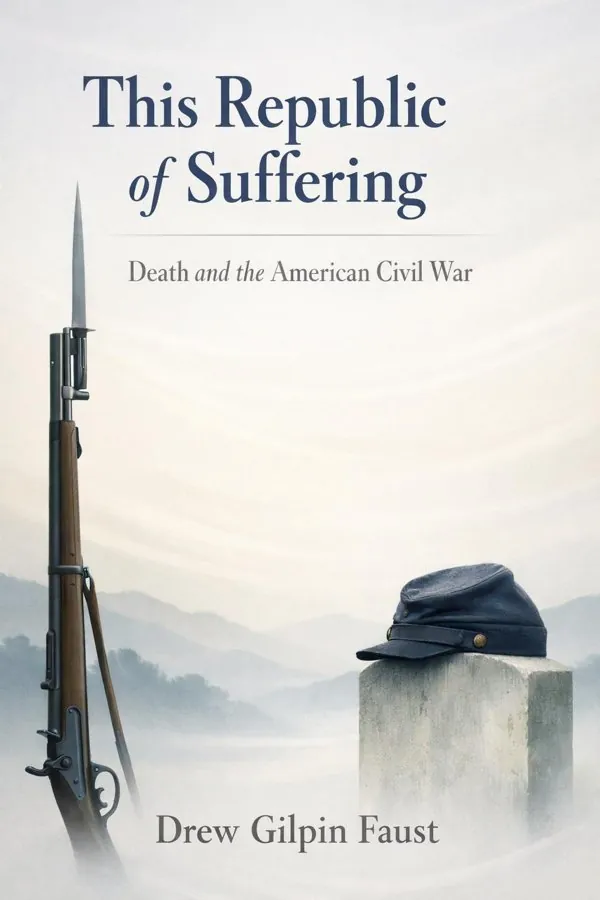
This Republic of Suffering: Death and the American Civil War: Summary & Key Insights
 10 min9 chaptersAudio available
Key Takeaways from This Republic of Suffering: Death and the American Civil War
A society reveals its deepest values in how it imagines a good death.
War does not simply require men to kill; it requires them to explain killing to themselves.
The treatment of the dead reveals the seriousness of a society’s promises to the living.
A name is often the final defense against disappearance.
Human beings can understand tragedy one life at a time, but mass death requires a new kind of perception.
What Is This Republic of Suffering: Death and the American Civil War About?
This Republic of Suffering: Death and the American Civil War by Drew Gilpin Faust is a war_military book spanning 9 pages. What happens to a nation when death becomes its most common shared experience? In This Republic of Suffering, historian Drew Gilpin Faust argues that the American Civil War did far more than decide the fate of the Union or end slavery’s legal foundation. It also forced Americans to confront death on a scale they had never imagined. More than 620,000 soldiers died, leaving families without bodies, graves, explanations, or closure. Faust shows how this staggering loss transformed not only private grief, but public institutions, religious belief, government responsibility, and the country’s moral imagination. Drawing on letters, diaries, sermons, hospital records, burial reports, and official correspondence, she reconstructs how soldiers, nurses, families, clergy, and politicians struggled to make sense of mass death. The result is a deeply human history of war that shifts attention from generals and battlefields to mourning, memory, and obligation. Faust’s authority as one of America’s leading Civil War historians makes this book both intellectually rigorous and emotionally powerful. It matters because it reveals that modern America was shaped not only by victory and emancipation, but also by suffering, loss, and the labor of remembering the dead.
This FizzRead summary covers all 9 key chapters of This Republic of Suffering: Death and the American Civil War in approximately 10 minutes, distilling the most important ideas, arguments, and takeaways from Drew Gilpin Faust's work. Also available as an audio summary and Key Quotes Podcast.
This Republic of Suffering: Death and the American Civil War
What happens to a nation when death becomes its most common shared experience? In This Republic of Suffering, historian Drew Gilpin Faust argues that the American Civil War did far more than decide the fate of the Union or end slavery’s legal foundation. It also forced Americans to confront death on a scale they had never imagined. More than 620,000 soldiers died, leaving families without bodies, graves, explanations, or closure. Faust shows how this staggering loss transformed not only private grief, but public institutions, religious belief, government responsibility, and the country’s moral imagination. Drawing on letters, diaries, sermons, hospital records, burial reports, and official correspondence, she reconstructs how soldiers, nurses, families, clergy, and politicians struggled to make sense of mass death. The result is a deeply human history of war that shifts attention from generals and battlefields to mourning, memory, and obligation. Faust’s authority as one of America’s leading Civil War historians makes this book both intellectually rigorous and emotionally powerful. It matters because it reveals that modern America was shaped not only by victory and emancipation, but also by suffering, loss, and the labor of remembering the dead.
Who Should Read This Republic of Suffering: Death and the American Civil War?
This book is perfect for anyone interested in war_military and looking to gain actionable insights in a short read. Whether you're a student, professional, or lifelong learner, the key ideas from This Republic of Suffering: Death and the American Civil War by Drew Gilpin Faust will help you think differently.
- ✓Readers who enjoy war_military and want practical takeaways
- ✓Professionals looking to apply new ideas to their work and life
- ✓Anyone who wants the core insights of This Republic of Suffering: Death and the American Civil War in just 10 minutes
Want the full summary?
Get instant access to this book summary and 100K+ more with Fizz Moment.
Get Free SummaryAvailable on App Store • Free to download
Key Chapters
A society reveals its deepest values in how it imagines a good death. Before the Civil War, many nineteenth-century Americans believed dying should follow a recognizable script: the dying person would be at home, surrounded by family, spiritually prepared, offering final words of faith and love. This “good death” reassured survivors that the deceased had met God properly and that the family’s emotional and religious world remained intact. The Civil War shattered that script. Soldiers often died far from home, among strangers, in pain, without clergy, kin, or the chance to speak final words. The distance between battlefield death and domestic expectation created a profound crisis.
Faust shows that soldiers entered the war carrying this cultural ideal with them. They wrote letters asking comrades to notify their families if they died. They kept photographs, Bibles, and tokens that tied them to home. Fellow soldiers often tried to record a dying comrade’s final moments so families could be told that he had died bravely and with faith. These accounts mattered because they tried to restore meaning where war had created chaos.
The book’s larger insight is that death is never only biological. It is social, emotional, and moral. When established rituals collapse, communities must invent new ones. In today’s terms, we can see this whenever sudden disaster, migration, or institutional breakdown interrupts normal mourning and forces people to create substitute forms of witness.
Actionable takeaway: Pay attention to the rituals your community uses around loss; they are not trivial traditions but tools that help people preserve dignity and meaning when life becomes unrecognizable.
War does not simply require men to kill; it requires them to explain killing to themselves. One of Faust’s most striking contributions is her exploration of how Civil War soldiers reconciled Christian morality with the brutal necessity of combat. Most soldiers came from a culture that condemned murder and prized compassion, yet the war demanded repeated acts of organized violence. To continue fighting, soldiers had to reinterpret killing as duty, justice, vengeance, or sacred necessity.
Faust shows that this moral adjustment did not happen automatically. Many soldiers struggled with guilt, horror, and numbness after battle. Some justified lethal violence by linking it to patriotism or divine purpose. Others dehumanized the enemy, making killing more psychologically manageable. Still others framed combat as reluctant obedience: they did not love bloodshed, but believed the cause required it. These strategies helped soldiers survive morally even as they were being transformed by violence.
The Civil War also blurred the line between righteous sacrifice and savage destruction. Faust reminds us that the battlefield was not only a place where Americans died nobly; it was also a place where they learned to inflict suffering on fellow citizens. This is one reason the war’s aftermath was so difficult. A nation cannot emerge from mass killing unchanged.
The practical application reaches beyond military history. Any institution that asks people to do harm in the name of a larger mission must also produce stories, language, and moral frameworks that make such harm tolerable. Understanding those frameworks helps us see how violence becomes thinkable.
Actionable takeaway: Whenever violence is justified as necessary, ask what moral language is being used, what it conceals, and what psychological cost it demands from those asked to carry it out.
The treatment of the dead reveals the seriousness of a society’s promises to the living. In the Civil War, burial became one of the most urgent and painful challenges facing soldiers, families, and the state. Bodies often lay unattended after battles, decomposed in heat, or were buried hastily in shallow graves. Identification was inconsistent, and many graves were temporary or unmarked. For families raised to believe in proper burial and sacred remembrance, this was a devastating violation.
Faust explains that burial in wartime was not just a logistical problem. It was a moral crisis. To leave the dead unnamed and unburied seemed to deny their humanity and dishonor their sacrifice. Soldiers often took great risks to retrieve comrades’ bodies. Chaplains, nurses, civilians, and burial teams tried to impose order on scenes of devastation. Yet the scale of death regularly overwhelmed these efforts. The war’s enormous casualty lists forced Americans to confront the possibility that many loved ones would never be recovered.
Out of this trauma emerged new institutional responses. National cemeteries, reburial programs, and expanded federal involvement in caring for the dead reflected a major shift in state responsibility. The government increasingly accepted that honoring the war dead was not merely a private family matter, but a public duty. This marked a profound change in the relationship between citizen and nation.
The lesson remains relevant today. Public institutions signal what they value by how they handle the dead after war, disaster, or neglect. Respectful recovery, identification, and memorialization are forms of civic truth-telling.
Actionable takeaway: Measure institutions not just by how they mobilize people for sacrifice, but by whether they accept long-term responsibility for honoring, identifying, and caring for those lost in that sacrifice.
A name is often the final defense against disappearance. In a war of unprecedented scale, one of the greatest fears for soldiers and families alike was anonymity. To die unknown, buried without identification, was more than unfortunate; it threatened erasure. Faust shows that naming the dead became a central emotional and political task of the Civil War. Families desperately sought news. Soldiers pinned scraps of paper into uniforms, marked belongings, and entrusted comrades with personal details in hopes that someone would carry their identity home.
This concern emerged from both affection and belief. In a culture shaped by Christian ideas and family-centered mourning, identity mattered eternally as well as emotionally. To know where a loved one died, how he died, and where he was buried helped restore a narrative that war had violently interrupted. Newspapers, casualty lists, hospital records, letters, and battlefield reports all became imperfect technologies of recognition.
Faust also shows that naming was uneven. Class, race, military status, and bureaucratic capacity affected whose identities were preserved. The struggle to identify the dead revealed the limits of nineteenth-century recordkeeping and the unequal distribution of dignity. In this sense, naming was not only sentimental; it was political. It determined who counted.
The wider application is clear in every modern effort to document victims of war, migration, epidemic, or state violence. Lists of names are not just administrative data. They are acts of resistance against oblivion and indifference.
Actionable takeaway: When confronting large-scale suffering, resist reducing people to statistics; insist on names, stories, and records, because recognition is one of the most basic forms of human respect.
Human beings can understand tragedy one life at a time, but mass death requires a new kind of perception. Faust argues that Americans during the Civil War gradually came to “realize” the scale and meaning of death through accumulation: casualty lists, hospital wards, amputated limbs, overcrowded cemeteries, and the steady arrival of letters announcing loss. The country did not comprehend the war’s toll all at once. It learned it through repetition, saturation, and the breakdown of earlier assumptions.
At first, many expected a short conflict. But as battles multiplied and bodies mounted, Americans recognized that this was not an ordinary war. Death had become central to national life. Towns lost whole clusters of young men. Families faced repeated bereavements. Civilians became accustomed to reading daily reports of slaughter. Faust emphasizes that this realization changed how Americans thought about sacrifice, citizenship, and the cost of political decisions.
The psychological importance of scale is one of the book’s enduring insights. Large numbers can numb rather than illuminate. Yet Faust demonstrates that people tried constantly to convert scale into comprehension through stories, rituals, and institutions. They needed frameworks to absorb what otherwise felt incomprehensible.
This has modern relevance wherever societies face cumulative loss, whether in war, pandemic, famine, or environmental disaster. Statistics alone rarely produce understanding. People need moral and narrative structures that connect numbers to lived experience.
Actionable takeaway: When confronting a crisis measured in large numbers, pair data with human context; if you want others to grasp the true scale of loss, make room for both statistics and individual stories.
Suffering does not always destroy faith, but it almost always tests it. Faust explores how the Civil War became a religious crisis as well as a military one. For many Americans, Christian belief offered the primary language for understanding death. Ministers preached that sacrifice had purpose, that God governed history, and that reunion in heaven awaited the faithful. These ideas helped survivors endure bereavement and gave meaning to battlefield loss.
But faith was not uniformly consoling. The sheer scale and brutality of the war also produced doubt, confusion, and spiritual exhaustion. How could a just God permit such carnage? Why were the righteous not spared? Why did so many die alone, disfigured, or unknown? Faust is especially strong in showing that belief and doubt often coexisted. People prayed and questioned, hoped and despaired, clung to providence while privately wrestling with silence.
The rise of spiritualism, efforts to communicate with the dead, and renewed emphasis on heaven all reflected attempts to bridge the chasm opened by war. These practices were not simply odd cultural footnotes. They were serious responses to the emotional reality of absence. When ordinary religious assurances seemed inadequate, Americans sought fresh forms of connection and certainty.
The broader lesson is that catastrophe often pluralizes belief rather than eliminating it. People adapt, revise, combine, or intensify spiritual frameworks in order to live with grief.
Actionable takeaway: In times of collective loss, do not assume people need either certainty or skepticism alone; create space for mourning that can hold faith, doubt, unanswered questions, and the desire for meaning at the same time.
States grow not only through power but through responsibility. One of Faust’s most important arguments is that the Civil War forced the American government to become more accountable for individual lives and deaths. Before the war, the federal state was relatively limited in its administrative reach. But mass casualties created urgent demands for recordkeeping, notification, hospital organization, burial systems, pension frameworks, and efforts to identify the missing.
Families wanted answers: Where did he die? Was he buried? Who saw him last? These were intimate questions, yet they increasingly required bureaucratic solutions. Faust demonstrates how the pressure of war expanded state obligations. Agencies and officials had to track soldiers, process remains, maintain graves, and support survivors. This was not always done efficiently or equally, but the shift mattered. The nation began to acknowledge that if it could claim men for war, it also owed them recognition in death.
This administrative transformation had long-term consequences. It helped redefine citizenship as a relationship involving reciprocal obligations between individual and state. The dead became part of the architecture of governance. Public mourning, pensions, cemeteries, and records were not peripheral to nation-building; they were central to it.
The concept applies far beyond the nineteenth century. Modern states are often judged by whether they can count, identify, and care for those harmed by policies, wars, or disasters. Bureaucracy may seem cold, but in moments of loss it can be a vehicle for dignity.
Actionable takeaway: When evaluating public institutions, ask not only whether they can mobilize resources in crisis, but whether they can account for each person affected with accuracy, transparency, and care.
To count the dead is necessary, but counting alone can flatten grief. Faust examines how numbering became an essential yet morally fraught response to Civil War death. Casualty figures allowed Americans to grasp the magnitude of the conflict, compare battles, and understand that the nation had entered a new era of destruction. Numbers made the scale visible. They also helped justify policies, shape memory, and define the war’s significance in public life.
Yet numbers had limits. A total of 620,000 dead could communicate enormity, but not individuality. It could not convey the mother waiting for a letter, the comrade writing home for a fallen friend, or the community hollowed out by repeated funerals. Faust is attentive to this tension. Statistics were indispensable for state administration and historical understanding, but they also risked making suffering abstract. The challenge was, and remains, how to hold aggregate truth and personal grief together.
This is one reason the book remains so resonant. In every large-scale crisis, societies struggle over what numbers mean. Some use them to illuminate reality; others use them to normalize or politicize loss. Faust reminds us that counting is never neutral. The way deaths are reported, disputed, or commemorated shapes public conscience.
The practical application is immediate in our own age of dashboards, data feeds, and quantified catastrophe. Numbers can create urgency, but only if they are interpreted ethically and connected to human experience.
Actionable takeaway: Use statistics to understand scope, but never let them become substitutes for empathy; whenever you encounter large death tolls, ask what lived realities those numbers represent and whose stories are missing from the count.
The end of battle does not end war’s deepest work; survivors must carry its aftermath. Faust closes her account by showing that “surviving” was itself a historical challenge. Families, veterans, widows, orphans, freedpeople, clergy, and communities all had to reconstruct life after unprecedented loss. Grief did not simply fade with surrender. It entered homes, rituals, politics, literature, and national memory.
Survival meant more than emotional endurance. It involved practical adaptation to absence: managing households without husbands or sons, making claims for pensions, preserving letters and relics, tending graves, and retelling stories of the dead. It also involved political struggle over the meaning of sacrifice. Who had died for what? Union? Confederacy? Freedom? States’ rights? Emancipation? Memory became contested because the dead conferred legitimacy on the causes they were believed to have served.
Faust’s insight is that mourning helped build postwar America. Memorial practices, cemetery visits, decoration rituals, and commemorative speech all allowed survivors to transform private pain into public meaning. But these acts could heal and distort at the same time. They honored the lost while also shaping selective narratives about the war’s purpose.
This has enduring relevance. After any collective trauma, societies do not simply “move on.” They build institutions, habits, ceremonies, and myths that determine how suffering will be remembered and what lessons will be carried forward.
Actionable takeaway: After loss, do not rush toward closure; instead, build deliberate practices of remembrance that honor grief honestly while also clarifying what values the dead should continue to call the living to defend.
All Chapters in This Republic of Suffering: Death and the American Civil War
About the Author
Drew Gilpin Faust is an American historian, public intellectual, and former president of Harvard University. She is widely regarded as one of the leading scholars of the Civil War era and the history of the American South. Her work often explores the intersections of war, slavery, gender, memory, and national identity, with a particular gift for connecting intimate personal experience to broad historical change. Before serving at Harvard, she taught at the University of Pennsylvania and built a distinguished academic career through influential research and writing. In This Republic of Suffering, Faust draws on deep archival knowledge and a humane interpretive style to examine how death shaped the Civil War and its aftermath. Her scholarship is valued for both its intellectual rigor and emotional insight.
Get This Summary in Your Preferred Format
Read or listen to the This Republic of Suffering: Death and the American Civil War summary by Drew Gilpin Faust anytime, anywhere. FizzRead offers multiple formats so you can learn on your terms — all free.
Available formats: App · Audio · PDF · EPUB — All included free with FizzRead
Download This Republic of Suffering: Death and the American Civil War PDF and EPUB Summary
Key Quotes from This Republic of Suffering: Death and the American Civil War
“A society reveals its deepest values in how it imagines a good death.”
“War does not simply require men to kill; it requires them to explain killing to themselves.”
“The treatment of the dead reveals the seriousness of a society’s promises to the living.”
“A name is often the final defense against disappearance.”
“Human beings can understand tragedy one life at a time, but mass death requires a new kind of perception.”
Frequently Asked Questions about This Republic of Suffering: Death and the American Civil War
This Republic of Suffering: Death and the American Civil War by Drew Gilpin Faust is a war_military book that explores key ideas across 9 chapters. What happens to a nation when death becomes its most common shared experience? In This Republic of Suffering, historian Drew Gilpin Faust argues that the American Civil War did far more than decide the fate of the Union or end slavery’s legal foundation. It also forced Americans to confront death on a scale they had never imagined. More than 620,000 soldiers died, leaving families without bodies, graves, explanations, or closure. Faust shows how this staggering loss transformed not only private grief, but public institutions, religious belief, government responsibility, and the country’s moral imagination. Drawing on letters, diaries, sermons, hospital records, burial reports, and official correspondence, she reconstructs how soldiers, nurses, families, clergy, and politicians struggled to make sense of mass death. The result is a deeply human history of war that shifts attention from generals and battlefields to mourning, memory, and obligation. Faust’s authority as one of America’s leading Civil War historians makes this book both intellectually rigorous and emotionally powerful. It matters because it reveals that modern America was shaped not only by victory and emancipation, but also by suffering, loss, and the labor of remembering the dead.
You Might Also Like

Patriot
Andrew Britton
10 min
War
John Hersey
10 min
An Army at Dawn: The War in North Africa, 1942–1943
Rick Atkinson
10 min
Brave New War: The Next Stage of Terrorism and the End of Globalization
John Robb
10 min
Catch-22
Joseph Heller
10 min
Command and Control: Nuclear Weapons, the Damascus Accident, and the Illusion of Safety
Eric Schlosser
10 minBrowse by Category
Ready to read This Republic of Suffering: Death and the American Civil War?
Get the full summary and 100K+ more books with Fizz Moment.