
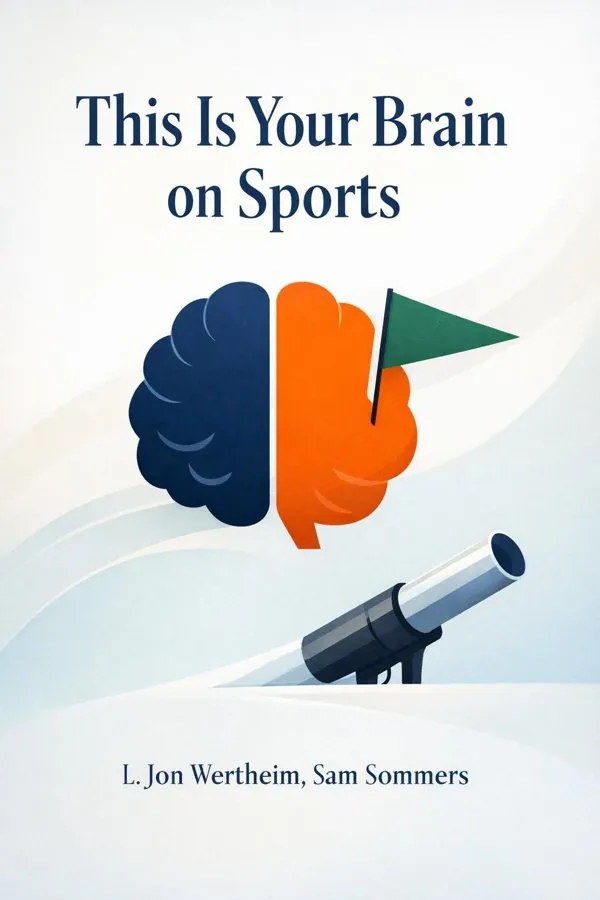
This Is Your Brain on Sports: The Science of Underdogs, the Value of Rivalry, and What We Can Learn from the T-Shirt Cannon: Summary & Key Insights
by L. Jon Wertheim, Sam Sommers
 10 min12 chaptersAudio available
What Is This Is Your Brain on Sports: The Science of Underdogs, the Value of Rivalry, and What We Can Learn from the T-Shirt Cannon About?
This Is Your Brain on Sports: The Science of Underdogs, the Value of Rivalry, and What We Can Learn from the T-Shirt Cannon by L. Jon Wertheim, Sam Sommers is a popular_sci book spanning 12 pages. This book explores the psychological and neuroscientific principles behind sports behavior, revealing how competition, fandom, and athletic performance reflect deeper aspects of human nature. Through engaging stories and scientific insights, the authors explain why people root for underdogs, how rivalries shape motivation, and what sports can teach us about decision-making and social dynamics.
This FizzRead summary covers all 12 key chapters of This Is Your Brain on Sports: The Science of Underdogs, the Value of Rivalry, and What We Can Learn from the T-Shirt Cannon in approximately 10 minutes, distilling the most important ideas, arguments, and takeaways from L. Jon Wertheim, Sam Sommers's work. Also available as an audio summary and Key Quotes Podcast.
This Is Your Brain on Sports: The Science of Underdogs, the Value of Rivalry, and What We Can Learn from the T-Shirt Cannon
This book explores the psychological and neuroscientific principles behind sports behavior, revealing how competition, fandom, and athletic performance reflect deeper aspects of human nature. Through engaging stories and scientific insights, the authors explain why people root for underdogs, how rivalries shape motivation, and what sports can teach us about decision-making and social dynamics.
Who Should Read This Is Your Brain on Sports: The Science of Underdogs, the Value of Rivalry, and What We Can Learn from the T-Shirt Cannon?
This book is perfect for anyone interested in popular_sci and looking to gain actionable insights in a short read. Whether you're a student, professional, or lifelong learner, the key ideas from This Is Your Brain on Sports: The Science of Underdogs, the Value of Rivalry, and What We Can Learn from the T-Shirt Cannon by L. Jon Wertheim, Sam Sommers will help you think differently.
- ✓Readers who enjoy popular_sci and want practical takeaways
- ✓Professionals looking to apply new ideas to their work and life
- ✓Anyone who wants the core insights of This Is Your Brain on Sports: The Science of Underdogs, the Value of Rivalry, and What We Can Learn from the T-Shirt Cannon in just 10 minutes
Want the full summary?
Get instant access to this book summary and 100K+ more with Fizz Moment.
Get Free SummaryAvailable on App Store • Free to download
Key Chapters
There is something almost universally endearing about an underdog. We cannot help ourselves—we cheer for the team that’s expected to lose, root for the player who defies the odds, and find joy in Cinderella stories. This peculiar bias isn’t a failure of logic; it’s a window into empathy. When we root for underdogs, we are emotionally responding to their struggle, their perceived fairness, and our intrinsic desire to see equilibrium restored.
Through controlled experiments and real-world examples, Sam and I show that the underdog effect is rooted in fundamental human psychology. People gravitate toward narratives of effort over advantage. We interpret success earned through struggle as more authentic and meaningful than success achieved through superiority or domination. This empathy-driven bias reveals how we process inequity—we want justice to prevail, and cheering for the underdog makes us participants in that moral balancing act.
In sports, this effect amplifies our engagement. Think of a lower-ranked tennis player facing Serena Williams or an NCAA mid-major school taking on a top seed. The moment the less-favored competitor shows signs of fight, our brains light up with excitement. By rooting for them, we signal our belief in possibility and transformation. Outside the stadium, this same tendency plays out whenever we champion the underprivileged or admire personal resilience. Sports teach us how our emotional circuits value fairness and effort—a lesson that reaches far beyond the scoreboards.
Few forces in life are as potent as rivalry. Whether it’s Yankees–Red Sox or Federer–Nadal, rivalries ignite energy that transforms ordinary contests into psychological battlegrounds. Research shows that competition against familiar adversaries triggers heightened focus, effort, and emotional investment. Our brains, it turns out, interpret rivalries as personal stakes; we don’t merely want to win—we want to triumph over *them*.
In studying rivalries, we found that they can act as powerful motivators but also as stress amplifiers. On one hand, facing a rival sharpens performance—players run faster, concentrate harder, and push themselves further. On the other hand, the emotional toll can distort judgment and provoke aggression. Rivalries intensify because they blend social comparison with identity defense. When your brain perceives another person or group as a rival, it activates the same networks that process threats to the self.
Rivalries are a microcosm of broader human behavior. The surge of motivation that comes from facing competition can be harnessed in work or learning if understood correctly. What matters is not erasing rivalry but reframing it. In sports and in life, opponents can be the catalysts for excellence—if we convert rivalry into challenge rather than animosity. That’s the lesson biology and psychology together offer us: competition doesn’t just reveal who we are; it helps us become better versions of ourselves.
+ 10 more chapters — available in the FizzRead app
All Chapters in This Is Your Brain on Sports: The Science of Underdogs, the Value of Rivalry, and What We Can Learn from the T-Shirt Cannon
About the Authors
L. Jon Wertheim is a senior writer for Sports Illustrated and an author known for his works on sports and psychology. Sam Sommers is a social psychologist and professor at Tufts University, specializing in human behavior and decision-making.
Get This Summary in Your Preferred Format
Read or listen to the This Is Your Brain on Sports: The Science of Underdogs, the Value of Rivalry, and What We Can Learn from the T-Shirt Cannon summary by L. Jon Wertheim, Sam Sommers anytime, anywhere. FizzRead offers multiple formats so you can learn on your terms — all free.
Available formats: App · Audio · PDF · EPUB — All included free with FizzRead
Download This Is Your Brain on Sports: The Science of Underdogs, the Value of Rivalry, and What We Can Learn from the T-Shirt Cannon PDF and EPUB Summary
Key Quotes from This Is Your Brain on Sports: The Science of Underdogs, the Value of Rivalry, and What We Can Learn from the T-Shirt Cannon
“There is something almost universally endearing about an underdog.”
“Few forces in life are as potent as rivalry.”
Frequently Asked Questions about This Is Your Brain on Sports: The Science of Underdogs, the Value of Rivalry, and What We Can Learn from the T-Shirt Cannon
This Is Your Brain on Sports: The Science of Underdogs, the Value of Rivalry, and What We Can Learn from the T-Shirt Cannon by L. Jon Wertheim, Sam Sommers is a popular_sci book that explores key ideas across 12 chapters. This book explores the psychological and neuroscientific principles behind sports behavior, revealing how competition, fandom, and athletic performance reflect deeper aspects of human nature. Through engaging stories and scientific insights, the authors explain why people root for underdogs, how rivalries shape motivation, and what sports can teach us about decision-making and social dynamics.
You Might Also Like

Structures: Or Why Things Don"t Fall Down
J.E. Gordon
10 min
The Road to Wigan Pier
George Orwell
10 min
Bonk: The Curious Coupling of Science and Sex
Mary Roach
10 min
First Bite: How We Learn to Eat
Bee Wilson
10 min
In Pursuit Of The Unknown: 17 Equations That Changed The World
Ian Stewart
10 min
Napoleon's Buttons: 17 Molecules That Changed History
Penny Le Couteur and Jay Burreson
10 minBrowse by Category
Ready to read This Is Your Brain on Sports: The Science of Underdogs, the Value of Rivalry, and What We Can Learn from the T-Shirt Cannon?
Get the full summary and 100K+ more books with Fizz Moment.