
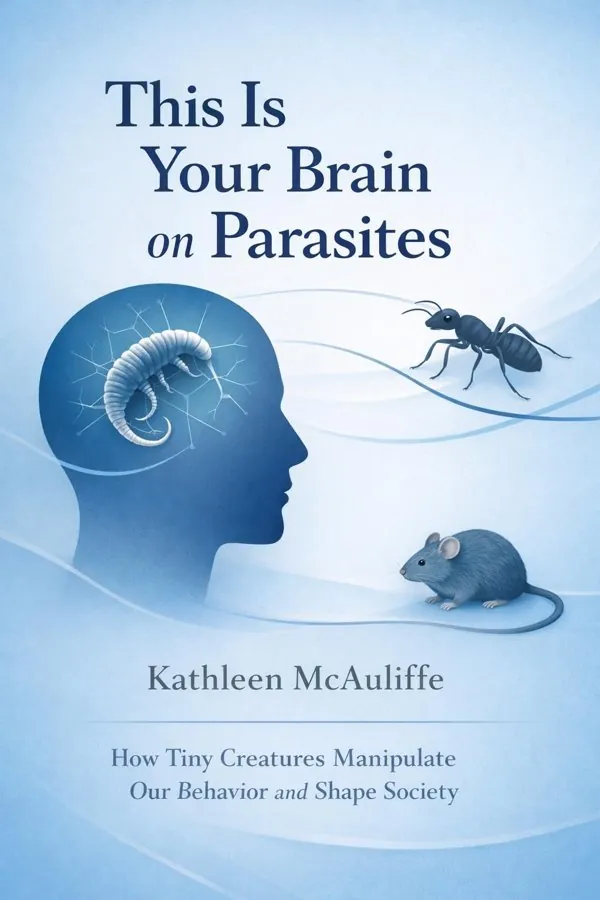
This Is Your Brain on Parasites: How Tiny Creatures Manipulate Our Behavior and Shape Society: Summary & Key Insights
 10 min5 chaptersAudio available
What Is This Is Your Brain on Parasites: How Tiny Creatures Manipulate Our Behavior and Shape Society About?
This Is Your Brain on Parasites: How Tiny Creatures Manipulate Our Behavior and Shape Society by Kathleen McAuliffe is a popular_sci book spanning 5 pages. In this fascinating exploration of the hidden world of parasites, science writer Kathleen McAuliffe reveals how microscopic organisms can influence the behavior of animals and humans alike. Drawing on cutting-edge research, she shows how parasites may affect everything from our moods and social interactions to cultural evolution. The book combines biology, psychology, and anthropology to illuminate the profound ways in which these unseen creatures shape life on Earth.
This FizzRead summary covers all 5 key chapters of This Is Your Brain on Parasites: How Tiny Creatures Manipulate Our Behavior and Shape Society in approximately 10 minutes, distilling the most important ideas, arguments, and takeaways from Kathleen McAuliffe's work. Also available as an audio summary and Key Quotes Podcast.
This Is Your Brain on Parasites: How Tiny Creatures Manipulate Our Behavior and Shape Society
In this fascinating exploration of the hidden world of parasites, science writer Kathleen McAuliffe reveals how microscopic organisms can influence the behavior of animals and humans alike. Drawing on cutting-edge research, she shows how parasites may affect everything from our moods and social interactions to cultural evolution. The book combines biology, psychology, and anthropology to illuminate the profound ways in which these unseen creatures shape life on Earth.
Who Should Read This Is Your Brain on Parasites: How Tiny Creatures Manipulate Our Behavior and Shape Society?
This book is perfect for anyone interested in popular_sci and looking to gain actionable insights in a short read. Whether you're a student, professional, or lifelong learner, the key ideas from This Is Your Brain on Parasites: How Tiny Creatures Manipulate Our Behavior and Shape Society by Kathleen McAuliffe will help you think differently.
- ✓Readers who enjoy popular_sci and want practical takeaways
- ✓Professionals looking to apply new ideas to their work and life
- ✓Anyone who wants the core insights of This Is Your Brain on Parasites: How Tiny Creatures Manipulate Our Behavior and Shape Society in just 10 minutes
Want the full summary?
Get instant access to this book summary and 100K+ more with Fizz Moment.
Get Free SummaryAvailable on App Store • Free to download
Key Chapters
The natural world abounds with chilling tales of mind control, and parasites are its most skilled manipulators. In ants, caterpillars, shrimp, and fish, parasitic invaders alter behavior so precisely it can feel mechanical, even cinematic. Consider the lancet liver fluke, whose larval form infects ants and drives them to climb grass blades at dusk, latching on as if hypnotized. The behavior seems suicidal, yet it ensures the ant will be eaten by grazing livestock—the next host the parasite needs for its life cycle. Or take certain hairworms, which grow inside crickets and then, when ready to emerge, compel their hosts to leap into water—drowning themselves so the worm can swim free.
Such examples are not metaphors; they are biological strategies honed by evolution. Parasites manipulate neurotransmitters, hijack hormones, or subtly rewire the sensory perceptions of their hosts. The phenomenon reveals a startling evolutionary truth: survival often depends not on strength or speed, but on the ability to control another’s mind. As I interviewed parasitologists around the world, I found many who speak with awe about such adaptations, for they challenge our traditional boundaries between self and other. What looks like individual choice may be, in some species, a microscopic conspiracy.
Understanding animal parasitic manipulation offers a key to interpreting our own behavior. If ants and crickets can be puppeteered so elegantly for another creature’s gain, can humans truly claim to be exceptions?
Among all mind-controlling parasites, *Toxoplasma gondii* has captured imaginations most vividly. Its life cycle pivots on a crucial step: it can reproduce sexually only inside the intestines of a cat. To get there, it infects rodents, which cats prey upon. But instead of hiding from feline scent as any sensible mouse would, infected ones exhibit a bizarre preference—they’re drawn to the smell of cat urine. Their neural fear circuits seem reversed, transforming what should be terror into attraction.
This stunning behavioral change has been confirmed in multiple experiments. The parasite penetrates the brain, forming cysts particularly in areas processing fear and pleasure—amygdala and nucleus accumbens—altering dopamine and other neurochemicals. From a biological standpoint, it’s ingenious: *Toxoplasma* manipulates its host’s neural wiring to engineer its own transmission.
Yet the story grows more provocative when researchers begin noticing similar neurological signatures in humans. About one-third of humanity carries latent *Toxoplasma* infection, typically acquired through undercooked meat or contact with cat feces. Most show no physical symptoms—yet statistical studies find subtle but consistent psychological differences. Infected men, on average, score as more risk-taking and rebellious; infected women somewhat more outgoing and affectionate. There are hints linking the parasite to a higher likelihood of car crashes, even correlations with schizophrenia. None of this implies direct causation or universal effects—but the possibility itself forces us to reconsider where biology ends and personality begins.
For me as a science communicator, *Toxoplasma* exemplifies how a single microbe can illuminate vast questions of identity. Our minds are not isolated fortresses but ecosystems where multiple species—some visible, most unseen—interact continuously, shaping perception and behavior in ways evolution never intended us to perceive.
+ 3 more chapters — available in the FizzRead app
All Chapters in This Is Your Brain on Parasites: How Tiny Creatures Manipulate Our Behavior and Shape Society
About the Author
Kathleen McAuliffe is an American science journalist whose work has appeared in publications such as Discover, The Atlantic, and National Geographic. She specializes in writing about biology, neuroscience, and the intersection of science and society.
Get This Summary in Your Preferred Format
Read or listen to the This Is Your Brain on Parasites: How Tiny Creatures Manipulate Our Behavior and Shape Society summary by Kathleen McAuliffe anytime, anywhere. FizzRead offers multiple formats so you can learn on your terms — all free.
Available formats: App · Audio · PDF · EPUB — All included free with FizzRead
Download This Is Your Brain on Parasites: How Tiny Creatures Manipulate Our Behavior and Shape Society PDF and EPUB Summary
Key Quotes from This Is Your Brain on Parasites: How Tiny Creatures Manipulate Our Behavior and Shape Society
“The natural world abounds with chilling tales of mind control, and parasites are its most skilled manipulators.”
“Among all mind-controlling parasites, *Toxoplasma gondii* has captured imaginations most vividly.”
Frequently Asked Questions about This Is Your Brain on Parasites: How Tiny Creatures Manipulate Our Behavior and Shape Society
This Is Your Brain on Parasites: How Tiny Creatures Manipulate Our Behavior and Shape Society by Kathleen McAuliffe is a popular_sci book that explores key ideas across 5 chapters. In this fascinating exploration of the hidden world of parasites, science writer Kathleen McAuliffe reveals how microscopic organisms can influence the behavior of animals and humans alike. Drawing on cutting-edge research, she shows how parasites may affect everything from our moods and social interactions to cultural evolution. The book combines biology, psychology, and anthropology to illuminate the profound ways in which these unseen creatures shape life on Earth.
You Might Also Like

Structures: Or Why Things Don"t Fall Down
J.E. Gordon
10 min
The Road to Wigan Pier
George Orwell
10 min
Bonk: The Curious Coupling of Science and Sex
Mary Roach
10 min
First Bite: How We Learn to Eat
Bee Wilson
10 min
In Pursuit Of The Unknown: 17 Equations That Changed The World
Ian Stewart
10 min
Napoleon's Buttons: 17 Molecules That Changed History
Penny Le Couteur and Jay Burreson
10 minBrowse by Category
Ready to read This Is Your Brain on Parasites: How Tiny Creatures Manipulate Our Behavior and Shape Society?
Get the full summary and 100K+ more books with Fizz Moment.