
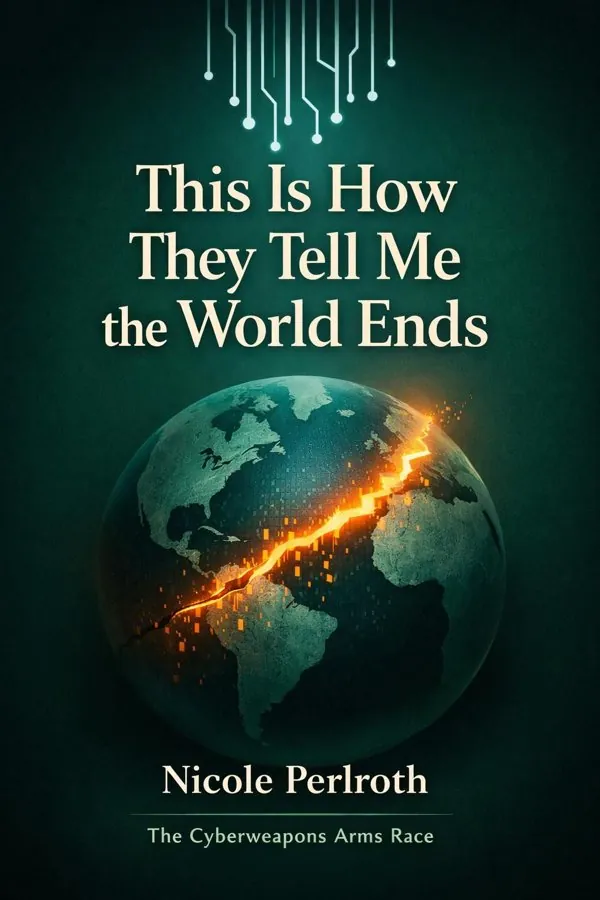
This Is How They Tell Me the World Ends: The Cyberweapons Arms Race: Summary & Key Insights
 10 min12 chaptersAudio available
What Is This Is How They Tell Me the World Ends: The Cyberweapons Arms Race About?
This Is How They Tell Me the World Ends: The Cyberweapons Arms Race by Nicole Perlroth is a politics book spanning 12 pages. A groundbreaking investigation into the global cyberweapons market, this book reveals how governments, hackers, and corporations have built a shadowy industry trading in digital exploits and vulnerabilities. Nicole Perlroth exposes the geopolitical and ethical consequences of this arms race, showing how cyberweapons have reshaped modern warfare and national security.
This FizzRead summary covers all 12 key chapters of This Is How They Tell Me the World Ends: The Cyberweapons Arms Race in approximately 10 minutes, distilling the most important ideas, arguments, and takeaways from Nicole Perlroth's work. Also available as an audio summary and Key Quotes Podcast.
This Is How They Tell Me the World Ends: The Cyberweapons Arms Race
A groundbreaking investigation into the global cyberweapons market, this book reveals how governments, hackers, and corporations have built a shadowy industry trading in digital exploits and vulnerabilities. Nicole Perlroth exposes the geopolitical and ethical consequences of this arms race, showing how cyberweapons have reshaped modern warfare and national security.
Who Should Read This Is How They Tell Me the World Ends: The Cyberweapons Arms Race?
This book is perfect for anyone interested in politics and looking to gain actionable insights in a short read. Whether you're a student, professional, or lifelong learner, the key ideas from This Is How They Tell Me the World Ends: The Cyberweapons Arms Race by Nicole Perlroth will help you think differently.
- ✓Readers who enjoy politics and want practical takeaways
- ✓Professionals looking to apply new ideas to their work and life
- ✓Anyone who wants the core insights of This Is How They Tell Me the World Ends: The Cyberweapons Arms Race in just 10 minutes
Want the full summary?
Get instant access to this book summary and 100K+ more with Fizz Moment.
Get Free SummaryAvailable on App Store • Free to download
Key Chapters
The story begins with a single and simple idea: wherever there is software, there are flaws. These flaws—known in my world as vulnerabilities—were once nuisances for programmers to patch. But to a spy agency, they became opportunities. A zero-day vulnerability is one unknown to the software maker and therefore unprotected. Whoever finds it first can slip through the cracks of systems thought to be secure. Early in my reporting, I met researchers who treated these exploits like treasures, trading them quietly in obscure online markets. It became clear that there was real money to be made—hundreds of thousands, even millions of dollars—for the right kind of hole in the right software.
The seeds of the cyberweapons trade were sown in the 1990s, often by well-meaning researchers who took pride in discovering flaws before bad actors did. But as governments realized the intelligence value of these tools, an informal underground economy developed. Zero-days became the currency of nation-states, sold and traded like rare commodities. I followed the trail from anonymous hackers in Eastern Europe to sleek offices in Washington where contractors bid secretly to supply intelligence agencies with their latest finds. What struck me most was how normal this had become—how markets meant for discovery and defense had morphed into markets for attack. As cyber threats matured, so too did the brokers and middlemen who linked governments with those willing to sell their code. This was the birth of a new kind of arms race, one fought not over oil or territory, but over control of cyberspace itself.
For much of the early 2000s, the United States sat unchallenged atop the digital hierarchy. The National Security Agency, with its sprawling campuses and unmatched budgets, built a cyber arsenal few could rival. The logic was simple: if wars were moving online, America should ensure it could strike first and strike hardest. The NSA’s mission expanded from defense to offense—it no longer merely protected U.S. networks but sought to penetrate foreign ones. The agency accumulated zero-day exploits, stockpiled malware, and constructed a library of digital weapons capable of sabotaging faraway systems.
Through my investigation, I learned how this strategy carried both power and peril. Many NSA actions were embedded in secrecy; oversight was minimal. Contractors such as those later linked to Edward Snowden operated within an opaque ecosystem where exploits were valued more for their exclusivity than for their ethical implications. This stockpiling, initially rationalized as ensuring national advantage, inadvertently created vulnerabilities for everyone. When classified exploits were stolen—most infamously in the 2016 Shadow Brokers leak—it was as if someone had broken into a nuclear weapons facility and begun giving away the bomb blueprints. Suddenly, the world had access to the same cyberweapons the U.S. had carefully built, and chaos ensued.
In retracing these events, I saw how hubris played a role. Many within the intelligence community truly believed that America could maintain control over what it designed. But digital weapons, unlike missiles, are infinitely replicable. Once released—even accidentally—they cannot be recalled. The NSA’s dominance would soon give way to a more multipolar and unpredictable cyber arena.
+ 10 more chapters — available in the FizzRead app
All Chapters in This Is How They Tell Me the World Ends: The Cyberweapons Arms Race
About the Author
Nicole Perlroth is an American journalist and cybersecurity expert. She served as a cybersecurity reporter for The New York Times, covering digital espionage, cyberwarfare, and online privacy. Her work has been recognized for its depth and insight into the hidden world of cyber conflict.
Get This Summary in Your Preferred Format
Read or listen to the This Is How They Tell Me the World Ends: The Cyberweapons Arms Race summary by Nicole Perlroth anytime, anywhere. FizzRead offers multiple formats so you can learn on your terms — all free.
Available formats: App · Audio · PDF · EPUB — All included free with FizzRead
Download This Is How They Tell Me the World Ends: The Cyberweapons Arms Race PDF and EPUB Summary
Key Quotes from This Is How They Tell Me the World Ends: The Cyberweapons Arms Race
“The story begins with a single and simple idea: wherever there is software, there are flaws.”
“For much of the early 2000s, the United States sat unchallenged atop the digital hierarchy.”
Frequently Asked Questions about This Is How They Tell Me the World Ends: The Cyberweapons Arms Race
This Is How They Tell Me the World Ends: The Cyberweapons Arms Race by Nicole Perlroth is a politics book that explores key ideas across 12 chapters. A groundbreaking investigation into the global cyberweapons market, this book reveals how governments, hackers, and corporations have built a shadowy industry trading in digital exploits and vulnerabilities. Nicole Perlroth exposes the geopolitical and ethical consequences of this arms race, showing how cyberweapons have reshaped modern warfare and national security.
You Might Also Like
Antifa: The Anti-Fascist Handbook
Mark Bray
10 min
Attack from Within: How Disinformation Is Sabotaging America
Barbara McQuade
10 min
Coercion, Capital, and European States, AD 990–1992
Charles Tilly
10 min
Digital Democracy: Concepts, Methodologies, Tools, and Applications
Various Authors
10 min
Fascism
Stanley G. Payne
10 min
Fire And Fury: Inside The Trump White House
Michael Wolff
10 minBrowse by Category
Ready to read This Is How They Tell Me the World Ends: The Cyberweapons Arms Race?
Get the full summary and 100K+ more books with Fizz Moment.