
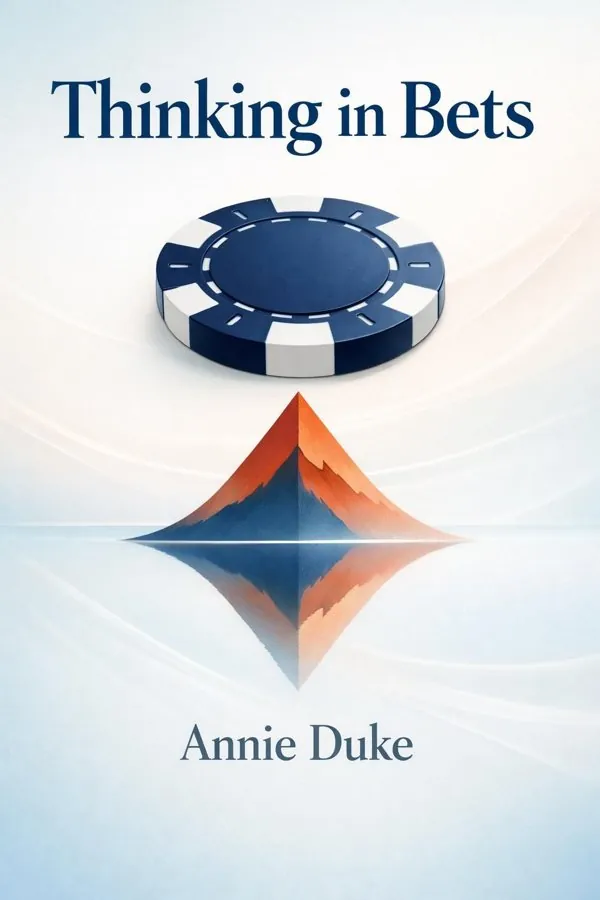
Thinking in Bets: Making Smarter Decisions When You Don't Have All the Facts: Summary & Key Insights
by Annie Duke
 10 min9 chaptersAudio available
Key Takeaways from Thinking in Bets: Making Smarter Decisions When You Don't Have All the Facts
A good result can come from a bad decision, and a bad result can come from a smart one.
Certainty feels comforting, but it is usually fiction.
The smartest people are not those who never change their minds; they are the ones who update them well.
We like to think our decisions come from reason, but much of the time they are shaped by hidden biases, emotional reactions, and the desire to protect our ego.
Experience is not automatically a good teacher.
What Is Thinking in Bets: Making Smarter Decisions When You Don't Have All the Facts About?
Thinking in Bets: Making Smarter Decisions When You Don't Have All the Facts by Annie Duke is a mindset book spanning 8 pages. Most of us judge our decisions by what happened afterward. If things work out, we assume we chose well. If they do not, we blame ourselves or others for making the wrong call. In Thinking in Bets, Annie Duke argues that this habit is deeply misleading. Life is not a chess game with perfect information; it is much closer to poker, where every decision must be made with incomplete data, shifting odds, and a strong dose of luck. The goal, then, is not to eliminate uncertainty but to think more clearly inside it. Drawing on her career as a world-class professional poker player and her academic training in cognitive psychology, Duke offers a practical framework for better judgment. She shows how to separate the quality of a decision from the quality of its outcome, how to update beliefs as new evidence appears, and how to reduce the impact of bias, emotion, and hindsight. The book matters because uncertainty shapes everything from careers and finances to relationships and leadership. Duke’s core lesson is empowering: you do not need perfect certainty to make smarter choices. You need a better process.
This FizzRead summary covers all 9 key chapters of Thinking in Bets: Making Smarter Decisions When You Don't Have All the Facts in approximately 10 minutes, distilling the most important ideas, arguments, and takeaways from Annie Duke's work. Also available as an audio summary and Key Quotes Podcast.
Thinking in Bets: Making Smarter Decisions When You Don't Have All the Facts
Most of us judge our decisions by what happened afterward. If things work out, we assume we chose well. If they do not, we blame ourselves or others for making the wrong call. In Thinking in Bets, Annie Duke argues that this habit is deeply misleading. Life is not a chess game with perfect information; it is much closer to poker, where every decision must be made with incomplete data, shifting odds, and a strong dose of luck. The goal, then, is not to eliminate uncertainty but to think more clearly inside it.
Drawing on her career as a world-class professional poker player and her academic training in cognitive psychology, Duke offers a practical framework for better judgment. She shows how to separate the quality of a decision from the quality of its outcome, how to update beliefs as new evidence appears, and how to reduce the impact of bias, emotion, and hindsight. The book matters because uncertainty shapes everything from careers and finances to relationships and leadership. Duke’s core lesson is empowering: you do not need perfect certainty to make smarter choices. You need a better process.
Who Should Read Thinking in Bets: Making Smarter Decisions When You Don't Have All the Facts?
This book is perfect for anyone interested in mindset and looking to gain actionable insights in a short read. Whether you're a student, professional, or lifelong learner, the key ideas from Thinking in Bets: Making Smarter Decisions When You Don't Have All the Facts by Annie Duke will help you think differently.
- ✓Readers who enjoy mindset and want practical takeaways
- ✓Professionals looking to apply new ideas to their work and life
- ✓Anyone who wants the core insights of Thinking in Bets: Making Smarter Decisions When You Don't Have All the Facts in just 10 minutes
Want the full summary?
Get instant access to this book summary and 100K+ more with Fizz Moment.
Get Free SummaryAvailable on App Store • Free to download
Key Chapters
A good result can come from a bad decision, and a bad result can come from a smart one. That uncomfortable truth sits at the heart of Annie Duke’s argument. We are wired to look backward from outcomes and assume they reveal whether we chose well, but in uncertain environments they often reveal very little. If you invest recklessly and happen to make money, the profit can disguise poor judgment. If you launch a well-researched project and external events ruin it, the failure can unfairly make the decision look foolish.
Poker makes this lesson impossible to ignore. A player can make the mathematically correct bet and still lose because the next card goes against them. Over time, strong decisions tend to win, but in any single hand luck can dominate. Duke argues that much of life works the same way. Hiring decisions, product launches, negotiations, medical choices, and personal commitments all unfold under uncertainty. When we evaluate choices only by outcomes, we reward luck, punish discipline, and learn the wrong lessons.
The practical alternative is to review decisions based on what you knew at the time, what options were available, what probabilities you assigned, and how reasonable your process was. A manager, for example, should ask not merely whether a hire succeeded, but whether the interview process, reference checks, and criteria were sound. A parent should judge a difficult decision not by one immediate reaction from a child, but by whether the choice reflected thoughtful values and evidence.
Actionable takeaway: After every major decision, write a short decision journal recording your reasoning, assumptions, and expected probabilities so you can later evaluate the process instead of being fooled by the outcome.
Certainty feels comforting, but it is usually fiction. Duke’s central shift is from binary thinking to probabilistic thinking: instead of asking, “Am I right?” ask, “How likely is this?” Most real-world decisions are not made between obvious truth and obvious falsehood. They are made between competing possibilities, each carrying different odds. Thinking in bets means treating beliefs like wagers calibrated to evidence, not declarations of absolute knowledge.
This mindset changes how you speak, decide, and learn. Rather than saying, “This strategy will work,” you might say, “Given what we know, there is a 70 percent chance this strategy will outperform the alternatives.” That small change encourages humility and flexibility. It also helps you compare options more clearly. If one path has a high upside but only a modest probability of success, and another offers steadier but smaller gains, you can discuss trade-offs instead of arguing in absolutes.
In everyday life, probabilistic thinking improves forecasting and planning. A sales leader can assign ranges to quarterly targets instead of clinging to one exact number. A job candidate can estimate the likelihood of receiving an offer and continue interviewing elsewhere. An entrepreneur can judge whether a business idea is promising enough to test rather than assuming it is destined to succeed or fail. Even in relationships, it can help: instead of declaring a conversation “definitely a disaster,” you can recognize that one awkward moment is only partial evidence.
Duke does not ask readers to become statisticians. She asks them to become more honest about uncertainty. The point is not precision for its own sake but a more accurate mental model of reality.
Actionable takeaway: Replace all-or-nothing language with probability language for one week by using phrases such as “likely,” “unlikely,” or “there’s a 60 percent chance,” and notice how it improves your judgment.
The smartest people are not those who never change their minds; they are the ones who update them well. Duke emphasizes that beliefs should function like working hypotheses, not permanent identities. When we treat opinions as extensions of who we are, new evidence feels like a threat. We defend weak assumptions, ignore contrary facts, and trap ourselves in outdated stories. Thinking in bets requires a different posture: every belief is provisional and should be revised when the evidence changes.
Poker again provides the model. A player forms an initial read on an opponent, then continuously adjusts as new betting patterns emerge. The first impression matters, but it should not dominate forever. In life, we often do the opposite. We cling to first judgments about people, markets, strategies, and ourselves long after the facts have shifted. A company may keep funding a bad initiative because leaders are emotionally attached to their original forecast. An individual may stay committed to a career path because changing course would feel like admitting error.
Duke draws on Bayesian thinking, even if she keeps it practical: start with your best current estimate, then update incrementally as new information arrives. This approach is useful in everything from investing to hiring. If you initially feel highly confident in a candidate but later uncover concerns in reference checks, your confidence should move downward. If a project seems risky but early experiments show strong traction, your estimate should move upward. The key is responsiveness without overreacting to every new signal.
Actionable takeaway: When you hold a strong opinion, ask yourself, “What evidence would make me change my mind?” If you cannot answer, your belief may be acting as an identity rather than a judgment.
We like to think our decisions come from reason, but much of the time they are shaped by hidden biases, emotional reactions, and the desire to protect our ego. Duke argues that poor decision-making often has less to do with a lack of intelligence and more to do with distorted interpretation. We seek information that confirms what we already believe, remember events in self-serving ways, and tell neat stories about messy realities. Emotions then intensify the problem, pushing us toward overconfidence, defensiveness, and impulsive action.
One major culprit is motivated reasoning. Instead of asking, “What is true?” we ask, often unconsciously, “What conclusion would I prefer to be true?” A manager may justify keeping an underperforming employee because admitting the hiring mistake is painful. An investor may hold a failing stock because selling would force recognition of a bad call. A couple in conflict may selectively interpret each other’s actions to preserve blame. In all these cases, the mind behaves more like a lawyer defending a client than a judge weighing evidence.
Duke’s solution is not to eliminate emotion, which is impossible, but to build habits that reduce its influence. Slow down decisions with high stakes. Invite disagreement from people who are not invested in your preferred answer. Use written criteria before outcomes are known. Notice language that signals certainty or identity, such as “I just know” or “I’m the kind of person who always.” These are often clues that bias is driving.
Actionable takeaway: Before making an important decision, list three reasons your preferred option might be wrong and ask someone neutral to challenge your thinking before you commit.
Experience is not automatically a good teacher. We often assume that time and repetition naturally improve judgment, but Duke shows that feedback can be noisy, incomplete, and misleading. In uncertain environments, the result we observe may not clearly reveal what caused it. When that happens, people can become more confident without becoming more accurate. They are learning, but they are learning the wrong lessons.
Consider a manager who makes an impulsive decision and gets lucky, then concludes that intuition is superior to analysis. Or someone who takes a thoughtful risk that fails and decides never to be bold again. Because outcomes are influenced by luck, feedback needs interpretation. Otherwise, we reinforce superstition, overfit to recent events, and confuse correlation with causation. Poker players survive by accepting this. A single hand means little; a pattern across many hands matters. They review not just whether they won, but whether the bet made sense given the odds.
Duke suggests creating more reliable learning loops. Decision journals are one powerful tool because they preserve your pre-outcome reasoning. Premortems help by asking in advance, “If this fails, what likely caused it?” Postmortems can then examine whether those risks materialized. Teams can also track prediction accuracy over time, not merely project results. A forecaster who is consistently well-calibrated is more valuable than one who occasionally makes dramatic but lucky calls.
In personal life, this matters too. If you change your routine and feel better for a week, that may be meaningful or random. If you repeatedly notice improvement under the same conditions, confidence should rise. Good learners respect patterns more than anecdotes.
Actionable takeaway: Build a simple review process for important choices by recording your prediction, confidence level, and rationale, then compare that record with what actually happened over time.
Other people can improve our thinking, but only if we use them well. Duke argues that a high-quality decision environment depends on honest dissent, shared norms for truth-seeking, and the willingness to treat disagreement as useful rather than hostile. Left unchecked, groups often do the opposite. They reward conformity, suppress uncertainty, and turn discussion into status contests. The result is groupthink, where consensus feels good but leads to fragile decisions.
In poker, serious players improve by discussing hands with people who care more about getting the analysis right than protecting one another’s egos. Duke calls this kind of truth-focused circle a valuable resource for better judgment. In business, the same principle applies. A leadership team makes stronger choices when members can challenge assumptions without fear. A board becomes more effective when it asks probabilistic questions rather than demanding false certainty. Even families make wiser decisions when they distinguish curiosity from criticism.
The outside view is especially useful. When we are close to a decision, we tend to focus on the unique details of our situation and overlook broader patterns. An outside perspective asks, “How do similar cases usually turn out?” For example, rather than believing your startup is a special exception, you might examine typical failure rates, funding timelines, or market adoption curves. A couple considering a move might look at common stresses associated with relocation rather than romanticizing their particular case.
The goal is not endless debate. It is disciplined collaboration that surfaces blind spots and improves calibration.
Actionable takeaway: Create a small decision group of thoughtful people who are allowed to disagree openly, and ask them to critique your reasoning rather than simply support your conclusion.
When pressure rises, people often improvise. Duke’s message is that the best time to improve decision-making is before the moment of choice, by designing a process that can withstand stress, ambiguity, and emotion. Structured decisions do not guarantee perfect outcomes, but they greatly reduce avoidable mistakes. Without structure, we are more likely to chase recent events, overvalue vivid anecdotes, or let the loudest voice dominate.
A strong process starts by clarifying the decision itself. What are you really choosing? What are the available options? What matters most? What information is relevant, and what is merely distracting? Duke encourages decision-makers to define criteria in advance whenever possible. A company hiring a leader, for instance, should agree on the traits that matter most before interviews begin. Otherwise, each candidate gets judged against shifting standards. A person buying a home should establish budget limits, location priorities, and deal breakers ahead of emotional visits.
Next comes probability and consequence. What is the chance each option succeeds? What are the upside and downside scenarios? What are the hidden costs of delay? This resembles expected-value thinking: a low-probability opportunity may still be worth taking if the upside is substantial and the downside manageable. Conversely, a likely outcome may not be attractive if the consequences of failure are severe.
Finally, process includes rules for revisiting a decision. Under what conditions will you re-evaluate? What signals would count as meaningful new evidence? This prevents both stubborn persistence and panicked flipping.
Actionable takeaway: For your next important choice, use a simple template with four sections: options, criteria, probabilities, and triggers for reassessment, and do not decide until all four are filled out.
A smart bet is not the same as a safe bet, and a risky bet is not always a bad one. Duke shows that good decision-making depends on understanding risk over time. In the short run, even excellent choices can produce painful losses. Over the long run, however, consistently taking favorable bets tends to win. The challenge is surviving the short run without abandoning a sound strategy or exposing yourself to ruin.
This is where bankroll thinking from poker becomes broadly useful. A poker player does not wager everything on one hand, even with strong odds, because variance can wipe them out. The same logic applies to business, investing, and career decisions. An entrepreneur might pursue a high-upside venture but maintain enough cash reserves to endure setbacks. An investor can diversify rather than overcommit to one idea. A professional may experiment with a new path through side projects before making a full leap. These are not signs of timidity; they are methods for staying in the game long enough for skill to matter.
Long-term thinking also changes how we interpret streaks. A run of success may inflate confidence beyond what the evidence supports. A run of failure may tempt us to abandon a sound approach. Duke argues for zooming out. Ask whether the strategy remains favorable, whether the assumptions still hold, and whether the losses are within the expected range of variance. This perspective is emotionally difficult, but it is crucial.
Actionable takeaway: Before taking any major risk, ask two questions: “What is my expected edge?” and “Can I survive if this goes badly?” If the second answer is no, reduce the size of the bet.
One of the subtler but powerful ideas in Thinking in Bets is that we often attach moral weight to being right. We treat changing our minds as weakness, uncertainty as incompetence, and disagreement as a threat. Duke argues that this mindset blocks learning. When being wrong feels shameful, people hide mistakes, defend brittle beliefs, and stop updating. Better thinkers replace the need to be right with the goal of being well-calibrated.
Calibration means aligning confidence with reality. If you are 90 percent sure, you should be right about nine times out of ten. If you are only slightly more certain than a coin flip, your language and decisions should reflect that. The point is not to become timid but accurate. In work settings, calibration can transform leadership. A calibrated leader does not pretend to know more than they do. They communicate confidence ranges, acknowledge uncertainty, and still act decisively. This builds trust because others learn that confidence is earned, not performed.
In personal life, calibration can reduce conflict. Instead of insisting, “You always do this,” you can admit, “I may be overreacting, but here is how it looks from my perspective.” Instead of saying, “This will never work,” a team member might say, “I’m skeptical, and I think there’s a significant risk we’re overlooking.” These shifts create room for evidence instead of ego.
Duke’s broader point is liberating: your identity does not need to depend on being correct in every moment. It can depend on being curious, honest, and adaptable.
Actionable takeaway: Start expressing confidence on a scale from 1 to 10 in meetings or personal discussions, then track whether your certainty levels match reality over time.
All Chapters in Thinking in Bets: Making Smarter Decisions When You Don't Have All the Facts
About the Author
Annie Duke is an American author, speaker, and decision strategist best known for translating the lessons of professional poker into practical tools for better judgment. She studied cognitive psychology at the University of Pennsylvania, where she pursued graduate work before shifting to a career in high-stakes poker. Duke became one of the game’s most successful and recognizable players, earning major tournament titles and a reputation for strategic thinking under pressure. After retiring from poker, she focused on teaching decision-making to business leaders, investors, and organizations. Her work explores how people can make smarter choices in environments shaped by uncertainty, incomplete information, and luck. Through books, speaking, and consulting, Duke has become a leading voice on probabilistic thinking, cognitive bias, and the disciplined evaluation of decisions.
Get This Summary in Your Preferred Format
Read or listen to the Thinking in Bets: Making Smarter Decisions When You Don't Have All the Facts summary by Annie Duke anytime, anywhere. FizzRead offers multiple formats so you can learn on your terms — all free.
Available formats: App · Audio · PDF · EPUB — All included free with FizzRead
Download Thinking in Bets: Making Smarter Decisions When You Don't Have All the Facts PDF and EPUB Summary
Key Quotes from Thinking in Bets: Making Smarter Decisions When You Don't Have All the Facts
“A good result can come from a bad decision, and a bad result can come from a smart one.”
“Certainty feels comforting, but it is usually fiction.”
“The smartest people are not those who never change their minds; they are the ones who update them well.”
“We like to think our decisions come from reason, but much of the time they are shaped by hidden biases, emotional reactions, and the desire to protect our ego.”
“Experience is not automatically a good teacher.”
Frequently Asked Questions about Thinking in Bets: Making Smarter Decisions When You Don't Have All the Facts
Thinking in Bets: Making Smarter Decisions When You Don't Have All the Facts by Annie Duke is a mindset book that explores key ideas across 9 chapters. Most of us judge our decisions by what happened afterward. If things work out, we assume we chose well. If they do not, we blame ourselves or others for making the wrong call. In Thinking in Bets, Annie Duke argues that this habit is deeply misleading. Life is not a chess game with perfect information; it is much closer to poker, where every decision must be made with incomplete data, shifting odds, and a strong dose of luck. The goal, then, is not to eliminate uncertainty but to think more clearly inside it. Drawing on her career as a world-class professional poker player and her academic training in cognitive psychology, Duke offers a practical framework for better judgment. She shows how to separate the quality of a decision from the quality of its outcome, how to update beliefs as new evidence appears, and how to reduce the impact of bias, emotion, and hindsight. The book matters because uncertainty shapes everything from careers and finances to relationships and leadership. Duke’s core lesson is empowering: you do not need perfect certainty to make smarter choices. You need a better process.
More by Annie Duke
You Might Also Like

Browse by Category
Ready to read Thinking in Bets: Making Smarter Decisions When You Don't Have All the Facts?
Get the full summary and 100K+ more books with Fizz Moment.