
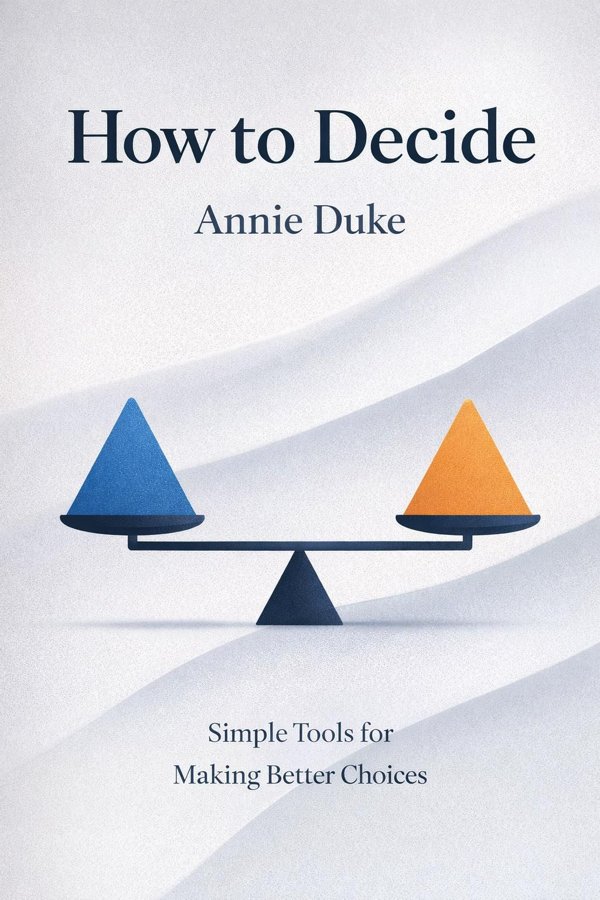
How to Decide: Simple Tools for Making Better Choices: Summary & Key Insights
by Annie Duke
 10 min11 chaptersAudio available
What Is How to Decide: Simple Tools for Making Better Choices About?
How to Decide: Simple Tools for Making Better Choices by Annie Duke is a mindset book spanning 11 pages. In this practical guide, Annie Duke, a former professional poker player and decision strategist, offers a framework for improving decision-making under uncertainty. Drawing on cognitive psychology and behavioral economics, she provides tools to separate decision quality from outcome, manage biases, and build confidence in complex choices. The book emphasizes learning from past decisions and developing a process-oriented approach to thinking clearly about risk and probability.
This FizzRead summary covers all 11 key chapters of How to Decide: Simple Tools for Making Better Choices in approximately 10 minutes, distilling the most important ideas, arguments, and takeaways from Annie Duke's work. Also available as an audio summary and Key Quotes Podcast.
How to Decide: Simple Tools for Making Better Choices
In this practical guide, Annie Duke, a former professional poker player and decision strategist, offers a framework for improving decision-making under uncertainty. Drawing on cognitive psychology and behavioral economics, she provides tools to separate decision quality from outcome, manage biases, and build confidence in complex choices. The book emphasizes learning from past decisions and developing a process-oriented approach to thinking clearly about risk and probability.
Who Should Read How to Decide: Simple Tools for Making Better Choices?
This book is perfect for anyone interested in mindset and looking to gain actionable insights in a short read. Whether you're a student, professional, or lifelong learner, the key ideas from How to Decide: Simple Tools for Making Better Choices by Annie Duke will help you think differently.
- ✓Readers who enjoy mindset and want practical takeaways
- ✓Professionals looking to apply new ideas to their work and life
- ✓Anyone who wants the core insights of How to Decide: Simple Tools for Making Better Choices in just 10 minutes
Want the full summary?
Get instant access to this book summary and 100K+ more with Fizz Moment.
Get Free SummaryAvailable on App Store • Free to download
Key Chapters
Decision-making is not a talent reserved for analysts or poker professionals—it is a learnable skill. In my work as a decision strategist, I’ve witnessed how structured thinking allows anyone to move from guessing to reasoning. The first step is acknowledging that every decision unfolds in a landscape of imperfect information. Most people try to avoid uncertainty; they wait until things feel clear. But clarity rarely comes. The real task is learning how to move forward despite not knowing everything.
When you see decision-making as a process to be improved rather than a moment requiring perfection, you free yourself to experiment, learn, and iterate. Probabilistic thinking—the art of estimating likelihoods rather than chasing absolutes—is your best ally. It allows you to evaluate options with greater nuance, weighing not just what might happen but how likely each outcome is. In doing so, you begin to uncover hidden assumptions and challenge automatic patterns of judgment.
You can apply this mindset anywhere, from strategic business choices to daily personal dilemmas. When deciding whether to change jobs, invest in a project, or even enter a relationship, the secret is not seeking the 'right' choice but developing a framework that helps make informed choices and then evaluate them honestly afterward. Once you start viewing every choice as a learning opportunity, you begin to unlearn the fear of making mistakes. What matters is improvement, not infallibility.
If you’ve ever felt crushed by a bad result or smug after a lucky win, you’ve experienced outcome bias firsthand. The antidote lies in redefining success—not by what happens, but by how you decided. In poker, even the most skillful player loses hands due to chance. My goal was never to win every hand but to make the highest-quality decision given the data, probabilities, and context available.
The same rule applies in life’s decisions. Separating process from outcome means cultivating the ability to review your choices independently of what followed. Imagine hiring a promising candidate who later struggles on the job. That doesn’t mean your hiring process was flawed; it may simply reveal unforeseeable factors. Conversely, a project lucky enough to succeed despite poor reasoning shouldn’t reinforce bad habits.
Good decision processes depend on preparation, reflection, and honest information gathering. This is why journaling, decision logs, and pre-analysis can be powerful. When you document your reasoning before results arrive, you preserve a snapshot of your thinking—later allowing you to compare what you expected with what occurred. Most people skip this step, and thus they rewrite history after seeing outcomes. We rationalize poor reasoning behind good luck and beat ourselves up over rational choices that didn’t pan out. When you focus instead on the process, you learn what is controllable and stop confusing randomness with error. The relief this brings is liberating: your growth ceases to depend on luck.
+ 9 more chapters — available in the FizzRead app
All Chapters in How to Decide: Simple Tools for Making Better Choices
About the Author
Annie Duke is an American author, decision strategist, and former professional poker player. She holds a degree in psychology from Columbia University and pursued doctoral studies at the University of Pennsylvania. After a successful poker career, she turned to teaching decision science, consulting for organizations, and writing bestselling books on thinking and decision-making.
Get This Summary in Your Preferred Format
Read or listen to the How to Decide: Simple Tools for Making Better Choices summary by Annie Duke anytime, anywhere. FizzRead offers multiple formats so you can learn on your terms — all free.
Available formats: App · Audio · PDF · EPUB — All included free with FizzRead
Download How to Decide: Simple Tools for Making Better Choices PDF and EPUB Summary
Key Quotes from How to Decide: Simple Tools for Making Better Choices
“Decision-making is not a talent reserved for analysts or poker professionals—it is a learnable skill.”
“If you’ve ever felt crushed by a bad result or smug after a lucky win, you’ve experienced outcome bias firsthand.”
Frequently Asked Questions about How to Decide: Simple Tools for Making Better Choices
How to Decide: Simple Tools for Making Better Choices by Annie Duke is a mindset book that explores key ideas across 11 chapters. In this practical guide, Annie Duke, a former professional poker player and decision strategist, offers a framework for improving decision-making under uncertainty. Drawing on cognitive psychology and behavioral economics, she provides tools to separate decision quality from outcome, manage biases, and build confidence in complex choices. The book emphasizes learning from past decisions and developing a process-oriented approach to thinking clearly about risk and probability.
More by Annie Duke

You Might Also Like



Browse by Category
Ready to read How to Decide: Simple Tools for Making Better Choices?
Get the full summary and 100K+ more books with Fizz Moment.