
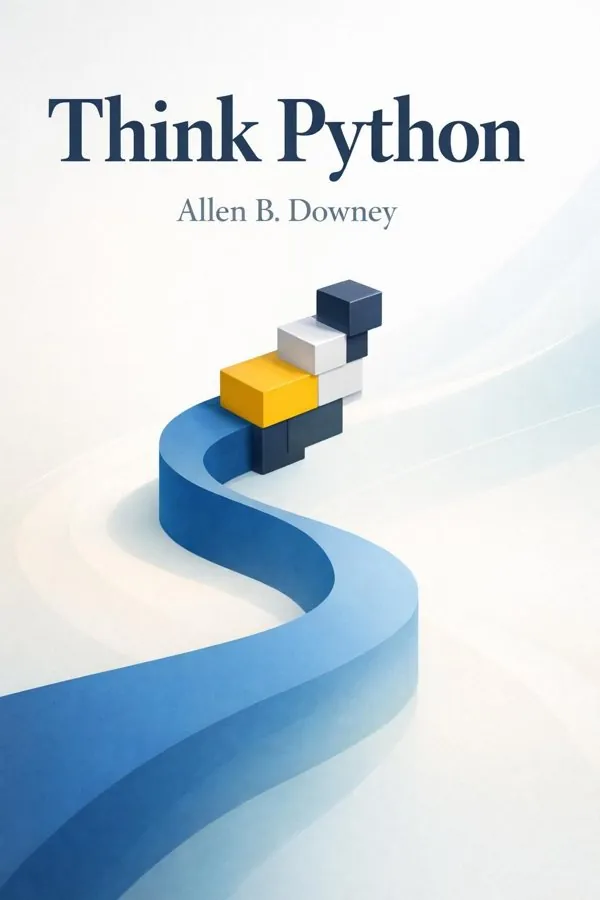
Think Python: How to Think Like a Computer Scientist: Summary & Key Insights
 10 min9 chaptersAudio available
What Is Think Python: How to Think Like a Computer Scientist About?
Think Python: How to Think Like a Computer Scientist by Allen B. Downey is a programming book spanning 9 pages. Think Python es un libro introductorio sobre programación en Python que enseña los fundamentos de la informática y el pensamiento computacional. El texto guía al lector desde conceptos básicos como variables y funciones hasta temas más avanzados como recursión, estructuras de datos y programación orientada a objetos. Su enfoque pedagógico enfatiza la claridad y la práctica, ayudando a los principiantes a desarrollar habilidades de resolución de problemas mediante ejemplos y ejercicios.
This FizzRead summary covers all 9 key chapters of Think Python: How to Think Like a Computer Scientist in approximately 10 minutes, distilling the most important ideas, arguments, and takeaways from Allen B. Downey's work. Also available as an audio summary and Key Quotes Podcast.
Think Python: How to Think Like a Computer Scientist
Think Python es un libro introductorio sobre programación en Python que enseña los fundamentos de la informática y el pensamiento computacional. El texto guía al lector desde conceptos básicos como variables y funciones hasta temas más avanzados como recursión, estructuras de datos y programación orientada a objetos. Su enfoque pedagógico enfatiza la claridad y la práctica, ayudando a los principiantes a desarrollar habilidades de resolución de problemas mediante ejemplos y ejercicios.
Who Should Read Think Python: How to Think Like a Computer Scientist?
This book is perfect for anyone interested in programming and looking to gain actionable insights in a short read. Whether you're a student, professional, or lifelong learner, the key ideas from Think Python: How to Think Like a Computer Scientist by Allen B. Downey will help you think differently.
- ✓Readers who enjoy programming and want practical takeaways
- ✓Professionals looking to apply new ideas to their work and life
- ✓Anyone who wants the core insights of Think Python: How to Think Like a Computer Scientist in just 10 minutes
Want the full summary?
Get instant access to this book summary and 100K+ more with Fizz Moment.
Get Free SummaryAvailable on App Store • Free to download
Key Chapters
Let’s begin by clarifying what it means to ‘think like a computer scientist.’ Many people approach programming as if it were a skill rooted in memorizing commands. But true programming begins with problem solving — breaking down a problem into the smallest possible steps, reasoning about those steps, and designing an algorithm that executes them efficiently.
In this first part of the book, I draw a parallel between programming and scientific thinking. Both involve hypothesis, testing, and refinement. A scientist decomposes a complex natural phenomenon into measurable variables; a programmer decomposes a complex computational task into executable statements. The difference lies only in context, not in the process.
The starting point is understanding that a computer, at its core, is not intelligent — it’s exacting. It obeys every instruction precisely as stated, which means your task is to express ideas with absolute clarity. Python makes that expression natural, because its syntax reads almost like English. But before writing code, the thinking must come first.
Thinking computationally means learning abstraction — the ability to simplify complexity without losing meaning. For instance, when you model a human behavior like ordering coffee, you ignore the irrelevant details (weather, clothing) and focus on the essential logic (choose beverage, pay, receive item). Programming teaches you to capture that logic formally.
Throughout this foundation, I encourage readers to experiment. The interpreter becomes your laboratory. Try things, fail, observe what happens, and refine your understanding. Programming teaches resilience: the willingness to see errors not as obstacles, but as feedback. When you learn to debug your code, you learn to debug your thinking.
Ultimately, this part of the book introduces a mindset — precision, creativity, and incremental learning. Thinking like a computer scientist is not just about machines; it’s about cultivating disciplined curiosity about how systems, natural or digital, can be understood and designed.
Once you begin to think with this clarity, you need a language to express it. Python gives you that language through variables, expressions, and statements — the basic grammar of every program.
Variables are names that refer to values. They represent memory locations where data lives temporarily while your program runs. Understanding variables is about understanding representation: when you assign `x = 5`, you’re instructing the computer to store the value 5 and label it as `x`. Simple, yet profoundly powerful — because naming allows computation to become human-readable and manageable.
Expressions combine values and operators to produce new results. For instance, `x + y` doesn’t just combine numbers; it represents the execution of logic, a request to perform addition. Every expression is a miniature algorithm: it converts input into output following clear, deterministic rules.
Statements are the building blocks of flow. They tell the computer to do something — assign a value, print a result, repeat an action. Understanding how statements operate sequentially is the basis for building any program.
In this section, the book makes a crucial pedagogical point: programming mirrors natural language, but with stricter grammar. You learn syntax like a new dialect of logical thought. And as you practice using variables and expressions, your reasoning starts to sharpen. You begin to see structure in your own thoughts, to represent abstract problems concretely.
I often remind students that these basics are not trivial. They are the foundation of everything you will build. Learning to visualize a program’s state — how variables and values interact — is the first step toward understanding execution. Once you grasp this, the complexity of future topics unfolds naturally.
+ 7 more chapters — available in the FizzRead app
All Chapters in Think Python: How to Think Like a Computer Scientist
About the Author
Allen B. Downey es profesor de informática en Olin College of Engineering. Es conocido por sus libros educativos sobre programación y ciencia de datos, incluyendo Think Python, Think Stats y Think Bayes. Su trabajo se centra en hacer accesibles los conceptos de la informática y la estadística a estudiantes de todos los niveles.
Get This Summary in Your Preferred Format
Read or listen to the Think Python: How to Think Like a Computer Scientist summary by Allen B. Downey anytime, anywhere. FizzRead offers multiple formats so you can learn on your terms — all free.
Available formats: App · Audio · PDF · EPUB — All included free with FizzRead
Download Think Python: How to Think Like a Computer Scientist PDF and EPUB Summary
Key Quotes from Think Python: How to Think Like a Computer Scientist
“Let’s begin by clarifying what it means to ‘think like a computer scientist.”
“Once you begin to think with this clarity, you need a language to express it.”
Frequently Asked Questions about Think Python: How to Think Like a Computer Scientist
Think Python: How to Think Like a Computer Scientist by Allen B. Downey is a programming book that explores key ideas across 9 chapters. Think Python es un libro introductorio sobre programación en Python que enseña los fundamentos de la informática y el pensamiento computacional. El texto guía al lector desde conceptos básicos como variables y funciones hasta temas más avanzados como recursión, estructuras de datos y programación orientada a objetos. Su enfoque pedagógico enfatiza la claridad y la práctica, ayudando a los principiantes a desarrollar habilidades de resolución de problemas mediante ejemplos y ejercicios.
You Might Also Like
ANSI Common Lisp
Paul Graham
10 min
Automate the Boring Stuff with Python: Practical Programming for Total Beginners
Al Sweigart
10 min
Black Hat Python: Python Programming for Hackers and Pentesters
Justin Seitz
10 min
Building Microservices: Designing Fine-Grained Systems
Sam Newman
10 min
C++ Primer
Stanley B. Lippman, Josée Lajoie, Barbara E. Moo
10 min
Clean Code: A Handbook of Agile Software Craftsmanship
Robert C. Martin
10 minBrowse by Category
Ready to read Think Python: How to Think Like a Computer Scientist?
Get the full summary and 100K+ more books with Fizz Moment.