
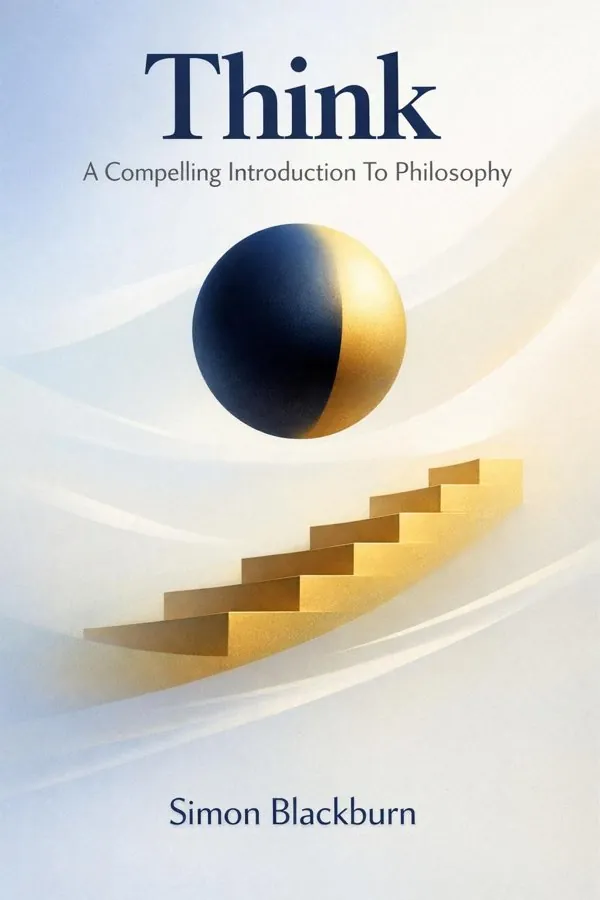
Think: A Compelling Introduction To Philosophy: Summary & Key Insights
 10 min7 chaptersAudio available
What Is Think: A Compelling Introduction To Philosophy About?
Think: A Compelling Introduction To Philosophy by Simon Blackburn is a western_phil book spanning 7 pages. Think: A Compelling Introduction to Philosophy is an accessible and engaging guide to the central questions of philosophy, written by Simon Blackburn. The book explores fundamental topics such as truth, knowledge, mind, freedom, and morality, offering readers a clear understanding of how philosophers have approached these issues throughout history.
This FizzRead summary covers all 7 key chapters of Think: A Compelling Introduction To Philosophy in approximately 10 minutes, distilling the most important ideas, arguments, and takeaways from Simon Blackburn's work. Also available as an audio summary and Key Quotes Podcast.
Think: A Compelling Introduction To Philosophy
Think: A Compelling Introduction to Philosophy is an accessible and engaging guide to the central questions of philosophy, written by Simon Blackburn. The book explores fundamental topics such as truth, knowledge, mind, freedom, and morality, offering readers a clear understanding of how philosophers have approached these issues throughout history.
Who Should Read Think: A Compelling Introduction To Philosophy?
This book is perfect for anyone interested in western_phil and looking to gain actionable insights in a short read. Whether you're a student, professional, or lifelong learner, the key ideas from Think: A Compelling Introduction To Philosophy by Simon Blackburn will help you think differently.
- ✓Readers who enjoy western_phil and want practical takeaways
- ✓Professionals looking to apply new ideas to their work and life
- ✓Anyone who wants the core insights of Think: A Compelling Introduction To Philosophy in just 10 minutes
Want the full summary?
Get instant access to this book summary and 100K+ more with Fizz Moment.
Get Free SummaryAvailable on App Store • Free to download
Key Chapters
Philosophy begins where certainty ends. In exploring knowledge, I invite readers to confront skepticism—the provocative claim that we might not know anything at all. From Descartes’ famous doubt to modern-day discussions of perception and evidence, the aim is not to stoke despair but to clarify the grounds on which belief becomes knowledge. If we are to claim that we know something, it must be more than habitual conviction or communal consensus. Knowledge implies justification, truth, and belief—but as soon as we demand those together, the cracks appear.
Skeptics challenge us: how do we know our senses are not deceiving us? Could we be dreaming—or worse, trapped in a fabricated reality? These questions are unsettling precisely because they reveal the precarious structure of our confidence in the world. Yet to acknowledge that vulnerability is not to fall silent. The task of epistemology, which I trace through thinkers like Hume, Locke, and more recent analytic traditions, is to navigate between naïve realism and paralyzing doubt. We must recognize the fallibility of human reason while still distinguishing reasoned belief from mere opinion.
To think about knowledge is also to confront the limits of our own cognitive apparatus. Our minds construct patterns, categories, and expectations, and these shape what appears to us as 'reality.' Philosophy does not reject this; rather, it teaches us to see it. Understanding this act of interpretation makes us not weaker but wiser: it trains us to treat our beliefs as revisable, to live within uncertainty yet keep reasoning forward.
The question 'What is truth?' has been abused by politics, distorted by ideology, and trivialized by relativism. To bring it back to its philosophical center, I begin with the classical theories: the correspondence theory, which ties truth to how statements match the world; the coherence theory, which roots truth in the consistency of belief networks; and the pragmatic theory, which measures truth by its usefulness in guiding action. These are not abstract taxonomies but living frameworks for how we align thought and world.
From the correspondence view, truth is fidelity—a proposition is true if it reflects reality. From the coherence view, we live within systems of interpretation, and truth emerges within their integrity. The pragmatic perspective, pioneered by American philosophers such as William James, insists that truth matters because it works—because it empowers effective engagement with life.
But these positions need not exclude one another. My concern is with how truth functions in our intellectual and moral lives. To deny truth—or to claim all truths are equally valid—is to dissolve the very grounds on which critique and progress depend. We can be humble about our access to truth without denying its existence. Philosophy thus restores truth as a regulative ideal: something we pursue, test, and refine through reason, evidence, and dialogue.
+ 5 more chapters — available in the FizzRead app
All Chapters in Think: A Compelling Introduction To Philosophy
About the Author
Simon Blackburn is a British philosopher known for his work in philosophy of mind, ethics, and language. He has served as a professor at the University of Cambridge and is the author of several popular philosophy books aimed at making philosophical reflection accessible to a general audience.
Get This Summary in Your Preferred Format
Read or listen to the Think: A Compelling Introduction To Philosophy summary by Simon Blackburn anytime, anywhere. FizzRead offers multiple formats so you can learn on your terms — all free.
Available formats: App · Audio · PDF · EPUB — All included free with FizzRead
Download Think: A Compelling Introduction To Philosophy PDF and EPUB Summary
Key Quotes from Think: A Compelling Introduction To Philosophy
“In exploring knowledge, I invite readers to confront skepticism—the provocative claim that we might not know anything at all.”
“' has been abused by politics, distorted by ideology, and trivialized by relativism.”
Frequently Asked Questions about Think: A Compelling Introduction To Philosophy
Think: A Compelling Introduction To Philosophy by Simon Blackburn is a western_phil book that explores key ideas across 7 chapters. Think: A Compelling Introduction to Philosophy is an accessible and engaging guide to the central questions of philosophy, written by Simon Blackburn. The book explores fundamental topics such as truth, knowledge, mind, freedom, and morality, offering readers a clear understanding of how philosophers have approached these issues throughout history.
You Might Also Like
A Little History of Philosophy
Nigel Warburton
10 min
Areopagitica
John Milton
10 min
How To Think Like A Philosopher: Essential Principles For Clear Thinking
Peter Cave
10 min
Language, Truth and Logic
A. J. Ayer
10 min
The Age of Reason
Thomas Paine
10 min
The Essays
Michel De Montaigne
10 minBrowse by Category
Ready to read Think: A Compelling Introduction To Philosophy?
Get the full summary and 100K+ more books with Fizz Moment.