
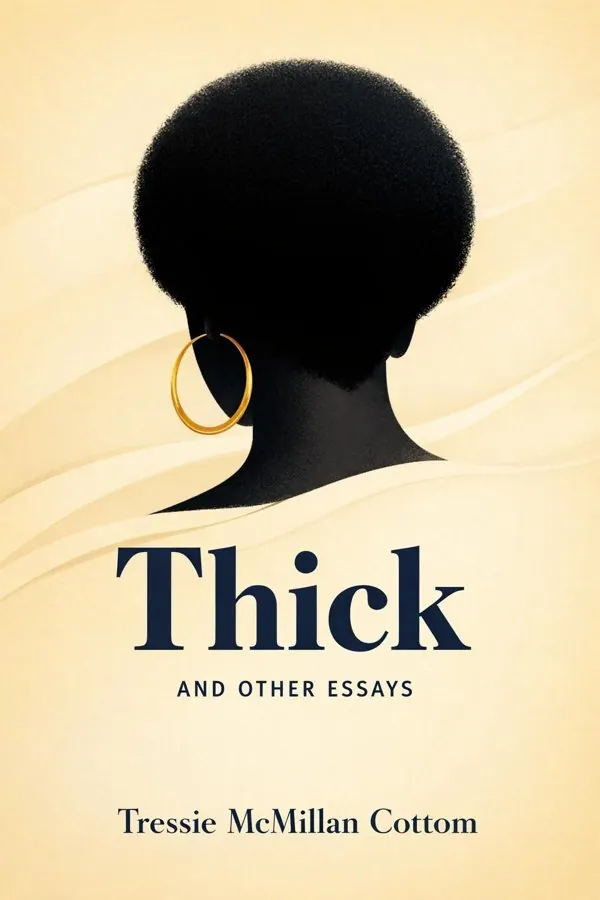
Thick: And Other Essays: Summary & Key Insights
 10 min10 chaptersAudio available
Key Takeaways from Thick: And Other Essays
Some lives are treated as footnotes unless they learn to narrate themselves in full.
Beauty looks personal, but in America it often functions like policy.
Power often survives by pretending it has no culture.
For many Black women, competence is not simply rewarded; it is extracted.
Inclusion often comes with fine print.
What Is Thick: And Other Essays About?
Thick: And Other Essays by Tressie McMillan Cottom is a sociology book spanning 10 pages. Thick: And Other Essays is a brilliant collection of cultural criticism in which Tressie McMillan Cottom examines how race, gender, class, beauty, sexuality, and status shape everyday life in America. Moving between memoir, sociology, and political commentary, she shows that the experiences of Black women are not side notes to public life; they are some of the clearest windows into how power actually works. Her essays explore beauty standards, respectability, white identity, labor, higher education, media, grief, and the emotional costs of being seen only through stereotype. What makes the book so powerful is its method: Cottom combines intellectual rigor with lived experience, refusing the false divide between personal feeling and social analysis. As a sociologist, professor, and public thinker, she brings both academic authority and sharp literary skill to every page. The result is a book that is deeply readable yet analytically rich. Thick matters because it asks readers to take seriously what society often dismisses, and in doing so, it reveals how inequality is made to feel natural, desirable, and inevitable.
This FizzRead summary covers all 10 key chapters of Thick: And Other Essays in approximately 10 minutes, distilling the most important ideas, arguments, and takeaways from Tressie McMillan Cottom's work. Also available as an audio summary and Key Quotes Podcast.
Thick: And Other Essays
Thick: And Other Essays is a brilliant collection of cultural criticism in which Tressie McMillan Cottom examines how race, gender, class, beauty, sexuality, and status shape everyday life in America. Moving between memoir, sociology, and political commentary, she shows that the experiences of Black women are not side notes to public life; they are some of the clearest windows into how power actually works. Her essays explore beauty standards, respectability, white identity, labor, higher education, media, grief, and the emotional costs of being seen only through stereotype. What makes the book so powerful is its method: Cottom combines intellectual rigor with lived experience, refusing the false divide between personal feeling and social analysis. As a sociologist, professor, and public thinker, she brings both academic authority and sharp literary skill to every page. The result is a book that is deeply readable yet analytically rich. Thick matters because it asks readers to take seriously what society often dismisses, and in doing so, it reveals how inequality is made to feel natural, desirable, and inevitable.
Who Should Read Thick: And Other Essays?
This book is perfect for anyone interested in sociology and looking to gain actionable insights in a short read. Whether you're a student, professional, or lifelong learner, the key ideas from Thick: And Other Essays by Tressie McMillan Cottom will help you think differently.
- ✓Readers who enjoy sociology and want practical takeaways
- ✓Professionals looking to apply new ideas to their work and life
- ✓Anyone who wants the core insights of Thick: And Other Essays in just 10 minutes
Want the full summary?
Get instant access to this book summary and 100K+ more with Fizz Moment.
Get Free SummaryAvailable on App Store • Free to download
Key Chapters
Some lives are treated as footnotes unless they learn to narrate themselves in full. In the opening essay, Cottom turns the word “thick” into both a metaphor and an intellectual method. Thickness describes a body that draws attention, a mind that refuses simplification, and a style of thinking that resists flattening complex realities into neat categories. For Black women especially, thin explanations have always been dangerous. They reduce pain to attitude, intelligence to exception, beauty to stereotype, and survival to personal grit. Cottom argues that to write thickly is to insist that context matters: history matters, institutions matter, the body matters, and private experience is also public evidence.
This is not a rejection of analysis but a demand for better analysis. She challenges the idea that detached, supposedly neutral language is automatically more truthful than embodied knowledge. If a Black woman says that an interaction at work, in school, or in public was shaped by race, gender, and class all at once, that complexity is not bias; it is data. A thick account refuses the convenience of single-cause stories.
In practice, this idea changes how we read news, interpret conflict, and evaluate expertise. When someone describes a social problem, we should ask what has been left out to make the story easier to tell. What structures made the event possible? Who benefits from calling the issue simple?
Actionable takeaway: When evaluating any social issue, replace the question “What happened?” with “What histories, institutions, and assumptions made this happen?”
Power often survives by pretending it has no culture. In “Know Your Whites,” Cottom pushes readers to see whiteness not as a default human setting but as a social identity with its own varieties, anxieties, habits, and uses. Black Americans, she suggests, have long had to become careful students of white people because understanding white behavior is often necessary for safety, employment, navigation, and survival. White people, by contrast, are rarely required to develop the same literacy about others.
This creates an asymmetry of knowledge. Marginalized groups become fluent in the moods and codes of dominant groups, while dominant groups can continue mistaking their own perspective for objectivity. Cottom is particularly attentive to the different ways whiteness performs itself: respectable, liberal, paternalistic, nostalgic, resentful, performatively innocent. These variations matter because power does not always announce itself through open hostility. It can also appear as politeness, surprise, fragility, or a self-flattering commitment to fairness.
The essay gives readers a better language for understanding everyday interactions. Why does one white colleague insist on being “nice” while blocking substantive change? Why does another become defensive when race is named, as if description itself were accusation? These responses are not random personality quirks; they are social behaviors shaped by a structure that protects comfort for some and risk for others.
Reading white identity accurately does not mean stereotyping individuals. It means recognizing that power has patterns. Once those patterns are visible, readers can stop confusing personal misunderstanding with structural inequality.
Actionable takeaway: In difficult conversations about race, pay less attention to stated intentions and more attention to recurring patterns of comfort, defensiveness, gatekeeping, and whose reality is treated as authoritative.
For many Black women, competence is not simply rewarded; it is extracted. In “Dying to Be Competent,” Cottom explores how being seen as capable often invites impossible expectations rather than security. Black women are frequently praised for strength, resilience, and reliability, but those labels can become traps. The same traits that earn admiration are used to justify overwork, emotional neglect, and institutional indifference. If you are always presumed to handle more, then people feel less responsible for your care.
Cottom connects this burden to a broader social pattern: society romanticizes the endurance of Black women while ignoring the conditions that require such endurance. The image of the “strong Black woman” can sound complimentary, but it often functions as a permission slip for abandonment. In workplaces, schools, healthcare settings, and families, competence becomes a reason not to intervene until crisis hits.
The essay also speaks to the emotional isolation created by this dynamic. When people depend on your steadiness, they may stop seeing your vulnerability as real. You become valuable as a function rather than as a person. This is especially dangerous in institutions that already under-recognize the pain, exhaustion, or grief of those lower in status.
A practical application of this idea is to reconsider how praise operates. Are we rewarding people with support, or merely flattering them while increasing their load? Managers, educators, and loved ones often confuse admiration with care.
Actionable takeaway: If someone is consistently described as “the one who can handle it,” pair every request for their labor with a concrete offer of protection, resources, rest, or redistribution of responsibility.
Inclusion often comes with fine print. In “Black Is Over (Or, Special Black),” Cottom examines how institutions welcome certain Black people only when they can be framed as exceptional, nonthreatening, and useful to the image of diversity. This is the logic of “special Blackness”: a person is celebrated not as evidence that the institution has become equitable, but as proof that one extraordinary individual managed to adapt to unequal conditions.
This distinction matters because exceptional inclusion can hide structural exclusion. A university may proudly point to a few visible Black success stories while maintaining policies, cultures, and informal networks that still disadvantage most Black students and workers. A company can elevate one charismatic Black executive while ignoring pay inequity, tokenism, or cultural isolation. Representation without redistribution is often public relations.
Cottom also shows how burdensome this role can be for the person chosen. To be “special” is to be watched, interpreted, and disciplined. You must symbolize progress while absorbing the frustration of those still left out. You may be expected to embody excellence, gratitude, and non-disruption all at once. Any critique you offer risks being treated as betrayal.
The essay helps readers distinguish between visibility and transformation. It asks whether an institution can survive the absence of its symbolic exceptions. If justice depends on a handful of remarkable individuals, then justice has not been built.
Actionable takeaway: Whenever an organization highlights diversity success, ask a second question: What systems changed for ordinary people, not just for the exceptional few who can be showcased?
A woman’s voice is rarely heard as just a voice; it arrives wrapped in assumptions about sexuality, class, race, and legitimacy. In “Girl 6,” Cottom uses cultural analysis to explore how Black women’s voices and desires are often consumed through stereotype. Black women are imagined as hypersexual, available, comic, excessive, or emotionally indestructible, and these images shape how they are listened to in both intimate and public life.
The essay’s brilliance lies in showing that representation is not superficial. Media scripts teach people what kinds of women are believable, lovable, dangerous, or disposable. When Black women speak with confidence, they may be heard as aggressive. When they claim desire, they may be judged as vulgar. When they withhold access, they may be called difficult. The problem is not expression itself but a culture trained to hear Black femininity through distortion.
This affects more than entertainment. It shapes dating norms, workplace interactions, online harassment, and the politics of credibility. Consider how often Black women in public life are asked to soften their tone, manage others’ comfort, or prove their humanity before their ideas can even be considered. Cottom reveals that these demands are forms of social control.
A useful application is to listen for the gap between what a Black woman says and what others report hearing. That gap often exposes prejudice more clearly than any explicit insult. The essay urges readers to become more aware of interpretive habits inherited from culture.
Actionable takeaway: In conversations and media consumption, pause before reacting to a Black woman’s tone or desirability, and ask whether your response is based on her actual words or on a stereotype you have been taught to recognize as truth.
Style can look like freedom while functioning as unpaid labor. In “The Price of Fabulousness,” Cottom examines the expectation that Black women should be dazzling, put-together, resilient, and aesthetically masterful even under conditions of inequality. Fabulousness is not merely glamour here; it is a social performance that signals taste, control, and worth in a world eager to deny all three. Looking magnificent can become a strategy of dignity, aspiration, and defense. But it is also expensive.
Cottom is careful not to mock pleasure, fashion, or self-presentation. Instead, she asks what it means when people with fewer resources are compelled to invest heavily in appearances in order to secure respect that others receive more automatically. Hair, clothes, makeup, accessories, and social polish all carry financial and emotional costs. For Black women, those costs are heightened because visibility itself is political. To appear “too plain�� may invite disregard; to appear “too fabulous” may invite judgment.
This is a larger argument about consumer culture and inequality. Markets do not simply respond to identity; they train people to buy solutions to social injury. If a person is denied status, the market offers prestige goods. If a person is misrecognized, the market offers image management. The performance can feel empowering because it is sometimes genuinely creative and joyful. Yet the structure behind it remains coercive.
Readers can apply this idea by thinking about how consumption masks structural problems. We should ask when self-improvement industries are solving real needs and when they are monetizing social exclusion.
Actionable takeaway: Notice one expense you consider necessary for being seen as respectable or professional, and ask whether it reflects personal preference, institutional pressure, or both.
The hustle is often praised as ambition, but Cottom shows that it is also a story societies tell when they want to hide abandonment. In “The Hustle,” she explores the moral language around hard work, side gigs, self-making, and entrepreneurial striving. For people with privilege, hustling may be a brand. For those with fewer protections, it is often a response to unstable wages, debt, weak social safety nets, and institutions that make ordinary survival precarious.
Cottom’s sociological insight is that hustle culture transforms structural risk into personal character. If you are exhausted, underpaid, or constantly improvising, the culture tells you to admire yourself as scrappy rather than question why so much life now depends on insecurity. This is particularly relevant for Black women, who are expected to be industrious, adaptable, and grateful while navigating labor markets already shaped by discrimination.
The essay also warns against confusing visibility with mobility. Social media and popular business culture celebrate the image of constant work, but not everyone hustles under the same conditions. Some people fail safely because family wealth, networks, or credentials cushion risk. Others cannot. What appears to be equal opportunity is often unequal exposure.
A practical implication is to change how we talk about success. Instead of asking only who worked hardest, ask who had margin for error, who had healthcare, who could borrow money, who had childcare, and who could survive one bad month. Hustle sounds democratic, but risk is not.
Actionable takeaway: When evaluating your own or others’ career progress, include invisible supports and vulnerabilities in the equation rather than treating outcomes as pure evidence of merit.
The past does not disappear; it changes clothes. In “Notes on the State of Virginia,” Cottom reflects on how history saturates place, politics, and belonging in the American South. Virginia becomes more than a location. It is a lens for seeing how slavery, hierarchy, gentility, education, and public memory continue to organize contemporary life. The essay resists the easy idea that racism belongs to a finished past while the present belongs to progress.
Cottom’s point is that institutions inherit moods as well as policies. Universities, legislatures, neighborhoods, and civic rituals carry the afterlife of earlier arrangements of power. A place may celebrate refinement, tradition, or civility while still preserving unequal distributions of comfort and legitimacy. This is one reason racial inequality can persist even when overt language changes. History survives through architecture, custom, reputation, and the selective stories communities tell about themselves.
The essay offers readers a way to interpret local politics more carefully. Debates over monuments, schools, policing, public history, and regional identity are not symbolic distractions. They reveal whose memories are treated as heritage and whose suffering is treated as inconvenience. Cottom asks readers to see that nostalgia is often political. What one group calls tradition, another may recognize as exclusion with better manners.
This idea applies broadly, not just to Virginia. Every city, school, and workplace has a memory structure. Understanding that structure helps explain why some reforms fail: they challenge policy without confronting the deeper story an institution tells about who naturally belongs.
Actionable takeaway: Investigate one institution you belong to and ask what version of its history is publicly celebrated, what version is omitted, and how those choices shape the present.
Grief is often described as private, yet it reveals exactly how public systems value certain lives. In “The Last Essay,” Cottom brings personal loss into conversation with social inequality, showing that mourning is never only emotional. It is shaped by access to healthcare, social support, family expectations, reproductive politics, and the language available for pain. Her writing demonstrates that intimate suffering can be sociological without becoming impersonal.
What makes this essay especially moving is its refusal to separate feeling from critique. Cottom does not use theory to avoid pain; she uses it to give pain structure. Loss becomes a way of understanding how vulnerability is distributed and how some people are denied the conditions to grieve cleanly. For Black women in particular, sorrow is often compressed by the demand to remain functional, competent, and strong. The world may permit spectacle around their pain, but not sustained care.
This closing perspective deepens the entire collection. It reminds readers that the social categories discussed throughout the book are not abstract identities but conditions that shape bodies, choices, family life, and survival. The essay argues that analysis matters precisely because people matter. To understand power is not to move away from feeling; it is to honor feeling by placing it in context.
In everyday life, this means treating personal narratives with more seriousness. Stories about illness, fertility, mourning, or exhaustion are not detours from public debate. They are often where policy becomes visible.
Actionable takeaway: The next time you encounter a personal account of grief or hardship, ask not only how the individual coped, but what institutions, norms, and inequities structured the experience.
All Chapters in Thick: And Other Essays
About the Author
Tressie McMillan Cottom is an American sociologist, essayist, and professor whose work focuses on race, education, labor, media, and inequality. She is widely known for bringing scholarly depth to public conversations about culture and power, often blending sociological analysis with personal reflection. Cottom is the author of Lower Ed, a study of the for-profit college industry, and Thick: And Other Essays, the acclaimed essay collection that established her as a major voice in contemporary nonfiction. Her writing has appeared in prominent publications, and she has earned recognition for making complex social issues clear, urgent, and deeply human. A MacArthur Fellow, Cottom is respected not only for her academic expertise but also for her distinctive ability to connect structural critique with lived experience.
Get This Summary in Your Preferred Format
Read or listen to the Thick: And Other Essays summary by Tressie McMillan Cottom anytime, anywhere. FizzRead offers multiple formats so you can learn on your terms — all free.
Available formats: App · Audio · PDF · EPUB — All included free with FizzRead
Download Thick: And Other Essays PDF and EPUB Summary
Key Quotes from Thick: And Other Essays
“Some lives are treated as footnotes unless they learn to narrate themselves in full.”
“Beauty looks personal, but in America it often functions like policy.”
“Power often survives by pretending it has no culture.”
“For many Black women, competence is not simply rewarded; it is extracted.”
“In “Black Is Over (Or, Special Black),” Cottom examines how institutions welcome certain Black people only when they can be framed as exceptional, nonthreatening, and useful to the image of diversity.”
Frequently Asked Questions about Thick: And Other Essays
Thick: And Other Essays by Tressie McMillan Cottom is a sociology book that explores key ideas across 10 chapters. Thick: And Other Essays is a brilliant collection of cultural criticism in which Tressie McMillan Cottom examines how race, gender, class, beauty, sexuality, and status shape everyday life in America. Moving between memoir, sociology, and political commentary, she shows that the experiences of Black women are not side notes to public life; they are some of the clearest windows into how power actually works. Her essays explore beauty standards, respectability, white identity, labor, higher education, media, grief, and the emotional costs of being seen only through stereotype. What makes the book so powerful is its method: Cottom combines intellectual rigor with lived experience, refusing the false divide between personal feeling and social analysis. As a sociologist, professor, and public thinker, she brings both academic authority and sharp literary skill to every page. The result is a book that is deeply readable yet analytically rich. Thick matters because it asks readers to take seriously what society often dismisses, and in doing so, it reveals how inequality is made to feel natural, desirable, and inevitable.
You Might Also Like

Between the World and Me
Ta-Nehisi Coates
10 min
Half the Sky
Nicholas D. Kristof, Sheryl WuDunn
10 min
Men Explain Things To Me
Rebecca Solnit
10 min
Rational Ritual
Michael Suk-Young Chwe
10 min
The New Jim Crow
Michelle Alexander
10 min
Beyond Culture
Edward T. Hall
10 minBrowse by Category
Ready to read Thick: And Other Essays?
Get the full summary and 100K+ more books with Fizz Moment.