
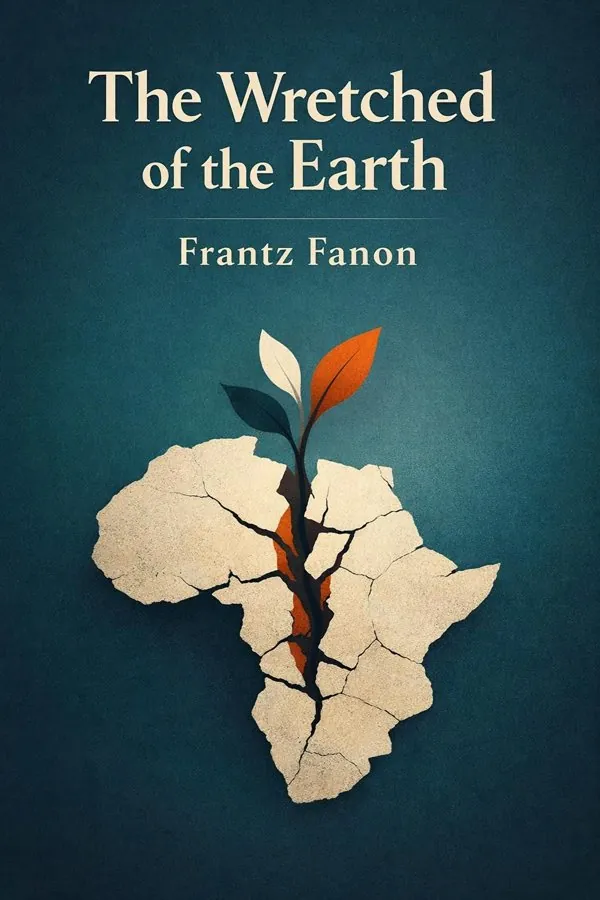
The Wretched of the Earth: Summary & Key Insights
by Frantz Fanon
 10 min5 chaptersAudio available
What Is The Wretched of the Earth About?
The Wretched of the Earth by Frantz Fanon is a politics book spanning 5 pages. Originally published in French in 1961 as 'Les Damnés de la Terre', this seminal work by Frantz Fanon examines the psychological, political, and social effects of colonialism and the process of decolonization. Fanon explores the inherent violence of colonial systems and argues for revolutionary struggle as a means of liberation for colonized peoples. With a preface by Jean-Paul Sartre, the book has become a cornerstone of postcolonial studies and a manifesto for anti-colonial movements worldwide.
This FizzRead summary covers all 5 key chapters of The Wretched of the Earth in approximately 10 minutes, distilling the most important ideas, arguments, and takeaways from Frantz Fanon's work. Also available as an audio summary and Key Quotes Podcast.
The Wretched of the Earth
Originally published in French in 1961 as 'Les Damnés de la Terre', this seminal work by Frantz Fanon examines the psychological, political, and social effects of colonialism and the process of decolonization. Fanon explores the inherent violence of colonial systems and argues for revolutionary struggle as a means of liberation for colonized peoples. With a preface by Jean-Paul Sartre, the book has become a cornerstone of postcolonial studies and a manifesto for anti-colonial movements worldwide.
Who Should Read The Wretched of the Earth?
This book is perfect for anyone interested in politics and looking to gain actionable insights in a short read. Whether you're a student, professional, or lifelong learner, the key ideas from The Wretched of the Earth by Frantz Fanon will help you think differently.
- ✓Readers who enjoy politics and want practical takeaways
- ✓Professionals looking to apply new ideas to their work and life
- ✓Anyone who wants the core insights of The Wretched of the Earth in just 10 minutes
Want the full summary?
Get instant access to this book summary and 100K+ more with Fizz Moment.
Get Free SummaryAvailable on App Store • Free to download
Key Chapters
Decolonization begins as a series of confrontations, a clash of absolute forces. Colonialism has made violence its language, and so the colonized learn to speak back through that same idiom. I observed in Algeria how occupation seeped into every structure of life—from the land seized by settlers to the consciousness of native people conditioned to obedience. Violence did not merely repress bodies; it reshaped minds. The colonized were taught to see themselves as inferior beings, unworthy of autonomy, destined to serve.
When I describe decolonization as inherently violent, I do not glorify bloodshed. I describe a process of catharsis. Colonization dehumanizes; revolution rehumanizes. The act of rebellion, though turbulent, is the only act through which the colonized reassert their existence. In the rural villages and in the hostile cities of the colonized world, the emergence of revolutionary violence signals the awakening of the people—a refusal to live as shadows beneath another’s civilization.
In this confrontation, there can be no neutral ground. The colonizer has organized the world along racial and spatial lines—the settlers in comfortable quarters, the natives confined to dusty margins. Decolonization thus overturns both geography and ideology. It is not a reform; it is a total replacement of one order with another. The moment of violence is also the moment of creation. Out of the old world, a new man is born—one who no longer accepts his own degradation as destiny.
I saw in Algeria how the use of arms was not mere insurgency but purification. Those who had been silenced found their voice. Those who had been fragmented as individuals came together as comrades. Violence provided unity where oppression had imposed division. This transformation, though dangerous, incarnated freedom in its rawest form. Without it, the colonized remain trapped within a system that claims peace while perpetuating servitude. Thus, violence is not the opposite of humanity—it is the passage through which humanity rebirths itself from the ashes of domination.
As a psychiatrist, I encountered daily the psychic devastation that colonialism inflicts. The colonized live with two bodies—one that moves through the world, and another that trembles under the gaze of the colonizer. Their sense of self is fractured, doubled, submerged beneath imposed inferiority. The colonizer defines the native as lazy, primitive, criminal; and gradually, the colonized begin to absorb these definitions. I saw in the asylum patients who were not merely ill but colonized souls—those who had internalized their oppression until it became madness.
Colonization poisons identity. It replaces the native’s culture with caricatures, their language with silence, their history with shame. The colonized learn to dream of becoming white, of escaping their condition through imitation. Here lies the most insidious victory of imperialism: when domination enters the mind, physical chains are no longer necessary. To heal, the colonized must first rediscover their worth, not in imitation but in opposition.
Psychological liberation begins when the colonized cease to look for validation from their oppressor. It begins when they recognize that the colonizer’s civilization is built on violence and hypocrisy. This awakening shatters fatalism. The people realize that they are not condemned to be passive recipients of history but can become its makers. The revolutionary movement becomes not only political but therapeutic—it restores the sense of agency, dignity, and belonging stripped away by centuries of conquest.
Liberation thus demands psychological reeducation. Those who fight must unlearn fear and learn responsibility. They must replace the inferiority complex with a consciousness of power. As revolutions unfold, the people rediscover singing, storytelling, collective memory—the ingredients of national consciousness. In these acts, healing occurs. A people who remember who they are can finally imagine who they might become.
+ 3 more chapters — available in the FizzRead app
All Chapters in The Wretched of the Earth
About the Author
Frantz Fanon (1925–1961) was a Martinican psychiatrist, philosopher, and revolutionary. Educated in France, he practiced in Algeria during its war of independence and joined the National Liberation Front (FLN). His works, including 'Black Skin, White Masks' and 'The Wretched of the Earth', profoundly influenced postcolonial thought, political psychology, and liberation movements across the globe.
Get This Summary in Your Preferred Format
Read or listen to the The Wretched of the Earth summary by Frantz Fanon anytime, anywhere. FizzRead offers multiple formats so you can learn on your terms — all free.
Available formats: App · Audio · PDF · EPUB — All included free with FizzRead
Download The Wretched of the Earth PDF and EPUB Summary
Key Quotes from The Wretched of the Earth
“Decolonization begins as a series of confrontations, a clash of absolute forces.”
“As a psychiatrist, I encountered daily the psychic devastation that colonialism inflicts.”
Frequently Asked Questions about The Wretched of the Earth
The Wretched of the Earth by Frantz Fanon is a politics book that explores key ideas across 5 chapters. Originally published in French in 1961 as 'Les Damnés de la Terre', this seminal work by Frantz Fanon examines the psychological, political, and social effects of colonialism and the process of decolonization. Fanon explores the inherent violence of colonial systems and argues for revolutionary struggle as a means of liberation for colonized peoples. With a preface by Jean-Paul Sartre, the book has become a cornerstone of postcolonial studies and a manifesto for anti-colonial movements worldwide.
You Might Also Like

Antifa: The Anti-Fascist Handbook
Mark Bray
10 min
Attack from Within: How Disinformation Is Sabotaging America
Barbara McQuade
10 min
Coercion, Capital, and European States, AD 990–1992
Charles Tilly
10 min
Digital Democracy: Concepts, Methodologies, Tools, and Applications
Various Authors
10 min
Fascism
Stanley G. Payne
10 min
Fire And Fury: Inside The Trump White House
Michael Wolff
10 minBrowse by Category
Ready to read The Wretched of the Earth?
Get the full summary and 100K+ more books with Fizz Moment.