
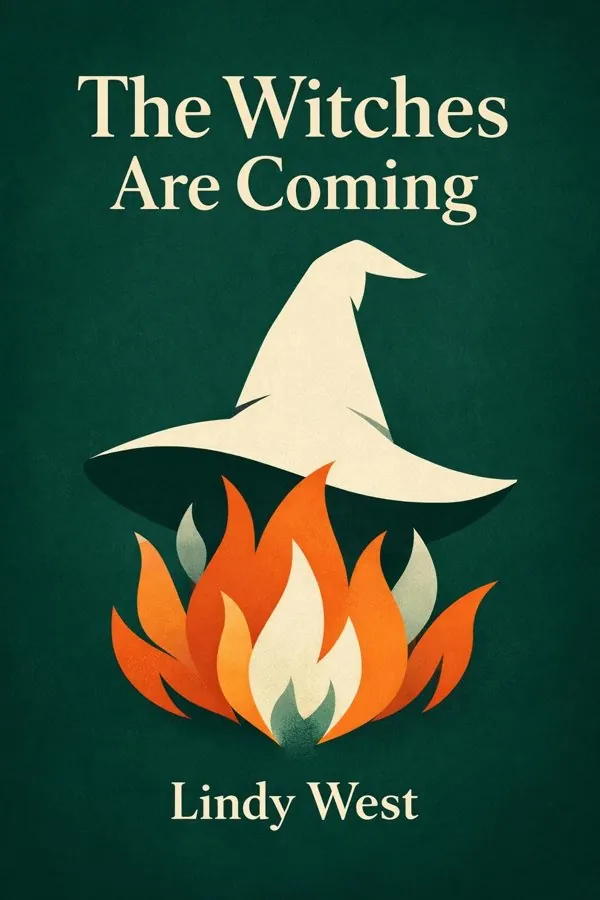
The Witches Are Coming: Summary & Key Insights
by Lindy West
 10 min10 chaptersAudio available
Key Takeaways from The Witches Are Coming
One of West’s most powerful insights is that injustice survives not only because of open cruelty, but because of collective pretending.
Entertainment is never just entertainment, and West insists that this matters more than many people want to admit.
West is skeptical of the way neutrality is celebrated in public life.
Whenever marginalized people gain visibility or power, backlash arrives dressed as common sense.
West does not present accountability as something only other people owe.
What Is The Witches Are Coming About?
The Witches Are Coming by Lindy West is a politics book spanning 11 pages. In The Witches Are Coming, Lindy West delivers a fierce, funny, and deeply unsettling diagnosis of modern American culture. Through a series of sharp essays, she examines how misogyny, racism, celebrity worship, media storytelling, and political hypocrisy have combined to create a society that regularly excuses cruelty while punishing those who name it. The book takes aim at the idea that calls for accountability—especially around sexism and abuse—represent some kind of overreaction. West argues the opposite: what many people dismiss as a “witch hunt” is actually a long-delayed reckoning with systems that have protected powerful people for generations. What makes this book so compelling is West’s ability to connect the personal, the political, and the cultural without losing humor or clarity. She moves easily from Donald Trump to pop culture, from internet discourse to sexual politics, showing how everyday entertainment and public narratives shape what we accept as normal. West writes with the authority of a seasoned cultural critic, feminist thinker, and comedian who understands both the absurdity and the danger of collective denial. This is not just a book about what is broken. It is also a call to stop pretending, tell the truth, and imagine something better.
This FizzRead summary covers all 10 key chapters of The Witches Are Coming in approximately 10 minutes, distilling the most important ideas, arguments, and takeaways from Lindy West's work. Also available as an audio summary and Key Quotes Podcast.
The Witches Are Coming
In The Witches Are Coming, Lindy West delivers a fierce, funny, and deeply unsettling diagnosis of modern American culture. Through a series of sharp essays, she examines how misogyny, racism, celebrity worship, media storytelling, and political hypocrisy have combined to create a society that regularly excuses cruelty while punishing those who name it. The book takes aim at the idea that calls for accountability—especially around sexism and abuse—represent some kind of overreaction. West argues the opposite: what many people dismiss as a “witch hunt” is actually a long-delayed reckoning with systems that have protected powerful people for generations.
What makes this book so compelling is West’s ability to connect the personal, the political, and the cultural without losing humor or clarity. She moves easily from Donald Trump to pop culture, from internet discourse to sexual politics, showing how everyday entertainment and public narratives shape what we accept as normal. West writes with the authority of a seasoned cultural critic, feminist thinker, and comedian who understands both the absurdity and the danger of collective denial. This is not just a book about what is broken. It is also a call to stop pretending, tell the truth, and imagine something better.
Who Should Read The Witches Are Coming?
This book is perfect for anyone interested in politics and looking to gain actionable insights in a short read. Whether you're a student, professional, or lifelong learner, the key ideas from The Witches Are Coming by Lindy West will help you think differently.
- ✓Readers who enjoy politics and want practical takeaways
- ✓Professionals looking to apply new ideas to their work and life
- ✓Anyone who wants the core insights of The Witches Are Coming in just 10 minutes
Want the full summary?
Get instant access to this book summary and 100K+ more with Fizz Moment.
Get Free SummaryAvailable on App Store • Free to download
Key Chapters
One of West’s most powerful insights is that injustice survives not only because of open cruelty, but because of collective pretending. American culture, she argues, has a remarkable ability to look directly at inequality and call it progress. We congratulate ourselves for being modern, enlightened, and fair while leaving intact the same structures that reward some people and endanger others. Sexism is treated as old news, racism as a fringe problem, and abuse as a series of isolated incidents rather than a pattern built into institutions.
West is especially interested in denial as a cultural habit. We tell ourselves stories that make reality easier to stomach: that bad men are rare exceptions, that meritocracy is real, that media simply reflects society instead of shaping it. These stories help people feel innocent, but they also keep harm invisible. If a society refuses to name a problem, it never has to solve it.
This idea becomes especially urgent when applied to everyday life. Denial shows up in workplaces that call harassment “miscommunication,” in families that protect abusers to avoid discomfort, and in public debates that treat structural inequality as mere opinion. The point is not that everyone is lying consciously. It is that comforting myths become social glue.
West’s challenge is to replace convenience with honesty. That means asking harder questions when a familiar narrative feels too neat. Who benefits from this version of events? Whose experience has been edited out? What are we pretending not to know?
Actionable takeaway: Pay attention to the stories your culture tells to avoid responsibility, and practice naming uncomfortable truths clearly instead of smoothing them over.
Entertainment is never just entertainment, and West insists that this matters more than many people want to admit. Movies, television, celebrity culture, and news media do not simply mirror social values; they help train audiences in what to admire, laugh at, fear, and excuse. Over time, repeated images and plots become a kind of moral education. If women are routinely mocked, sexual aggression is romanticized, and powerful men are framed as lovable rogues, audiences absorb those assumptions as normal.
West writes as someone who genuinely loves pop culture, which makes her critique sharper rather than colder. She understands the pleasure of being entertained, but she also sees the cost of narratives that normalize cruelty. Cultural products can make injustice feel natural, inevitable, or even funny. That is why media complicity matters. It gives harmful ideas a charming face.
This insight applies far beyond obvious examples. Think of reality television that rewards humiliation, political coverage that turns authoritarian behavior into spectacle, or nostalgic reboots that revive outdated stereotypes under the banner of harmless fun. Even “neutral” reporting can distort reality when it gives equal weight to truth and bad faith. Media often claims objectivity while quietly reinforcing the status quo.
For readers, West’s argument is not a demand to stop enjoying art. It is a call to become more conscious consumers. Ask what a story is asking you to sympathize with. Notice who gets complexity and who gets reduced to a punchline. Question why some harms are dramatized while others are erased.
Actionable takeaway: Watch, read, and share media more critically by asking what behaviors and beliefs it makes seem acceptable, admirable, or inevitable.
West is skeptical of the way neutrality is celebrated in public life. In theory, neutrality sounds fair-minded, mature, and balanced. In practice, she argues, it often becomes a shield for cowardice or complicity. When one side is demanding dignity and the other is defending hierarchy, treating both positions as equally reasonable does not create fairness. It launders injustice into just another perspective.
This is especially visible in journalism and political discourse. West criticizes the reflex to frame every issue as a debate between two equally valid camps, even when one side is trafficking in lies or cruelty. The performance of balance can become more important than truth. A reporter may avoid moral clarity in order to appear objective; a public figure may refuse to take a position in order to preserve status. But refusing to judge harmful behavior does not make a person impartial. It often means they are more committed to decorum than to reality.
The myth of neutrality also shapes personal behavior. People avoid confronting racism at dinner tables, sexism in meetings, or transphobia in schools because they do not want to seem divisive. Yet the social peace they protect usually comes at someone else’s expense. Silence tends to comfort the powerful, not the vulnerable.
West’s larger point is that values are always present, whether acknowledged or not. Every institution already has a moral position embedded in what it permits. The question is not whether we will be political, but whether we will be honest about which side our silence supports.
Actionable takeaway: When you hear appeals to “both sides” or “staying neutral,” ask who is being protected by that stance and whether fairness is being confused with avoidance.
Whenever marginalized people gain visibility or power, backlash arrives dressed as common sense. West argues that reactionary panic is often framed as concern for fairness, freedom, or tradition, but underneath it lies fear: fear of losing dominance, fear of accountability, and fear of a world that no longer centers the same people in the same way. This is why movements for equality are so often portrayed as threats rather than corrections.
The phrase “witch hunt” becomes central here. Powerful men accused of abuse or misconduct often cast themselves as persecuted victims, as though consequences were more outrageous than the harm itself. West brilliantly flips this narrative. She reminds readers that for most of history, the real targets of punishment and suspicion were women, outsiders, and dissenters. To call accountability a witch hunt is to exploit history while erasing its actual victims.
Backlash also appears in cultural complaints that feminism has gone too far, cancel culture is everywhere, or men can no longer say anything. These claims are persuasive because they recast discomfort as oppression. But being challenged, criticized, or held responsible is not the same as being silenced. West shows that what many people mourn is not freedom, but unchallenged power.
This matters in ordinary settings too. A workplace diversity initiative may trigger resentment from people who mistake inclusion for exclusion. A school’s updated curriculum may be attacked simply because it tells a fuller truth. Progress often feels unfair to those accustomed to unearned ease.
Actionable takeaway: When you encounter backlash, look past the emotional rhetoric and ask what social shift is being resisted, and whose power that resistance is trying to preserve.
West does not present accountability as something only other people owe. One of the book’s strongest undercurrents is that social change requires personal honesty as well as structural critique. It is easy to identify villains in politics, media, or celebrity culture. It is harder to ask how we ourselves benefit from harmful systems, repeat convenient myths, or stay silent when speaking up would cost us something.
Her approach to accountability is not puritanical perfectionism. It is closer to moral adulthood. People are shaped by flawed cultures, and everyone absorbs biases, habits, and blind spots. The goal is not to become pure, but to become more truthful and responsive. That means listening without instant defensiveness, correcting yourself when new information arrives, and understanding that intent does not erase impact.
This is especially useful in conversations about sexism and racism. Many people hear criticism as a personal attack and rush to prove they are one of the good ones. West pushes against that reflex. If the point is to reduce harm, then self-protection cannot be the highest value. Accountability is not humiliation; it is a willingness to change behavior in light of reality.
In practice, this may mean rethinking a joke you used to defend, noticing how often you interrupt women, questioning where your political information comes from, or admitting that your comfort depends on someone else doing invisible labor. These are small acts, but they build a culture of seriousness.
Actionable takeaway: Replace the question “Am I a good person?” with “How do my actions affect others, and what can I change now that I know more?”
West treats pop culture not as a distraction from politics but as one of its most important arenas. Celebrities, prestige television, viral controversies, and nostalgic entertainment shape public feeling long before policy enters the conversation. The stories a culture tells about gender, race, beauty, authority, and belonging influence what kinds of politics people later find believable.
This is why her criticism of pop culture is so incisive. She pays attention to what seems trivial because trivial things often prepare the ground for larger injustices. A sexist comedy, a sympathetic portrayal of a predatory man, or a tabloid narrative that punishes women for ambition may look like harmless content in isolation. But repeated across years and platforms, these messages become common sense. They teach audiences whose pain matters, whose flaws are forgivable, and who exists to be consumed.
West also highlights the emotional power of nostalgia. Cultural products from the past are often defended as untouchable because people associate them with comfort or identity. But nostalgia can function as a censorship device, shutting down criticism by treating any re-evaluation as joyless overreaction. West argues that loving culture should make us more willing, not less willing, to examine what it taught us.
For readers, this means understanding culture as a site of civic responsibility. The jokes we normalize, the stars we excuse, and the narratives we elevate all affect the moral atmosphere. Politics does not begin at the ballot box. It begins in imagination.
Actionable takeaway: Take your entertainment choices seriously by noticing which cultural products reinforce dehumanizing patterns and which ones widen empathy and truth.
A recurring theme in West’s essays is that modern politics often operates like a grotesque branch of entertainment. Public figures say outrageous things, violate obvious norms, and generate endless scandal, yet the sheer volume of spectacle dulls outrage. Hypocrisy becomes background noise. Leaders can preach family values while enabling abuse, champion freedom while attacking vulnerable groups, or invoke patriotism while undermining democratic norms. The contradiction is not hidden; it is simply normalized.
West is particularly sharp on how Donald Trump embodies this collapse between politics and performance. His power is not only ideological but aesthetic. He dominates attention, floods the zone with absurdity, and makes serious ethical violations feel like episodes in a reality show. In that environment, citizens can begin to consume politics rather than evaluate it. Outrage becomes entertainment, and accountability slips away.
The broader lesson is that hypocrisy survives when people become exhausted, cynical, or numbed. If every scandal is treated as unbelievable but unsurprising, then moral standards erode. West resists this deadening effect by insisting that contradictions still matter. It is not naive to expect coherence between values and actions; it is necessary.
This analysis applies beyond national politics. In workplaces, institutions may advertise inclusion while exploiting workers. Brands may market empowerment while relying on harmful labor systems. Hypocrisy often hides in polished messaging.
Actionable takeaway: Do not let spectacle replace judgment; compare what leaders and institutions say with what they repeatedly do, and base your trust on patterns rather than performance.
West’s voice is funny, but her humor is not decorative. It is a tool for clarity. Comedy can puncture euphemism, reveal absurdity, and make denial harder to sustain. When power wraps itself in grandeur, seriousness, or fake innocence, humor can strip away the costume. A joke can expose hypocrisy faster than a policy memo because it names the contradiction people already sense but have been taught to ignore.
This is one reason West’s essays resonate. She understands that laughter can be a form of political perception. It can help readers endure grim subjects without becoming numb, and it can create solidarity among people who recognize the same absurdities. Humor says: you are not crazy, this really is ridiculous. That recognition can be liberating.
But West also understands the ethical stakes of comedy. Humor is not automatically subversive. It can just as easily reinforce cruelty, punch down at vulnerable people, or disguise prejudice as edginess. The key question is always: who is the joke serving? If humor protects the powerful by making criticism seem humorless, it becomes another instrument of control. If it illuminates harm and punctures domination, it becomes resistance.
In everyday life, this distinction matters. People often use “just joking” to evade responsibility for sexist, racist, or degrading remarks. West challenges that habit by refusing to treat impact as irrelevant. Comedy does not float above morality.
Actionable takeaway: Use humor to reveal truth and challenge power, not to excuse harm; when you laugh, ask whether the joke is widening empathy or narrowing it.
West returns again and again to the importance of narrative. The world people accept is partly the world they have been taught to describe. If women are framed as hysterical, victims as unreliable, marginalized groups as overreacting, and powerful men as naturally entitled to second chances, then injustice becomes narratively inevitable. To challenge harm, people must also challenge the stories that justify it.
Reclaiming the narrative means more than correcting isolated misconceptions. It means creating new cultural scripts for whose voices matter, what accountability looks like, and what progress actually requires. West’s essays participate in that project by refusing familiar frames. She does not politely debate whether misogyny still exists; she shows how deeply it organizes public life. She does not accept the language of moral panic around feminist progress; she exposes it as backlash.
This idea has practical importance. In organizations, the story told about a problem affects whether it gets solved. If turnover is framed as a personality issue rather than burnout, leaders avoid responsibility. If police violence is described as a communication problem instead of systemic abuse, reform remains superficial. Narrative is not cosmetic. It directs attention and resources.
West also leaves room for hope. If stories can normalize cruelty, they can also normalize solidarity, complexity, and courage. Cultural change is slow, but it often begins when people stop repeating inherited lies.
Actionable takeaway: Listen closely to the language used around power and harm, and help build better narratives that center truth, context, and the voices most often pushed aside.
For all its anger and satire, The Witches Are Coming is not a surrender to hopelessness. West recognizes that contemporary politics can feel exhausting, absurd, and demoralizing. Yet she argues that cynicism is not the same as wisdom. Despair may feel realistic, but it can become a form of withdrawal that leaves harmful systems untouched. The challenge is to see clearly without giving up.
Hope in West’s framework is not optimism that everything will work out on its own. It is a decision to keep acting even when progress is incomplete and backlash is loud. She points to the fact that accountability movements exist at all as evidence that change is possible. The furious reaction against feminism, antiracism, and social justice is itself proof that these movements have disrupted something real. Power does not panic when nothing is changing.
Resistance can take many forms: supporting independent journalism, speaking up in professional settings, voting, donating, organizing locally, teaching children more honest histories, and refusing to laugh along with dehumanizing norms. Not every act has to be dramatic to matter. Cultural shifts are built through repeated refusals to participate in the old script.
West’s deeper contribution is emotional as much as intellectual. She offers readers a way to metabolize rage without turning it inward. Anger can clarify values. Humor can sustain stamina. Community can keep people from confusing isolation with truth.
Actionable takeaway: Treat hope as a practice rather than a mood by choosing one concrete, repeatable action that aligns your daily life with the more honest and just world you want.
All Chapters in The Witches Are Coming
About the Author
Lindy West is an American writer, comedian, and cultural critic known for her incisive work on feminism, body image, media, and social justice. She first gained major attention through essays that combined personal vulnerability with biting humor and sharp political analysis. West has written for outlets such as The Guardian and Jezebel, and she has contributed to This American Life. Her memoir Shrill became especially influential and was later adapted into a television series, further expanding her audience. Across her work, West is recognized for challenging the stories culture tells about gender, power, beauty, and belonging. In The Witches Are Coming, she brings together her strengths as an essayist and satirist to confront modern America’s habits of denial, hypocrisy, and backlash with wit, anger, and moral clarity.
Get This Summary in Your Preferred Format
Read or listen to the The Witches Are Coming summary by Lindy West anytime, anywhere. FizzRead offers multiple formats so you can learn on your terms — all free.
Available formats: App · Audio · PDF · EPUB — All included free with FizzRead
Download The Witches Are Coming PDF and EPUB Summary
Key Quotes from The Witches Are Coming
“One of West’s most powerful insights is that injustice survives not only because of open cruelty, but because of collective pretending.”
“Entertainment is never just entertainment, and West insists that this matters more than many people want to admit.”
“West is skeptical of the way neutrality is celebrated in public life.”
“Whenever marginalized people gain visibility or power, backlash arrives dressed as common sense.”
“West does not present accountability as something only other people owe.”
Frequently Asked Questions about The Witches Are Coming
The Witches Are Coming by Lindy West is a politics book that explores key ideas across 10 chapters. In The Witches Are Coming, Lindy West delivers a fierce, funny, and deeply unsettling diagnosis of modern American culture. Through a series of sharp essays, she examines how misogyny, racism, celebrity worship, media storytelling, and political hypocrisy have combined to create a society that regularly excuses cruelty while punishing those who name it. The book takes aim at the idea that calls for accountability—especially around sexism and abuse—represent some kind of overreaction. West argues the opposite: what many people dismiss as a “witch hunt” is actually a long-delayed reckoning with systems that have protected powerful people for generations. What makes this book so compelling is West’s ability to connect the personal, the political, and the cultural without losing humor or clarity. She moves easily from Donald Trump to pop culture, from internet discourse to sexual politics, showing how everyday entertainment and public narratives shape what we accept as normal. West writes with the authority of a seasoned cultural critic, feminist thinker, and comedian who understands both the absurdity and the danger of collective denial. This is not just a book about what is broken. It is also a call to stop pretending, tell the truth, and imagine something better.
You Might Also Like
Antifa: The Anti-Fascist Handbook
Mark Bray
10 min
Attack from Within: How Disinformation Is Sabotaging America
Barbara McQuade
10 min
Coercion, Capital, and European States, AD 990–1992
Charles Tilly
10 min
Digital Democracy: Concepts, Methodologies, Tools, and Applications
Various Authors
10 min
Fascism
Stanley G. Payne
10 min
Fire And Fury: Inside The Trump White House
Michael Wolff
10 minBrowse by Category
Ready to read The Witches Are Coming?
Get the full summary and 100K+ more books with Fizz Moment.