
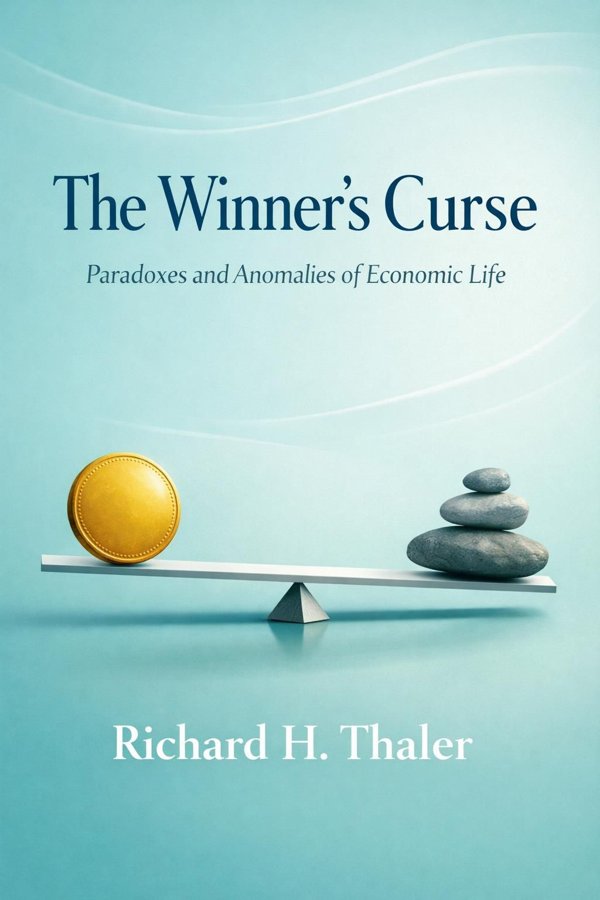
The Winner's Curse: Paradoxes and Anomalies of Economic Life: Summary & Key Insights
 10 min10 chaptersAudio available
Key Takeaways from The Winner's Curse: Paradoxes and Anomalies of Economic Life
The most important challenge in economics begins with an uncomfortable truth: people are not as rational, consistent, or self-controlled as classical theory assumes.
Success can be a warning sign.
Money is fungible in theory, but in practice people do not treat every dollar the same.
Markets do not operate in a moral vacuum.
People do not value objects neutrally; ownership itself changes perception.
What Is The Winner's Curse: Paradoxes and Anomalies of Economic Life About?
The Winner's Curse: Paradoxes and Anomalies of Economic Life by Richard H. Thaler is a economics book spanning 10 pages. Why do smart people make predictably bad economic decisions? Why do markets sometimes reward overconfidence, punish caution, and produce outcomes that look irrational in hindsight? In The Winner's Curse, Richard H. Thaler tackles these questions by examining the gap between elegant economic theory and messy human behavior. Rather than rejecting economics, he enriches it, showing how psychology explains many of the anomalies that standard models struggle to handle. Through vivid examples involving auctions, spending habits, investing, fairness, self-control, and everyday choice, Thaler demonstrates that people are not cold calculators. We use mental shortcuts, care deeply about reference points, dislike losses more than we value gains, and often judge outcomes through emotion as much as logic. These patterns are not random quirks; they are systematic, predictable, and economically important. The book matters because it helped lay the foundation for behavioral economics, a field that has transformed how we think about consumers, markets, public policy, and personal decision-making. Thaler writes not only as a gifted storyteller, but as one of the discipline's central architects. His insights remain essential for anyone who wants to understand how economic life actually works.
This FizzRead summary covers all 10 key chapters of The Winner's Curse: Paradoxes and Anomalies of Economic Life in approximately 10 minutes, distilling the most important ideas, arguments, and takeaways from Richard H. Thaler's work. Also available as an audio summary and Key Quotes Podcast.
The Winner's Curse: Paradoxes and Anomalies of Economic Life
Why do smart people make predictably bad economic decisions? Why do markets sometimes reward overconfidence, punish caution, and produce outcomes that look irrational in hindsight? In The Winner's Curse, Richard H. Thaler tackles these questions by examining the gap between elegant economic theory and messy human behavior. Rather than rejecting economics, he enriches it, showing how psychology explains many of the anomalies that standard models struggle to handle.
Through vivid examples involving auctions, spending habits, investing, fairness, self-control, and everyday choice, Thaler demonstrates that people are not cold calculators. We use mental shortcuts, care deeply about reference points, dislike losses more than we value gains, and often judge outcomes through emotion as much as logic. These patterns are not random quirks; they are systematic, predictable, and economically important.
The book matters because it helped lay the foundation for behavioral economics, a field that has transformed how we think about consumers, markets, public policy, and personal decision-making. Thaler writes not only as a gifted storyteller, but as one of the discipline's central architects. His insights remain essential for anyone who wants to understand how economic life actually works.
Who Should Read The Winner's Curse: Paradoxes and Anomalies of Economic Life?
This book is perfect for anyone interested in economics and looking to gain actionable insights in a short read. Whether you're a student, professional, or lifelong learner, the key ideas from The Winner's Curse: Paradoxes and Anomalies of Economic Life by Richard H. Thaler will help you think differently.
- ✓Readers who enjoy economics and want practical takeaways
- ✓Professionals looking to apply new ideas to their work and life
- ✓Anyone who wants the core insights of The Winner's Curse: Paradoxes and Anomalies of Economic Life in just 10 minutes
Want the full summary?
Get instant access to this book summary and 100K+ more with Fizz Moment.
Get Free SummaryAvailable on App Store • Free to download
Key Chapters
The most important challenge in economics begins with an uncomfortable truth: people are not as rational, consistent, or self-controlled as classical theory assumes. Traditional economics often relies on the image of an optimizing individual who has stable preferences, processes information correctly, and always chooses what maximizes long-term welfare. Thaler's project begins by asking what happens when this image collides with actual human behavior.
He shows that many so-called anomalies are not statistical noise or isolated mistakes. They are regular patterns. People procrastinate even when delay hurts them. They spend windfalls differently from earned income. They hold onto bad investments to avoid admitting defeat. They reject economically advantageous deals if the terms feel unfair. These choices do not fit the standard model well, yet they happen constantly in homes, firms, and financial markets.
Thaler's contribution is not to say that economics is useless, but that it is incomplete. By incorporating psychology, economics can better explain saving, spending, bargaining, pricing, and investing. This shift matters because policies and business strategies built on unrealistic assumptions often fail. A retirement plan that assumes people will calmly optimize contributions may underperform if workers procrastinate. A market forecast that assumes traders react objectively may miss waves of sentiment and overreaction.
In practice, this means managers, policymakers, and individuals should expect systematic bias rather than perfect calculation. If you are designing choices for yourself or others, build systems that account for inertia, emotion, and limited attention. The actionable takeaway: stop asking how perfectly rational people should behave, and start asking how real people actually decide.
Success can be a warning sign. That is the paradox at the heart of the winner's curse, one of Thaler's most famous contributions. In auctions or competitive bidding situations where the true value of an asset is uncertain, the winner is often the person with the most optimistic estimate. If all bidders are making imperfect guesses, the highest bid is likely to be an overestimate. Winning, in that case, means overpaying.
Thaler uses this idea to challenge the comforting belief that markets always aggregate information efficiently. In many real settings, participants are not merely revealing knowledge; they are also revealing overconfidence, poor judgment, and failure to adjust for uncertainty. The problem is especially severe in common-value auctions, such as oil leases, mineral rights, or spectrum sales, where the item has roughly the same underlying value for everyone but estimates differ.
The winner's curse extends beyond formal auctions. A company that aggressively acquires another firm may later discover it paid too much because competitors declined to match the bid. A job candidate who accepts the first unusually generous offer may wonder whether expectations are unrealistic. Investors chasing the hottest asset may be the ones buying at the top.
The lesson is not to avoid competition, but to bid with humility. Skilled participants adjust downward to account for the fact that winning itself contains information. If you are in a contest with uncertain value, ask what it means if everyone else walked away. The actionable takeaway: whenever you win a deal under uncertainty, pause and recalculate whether victory reflects insight or overestimation.
Money is fungible in theory, but in practice people do not treat every dollar the same. Thaler's idea of mental accounting explains how we create informal budgets in our minds, assigning money to categories such as rent, entertainment, savings, or vacation. This mental bookkeeping can be useful, but it also produces irrational and costly choices.
For example, someone may splurge with a tax refund while refusing to touch money in a savings account, even though both belong to the same household balance sheet. A person might drive across town to save ten dollars on a small purchase but ignore a much larger inefficiency in a major contract. Investors often keep separate mental accounts for gains and losses, making them more willing to take risks in one area while remaining overly conservative in another.
Mental accounting also helps explain why people value windfalls differently from earned income. Casino winnings, bonuses, and gifts often feel like "extra" money, so they are spent more freely. Businesses use this tendency all the time through gift cards, store credits, and loyalty points, which consumers often treat as less real than cash. Governments and employers can use the same insight more constructively by earmarking tax refunds or payroll deductions for savings goals.
The larger point is that mental accounting simplifies life, but simplification has side effects. It can encourage discipline, yet it can also hide the true opportunity cost of decisions. A family may feel prudent by preserving a college fund while carrying high-interest credit card debt.
The actionable takeaway: use mental accounts intentionally, but regularly step back and review your finances as one integrated system rather than a collection of emotionally labeled buckets.
Markets do not operate in a moral vacuum. One of Thaler's most influential insights is that people care about fairness, even when standard economics says they should focus only on outcomes. Consumers, workers, and citizens routinely judge transactions not just by what they receive, but by whether the process and motive feel just.
This helps explain why people may reject a profitable offer if it seems exploitative. A customer may accept a price increase caused by higher supplier costs but resent the same increase if it appears to take advantage of a snowstorm or emergency. Employees may tolerate lower bonuses in a bad year but feel outraged if executives reward themselves while asking everyone else to sacrifice. Traditional models often interpret these reactions as irrational, yet they are both widespread and predictable.
Fairness norms influence wages, pricing, negotiations, and regulation. Firms that violate these expectations may gain in the short run but damage trust, morale, and customer loyalty. On the other hand, leaders who understand fairness can design policies that people are more willing to accept. This is one reason transparent communication matters. People are more accepting of difficult decisions when they perceive shared burden and honest reasoning.
Thaler shows that economic behavior is embedded in social expectations. A technically efficient policy can still fail if it offends widely held fairness norms. Likewise, a business strategy that maximizes immediate profit may provoke backlash if customers feel manipulated.
The actionable takeaway: before evaluating a decision purely by price or efficiency, ask how the people affected will judge its fairness. In many real-world settings, perceived legitimacy is as valuable as the transaction itself.
People do not value objects neutrally; ownership itself changes perception. Thaler explores the endowment effect, the tendency for people to demand more to give up something they own than they would have been willing to pay to acquire it. This asymmetry reveals a powerful feature of human psychology: losses loom larger than gains.
If you own a coffee mug, selling it can feel like giving something up, not merely exchanging one asset for another. That sense of loss raises your valuation. Similarly, homeowners often overprice their houses because they are comparing the sale not to market conditions, but to the pain of surrendering a familiar possession. Investors cling to losing stocks because selling turns a paper loss into a psychologically real one.
Loss aversion helps explain many economic behaviors. Consumers resist price increases more strongly than they celebrate equivalent discounts. Workers perceive nominal pay cuts as painful, even if inflation is already reducing real wages. Companies know this, which is why they often prefer to remove discounts quietly rather than announce direct hikes. Policymakers must also account for it when introducing reforms: people often fight to keep existing benefits even when alternative arrangements are objectively similar.
The key insight is that preferences are reference-dependent. We judge outcomes relative to what we have, what we expect, or what we believe we deserve. This makes human valuation more emotional and context-bound than standard theory assumes.
The actionable takeaway: when you feel unusually attached to keeping what you already have, ask whether you truly value it that highly or whether you are reacting to the pain of loss rather than the item's actual worth.
Some of our biggest economic failures are not caused by ignorance, but by conflict within the self. Thaler emphasizes that people often have one set of preferences for the future and another for the present. We plan to save more, eat better, study earlier, and avoid impulse purchases, yet when the decisive moment arrives, immediate temptation wins.
This insight challenges the idea that observed choices always reveal true preferences. If someone repeatedly fails to save for retirement, does that mean they do not care about the future? Not necessarily. It may mean that the short-term self continually overrules the long-term self. Recognizing this helps explain why people seek commitment devices, from Christmas savings clubs to automatic payroll deductions and apps that block distracting websites.
Thaler's framing of self-control is economically important because it changes how institutions should be designed. A pension system that requires active enrollment will miss many workers who fully intend to join later. A cafeteria that places healthy food at eye level may improve choices without coercion. Credit products, subscriptions, and online platforms often exploit self-control problems by making spending frictionless and cancellation difficult.
The broader lesson is that freedom alone does not guarantee good outcomes. People often benefit from structures that align immediate behavior with long-term goals. This is not paternalism in the crude sense; it is recognition of how human motivation actually works.
The actionable takeaway: do not rely solely on willpower. Create rules, defaults, and barriers that make your better long-term choice easier at the moment when temptation is strongest.
Household financial behavior often looks like a collection of contradictions. People carry expensive credit card debt while keeping money in low-yield savings accounts. They celebrate rebates as gains while ignoring recurring fees that cost more over time. They consume too much during windfalls and too little when they would benefit from smoothing spending across periods. Thaler uses these anomalies to show that real consumption decisions are shaped by psychology, not just income and interest rates.
One reason is that people do not treat all resources as interchangeable. Current income, assets, and future income are often handled differently, even when basic economic logic suggests they should be integrated. Another reason is framing. A bonus may be viewed as spendable fun money, while regular wages are treated as serious money for bills. Consumers also anchor on nominal amounts, underreact to gradual costs, and avoid painful acts such as confronting debt.
These patterns matter for both personal finance and public policy. Tax cuts, stimulus payments, and retirement incentives can have very different effects depending on how households mentally categorize them. Financial products that seem attractive on paper may fail if they require too much discipline or too much active optimization. Advice that simply tells people to be more rational usually falls flat because it ignores the structure of actual decision-making.
Thaler's work suggests that better saving behavior comes from redesigning choice environments, not just delivering lectures on prudence. Automatic escalation in retirement plans, emergency savings buckets, and debt repayment automation all help by reducing reliance on fragile self-control.
The actionable takeaway: if your financial life feels inconsistent, stop blaming character alone and start redesigning your system so saving and spending decisions happen with less friction and fewer temptations.
Financial markets are often presented as arenas of pure rationality, but Thaler shows that investor behavior is shaped by the same biases found in everyday life. Overconfidence, loss aversion, mental accounting, and framing do not disappear when people buy stocks. In many cases, large sums of money only magnify them.
Investors tend to chase recent winners, extrapolating trends too far into the future. They may hold losing investments too long because selling would force them to admit a mistake, while selling winners too early to lock in gains. They react strongly to narratives, headlines, and vivid events, even when the underlying information is weak. Professional expertise offers some protection, but it does not eliminate bias. Market participants remain social, emotional, and status-conscious.
These tendencies can produce anomalies that standard efficient-market thinking struggles to explain, such as excessive volatility, reversals, momentum, and persistent mispricing. Thaler does not claim markets are always wildly irrational. Rather, he shows that the path to prices is filtered through human psychology. Limits to arbitrage mean even sophisticated traders may be unable or unwilling to correct mispricing immediately.
For ordinary investors, this perspective is liberating as well as cautionary. It suggests that many investing mistakes are predictable, which means they can be guarded against. Rules-based investing, diversification, long holding periods, and precommitment can reduce the damage caused by emotional reactions.
The actionable takeaway: treat investing as a domain where your psychology is part of the risk. Build a process that protects you from chasing excitement, denying losses, and confusing confidence with skill.
The same decision can produce different choices depending on how it is presented. Thaler highlights framing as a central reason economic behavior often departs from the textbook model. If preferences were fully stable and context-free, equivalent descriptions would lead to equivalent decisions. In reality, wording, defaults, comparisons, and presentation can shift what people notice, fear, and prefer.
A medical treatment described in terms of survival rates may feel more attractive than one described in terms of mortality, even when the numbers are identical. A discount framed as avoiding a loss can be more powerful than one framed as securing a gain. Consumers are also influenced by reference prices, menu structure, and the presence of decoy options that make one alternative seem superior.
Framing matters in public policy, business, and personal life. Employers can dramatically increase retirement participation simply by making enrollment the default rather than an active choice. Governments can improve tax compliance or organ donation rates by changing forms and wording. Retailers can steer customers toward premium products by arranging options strategically. None of this works because people are foolish in a simple sense; it works because attention is limited and judgments are comparative.
The deeper lesson is that preferences are often constructed in the moment rather than fully formed in advance. Understanding this can make us more cautious both as decision-makers and as designers of decisions.
The actionable takeaway: whenever a choice feels obvious, reframe it at least once. Ask how your preference might change if the same options were presented as gains versus losses, defaults versus active choices, or percentages versus absolute amounts.
If human behavior is predictably imperfect, then economic policy should be designed for actual people rather than imaginary optimizers. This is one of the most practical implications of Thaler's work. The anomalies he documents are not academic curiosities. They affect retirement security, consumer protection, taxation, health, education, and market regulation.
A policy built on the assumption that people carefully compare every option and act instantly on their best interests will often disappoint. Citizens procrastinate, ignore complexity, stick with defaults, and respond strongly to presentation. Behavioral evidence therefore supports policies that simplify decisions, improve defaults, enhance transparency, and protect against exploitation without unnecessarily restricting freedom.
This perspective later became associated with ideas such as choice architecture and nudging, but the foundation is already visible here. If workers intend to save but fail to enroll, automatic enrollment is smarter than repeated reminders. If borrowers underestimate future repayment burdens, clearer disclosures and product design rules may matter more than abstract financial education. If fairness concerns affect compliance and trust, then legitimacy and communication should be treated as economic variables, not public-relations afterthoughts.
Importantly, behavioral policy is not about assuming people are helpless. It is about recognizing patterns in real behavior and using institutions to help people achieve their own goals more effectively. Good design can preserve choice while reducing predictable mistakes.
The actionable takeaway: when evaluating any policy or system, ask not whether it works for an idealized rational actor, but whether it works for distracted, emotional, habit-driven people living in the real world.
All Chapters in The Winner's Curse: Paradoxes and Anomalies of Economic Life
About the Author
Richard H. Thaler is an American economist widely regarded as one of the founders of behavioral economics, the field that integrates insights from psychology into the study of economic decision-making. He served as a professor at the University of Chicago Booth School of Business, where his work challenged the traditional assumption that people always act rationally in markets. Thaler introduced and developed influential concepts such as mental accounting, the endowment effect, self-control problems, and choice architecture. His research has had a major impact not only on academic economics, but also on finance, business strategy, and public policy. In 2017, he was awarded the Nobel Prize in Economic Sciences for his contributions to understanding how human behavior systematically shapes economic outcomes.
Get This Summary in Your Preferred Format
Read or listen to the The Winner's Curse: Paradoxes and Anomalies of Economic Life summary by Richard H. Thaler anytime, anywhere. FizzRead offers multiple formats so you can learn on your terms — all free.
Available formats: App · Audio · PDF · EPUB — All included free with FizzRead
Download The Winner's Curse: Paradoxes and Anomalies of Economic Life PDF and EPUB Summary
Key Quotes from The Winner's Curse: Paradoxes and Anomalies of Economic Life
“The most important challenge in economics begins with an uncomfortable truth: people are not as rational, consistent, or self-controlled as classical theory assumes.”
“That is the paradox at the heart of the winner's curse, one of Thaler's most famous contributions.”
“Money is fungible in theory, but in practice people do not treat every dollar the same.”
“Markets do not operate in a moral vacuum.”
“People do not value objects neutrally; ownership itself changes perception.”
Frequently Asked Questions about The Winner's Curse: Paradoxes and Anomalies of Economic Life
The Winner's Curse: Paradoxes and Anomalies of Economic Life by Richard H. Thaler is a economics book that explores key ideas across 10 chapters. Why do smart people make predictably bad economic decisions? Why do markets sometimes reward overconfidence, punish caution, and produce outcomes that look irrational in hindsight? In The Winner's Curse, Richard H. Thaler tackles these questions by examining the gap between elegant economic theory and messy human behavior. Rather than rejecting economics, he enriches it, showing how psychology explains many of the anomalies that standard models struggle to handle. Through vivid examples involving auctions, spending habits, investing, fairness, self-control, and everyday choice, Thaler demonstrates that people are not cold calculators. We use mental shortcuts, care deeply about reference points, dislike losses more than we value gains, and often judge outcomes through emotion as much as logic. These patterns are not random quirks; they are systematic, predictable, and economically important. The book matters because it helped lay the foundation for behavioral economics, a field that has transformed how we think about consumers, markets, public policy, and personal decision-making. Thaler writes not only as a gifted storyteller, but as one of the discipline's central architects. His insights remain essential for anyone who wants to understand how economic life actually works.
More by Richard H. Thaler
You Might Also Like
Business Adventures
John Brooks
10 min
Nudge
Richard H. Thaler, Cass R. Sunstein
10 min
The Hitchhiker"s Guide to the Galaxy
Douglas Adams
10 minThe Muqaddimah
Ibn Khaldun
10 minThe Outsiders
William N. Thorndike
10 min
A Little History of Economics
Niall Kishtainy
10 minBrowse by Category
Ready to read The Winner's Curse: Paradoxes and Anomalies of Economic Life?
Get the full summary and 100K+ more books with Fizz Moment.