
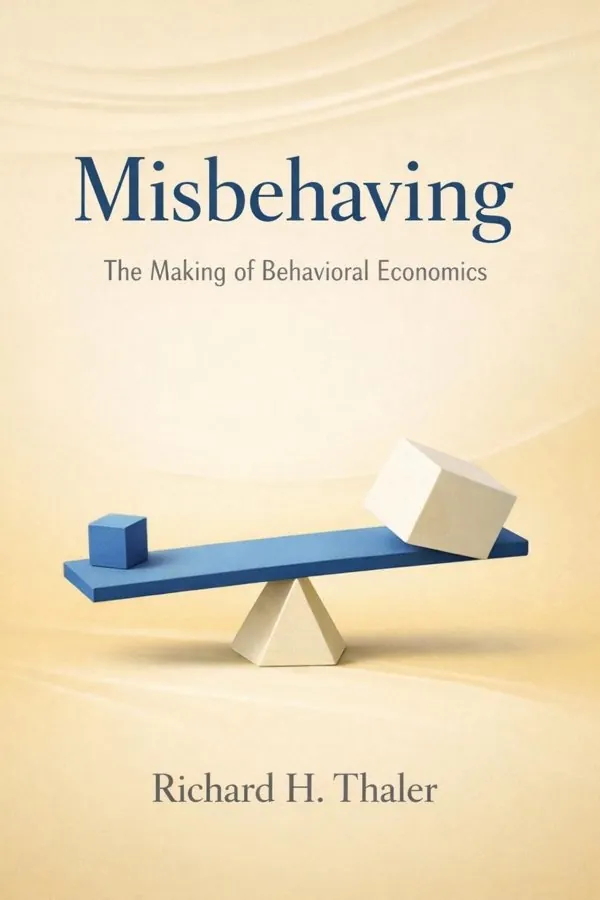
Misbehaving: The Making of Behavioral Economics: Summary & Key Insights
 10 min10 chaptersAudio available
Key Takeaways from Misbehaving: The Making of Behavioral Economics
The most powerful revolutions often begin with a simple question: what if the basic model is wrong?
Progress in science often starts with small embarrassments.
A field changes when it borrows a better lens.
New ideas rarely arrive as polished systems; they emerge from scattered insights that eventually cohere.
One of the boldest claims in economics is that markets are efficient, meaning prices generally reflect all available information.
What Is Misbehaving: The Making of Behavioral Economics About?
Misbehaving: The Making of Behavioral Economics by Richard H. Thaler is a economics book spanning 10 pages. What if the biggest flaw in economics was its view of human nature? In Misbehaving, Richard H. Thaler tells the lively, deeply personal story of how behavioral economics emerged by challenging one of the discipline’s most cherished assumptions: that people make consistently rational decisions. Instead of treating humans as flawless calculators, Thaler shows that real people are impulsive, emotional, inconsistent, and influenced by context—and that these “misbehaviors” are not random noise, but predictable patterns. Through entertaining anecdotes, landmark experiments, and professional battles with orthodox economists, he explains how insights from psychology transformed economics, finance, and public policy. The book matters because it helps readers understand why markets can misfire, why people save too little, overspend too much, and make choices they later regret. It also shows how better systems can be designed to help people make better decisions without removing freedom. Thaler writes with unusual authority: as a pioneering economist, longtime University of Chicago professor, and Nobel Prize winner, he didn’t just document the rise of behavioral economics—he helped create it.
This FizzRead summary covers all 10 key chapters of Misbehaving: The Making of Behavioral Economics in approximately 10 minutes, distilling the most important ideas, arguments, and takeaways from Richard H. Thaler's work. Also available as an audio summary and Key Quotes Podcast.
Misbehaving: The Making of Behavioral Economics
What if the biggest flaw in economics was its view of human nature? In Misbehaving, Richard H. Thaler tells the lively, deeply personal story of how behavioral economics emerged by challenging one of the discipline’s most cherished assumptions: that people make consistently rational decisions. Instead of treating humans as flawless calculators, Thaler shows that real people are impulsive, emotional, inconsistent, and influenced by context—and that these “misbehaviors” are not random noise, but predictable patterns. Through entertaining anecdotes, landmark experiments, and professional battles with orthodox economists, he explains how insights from psychology transformed economics, finance, and public policy. The book matters because it helps readers understand why markets can misfire, why people save too little, overspend too much, and make choices they later regret. It also shows how better systems can be designed to help people make better decisions without removing freedom. Thaler writes with unusual authority: as a pioneering economist, longtime University of Chicago professor, and Nobel Prize winner, he didn’t just document the rise of behavioral economics—he helped create it.
Who Should Read Misbehaving: The Making of Behavioral Economics?
This book is perfect for anyone interested in economics and looking to gain actionable insights in a short read. Whether you're a student, professional, or lifelong learner, the key ideas from Misbehaving: The Making of Behavioral Economics by Richard H. Thaler will help you think differently.
- ✓Readers who enjoy economics and want practical takeaways
- ✓Professionals looking to apply new ideas to their work and life
- ✓Anyone who wants the core insights of Misbehaving: The Making of Behavioral Economics in just 10 minutes
Want the full summary?
Get instant access to this book summary and 100K+ more with Fizz Moment.
Get Free SummaryAvailable on App Store • Free to download
Key Chapters
The most powerful revolutions often begin with a simple question: what if the basic model is wrong? Traditional economics was built around Homo economicus, a fictional being who always has stable preferences, perfect self-control, and the ability to calculate the best possible choice in every situation. This model is elegant, mathematically convenient, and useful in some cases—but Thaler argues it is a poor description of how actual humans behave.
Real people forget, procrastinate, get tempted, overreact to losses, and care about fairness even when it reduces their own material gain. They use mental shortcuts because life is complex and time is limited. They frame the same decision differently depending on context. In other words, humans are not defective versions of rational agents; they are a different species altogether. That difference matters because policies, business strategies, and financial models built on unrealistic assumptions can fail in predictable ways.
Thaler’s contribution was not simply to mock old economics, but to show where the rational model works and where it breaks down. A person might compare mortgage rates carefully yet still leave free retirement matching money on the table. A shopper may drive across town to save $10 on a toaster but not to save $10 on a television. These choices make sense psychologically even when they look irrational mathematically.
The practical lesson is straightforward: whenever you make plans—whether for investing, pricing, saving, or designing products—assume you are dealing with humans, not idealized calculators. Build systems that expect error, emotion, and inconsistency rather than pretending they do not exist.
Progress in science often starts with small embarrassments. Thaler’s journey began by collecting what economists called anomalies: recurring cases where actual behavior did not match theoretical predictions. Traditional economists often treated these episodes as minor exceptions. Thaler treated them as clues.
One famous example is the endowment effect. People tend to value something more once they own it than before they acquire it. In theory, willingness to pay and willingness to accept should be roughly similar. In practice, someone who would pay $5 for a mug may demand $10 to give up that same mug once it is theirs. Ownership changes perceived value. Another anomaly is mental accounting, where people separate money into artificial categories. A person may splurge with a tax refund while carrying credit card debt, even though money is fungible in economic theory.
These are not isolated mistakes. They reveal stable psychological tendencies: loss aversion, reference points, and the desire to simplify decisions. Taxi drivers, for example, may stop early on high-demand days because they reach a daily earnings target, even though working longer when demand is high would maximize income. Investors may hold losing stocks too long because selling crystallizes a painful loss.
Thaler’s genius was to see that anomalies were not annoyances to be explained away; they were evidence that the core theory needed revision. For managers, policymakers, and everyday readers, this mindset is invaluable. Instead of dismissing surprising behavior as irrational nonsense, ask what pattern it reveals. The actionable takeaway: start a personal or professional “anomaly list.” When people repeatedly act against your model, do not blame the people first—question the model.
A field changes when it borrows a better lens. Behavioral economics took shape when Thaler and others began integrating insights from psychology, especially the work of Daniel Kahneman and Amos Tversky. Their research showed that people do not process information like emotionless computers. Instead, they rely on heuristics—fast mental rules of thumb—that are often useful but sometimes systematically biased.
This collaboration mattered because psychology offered mechanisms for the anomalies economists kept observing. Prospect theory, for instance, explained why losses loom larger than gains. People dislike losing $100 more than they enjoy gaining $100. That asymmetry helps explain risk aversion in some contexts and risk seeking in others. It also explains why framing matters so much. A medical treatment described as having a 90% survival rate feels different from one described as having a 10% mortality rate, even though the statistics are identical.
Psychology also illuminated self-control problems. Many people intend to diet, save, exercise, or quit smoking, then fail when temptation appears. Standard economics struggles with this inconsistency because it assumes stable, coherent preferences. Behavioral economics accepts that the “planner” and the “doer” inside the same person may want different things.
In practical settings, this insight changes everything. Marketers can exploit biases, but leaders and policymakers can also protect people from predictable errors. Presenting costs clearly, reducing choice overload, and using helpful defaults can improve decisions without coercion.
The key takeaway is to treat decision-making as a psychological process, not just a mathematical one. If you want to understand behavior—or influence it ethically—study not only incentives, but attention, emotion, framing, and self-control.
New ideas rarely arrive as polished systems; they emerge from scattered insights that eventually cohere. In Misbehaving, Thaler shows how behavioral economics developed from an outsider critique into a legitimate field. Early on, he and his allies were not offering a full replacement for economics. They were highlighting repeated mismatches between theory and reality. Over time, these observations accumulated into a powerful alternative approach.
What made behavioral economics distinct was not a rejection of economics itself, but a more realistic foundation for it. It preserved the economist’s interest in incentives, trade-offs, and markets while adding a richer account of human judgment and behavior. Instead of assuming away mistakes, it studied them. Instead of expecting preferences to be stable and context-free, it examined how choices are shaped by defaults, social norms, and framing.
The field gained momentum because it proved useful. It explained consumer behavior more accurately, helped decode financial bubbles and trading patterns, and offered practical tools for improving savings, health, and public policy. Importantly, behavioral economics also changed the tone of economic inquiry. It invited humility. If experts and ordinary people are both prone to bias, then institutions must be designed with human limits in mind.
For readers, the rise of behavioral economics offers a broader lesson about innovation. Big intellectual shifts often come not from one grand theory but from patiently documenting where old theories fail. The actionable takeaway: if you are trying to improve a system—at work, in government, or in your own life—do not wait for perfect models. Start by identifying recurring friction points where human behavior resists your assumptions. Those friction points often reveal the path to better design.
One of the boldest claims in economics is that markets are efficient, meaning prices generally reflect all available information. Thaler does not deny that markets can be impressively smart, but he shows they are not infallible—especially when humans, not robots, do the trading. If investors are subject to overconfidence, herd behavior, loss aversion, and limited attention, then prices can drift away from fundamentals for long periods.
Behavioral finance emerged from this insight. Traditional finance models assume investors process information rationally and arbitrage away mistakes. But in reality, even sophisticated investors face constraints, career risk, and emotional pressures. A fund manager may recognize a bubble yet hesitate to bet against it too early. Individual investors chase past performance, panic during downturns, and mentally separate gains and losses in ways that distort judgment.
Thaler points to patterns such as the equity premium puzzle, excessive trading, and the tendency of investors to sell winners too soon while holding losers too long. These are not random quirks; they are systematic behaviors. The practical consequences are enormous. Mispricing can create risk, but it can also create opportunity for disciplined investors who understand human tendencies.
For ordinary readers, the lesson is not that markets are easy to beat. It is that your greatest investing risk may be your own behavior. Chasing hot stocks, reacting emotionally to headlines, or treating short-term losses as personal failures can damage long-term returns.
The actionable takeaway: create rules before emotions take over. Automate contributions, diversify broadly, limit unnecessary trading, and judge decisions by process rather than by recent outcomes.
Economics long assumed that people care primarily about maximizing their own material payoff. Yet one of behavioral economics’ most revealing discoveries is that people also care deeply about fairness. They are willing to reject profitable offers, punish unfair behavior, and reward generosity—even when doing so costs them money.
This matters because fairness is not a soft moral side issue; it is an economic force. In experiments like the ultimatum game, people often refuse low but positive offers because the split feels insulting. In workplaces, employees compare their pay not only to market rates but to peers, expectations, and perceived respect. Consumers react strongly to “unfair” price increases, even if those increases make sense from a textbook supply-and-demand perspective. A hardware store raising snow shovel prices after a blizzard may maximize profit, but customers often see it as exploitation.
Thaler’s point is that markets operate inside social norms. Companies that ignore fairness can provoke backlash, damage trust, and lose loyalty. Managers who focus only on incentives may misunderstand motivation. Public policy that appears efficient on paper may fail if people see it as illegitimate or one-sided.
In everyday life, fairness shapes negotiations, family decisions, and community cooperation. People accept sacrifices more readily when rules are transparent and burdens are shared.
The actionable takeaway: when making decisions that affect others—pricing, compensation, policies, or negotiations—ask not only “Is this efficient?” but also “Will this feel fair?” Long-term cooperation often depends as much on perceived justice as on immediate gain.
People do not treat all dollars equally, even though economics says they should. Thaler’s concept of mental accounting explains how we divide money into separate psychological buckets—rent money, vacation money, bonus money, gambling winnings, emergency savings—even though each dollar has the same objective value. This mental bookkeeping helps simplify life, but it also creates predictable mistakes.
Consider a person who receives a tax refund and uses it for a luxury purchase while simultaneously carrying high-interest credit card debt. From a strictly rational perspective, the refund should go toward the debt. But psychologically, the refund feels like “extra money,” not part of the regular budget. Similarly, someone may refuse to buy theater tickets after losing a prepaid ticket, yet happily buy one after losing an equivalent amount of cash. The financial loss is the same, but the mental account differs.
Mental accounting also explains why people are more willing to spend small windfalls than hard-earned wages, why they evaluate investments one by one rather than as a portfolio, and why budgeting apps can sometimes improve behavior simply by making categories visible.
This idea is useful because it can be harnessed, not just criticized. Separate savings accounts for travel, taxes, or emergencies can support discipline. Employers can frame retirement contributions as future-pay protection rather than present-pay loss. Households can create “fun money” accounts to enjoy spending without guilt.
The actionable takeaway: examine the mental labels you place on money. Use them intentionally. Create categories that support your goals, but periodically step back and ask whether your financial buckets are helping you make better decisions—or quietly leading you astray.
Small design choices can produce big behavioral consequences. One of Thaler’s most influential ideas is that people’s decisions are heavily shaped by the environments in which they choose. This is called choice architecture. Because humans are busy, distracted, and prone to inertia, details such as defaults, ordering, wording, and timing can dramatically affect outcomes.
The classic example is retirement savings. When employees must actively sign up for a pension plan, many delay enrollment even when it is clearly in their interest. But when enrollment is automatic and workers must opt out instead of opt in, participation rises sharply. The options are the same, freedom is preserved, yet the default changes behavior. Similar effects appear in organ donation, subscription renewals, food placement in cafeterias, and digital privacy settings.
Thaler argues that because some choice architecture is unavoidable, the real question is not whether to influence decisions, but whether to do so well and ethically. Good choice architecture makes beneficial behavior easier without banning alternatives. It reduces friction, clarifies trade-offs, and anticipates common mistakes.
For organizations, this can mean simplifying forms, highlighting total costs, or sequencing options to reduce confusion. For individuals, it means designing your own environment: placing healthy food at eye level, using automatic transfers to savings, or turning off distracting notifications.
The actionable takeaway: stop relying only on willpower. Redesign the decision environment around you. When a good habit requires less effort than a bad one, better choices become far more likely.
Helping people does not always require forcing them. A central implication of Thaler’s work is the idea of the nudge: a subtle intervention that steers behavior in a beneficial direction while preserving freedom of choice. Nudges are grounded in the recognition that people often want good outcomes—more savings, better health, fewer mistakes—but struggle with procrastination, confusion, or inattention.
Examples are everywhere. Sending reminders before appointments reduces missed visits. Displaying calorie information prominently can influence food choices. Reframing tax messages to note that most people pay on time can improve compliance through social norms. Save More Tomorrow, a program Thaler helped develop, allows employees to commit in advance to increasing retirement contributions when future pay raises arrive. This overcomes present bias because the sacrifice feels smaller in the future than it does now.
Critics worry that nudges can be manipulative. Thaler’s response is that influence is inevitable: forms must be designed, options must be ordered, defaults must be set. The ethical responsibility is to make these structures transparent and aligned with people’s long-term interests, not to pretend neutrality exists.
For readers, the deeper lesson is empowering. You can nudge yourself by creating commitment devices, reminders, automatic rules, and social accountability. You can also evaluate when others are nudging you—toward impulse buying, endless scrolling, or inertia.
The actionable takeaway: use nudges deliberately. Build systems that make your preferred future behavior the path of least resistance, while keeping your freedom to choose differently when it truly matters.
Intellectual change is rarely smooth, especially when it threatens a beautiful theory. Thaler recounts how behavioral economics faced skepticism, dismissal, and sometimes outright hostility from traditional economists. Many critics saw the field as a collection of curiosities rather than a serious challenge to established models. Some defended the rational framework because of its simplicity and predictive usefulness. Others resisted because academic disciplines, like people, are slow to abandon familiar habits.
This resistance is one of the book’s most human elements. Misbehaving is not just about theories; it is about the sociology of ideas. Thaler describes debates, collaborations, rivalries, and moments when seemingly marginal findings slowly gained legitimacy. The lesson is not that orthodox economists were foolish. In many contexts, rational models remain useful approximations. The problem arises when elegance becomes dogma and anomalies are ignored because they are inconvenient.
Behavioral economics eventually gained ground because it generated better explanations and practical applications. Its success in finance, policy, and organizational design made it harder to dismiss. But Thaler’s story is also a reminder that progress often depends on persistence, humor, and a willingness to keep presenting evidence when institutions are reluctant to listen.
For anyone trying to introduce new ideas in business, science, or public life, this is highly relevant. People rarely reject innovation only because it is wrong; they often reject it because it disrupts identities, incentives, and status hierarchies.
The actionable takeaway: when evidence challenges a dominant model, stay curious and patient. Test your ideas rigorously, communicate them clearly, and expect resistance—not as proof you are wrong, but as part of how real change happens.
All Chapters in Misbehaving: The Making of Behavioral Economics
About the Author
Richard H. Thaler is an American economist and one of the founding figures of behavioral economics, the field that blends psychology with economics to explain how people actually make decisions. He has spent much of his academic career at the University of Chicago Booth School of Business, where he helped challenge the traditional assumption that individuals are fully rational actors. Thaler is known for influential ideas including mental accounting, the endowment effect, self-control problems, and choice architecture. His work has shaped research in finance, public policy, and organizational behavior, and reached a broad audience through his writing, including the bestselling book Nudge, co-authored with Cass Sunstein. In 2017, he received the Nobel Memorial Prize in Economic Sciences for his pioneering contributions to behavioral economics.
Get This Summary in Your Preferred Format
Read or listen to the Misbehaving: The Making of Behavioral Economics summary by Richard H. Thaler anytime, anywhere. FizzRead offers multiple formats so you can learn on your terms — all free.
Available formats: App · Audio · PDF · EPUB — All included free with FizzRead
Download Misbehaving: The Making of Behavioral Economics PDF and EPUB Summary
Key Quotes from Misbehaving: The Making of Behavioral Economics
“The most powerful revolutions often begin with a simple question: what if the basic model is wrong?”
“Progress in science often starts with small embarrassments.”
“A field changes when it borrows a better lens.”
“New ideas rarely arrive as polished systems; they emerge from scattered insights that eventually cohere.”
“One of the boldest claims in economics is that markets are efficient, meaning prices generally reflect all available information.”
Frequently Asked Questions about Misbehaving: The Making of Behavioral Economics
Misbehaving: The Making of Behavioral Economics by Richard H. Thaler is a economics book that explores key ideas across 10 chapters. What if the biggest flaw in economics was its view of human nature? In Misbehaving, Richard H. Thaler tells the lively, deeply personal story of how behavioral economics emerged by challenging one of the discipline’s most cherished assumptions: that people make consistently rational decisions. Instead of treating humans as flawless calculators, Thaler shows that real people are impulsive, emotional, inconsistent, and influenced by context—and that these “misbehaviors” are not random noise, but predictable patterns. Through entertaining anecdotes, landmark experiments, and professional battles with orthodox economists, he explains how insights from psychology transformed economics, finance, and public policy. The book matters because it helps readers understand why markets can misfire, why people save too little, overspend too much, and make choices they later regret. It also shows how better systems can be designed to help people make better decisions without removing freedom. Thaler writes with unusual authority: as a pioneering economist, longtime University of Chicago professor, and Nobel Prize winner, he didn’t just document the rise of behavioral economics—he helped create it.
More by Richard H. Thaler
You Might Also Like

Business Adventures
John Brooks
10 min
Nudge
Richard H. Thaler, Cass R. Sunstein
10 min
The Hitchhiker"s Guide to the Galaxy
Douglas Adams
10 minThe Muqaddimah
Ibn Khaldun
10 minThe Outsiders
William N. Thorndike
10 min
A Little History of Economics
Niall Kishtainy
10 minBrowse by Category
Ready to read Misbehaving: The Making of Behavioral Economics?
Get the full summary and 100K+ more books with Fizz Moment.