
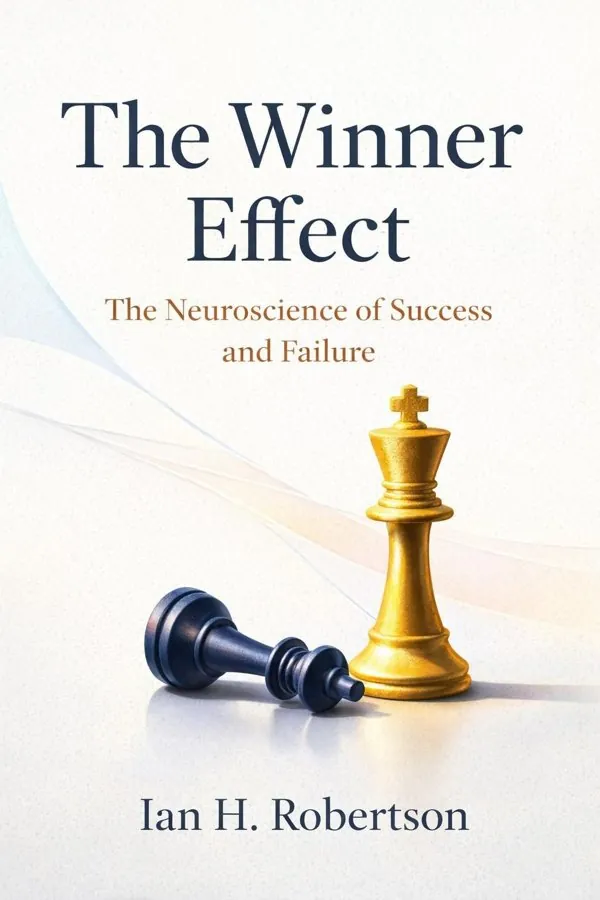
The Winner Effect: The Neuroscience of Success and Failure: Summary & Key Insights
 10 min4 chaptersAudio available
What Is The Winner Effect: The Neuroscience of Success and Failure About?
The Winner Effect: The Neuroscience of Success and Failure by Ian H. Robertson is a neuroscience book spanning 4 pages. In this book, Ian Robertson explores how success changes the brain and behavior, revealing the neuroscience behind winning and losing. He explains how power and achievement can alter dopamine levels, confidence, and decision-making, offering insights into how individuals and societies can harness these effects for better outcomes.
This FizzRead summary covers all 4 key chapters of The Winner Effect: The Neuroscience of Success and Failure in approximately 10 minutes, distilling the most important ideas, arguments, and takeaways from Ian H. Robertson's work. Also available as an audio summary and Key Quotes Podcast.
The Winner Effect: The Neuroscience of Success and Failure
In this book, Ian Robertson explores how success changes the brain and behavior, revealing the neuroscience behind winning and losing. He explains how power and achievement can alter dopamine levels, confidence, and decision-making, offering insights into how individuals and societies can harness these effects for better outcomes.
Who Should Read The Winner Effect: The Neuroscience of Success and Failure?
This book is perfect for anyone interested in neuroscience and looking to gain actionable insights in a short read. Whether you're a student, professional, or lifelong learner, the key ideas from The Winner Effect: The Neuroscience of Success and Failure by Ian H. Robertson will help you think differently.
- ✓Readers who enjoy neuroscience and want practical takeaways
- ✓Professionals looking to apply new ideas to their work and life
- ✓Anyone who wants the core insights of The Winner Effect: The Neuroscience of Success and Failure in just 10 minutes
Want the full summary?
Get instant access to this book summary and 100K+ more with Fizz Moment.
Get Free SummaryAvailable on App Store • Free to download
Key Chapters
Every success releases dopamine in the brain’s reward system: the nucleus accumbens, prefrontal cortex, and ventral tegmental area all participate in this biochemical celebration. Dopamine is more than the molecule of pleasure—it is the signal of motivation, anticipation, and learning. When an animal wins a fight, or when a person succeeds in a competition or career milestone, dopamine reinforces the circuits that created the winning behavior. It strengthens confidence, sharpens focus, and enhances creativity. But the real magic of dopamine lies in its predictive power: it teaches the brain to expect pleasure from effort, creating a cycle of striving.
As victories accumulate, dopamine transports a sensation of control. Yet control itself is intoxicating. In laboratory studies of mice and fish, we see how repeated victories change their behavior—dominant individuals become more aggressive, more willing to take risks, and often more successful again simply because their brains now expect dominance to be natural. Translating that to humans, we find that the same mechanisms operate in business leaders and politicians: their successes prime their brains for confidence, sometimes to the point of blindness to danger.
Dopamine also interacts with testosterone, creating a synergy that deepens the physiological winner effect. Higher testosterone levels enhance dopamine sensitivity, making victories feel even more rewarding. This biological feedback loop can produce astonishing confidence—but if uncontrolled, can evolve into overconfidence and rash decision-making. In the book, I emphasize that the power of winning lies not in the rush itself, but in learning to observe it. Awareness of our neurochemical state lets us temper our triumph with reflection, using success as a rehearsal for resilience rather than dominance.
The human brain is exquisitely sensitive to power. Gaining authority changes how we perceive the world, and neuroscience shows that power actually modulates brain function, particularly in areas responsible for empathy and social judgment. When we rise in status, the prefrontal cortex recalibrates, sometimes dampening the capacity to read others’ emotions or imagine their perspectives. This is why leaders can drift into self-reference: power alters self-regulation.
In my research—and in studies of primates—we see that dominant individuals begin to take bigger risks after repeated wins. They interpret ambiguity as opportunity rather than danger. Politicians and executives often exhibit the same neural signatures: an elevation of dopamine-linked optimism accompanied by suppression of caution signals from the anterior cingulate cortex. Success can make people more decisive and courageous, but it can also erode prudence and moral sensitivity.
The tragic irony is that the same biology that makes us successful can undermine that success if left untempered. Overconfidence causes misjudgments; power breeds isolation, which further distorts feedback. Historical examples, from rulers to modern financial leaders, show how the winner effect can lead to spectacular collapses. In these instances, the brain’s reward circuits have become addicted to victory—an addiction that values the emotional high over the quality of decisions.
But there is hope: by recognizing the physiological nature of success, we can design disciplines to keep power cognitively healthy. Mindfulness, balanced challenge, and social empathy recalibrate neurochemistry. Success must be coupled with reflection, because awareness reverses the narrowing of perspective that the winner effect can cause. The great winners are those who can stay curious after triumph—they remain students of reality rather than prisoners of their own dopamine.
+ 2 more chapters — available in the FizzRead app
All Chapters in The Winner Effect: The Neuroscience of Success and Failure
About the Author
Ian H. Robertson is a professor of psychology at Trinity College Dublin and a leading neuroscientist. His research focuses on the brain mechanisms underlying attention, emotion, and success. He has written several books on psychology and neuroscience and is widely recognized for his ability to make complex scientific ideas accessible to general readers.
Get This Summary in Your Preferred Format
Read or listen to the The Winner Effect: The Neuroscience of Success and Failure summary by Ian H. Robertson anytime, anywhere. FizzRead offers multiple formats so you can learn on your terms — all free.
Available formats: App · Audio · PDF · EPUB — All included free with FizzRead
Download The Winner Effect: The Neuroscience of Success and Failure PDF and EPUB Summary
Key Quotes from The Winner Effect: The Neuroscience of Success and Failure
“Every success releases dopamine in the brain’s reward system: the nucleus accumbens, prefrontal cortex, and ventral tegmental area all participate in this biochemical celebration.”
“The human brain is exquisitely sensitive to power.”
Frequently Asked Questions about The Winner Effect: The Neuroscience of Success and Failure
The Winner Effect: The Neuroscience of Success and Failure by Ian H. Robertson is a neuroscience book that explores key ideas across 4 chapters. In this book, Ian Robertson explores how success changes the brain and behavior, revealing the neuroscience behind winning and losing. He explains how power and achievement can alter dopamine levels, confidence, and decision-making, offering insights into how individuals and societies can harness these effects for better outcomes.
You Might Also Like
Anxious
Joseph LeDoux
10 min
Hallucinations
Oliver Sacks
10 min
The Biological Mind: How Brain, Body, and Environment Collaborate to Make Us Who We Are
Alan Jasanoff
10 min
The Feeling of Life Itself: Why Consciousness Is Widespread but Can't Be Computed
Christof Koch
10 min
The No-Nonsense Meditation Book
Steven Laureys
10 min
A General Theory of Love
Thomas Lewis, Fari Amini, Richard Lannon
10 minBrowse by Category
Ready to read The Winner Effect: The Neuroscience of Success and Failure?
Get the full summary and 100K+ more books with Fizz Moment.