
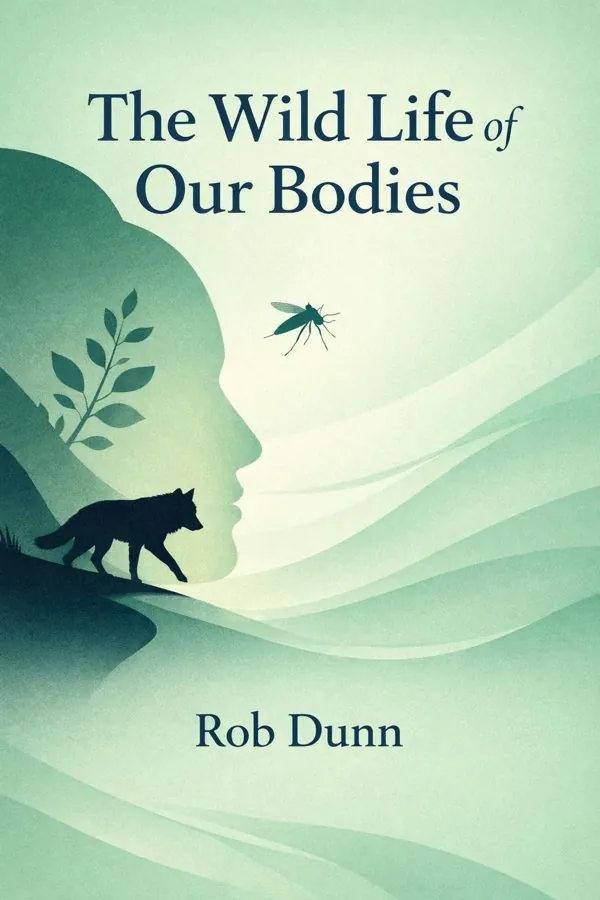
The Wild Life of Our Bodies: Predators, Parasites, and Partners That Shape Who We Are Today: Summary & Key Insights
by Rob Dunn
 10 min8 chaptersAudio available
What Is The Wild Life of Our Bodies: Predators, Parasites, and Partners That Shape Who We Are Today About?
The Wild Life of Our Bodies: Predators, Parasites, and Partners That Shape Who We Are Today by Rob Dunn is a life_science book spanning 8 pages. In this book, biologist Rob Dunn explores how the human body has evolved in constant interaction with other species—predators, parasites, and symbionts—and how modern life has disrupted these relationships. He argues that understanding our biological connections to other organisms is essential to grasping health, disease, and human evolution.
This FizzRead summary covers all 8 key chapters of The Wild Life of Our Bodies: Predators, Parasites, and Partners That Shape Who We Are Today in approximately 10 minutes, distilling the most important ideas, arguments, and takeaways from Rob Dunn's work. Also available as an audio summary and Key Quotes Podcast.
The Wild Life of Our Bodies: Predators, Parasites, and Partners That Shape Who We Are Today
In this book, biologist Rob Dunn explores how the human body has evolved in constant interaction with other species—predators, parasites, and symbionts—and how modern life has disrupted these relationships. He argues that understanding our biological connections to other organisms is essential to grasping health, disease, and human evolution.
Who Should Read The Wild Life of Our Bodies: Predators, Parasites, and Partners That Shape Who We Are Today?
This book is perfect for anyone interested in life_science and looking to gain actionable insights in a short read. Whether you're a student, professional, or lifelong learner, the key ideas from The Wild Life of Our Bodies: Predators, Parasites, and Partners That Shape Who We Are Today by Rob Dunn will help you think differently.
- ✓Readers who enjoy life_science and want practical takeaways
- ✓Professionals looking to apply new ideas to their work and life
- ✓Anyone who wants the core insights of The Wild Life of Our Bodies: Predators, Parasites, and Partners That Shape Who We Are Today in just 10 minutes
Want the full summary?
Get instant access to this book summary and 100K+ more with Fizz Moment.
Get Free SummaryAvailable on App Store • Free to download
Key Chapters
Our evolution was never solitary. Long before cities, before agriculture, even before fire, we lived enmeshed in a web of life where every movement bore consequences. When our ancestors crossed open grasslands, they were watched by lions and leopards. When they drank from streams, parasites entered their guts. And yet, these dangers were the crucible of our species — shaping our physiology, cognition, and culture.
Archaeological and genetic evidence tells us that early humans coexisted with a dense array of species. Predators imposed vigilance and group cooperation. Pathogens sculpted our immune genes through selective pressure. Even our digestion was tailored by the availability of microbes in food and soil. To survive, we needed not only to fight but to partner — with fire to cook away parasites, with dogs to extend our senses, with yeasts to preserve nutrients.
This ecological intimacy lasted almost unchanged for hundreds of thousands of years. But with agriculture and urbanization, we began to manipulate these relationships. Sanitation removed wastes that carried deadly organisms — yet it also severed ancient exposures our immune systems had come to expect. Medicine saved lives by eliminating infections, but in the process silenced the evolutionary dialogue that had maintained our internal equilibrium. What was once a dance with a billion species became a monologue of control.
Understanding this history is vital because our bodies still operate under rules written in that earlier age. Our genes, our hormones, our gut flora — all evolved expecting a world teeming with life, not one sanitized of it. The discrepancy between past and present is now one of the central tensions of modern health.
For much of our evolutionary history, fear was a friend. The sudden spike of adrenaline, the tunnel vision, the quickened breath — these were not flaws but exquisite survival tools. When a rustle in the grass might mean a lion, it paid to imagine danger where there was none. Those who felt fear too little tended not to live long enough to pass on their genes.
I often think of the fear response as our most ancient companion. Even as we invented language, tools, and religion, fear remained our constant teacher. It honed our senses and, paradoxically, fostered empathy: we learned to read each other's eyes for warnings, to share vigilance, to trust in group safety. In modern neurobiology, the amygdala — that small almond-shaped structure deep in the brain — still carries the echoes of those ancient nights under the Serengeti stars.
Yet today, most of us live without lions. The growl that once triggered life-saving reactions has been replaced by an overabundance of abstract anxieties: deadlines, social standing, invisible threats. Our physiology has not changed as fast as our world. The same hormones that once helped us sprint from predators now simmer during traffic jams and office politics. Chronic activation of this system leads to inflammation, hypertension, and fatigue. The adaptive has become maladaptive because the ecology of fear has vanished.
But fear need not be our enemy. If we understand its evolutionary roots, we can reinterpret it — channeling it into motivation, awareness, or creative energy. Reconnecting with the natural contexts that shaped our responses — walks through wild places, encounters with risk and uncertainty — helps recalibrate our emotions. Evolution made us to live in conversation with the world’s dangers, not to be insulated from them.
+ 6 more chapters — available in the FizzRead app
All Chapters in The Wild Life of Our Bodies: Predators, Parasites, and Partners That Shape Who We Are Today
About the Author
Rob Dunn is an American biologist and professor at North Carolina State University. His research focuses on ecology, evolution, and the species that live in and around human environments. He is known for his accessible science writing and books that connect everyday life to evolutionary biology.
Get This Summary in Your Preferred Format
Read or listen to the The Wild Life of Our Bodies: Predators, Parasites, and Partners That Shape Who We Are Today summary by Rob Dunn anytime, anywhere. FizzRead offers multiple formats so you can learn on your terms — all free.
Available formats: App · Audio · PDF · EPUB — All included free with FizzRead
Download The Wild Life of Our Bodies: Predators, Parasites, and Partners That Shape Who We Are Today PDF and EPUB Summary
Key Quotes from The Wild Life of Our Bodies: Predators, Parasites, and Partners That Shape Who We Are Today
“Long before cities, before agriculture, even before fire, we lived enmeshed in a web of life where every movement bore consequences.”
“For much of our evolutionary history, fear was a friend.”
Frequently Asked Questions about The Wild Life of Our Bodies: Predators, Parasites, and Partners That Shape Who We Are Today
The Wild Life of Our Bodies: Predators, Parasites, and Partners That Shape Who We Are Today by Rob Dunn is a life_science book that explores key ideas across 8 chapters. In this book, biologist Rob Dunn explores how the human body has evolved in constant interaction with other species—predators, parasites, and symbionts—and how modern life has disrupted these relationships. He argues that understanding our biological connections to other organisms is essential to grasping health, disease, and human evolution.
You Might Also Like
The Selfish Gene
Richard Dawkins
10 min
Awakenings
Oliver Sacks
10 min
Parasite Rex: Inside the Bizarre World of Nature's Most Dangerous Creatures
Carl Zimmer
10 min
The Atlas of Life on Earth
Various
10 min
The Book of Humans: The Story of How We Became Us
Adam Rutherford
10 min
The Horse
Wendy Williams
10 minBrowse by Category
Ready to read The Wild Life of Our Bodies: Predators, Parasites, and Partners That Shape Who We Are Today?
Get the full summary and 100K+ more books with Fizz Moment.