
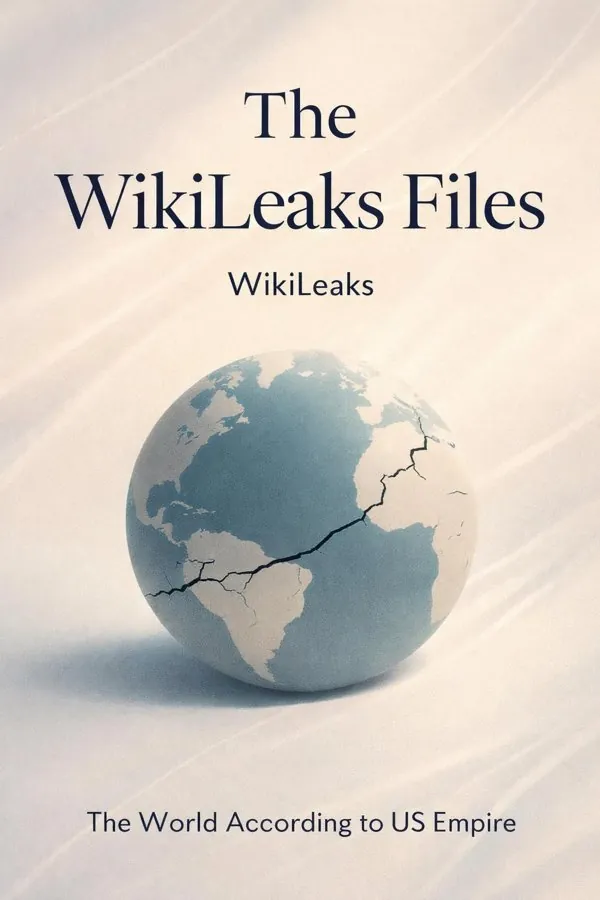
The WikiLeaks Files: The World According to US Empire: Summary & Key Insights
by WikiLeaks
 10 min8 chaptersAudio available
Key Takeaways from The WikiLeaks Files: The World According to US Empire
The leaked cables show US diplomats acting not simply as neutral messengers or peace-building intermediaries, but as active instruments of strategic influence.
Secrecy is not just a bureaucratic habit; it is a political resource.
A common misunderstanding is that empire looks only like direct conquest or permanent military occupation.
The book repeatedly exposes a sharp divide between what governments proclaim and what they practice.
Power does not only control territory, weapons, or money; it also fights to control meaning.
What Is The WikiLeaks Files: The World According to US Empire About?
The WikiLeaks Files: The World According to US Empire by WikiLeaks is a politics book. The WikiLeaks Files: The World According to US Empire is a sweeping political investigation built from one of the most controversial archives of the 21st century: leaked US diplomatic cables. Rather than treating the cables as isolated scandals, the book organizes them into a broader picture of how power actually works in international politics. Across essays by journalists, scholars, historians, and regional experts, it examines what the documents reveal about American diplomacy, intelligence gathering, military influence, corporate interests, and the hidden mechanics of empire. What makes the book matter is not simply that it exposes secrets. Its real value lies in showing how official language, private strategy, and public rhetoric often diverge. The cables reveal how governments negotiate, pressure, flatter, threaten, and maneuver behind the scenes, often in ways citizens never see. The result is a grounded, document-based account of global politics that challenges comforting myths about neutrality, transparency, and democratic accountability. WikiLeaks’ authority comes from its role in publishing primary source material that reshaped public debate worldwide. This book turns that raw archive into a structured argument, helping readers understand not only what was revealed, but why those revelations still matter.
This FizzRead summary covers all 8 key chapters of The WikiLeaks Files: The World According to US Empire in approximately 10 minutes, distilling the most important ideas, arguments, and takeaways from WikiLeaks's work. Also available as an audio summary and Key Quotes Podcast.
The WikiLeaks Files: The World According to US Empire
The WikiLeaks Files: The World According to US Empire is a sweeping political investigation built from one of the most controversial archives of the 21st century: leaked US diplomatic cables. Rather than treating the cables as isolated scandals, the book organizes them into a broader picture of how power actually works in international politics. Across essays by journalists, scholars, historians, and regional experts, it examines what the documents reveal about American diplomacy, intelligence gathering, military influence, corporate interests, and the hidden mechanics of empire.
What makes the book matter is not simply that it exposes secrets. Its real value lies in showing how official language, private strategy, and public rhetoric often diverge. The cables reveal how governments negotiate, pressure, flatter, threaten, and maneuver behind the scenes, often in ways citizens never see. The result is a grounded, document-based account of global politics that challenges comforting myths about neutrality, transparency, and democratic accountability.
WikiLeaks’ authority comes from its role in publishing primary source material that reshaped public debate worldwide. This book turns that raw archive into a structured argument, helping readers understand not only what was revealed, but why those revelations still matter.
Who Should Read The WikiLeaks Files: The World According to US Empire?
This book is perfect for anyone interested in politics and looking to gain actionable insights in a short read. Whether you're a student, professional, or lifelong learner, the key ideas from The WikiLeaks Files: The World According to US Empire by WikiLeaks will help you think differently.
- ✓Readers who enjoy politics and want practical takeaways
- ✓Professionals looking to apply new ideas to their work and life
- ✓Anyone who wants the core insights of The WikiLeaks Files: The World According to US Empire in just 10 minutes
Want the full summary?
Get instant access to this book summary and 100K+ more with Fizz Moment.
Get Free SummaryAvailable on App Store • Free to download
Key Chapters
One of the book’s most unsettling insights is that diplomacy is not merely the polite management of relations between sovereign states; it is often the language power uses when it wants obedience without open coercion. The leaked cables show US diplomats acting not simply as neutral messengers or peace-building intermediaries, but as active instruments of strategic influence. Behind the public image of partnership and mutual respect lies a more transactional reality: pressure, bargaining, surveillance, and political choreography.
The book argues that this is not an occasional distortion of diplomacy but part of its operating logic within an imperial system. Smaller states are frequently treated as arenas to be managed rather than equal participants in decision-making. US embassies monitor political actors, shape elite networks, and relay local vulnerabilities back to Washington. Even when interactions appear cordial, the underlying question is often how American priorities can be advanced, insulated, or imposed.
This matters because many citizens still interpret foreign policy through speeches, press conferences, and official statements. The cables reveal a different layer: what policymakers say privately when they assume the public is not listening. For example, a government might publicly celebrate sovereignty and regional cooperation while privately asking US officials for military assistance, domestic political support, or intervention against rivals. Likewise, US officials may publicly endorse democratic norms while privately backing stability over accountability.
In practical terms, readers can apply this insight by becoming more skeptical consumers of foreign policy narratives. When states invoke values like democracy, security, or partnership, it is worth asking what material interests are also in play: bases, trade routes, intelligence access, energy supplies, or elite alliances. Looking at who benefits, who is pressured, and what remains hidden can reveal far more than official rhetoric.
Actionable takeaway: whenever you read about an international dispute or alliance, compare public statements with likely strategic interests and ask what power dynamics the language of diplomacy is concealing.
Secrecy is not just a bureaucratic habit; it is a political resource. The book shows that governments depend on secrecy not only to protect legitimate national security concerns, but also to shield embarrassing truths, preserve leverage, and avoid democratic scrutiny. By publishing the cables, WikiLeaks disrupted that protected zone and changed the balance between rulers and the ruled, even if only temporarily.
The central lesson is that transparency is powerful because it rearranges who gets to interpret reality. Before a leak, officials can define events through selective disclosures and controlled messaging. After a leak, journalists, activists, scholars, and ordinary citizens gain access to primary source evidence that can challenge the official story. The book demonstrates how leaked material allows the public to move from suspicion to documentation. It is one thing to believe governments may manipulate narratives; it is another to read confidential cables that show the methods in detail.
At the same time, the book does not romanticize transparency as a magic solution. Information alone does not guarantee reform. Institutions can absorb scandal, deny context, reframe evidence, or simply wait for public attention to fade. But the release of documents still matters because it expands the archive available to democratic inquiry. It gives future investigations a factual basis and makes denial harder.
A practical application is in civic life and organizational culture. The same principle holds beyond geopolitics: in corporations, nonprofits, universities, and local governments, opacity often protects concentrated power. People who want accountability need records, documents, and traceable decisions, not just promises. Transparency does not eliminate abuse, but it creates conditions where abuse can be contested.
Actionable takeaway: treat access to documents, data, and source material as essential to accountability, and support institutions, media practices, and civic norms that make hidden decision-making harder to sustain.
A common misunderstanding is that empire looks only like direct conquest or permanent military occupation. This book presents a more modern and more subtle picture: empire often works through networks of influence, dependency, intelligence-sharing, economic leverage, and elite cooperation. The cables reveal a system in which embassies, military commands, aid programs, corporations, and allied governments form an interconnected architecture of control.
This framework helps explain why American power can remain decisive even where there is no formal colonial administration. Influence travels through security agreements, diplomatic pressure, development funding, sanctions, training programs, and private relationships among officials. A local government may appear autonomous while still calibrating major decisions around US expectations. Political leaders may rely on American support for legitimacy, military equipment, intelligence access, or financial backing. That reliance shapes behavior long before overt threats are necessary.
The book’s wider contribution is to move readers away from simplistic binaries like independent versus occupied. Many states occupy a middle ground: formally sovereign, but constrained by a hierarchy they did not design. This is visible in how regional conflicts, domestic political crises, and economic negotiations are often mediated through Washington’s strategic interests. The system is flexible precisely because it does not always need direct rule.
In practical terms, this idea can improve how readers analyze world events. If a policy shift in one country seems abrupt or irrational, consider the network around it. Which external actors supply arms, loans, intelligence, diplomatic cover, or market access? Which domestic elites are linked to those channels? Influence often follows infrastructure, not headlines.
Actionable takeaway: when evaluating global power, look beyond troops and treaties to the full network of financial, diplomatic, military, and elite relationships that shape what governments can realistically do.
The book repeatedly exposes a sharp divide between what governments proclaim and what they practice. Publicly, US foreign policy often presents itself as a defender of democracy, human rights, rule of law, and international stability. Privately, the cables show a more conditional approach in which those principles are frequently subordinated to strategic convenience. The contradiction is not presented as hypocrisy alone, but as a structural feature of great-power politics.
This does not mean every official statement is false. Rather, it means ideals often function alongside interests, and when the two clash, interests usually prevail. The cables illuminate this pattern across multiple regions: authoritarian allies are tolerated, elections are viewed through strategic lenses, and abuses may be downplayed if cooperation on security, intelligence, or commerce is considered more important. Human rights language may still be used, but selectively and unevenly.
This insight matters because many people evaluate international events through moral categories alone. The book encourages a more disciplined approach. Instead of asking only whether a government claims to support democracy, readers should ask how consistently it applies that standard, to whom, and at what cost. For example, if protests in one country are praised while similar dissent in an allied state is ignored, the discrepancy reveals the hierarchy of interests beneath the moral language.
The same lesson applies in everyday institutional life. Organizations often cultivate value-driven branding while making internal decisions based on reputation management, funding pressure, or political alliances. Learning to compare stated principles with actual behavior is a transferable critical skill.
Actionable takeaway: judge political actors by patterns of conduct across cases, not by their declared values, and look for consistency when claims of principle are used to justify power.
Power does not only control territory, weapons, or money; it also fights to control meaning. The book makes clear that information itself is a contested battlefield. Diplomatic cables are not neutral snapshots of reality, but they reveal the machinery through which reality is classified, narrated, prioritized, and transmitted inside an empire. Who gets reported on, how they are described, what is considered a threat, and which events deserve urgency all shape policy outcomes.
The significance of the leaks lies partly in exposing that process. Readers can see how intelligence and diplomatic reporting produce a worldview. Local leaders become assets, obstacles, reformers, extremists, or risks according to categories that serve strategic frameworks. Entire societies can be reduced to manageable abstractions. Once these narratives circulate through bureaucracies, they influence aid decisions, military cooperation, sanctions, and media framing.
The book encourages readers to understand that political conflict includes battles over classification and interpretation. If a movement is labeled extremist, if a government is framed as unstable, or if a region is defined primarily through terrorism or resource competition, those labels are not merely descriptive. They can justify intervention, neglect, partnership, or repression. The struggle over language often precedes the struggle over policy.
A practical application is in media literacy. Readers should ask where dominant narratives come from, which institutions produce them, and what alternatives are excluded. This does not require rejecting all official reporting, but it does require awareness that every information system has incentives and blind spots. Cross-checking sources, especially from local journalists and independent researchers, can reveal perspectives buried by state-centered analysis.
Actionable takeaway: treat political language as consequential, not cosmetic, and examine how labels, categories, and selective reporting shape what actions become thinkable or acceptable.
Empire is rarely imposed from outside alone. One of the book’s strongest themes is that global dominance depends on cooperation from local elites who translate external priorities into domestic policy. The cables show ministers, military officials, business leaders, and political insiders engaging with US diplomats in ways that reveal mutual dependency. Washington needs reliable local partners, and those partners often need external support to maintain their own position.
This dynamic complicates simple stories of foreign domination. It is not only that a powerful state pressures weaker ones; it is also that domestic actors invite, bargain over, and strategically use that pressure. Leaders may present themselves publicly as defenders of national sovereignty while privately soliciting backing against rivals, requesting intelligence support, or aligning policy with foreign expectations. In this sense, empire can function as a joint project between external power and domestic intermediaries.
The practical importance of this insight is profound. It means reformers cannot explain political failure only by pointing to foreign interference. They also need to analyze how internal class structures, patronage systems, and elite incentives make external influence effective. Corruption, authoritarian resilience, and policy dependency often persist because local beneficiaries are embedded in the system.
This applies beyond geopolitics. In organizations, concentrated power frequently depends on mid-level enforcers and gatekeepers who convert top-down priorities into daily practice. Systems endure when insiders profit from them. Understanding this helps people identify where leverage for change actually lies.
Actionable takeaway: when examining any political system, identify the local actors who gain from external alliances and ask how their incentives help reproduce wider structures of domination.
Many people encounter leaks as a sequence of shocking headlines: a candid insult, a hidden deal, a covert request, an embarrassing revelation. The book insists that the real importance of the cables lies beyond isolated scandals. Their value emerges when they are read together, comparatively, and historically. Patterns become visible that no single cable could show on its own.
This shift from anecdote to structure is central to the book’s method. A lone document may expose a contradiction, but a large archive can reveal recurring mechanisms: how allied authoritarian regimes are managed, how strategic resources influence diplomacy, how military and diplomatic arms of policy reinforce each other, and how certain regions are consistently framed through security and containment. The result is a portrait of systemic behavior rather than episodic misconduct.
That perspective matters because scandal politics often produces outrage without understanding. Citizens may react strongly to a single revelation and then move on, while the deeper machinery remains intact. By organizing the cables into thematic analyses, the book helps readers see continuity across countries and crises. It asks not merely, “What happened here?” but “What model of power makes these outcomes predictable?”
In practical life, the same principle improves critical thinking. Whether analyzing workplace problems, media controversies, or public policy failures, isolated incidents should be tested for pattern. Is this exception or routine? Does the same logic recur across cases? Durable insight comes from aggregation, not only reaction.
Actionable takeaway: whenever a political leak or scandal appears, look for repeated behaviors across time and contexts so you can understand the system behind the episode, not just the episode itself.
A democracy cannot function meaningfully if citizens are expected to authorize policies they are systematically prevented from understanding. One of the book’s deepest arguments is that secrecy in foreign policy creates a democratic deficit. Decisions affecting war, alliances, sanctions, surveillance, and international coercion are often made within insulated institutions, while the public receives sanitized narratives after the fact. The cables reveal how much of global governance occurs beyond normal accountability.
The authors and contributors suggest that this is not a side issue but a central political problem. If voters cannot evaluate the real conduct of their state abroad, electoral consent becomes thin and partially manufactured. Public debate then operates on incomplete information, allowing leaders to claim moral legitimacy for actions whose actual motives or consequences are hidden. Leaks do not solve this problem, but they can puncture the illusion that democratic oversight is already sufficient.
This insight has practical implications for citizenship. An informed public sphere depends on investigative journalism, independent archives, whistleblower protections, and readers willing to engage with complexity rather than slogans. It also requires resisting the reflex that all secrecy is necessary simply because governments invoke national security. Some secrecy is justified, but the category is often stretched to include politically inconvenient truth.
On a personal level, readers can use this framework to become more active participants in public life. Supporting rigorous reporting, reading primary documents when possible, and asking elected officials harder questions are small but real forms of democratic practice.
Actionable takeaway: strengthen your political judgment by seeking original sources, backing independent scrutiny, and refusing to treat foreign policy as a domain too secret or technical for democratic oversight.
All Chapters in The WikiLeaks Files: The World According to US Empire
About the Author
WikiLeaks is an international publishing organization best known for obtaining and releasing confidential documents from governments, corporations, and other centers of power. Founded in 2006, it emerged as a major force in global journalism and political debate by publishing large archives of primary source materials, including US military records and diplomatic cables. Its work has been praised by supporters for advancing transparency, exposing hidden abuses, and expanding the public record on war, diplomacy, and state secrecy. At the same time, it has drawn criticism and intense legal and political pressure over questions of security, editorial judgment, and responsibility. As the credited source behind The WikiLeaks Files, WikiLeaks represents not a single traditional authorial voice, but a document-driven transparency project that helped redefine the relationship between leaked information, journalism, and public accountability.
Get This Summary in Your Preferred Format
Read or listen to the The WikiLeaks Files: The World According to US Empire summary by WikiLeaks anytime, anywhere. FizzRead offers multiple formats so you can learn on your terms — all free.
Available formats: App · Audio · PDF · EPUB — All included free with FizzRead
Download The WikiLeaks Files: The World According to US Empire PDF and EPUB Summary
Key Quotes from The WikiLeaks Files: The World According to US Empire
“The leaked cables show US diplomats acting not simply as neutral messengers or peace-building intermediaries, but as active instruments of strategic influence.”
“Secrecy is not just a bureaucratic habit; it is a political resource.”
“A common misunderstanding is that empire looks only like direct conquest or permanent military occupation.”
“The book repeatedly exposes a sharp divide between what governments proclaim and what they practice.”
“Power does not only control territory, weapons, or money; it also fights to control meaning.”
Frequently Asked Questions about The WikiLeaks Files: The World According to US Empire
The WikiLeaks Files: The World According to US Empire by WikiLeaks is a politics book that explores key ideas across 8 chapters. The WikiLeaks Files: The World According to US Empire is a sweeping political investigation built from one of the most controversial archives of the 21st century: leaked US diplomatic cables. Rather than treating the cables as isolated scandals, the book organizes them into a broader picture of how power actually works in international politics. Across essays by journalists, scholars, historians, and regional experts, it examines what the documents reveal about American diplomacy, intelligence gathering, military influence, corporate interests, and the hidden mechanics of empire. What makes the book matter is not simply that it exposes secrets. Its real value lies in showing how official language, private strategy, and public rhetoric often diverge. The cables reveal how governments negotiate, pressure, flatter, threaten, and maneuver behind the scenes, often in ways citizens never see. The result is a grounded, document-based account of global politics that challenges comforting myths about neutrality, transparency, and democratic accountability. WikiLeaks’ authority comes from its role in publishing primary source material that reshaped public debate worldwide. This book turns that raw archive into a structured argument, helping readers understand not only what was revealed, but why those revelations still matter.
You Might Also Like
Antifa: The Anti-Fascist Handbook
Mark Bray
10 min
Attack from Within: How Disinformation Is Sabotaging America
Barbara McQuade
10 min
Coercion, Capital, and European States, AD 990–1992
Charles Tilly
10 min
Digital Democracy: Concepts, Methodologies, Tools, and Applications
Various Authors
10 min
Fascism
Stanley G. Payne
10 min
Fire And Fury: Inside The Trump White House
Michael Wolff
10 minBrowse by Category
Ready to read The WikiLeaks Files: The World According to US Empire?
Get the full summary and 100K+ more books with Fizz Moment.